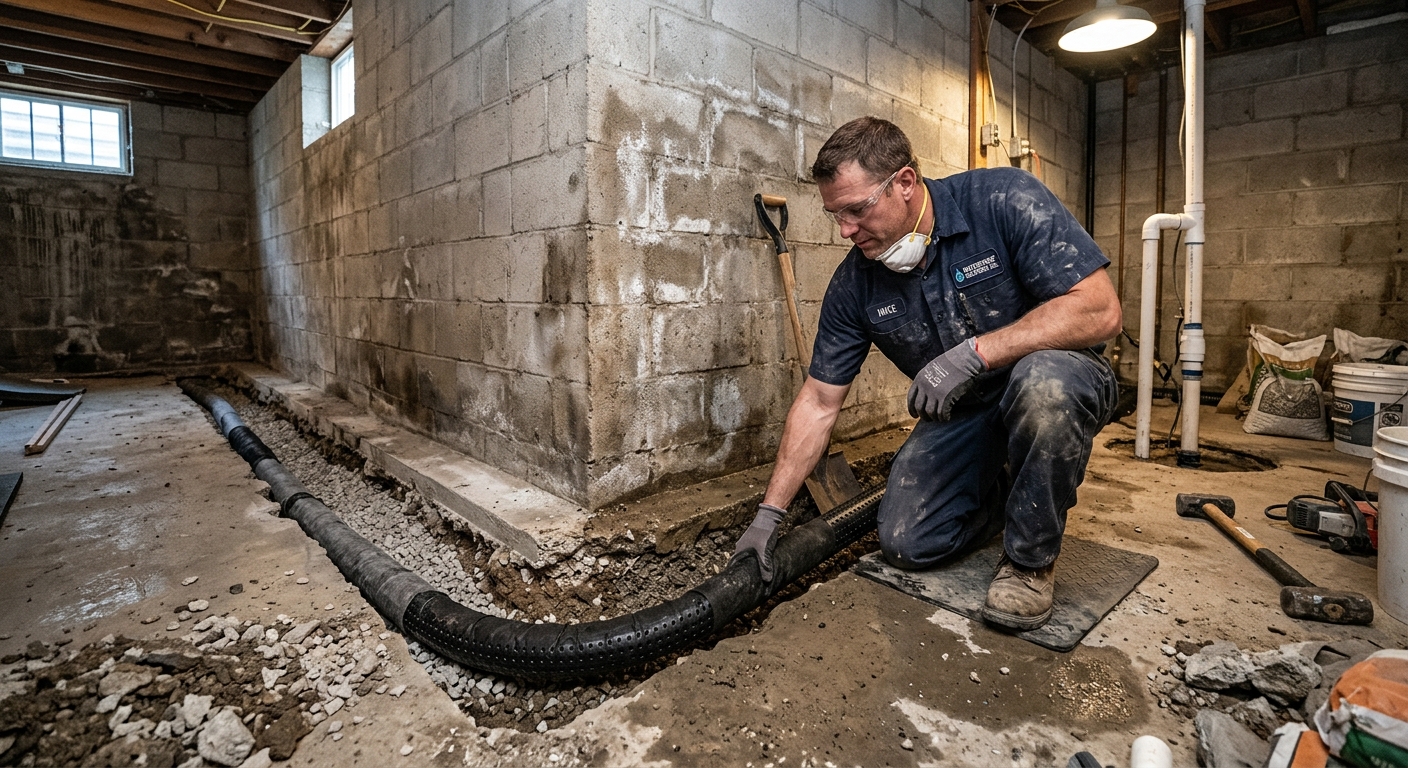
Basement waterproofing options and costs in Fort McMurray
In Fort McMurray, basement waterproofing is mostly about managing how water moves through the ground around your foundation—then controlling what happens once moisture reaches below grade. With a population of 66,573 (Statistics Canada, 2021 Census), there’s steady demand for waterproofing work, particularly on older housing stock where original drainage and membranes have aged out. In Wood Buffalo–Cold Lake, many homes from earlier decades are more likely to have failing weeping tile and aging wall coatings, so problems often start as damp corners and progress to seepage, efflorescence, and crack-driven leakage.
Local costs are shaped by the region’s loamy to clayey glaciolacustrine and morainal soils, which can hold water and increase drainage pressure against below-grade walls. Add freeze-thaw cycling, and you’ll see cracks widen over time—especially if the weeping tile is clogged or if runoff has nowhere to go. On top of that, excavation can be harder when the ground is saturated, so exterior projects often require more labour, more drainage rock, and longer pump-off periods.
In practice, contractors get busier around neighbourhoods with lots of mature lots and older foundations, such as Timberlea and parts of Gregoire Park, where driveway access and backyard regrading can be more involved. If you’re getting multiple quotes, the method chosen (full exterior excavation versus interior perimeter drainage) is usually the deciding factor, and the right option depends on whether you have active seepage, ongoing hydrostatic pressure, or just a crack that’s letting water through. Here’s a quick comparison of the main options and typical price ranges before you review scopes in a table.
| Method |
What It Addresses |
Disruption Level |
Durability |
Price Range |
| Exterior excavation + new membrane + drainage tile |
Source control of groundwater pressure; replaces failed weeping tile and membrane system |
High (excavation, landscaping restoration) |
Long-term (often the most complete fix) |
$10,500–$22,000 |
| Interior perimeter drain channel + sump pit |
Collects and redirects seepage from the interior; reduces hydrostatic pressure effects inside |
Medium (some floor cutting, wall rework) |
Good (depends on pump reliability and maintenance) |
$7,500–$14,000 |
| Foundation crack injection (epoxy or polyurethane) |
Seals cracks; polyurethane for active leaks, epoxy for stabilized/hairline cracks |
Low to Medium (access drilling at crack line) |
Medium to long-term (better when water entry is stopped) |
$650–$1,800 |
| Sump pump installation (primary + battery backup) |
Prevents flooding and controls water during peak wet periods |
Medium (electrical work, pit/sump placement) |
Good when backed up for outages |
$2,200–$4,500 |
| Window well drain installation |
Stops water pooling and seepage around egress/window areas |
Low to Medium (window well access) |
Good (when grading and weep paths are correct) |
$1,100–$2,900 |
| Lot re-grading / downspout extension |
Redirects roof runoff away from foundation; improves surface drainage |
Low to Medium (yard work, minor restoration) |
Variable (depends on how it manages subsurface water) |
$2,000–$6,000 |
Prices are estimates only and vary by project scope, site access and material selection.
What affects the price of waterproofing in Fort McMurray
In Fort McMurray and the broader Wood Buffalo–Cold Lake region, it’s common to see waterproofing quotes for the “same” symptom come in 30–50% apart. Contractors aren’t necessarily disagreeing on whether you have a problem—they’re pricing different root causes and different levels of water control. Exterior drainage work can also swing sharply with excavation depth and saturation, while interior systems can swing based on how much concrete/floor needs to be opened and how complex the sump and discharge routing becomes.
Three regional drivers separate local costs from a simple national average: soil type, water table behaviour, and freeze-thaw cycling. Clay-heavy soils can expand and contract more than sand, exerting lateral pressure that worsens cracks over time—so a small “seal and forget” crack job may be inadequate. High moisture conditions in the area can increase drainage pressure, which means longer pump duty cycles and bigger drainage designs. During Alberta freeze-thaw, water trapped behind foundations can expand, helping propagate existing hairline cracking; this is why older foundations with aging concrete and failing drainage often require both crack repair and drainage upgrades. (In older homes, the frequency of failing weeping tile rises, and that can turn a minor leak into recurring seepage.)
Concrete examples from the Fort McMurray market: (1) If excavation is required to reach footing-level drainage on a saturated, loamy to clayey site, exterior work is often priced closer to the upper end of the $10,000–$22,000 band. (2) If the issue is mainly active seepage at a limited crack line and the wall is otherwise stable, crack injection may fit the $500–$1,800 band and reduce the need for full excavation. (3) If you discover persistent dampness across multiple wall sections, an interior perimeter drain plus sump can be the practical midpoint versus full exterior, landing commonly in the $7,000–$14,000 range—especially when access constraints make excavation expensive.
| Price Factor |
Why It Matters |
Cost Impact |
| Interior vs. exterior approach — interior is less disruptive but addresses symptoms |
Exterior controls water entry at the source; interior manages water after it arrives |
Exterior typically costs materially more (excavation + membrane), interior is usually lower and faster |
| Foundation type — poured concrete vs. block vs. stone vs. ICF |
Different materials respond differently to injection, sealing, and drainage pressure |
Poured concrete often suits injection better; block frequently needs drainage plus sealing |
| Soil type — clay expands more than sand, adding pressure |
Clayey backfill increases hydrostatic pressure and crack cycling during freeze-thaw |
Often increases drainage rock, backfill management, and sealing scope |
| Crack type and length — hairline vs. structural horizontal cracks |
Active/structural cracking may require engineering review and broader repair |
Structural cracks can add engineer cost and possible underpinning contingency |
| Sump pump backup system — battery or water-powered backup needed |
Backup protects during spring flooding and outages |
Backup adds cost but reduces flooding risk |
| Access — landscaping, decks, or driveways must be removed for exterior |
Excavation footprint and restoration drive labour and disposal costs |
More removals pushes exterior closer to the top of the local excavation band |
| Weeping tile age — original tile (60+ years) may be completely failed |
Old tile blocks drainage pathways and increases saturation around the foundation |
May require full replacement or interior capture system escalation |
| Mould or efflorescence remediation required before sealing |
Moisture damage must be addressed for materials to bond properly |
Can add time and special cleaning/controlled drying steps before waterproofing |
Permits & regulations in Alberta
In Alberta, some types of foundation-related work typically require a building permit, especially where you’re changing structural capacity or altering drainage in a way that affects the building system. Foundation excavation for new exterior drainage and membrane systems generally requires a permit because it impacts the foundation system and involves significant site work. Structural crack repair that involves major crack movement—such as structural horizontal cracks in block walls—or any work that could lead to underpinning often needs additional review. Sump pump installations that connect to municipal sewer systems can require municipal approval; even when discharge is handled on-site, your contractor should confirm whether any connection or alteration triggers approval requirements.
Step-by-step, here’s how a Fort McMurray homeowner can verify a contractor’s compliance: (1) Ask for their contractor details and confirm what building permits they plan to pull (and who pulls them). (2) For structural repairs, request confirmation that they have access to engineering support for assessment—especially when cracks suggest structural movement. (3) Verify liability insurance by requesting a current certificate of insurance showing the contractor name, effective dates, and coverage limits. (4) Confirm workers’ protection coverage—ask whether they are registered for WSIB/WCB and request evidence if applicable. (5) If a permit is required, make sure the contractor’s written scope lists permit handling as part of their service and provides proof once filed.
When in doubt, ask for the exact permit number once it’s submitted, and don’t rely on “we usually don’t need one” for work near footings, major cracking, or drainage discharge routing.
Interior vs exterior waterproofing — what does Fort McMurray need?
The fundamental difference is source control versus water management. Exterior waterproofing (full excavation, new membrane, new drainage tile, and backfill) aims to stop groundwater and seepage before it ever reaches your basement walls. It’s the most permanent approach when soils are saturated, weeping tile has failed, or you have repeated seepage along multiple wall sections. The trade-off is disruption: excavation is labour-heavy, often requires temporary pump-off and longer site access time, and usually involves landscaping restoration costs.
Interior waterproofing (perimeter drain channel, sump pit, sump pump) manages water after it reaches the interior. It’s typically less invasive and can be more attractive where excavation is difficult or groundwater seepage appears persistent but targeted access is limited. However, interior systems don’t eliminate hydrostatic pressure on the wall itself—so you still need the right crack strategy. In Fort McMurray, poured concrete walls often respond well to properly selected crack injection (epoxy for stable cracks; polyurethane for active seepage), while block foundations commonly benefit from combining sealing with interior drainage because block joints can invite moisture movement.
Given Alberta’s freeze-thaw conditions and spring runoff risk, sump pump backup systems are often a smart addition if you’ve experienced outages. As a pricing example, full exterior excavation might land near the higher end of the $10,000–$22,000 range, while an interior perimeter drain with sump can be closer to the $7,000–$14,000 range. The difference is justified when you can clearly see water entry from outside (failed weeping tile, widespread perimeter wetting), because interior-only fixes can turn into recurring maintenance if the source pressure isn’t relieved.
| Method |
Best For |
Addresses Source? |
Disruption |
Lifespan |
Price Band |
| Full exterior excavation + membrane |
Widespread seepage, failed weeping tile, high drainage pressure around the perimeter |
Yes |
High |
Long (when drainage design is correct and backfill is managed) |
$10,000–$22,000 |
| Interior French drain + sump system |
Persistent dampness or seepage where excavation is expensive or impractical |
No (it captures water inside) |
Medium |
Good (depends on pump condition and discharge routing) |
$7,000–$14,000 |
| Crack injection — epoxy (structural) |
Stabilized, non-moving cracks in poured concrete where active seepage isn’t constant |
Yes for crack pathway once stabilized |
Low to Medium |
Medium to long (best with correct prep and compatible wall conditions) |
$500–$1,500 |
| Crack injection — polyurethane (active leak) |
Cracks with active seepage where water is coming through under pressure |
Partially (stops leak pathway; may still need drainage) |
Low to Medium |
Medium (often improved when combined with interior/exterior drainage) |
$650–$1,800 |
| Interior drain channel only (no sump) |
Minor seepage that can be managed without frequent pumping |
No |
Medium to Low |
Variable (can struggle in high seepage seasons) |
$4,000–$8,500 |
| Re-grading + downspout extensions |
Surface runoff problems (foundation wetness after rain) with minimal interior seepage |
No (focuses on surface drainage) |
Low to Medium |
Variable (helps a lot when water entry is mostly surface-driven) |
$2,000–$6,000 |
How to choose a waterproofing contractor in Fort McMurray
Choosing the right contractor in Fort McMurray starts with proof, not promises. First, verify Alberta coverage and legitimacy. Request their contractor details and check their documentation: a certificate of liability insurance showing coverage limits and effective dates; proof of WSIB/WCB coverage for workers; and (where applicable) confirmation that they carry any required trade permissions for the scope they’re quoting. Next, don’t just ask “are you insured?”—ask for the documents and check names match the company on the estimate.
Then get 2–3 itemised written quotes. You want labour and materials broken out, not a single lump sum, so you can compare disposal, drainage rock, membranes, pump model, discharge method, and concrete restoration. Read the scope for exclusions: is permit pulling included, are they handling soil disposal, will they replace damaged insulation or only patch the floor, and do they include dehumidification or remediation if mould or heavy efflorescence is present?
Warranty matters. Ask for both workmanship warranty length and product/manufacturer warranty terms. Confirm whether the warranty is transferable to a future owner—important if you sell. For payment schedule, keep it conservative: never pay more than 10–15% upfront, and use holdback until key deliverables are complete (for example, after drainage and waterproofing are inspected and floors are restored). Finally, insist on a written timeline with start date and completion estimate; in Alberta, delays tied to excavation saturation happen, but they should be explained up front.
- Ask for the exact scope: where excavation starts/ends, what gets replaced, and what stays.
- Confirm whether a permit is required and who pulls it.
- Request a site plan for drainage flow (where water goes, not just “we’ll route it away”).
- Compare pump models (including discharge height and basin size) and ask for battery backup options.
- Get itemised disposal costs for saturated soil and removed concrete/asphalt.
- Verify they’ll remediate mould/efflorescence before sealing where conditions require it.
- Ask how they test for active leaks before choosing epoxy vs polyurethane injection.
- Confirm foundation crack prep (surface cleaning, drilling layout, and injection method).
- Check that warranty covers labour for leaks back into the basement, not only product defects.
- Use milestone payments: deposit + materials only, then remainder after verified completion.
- Ensure they provide start/completion dates and weather/saturation contingencies in writing.
- Look for a clear maintenance recommendation (pump check frequency, alarm checks, filter intervals).
Red flags I see in the Fort McMurray waterproofing market: (1) they won’t discuss the cause (soil drainage, water entry path, crack type) and only sell a generic sealant; (2) they avoid engineering conversations when cracks suggest structural movement; (3) they quote the job without a site visit or without explaining excavation depth/access assumptions; (4) they pressure you for large upfront payments beyond 10–15%; and (5) their quote excludes critical items like disposal, permit handling, pump discharge routing, or warranty details.
Frequently asked questions — waterproofing in Fort McMurray
How much does foundation crack repair cost in Fort McMurray?
In Fort McMurray, foundation crack repair is often priced by the crack length and whether the crack is actively leaking. If the issue is a limited, stabilized crack, epoxy injection is commonly less costly; for active seepage, polyurethane injection typically costs more because it needs to seal under water pressure. A realistic local expectation is the foundation crack repair band of $500–$1,800, with the higher end when multiple crack lines are involved or when prep and access require extra drilling and labour. If your cracks widened during freeze-thaw and there’s ongoing water pressure from drainage problems (failed weeping tile, saturated soils), contractors may recommend pairing injection with interior drainage—otherwise you can get repeat seepage.
Do I need a sump pump in Fort McMurray?
You may need a sump pump when water is actively entering your basement and you have persistent seepage, damp flooring, or signs that the perimeter drains cannot keep up during wet seasons. In Wood Buffalo–Cold Lake, soil moisture and freeze-thaw can increase the volume of seepage, so interior systems often include a sump for reliable water capture. If you’re doing interior perimeter drainage, it’s common for costs to move into the $7,000–$14,000 range, and the sump pump install commonly adds around $1,800–$4,500 depending on whether you add battery backup. You can sometimes avoid a sump if seepage is minor and seasonal, but if water shows up repeatedly in the spring or after heavy melt, a sump is usually the safer design.
How does Fort McMurray's soil affect my foundation?
Fort McMurray’s area commonly includes loamy to clayey glaciolacustrine and morainal soils that can hold water and create drainage pressure against foundation walls. Clayey conditions are also more prone to expansion and movement during freeze-thaw, which can widen existing cracks and turn small defects into active seepage over time. That’s why, in the Wood Buffalo–Cold Lake region, waterproofing quotes often differ based on whether the water problem is coming from outside pressure (which favours exterior drainage and membrane) or from inside seepage (which favours interior drains and sump pumping). If you have dampness along multiple wall sections or evidence that the weeping tile is old or failed, expect more extensive excavation and drainage layers to be recommended.
Do I need a permit for foundation work in Alberta?
Often, yes—especially when the work involves foundation excavation, changes to lot drainage, or structural repairs that could affect the building system. In Alberta, contractors should confirm permit requirements based on your scope. Generally, excavation for exterior waterproofing and major drainage changes typically require a building permit, and structural crack repair assessments may require engineering input when cracks indicate possible movement. Sump pump installations that connect to municipal sewer systems may also need municipal approval. Your best move in Fort McMurray is to ask the contractor to identify which permits they will pull, who pulls them, and to provide proof after submission. If they say permits are “never needed,” ask for their justification in writing.
How long does waterproofing last?
How long waterproofing lasts depends on the method and whether the contractor addressed the true water entry path. Exterior waterproofing—when membrane, drainage tile, and backfill are correctly installed—can provide the longest service life because it controls moisture at the source. Interior systems can last many years too, but their performance depends heavily on pump reliability, discharge routing, and the condition of the collected water pathway. Crack injection can last well when the crack is stabilized and the chosen product matches the leak condition (epoxy for stable cracks; polyurethane for active leakage). In practical terms, homeowners should budget for inspection and maintenance of interior systems, particularly before spring thaw. If you’re told the job is “guaranteed forever” without addressing drainage pressure and pump redundancy, that’s a concern.
Can I waterproof my basement from the inside only?
You can often waterproof a basement from the inside only—especially if excavation is too disruptive or if you have targeted seepage that can be captured with an interior perimeter drain and sump. However, interior-only solutions manage water after it enters; they don’t eliminate hydrostatic pressure acting on the wall. In Fort McMurray, this matters because freeze-thaw can widen cracks when exterior drainage pressure remains high. For some homes, an interior approach plus crack injection is a strong compromise—particularly for block foundations that need practical complement drainage. If you have widespread wetting around most of the perimeter or evidence of long-term weeping tile failure, interior-only work may reduce symptoms but can cost more over time. A good contractor will assess whether exterior source control is likely needed before recommending an interior-only plan.