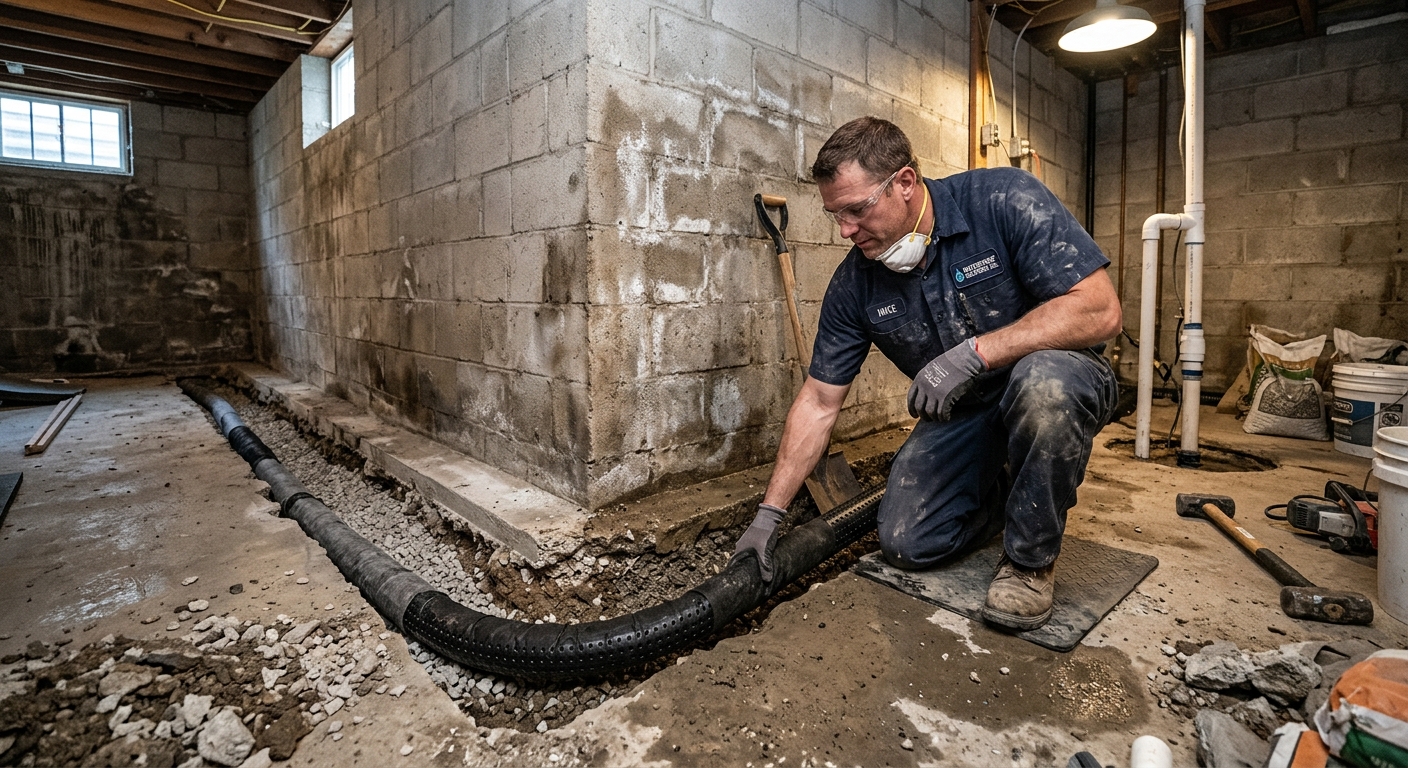
Basement waterproofing options and costs in Panorama Hills
Panorama Hills, Alberta homes are commonly impacted by groundwater swings, heavy spring runoff, and the freeze–thaw cycles that repeatedly widen cracks and joints. With a population of 25,535 residents (Statistics Canada, 2021 Census), the neighbourhood has a mix of newer builds and older homes where original waterproofing can be long past its service life. That matters because older tar-and-paper approaches and early weeping-tile layouts are more likely to be failing, especially once clay-till soils hold water and expand during saturated freeze cycles.
In the Calgary area, exterior waterproofing is priced largely around excavation depth, access constraints (tight lots, patios, driveways, and mature landscaping), and the disposal of clay spoil. Interior systems usually cost less and disturb less landscaping, but they’re often selected as a practical “manage the water” strategy when full exterior excavation isn’t feasible. Contractor availability and scheduling also affect budgets; during spring thaw and peak renewal season, labour demand can push timelines and change the final installed cost for drainage piping, sump components, and membrane materials.
In Panorama Hills—especially around the newer infill edges where backyards are tight—exterior work is in high demand because homeowners frequently discover clogged weeping tile or wet wall corners after landscaping is already established. Below is a quick comparison of the most common approaches so you can see what each method is designed to address.
| Method |
What It Addresses |
Disruption Level |
Durability |
Price Range |
| Exterior excavation + new membrane + drainage tile |
Water entry control at the foundation exterior; restores perimeter drainage path and reduces hydrostatic pressure |
High (excavation, regrading, landscaping impact) |
Long-term when installed to grade with proper backfill and drainage |
$9,500 – $24,500 |
| Interior perimeter drain channel + sump pit |
Collects seepage after it enters; reduces water accumulation behind/below slab edges |
Medium (floor cutting and limited wall work) |
Very durable if sump discharge and power backup are correctly specified |
$6,500 – $13,500 |
| Foundation crack injection (epoxy or polyurethane) |
Seals or actively channels water through cracks; restores watertightness depending on crack type |
Low to Medium (surface prep; potential minor patching) |
Best for stable cracks; polyurethane helps where active leakage exists |
$800 – $1,950 |
| Sump pump installation (primary + battery backup) |
Prevents hydrostatic buildup from discharging water away from the basement |
Medium (pit excavation and discharge line routing) |
Longer service life with proper pump selection and backup |
$1,450 – $3,250 |
| Window well drain installation |
Stops overflow/surface water intrusion at basement egress windows |
Low to Medium (small exterior excavation at each window well) |
Good when connected to perimeter drainage or approved discharge route |
$650 – $1,650 |
| Lot re-grading / downspout extension |
Directs roof runoff away from foundation; improves shed of water during spring storms |
Low to Medium (minor landscaping disruption) |
Moderate (depends on maintaining grade and downspout function) |
$400 – $1,800 |
Prices are estimates only and vary by project scope, site access and material selection.
What affects the price of waterproofing in Panorama Hills
In Panorama Hills, Alberta, even “same type of leak” quotes can differ by 30–50% across Calgary and the broader region because contractors price the risk and the actual site conditions, not just the product. A basement with a damp corner is not the same as a basement with failed perimeter drainage, clogged weeping tile, or hydrostatic pressure that keeps returning during melt season. That site-specific variance is why one contractor might recommend interior drainage plus a sump, while another pushes full exterior excavation.
Three drivers most strongly separate Calgary-area costs from national averages: soil type, water table conditions, and freeze–thaw. Clay-heavy soils common in Alberta hold water and expand when saturated, increasing lateral pressure on foundation walls and worsening existing cracks over time—so repairs that only “patch the symptom” can fail sooner. In areas with higher seasonal groundwater along low-lying pockets, you typically need better drainage capacity and longer sump run times. Freeze–thaw then turns small gaps into active seepage pathways; the workmanship must include correct sealing, proper slopes, and durable drainage materials.
By comparison, a coastal pattern isn’t what we face here, but the lesson is similar: when original drainage fails, saturated backfill raises hydrostatic pressure quickly. In Panorama Hills, two common examples are: (1) homes with older weeping tile that’s 60+ years old may be completely failed, increasing the scope; (2) projects with a detached patio or limited access can require more excavation effort and disposal work. Depending on findings, you can see interior systems priced around the mid-range of interior waterproofing (for example, $6,500 – $13,500), while full exterior programs often climb into the exterior excavation band (for example, $9,500 – $24,500) when access and full-perimeter drainage restoration are required.
| Price Factor |
Why It Matters |
Cost Impact |
| Interior vs. exterior approach — interior is less disruptive but addresses symptoms |
Interior handles water after entry; exterior reduces water entry and pressure |
Exterior usually costs more but can be more definitive; interior typically lowers disruption costs |
| Foundation type — poured concrete vs. block vs. stone vs. ICF |
Different wall compositions respond differently to injection, sealing, and drainage |
Block walls and transitions often need interior drainage as a practical complement |
| Soil type — clay expands more than sand, adding pressure |
Clay saturation increases lateral forces and crack activity during freeze cycles |
Higher risk of recurring leaks if drainage isn’t restored; increases recommended scope |
| Crack type and length — hairline vs. structural horizontal cracks |
Structural movement changes injection suitability and may require further assessment |
Structural or longer crack systems can add labour, materials, and engineer involvement |
| Sump pump backup system — battery or water-powered backup needed |
Power interruptions during spring high-water events can rapidly worsen conditions |
Backup increases install price but protects against failure during outages |
| Access — landscaping, decks, or driveways must be removed for exterior |
Exterior excavation requires space and safe spoil removal |
More demolition and rework can add thousands to the excavation side of the budget |
| Weeping tile age — original tile (60+ years) may be completely failed |
Older systems may be collapsed, disconnected, or clogged with fines |
Replacement scope expands to full perimeter drainage rather than localized repairs |
| Mould or efflorescence remediation required before sealing |
Active moisture staining must be cleaned and stabilized for coatings/injection to bond |
Additional remediation labour and time before waterproofing materials can be applied |
Permits & regulations in Alberta
In Alberta, foundation excavation, structural crack repair, and changes to lot drainage typically require a building permit, particularly when work affects structural elements or alters drainage patterns that can impact neighbours and municipal infrastructure. Sump pump installations may also require municipal approval when the discharge is connected to storm or sanitary systems, or where specific discharge routes are mandated. If you’re redirecting downspouts, modifying exterior grading, or changing how and where water is discharged, ask the contractor to confirm whether a permit is required for your exact scope.
For structural crack repair—especially horizontal cracks in block walls or major step cracks—an assessment by a structural engineer is often required to determine whether underpinning, reinforcement, or other structural work is needed before waterproofing proceeds. A reputable waterproofing contractor should be transparent about their approach: waterproofing and structural evaluation should be sequenced properly so you don’t simply seal a crack that’s still moving.
Step-by-step verification for homeowners in Panorama Hills:
- Ask for the contractor’s Alberta business/licence information and verify it using the province’s online business registry tools.
- Request a current certificate of insurance showing liability coverage; review the effective dates and ensure it aligns with your project dates.
- Confirm WSIB/WCB coverage status (as applicable) and request documentation/clearance letter or proof of registration.
- For structural work or suspected movement, request proof they work with engineering support (or provide engineer coordination in writing).
- Get the permit plan in writing: who pulls permits, what is included, and any timelines tied to inspection bookings.
Interior vs exterior waterproofing — what does Panorama Hills need?
The fundamental difference is that exterior waterproofing (full excavation, new exterior membrane, new drainage tile, and backfill) targets the source by preventing water from entering and reducing hydrostatic pressure on the wall. It’s the most complete solution, but it costs more and requires significant landscaping disruption. Interior waterproofing—typically a perimeter drain channel around the basement edge, a sump pit, and a sump pump—manages water after it enters. Because it doesn’t stop hydrostatic pressure from acting on the wall itself, it works best when paired with correct grading/downspouts and when exterior work isn’t practical.
In Panorama Hills, clay-till soils and freeze–thaw mean cracks can re-open and seep over time. Poured-concrete walls often respond well to crack injection when movement is minimal; injection can be an efficient add-on or stand-alone fix for stable leaks. Block foundations, on the other hand, often benefit from interior drainage as a practical complement because capillary moisture and joint movement can overwhelm a purely surface-focused repair. For any system involving a sump, a backup strategy is important in spring high-water periods—power can go out during storms, and Alberta basements can begin to accumulate water quickly if the pump stops.
Where the price difference is justified: if exterior inspection shows failed weeping tile across multiple corners and recurring seepage during melt, full exterior programs can be the long-term value. If the issue is localized (one corner, a few window wells, or a limited seep through stable cracks), interior systems plus targeted crack injection can be smarter. For example, a localized injection may land closer to the crack repair band ($800 – $1,950), while full exterior excavation can run into $9,500 – $24,500 when perimeter drainage restoration and deep excavation are required.
| Method |
Best For |
Addresses Source? |
Disruption |
Lifespan |
Price Band |
| Full exterior excavation + membrane |
Recurring leaks from multiple walls, failed perimeter drainage, or higher seasonal groundwater pressure |
Yes (source reduction at exterior) |
High (excavation and landscaping restoration) |
Many years when installed with proper drainage, membrane overlap, and backfill |
$9,000 – $25,000 |
| Interior French drain + sump system |
When exterior excavation is impractical, or seepage is already entering and collecting below grade |
No (water management after entry) |
Medium (floor saw-cut and pit/corresponding discharge work) |
Long as long as sump, discharge, and backup are reliable |
$6,000 – $15,000 |
| Crack injection — epoxy (structural) |
Stable cracks with minimal active movement and primarily non-wet pathways |
Partially (seals crack pathways) |
Low to Medium |
Best for stable conditions; performance depends on crack activity |
$500 – $1,600 |
| Crack injection — polyurethane (active leak) |
Active seepage where material must expand and seal under slight hydrostatic pressure |
Partially (treats active leakage channel) |
Low to Medium |
Good for active leaks when correct ports and staging are used |
$700 – $1,950 |
| Interior drain channel only (no sump) |
Minor seepage where gravity discharge is feasible and storage isn’t required |
No (management after entry) |
Medium to Low |
Limited if water volume increases during spring melt |
$4,500 – $9,500 |
| Re-grading + downspout extensions |
Surface runoff problems, overflow around window wells, or early-stage dampness linked to drainage |
Yes (reduces roof/site water reaching foundation) |
Low to Medium |
Moderate—requires maintenance of grades and clean downspouts |
$400 – $1,800 |
How to choose a waterproofing contractor in Panorama Hills
Start by verifying Alberta credentials and coverage. Ask for the contractor’s business licence details (and any relevant trade documentation), then request a certificate of liability insurance showing it’s active for your job dates. Next, confirm WSIB/WCB coverage status; reputable companies can provide proof of registration and clearance where applicable. If a contractor suggests structural crack work, ask how they handle engineering involvement—no reputable team wants to guess when horizontal cracks in block walls could indicate movement.
Get 2–3 itemised written quotes rather than a single lump sum. You want labour and materials broken out (excavation, membrane/drain tile, sump pit and pump, discharge lines, disposal, and reinstatement), and you should see line items for what’s excluded—like patio removal, landscaping restoration, and permit fees (if any). Ask whether a permit pull is included when required. In Panorama Hills, we also routinely see confusion around disposal fees for clay spoils and where the contractor plans to discharge sump water.
Warranty matters: confirm workmanship warranty length, product/manufacturer warranty coverage, and whether warranties transfer to future owners if you sell. For payment scheduling, don’t pay more than about 10–15% upfront; hold back the remainder until completion and final walkthrough. Finally, request a start date and completion timeline in writing; a waterproofing plan should include inspection checkpoints and curing/recovery time for sealing systems.
- Request proof of Alberta business registration and confirm it before signing.
- Verify liability insurance certificate (active dates + appropriate coverage limits).
- Confirm WSIB/WCB clearance or registration proof in writing.
- Ask for at least 2–3 similar local projects in the Calgary area (and request photos with dates).
- Get itemised scope: excavation depth, membrane type, drainage tile size, and filter fabric.
- Confirm disposal included vs charged separately (clay spoil disposal can swing the price).
- Clarify discharge route for sump water and whether municipal approval is needed.
- Ask which cracks are eligible for injection and which require engineering/extra steps.
- Confirm the sump pump model and whether battery backup is included when recommended.
- Review warranty terms: workmanship, product warranty, exclusions, and transferability.
- Keep a payment schedule with a final holdback until testing and cleanup are complete.
- Ensure the timeline includes inspection/curing periods and a cleanup/reinstatement plan.
Red flags in Panorama Hills include: contractors who avoid discussing discharge routing and permits, vague scopes that don’t list disposal and reinstatement, overly aggressive promises like “we’ll guarantee it never leaks again” without an engineering or drainage assessment, refusing to provide proof of liability insurance or WSIB/WCB coverage, and quotes that include no inspection steps (no moisture mapping, no crack characterization, no discussion of weeping tile condition).
Frequently asked questions — waterproofing in Panorama Hills
How do I choose a waterproofing contractor in Panorama Hills?
In Panorama Hills and across Alberta, you’ll want a contractor who can explain the source of water—not just the symptom. Ask for an itemised quote with labour and materials broken down, including excavation/disposal (if exterior), drainage tile and membrane specs, and whether sump discharge needs approval. Verify coverage first: request a current liability insurance certificate and confirm WSIB/WCB status with documentation. Then confirm they’ll match the approach to the crack type—stable cracks may suit epoxy injection, while active seepage often needs polyurethane staging. Finally, compare warranties: workmanship duration, manufacturer product coverage, and whether warranties transfer if you sell. If one quote lands far below a realistic band (for example, interior waterproofing commonly sits around $6,000 – $15,000), ask why the scope is smaller.
What is a battery backup sump pump and do I need one in Panorama Hills?
A battery backup sump pump keeps your sump system running during power outages, which can matter in southern Alberta spring storms when basements can start to accumulate water quickly if the primary pump stops. A battery backup can be water-powered or battery-based depending on the design, but the goal is the same: keep water moving to prevent hydrostatic pressure from building during short outages. In Panorama Hills, we typically recommend backup when you have recurring sump operation during melt season, a history of basement flooding, or when the discharge route and capacity are confirmed but power interruptions would be risky. If your quote includes a sump pump only (without any backup discussion) but your leak timing aligns with spring runoff, it’s reasonable to ask about backup options and the associated cost, which often places sump installs with backup into the $1,450 – $3,250 range.
How much does basement waterproofing cost in Panorama Hills?
Cost in Panorama Hills depends on whether you’re stopping water at the exterior or managing it after entry with interior drainage and a sump. Exterior waterproofing (excavation, membrane, and perimeter drainage restoration) commonly runs about $9,000 – $25,000 because it involves deeper excavation, clay spoil disposal, and significant reinstatement. Interior perimeter drainage and weeping-tile style solutions often land around $5,000 – $15,000, depending on whether a sump pit and reliable discharge lines are included. Foundation crack repairs by injection are usually smaller-scope projects, often in the $500 – $1,800 band for typical crack lengths, but active leaks or multiple cracks can push higher. For homeowners, the best way to budget is to request a site inspection that checks weeping tile condition, moisture patterns, and crack activity during thaw—so you don’t pay twice.
Interior vs exterior waterproofing — which is better?
Neither option is “better” for every basement in Alberta; the right choice depends on where the water is coming from and how the foundation is performing. Exterior waterproofing is usually the most definitive because it reduces water entry and hydrostatic pressure at the source, but it’s more disruptive and can be expensive when you need full excavation and perimeter drainage. Interior waterproofing is less invasive and often the practical choice when excavation access is limited, but it manages water after it enters through a drain channel and sump system. In Panorama Hills, poured-concrete foundations often pair well with crack injection for stable leaks, while block foundations frequently need interior drainage as a complement due to joint/capillary pathways. If your basement leak is recurring during spring melt and tied to failed perimeter drainage, exterior work can justify the higher budget (often $9,500 – $24,500) compared with an interior-only plan.
Why is my basement leaking in Panorama Hills?
Most basement leaks in Panorama Hills come from a combination of clay-till soils holding water, freeze–thaw widening cracks, and drainage systems not performing as originally intended. During spring runoff, water can penetrate through hairline cracks, joint transitions, or around window wells—especially if downspouts discharge too close to the foundation or grading has shifted. If original weeping tile is clogged, disconnected, or failed over time, water can collect and press against walls, triggering seepage and efflorescence. We also see localized leaks when weeping tile is undersized or when sump capacity is insufficient for melt-season volumes. Start with observation: note whether the leak is worst during heavy rain or thaw days, whether it’s concentrated near corners/wall-slab edges, and whether efflorescence appears. Those clues help determine whether crack injection, interior drainage, or full exterior correction is the correct first step.
How do I know if a foundation crack is serious?
A crack’s seriousness is about movement and pattern, not just width. In Alberta, freeze–thaw can turn small gaps into active leaks, but some crack types raise higher concern. Horizontal cracks in block walls, major step cracks that continue progressing, and cracks that show ongoing moisture or staining can indicate structural movement or significant water pressure. If you can feel drafts, see active seepage, or notice consistent worsening after spring thaws, don’t treat it as a cosmetic issue. For Panorama Hills homeowners, the safer path is to ask for crack characterization: is it stable (good candidate for epoxy injection) or actively leaking (often better suited to polyurethane injection)? For any suspected structural movement, a structural engineer assessment may be necessary before waterproofing proceeds. This protects you from sealing over a moving condition.