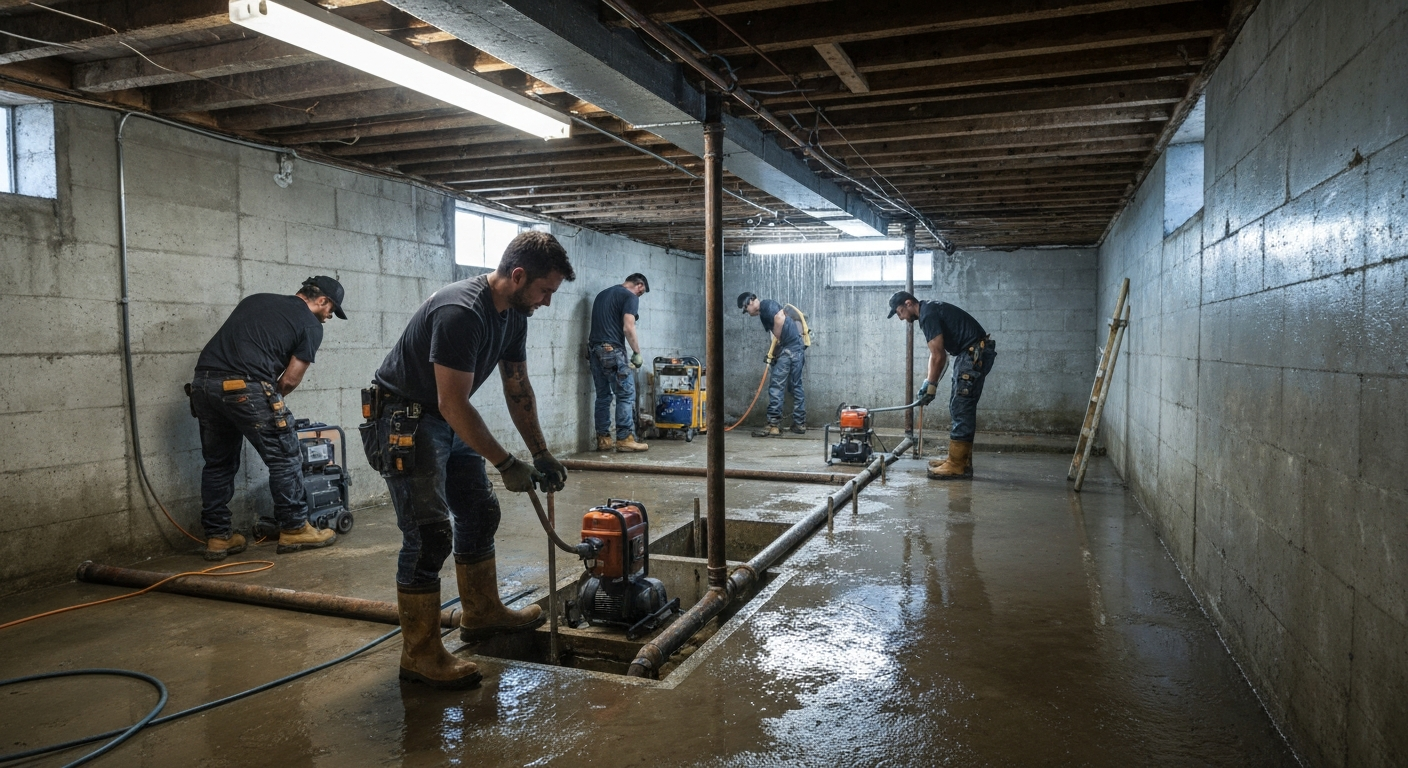
Basement waterproofing options and costs in Burnaby
Basement waterproofing in Burnaby usually comes down to choosing whether to tackle water at the source (exterior excavation) or manage water after it enters (interior drainage). Burnaby’s housing stock plays a major role: with 35.5% of homes built before 1981, many properties are more likely to have aged membrane details and failing weeping tile, which can lead to recurring seepage even after smaller patch jobs. At the same time, Burnaby’s Lower Mainland–Southwest conditions—high groundwater periods, frequent heavy rainfall, and persistent saturation—can keep hydrostatic pressure against basement walls long enough that “dry” seasons don’t solve the underlying problem.
Cost is also shaped by local access and labour realities. In neighbourhoods like Metrotown and along parts of Brentwood, tight lots, mature landscaping, and townhouse-to-lot constraints can increase excavation time and disposal costs. When excavation hits rocky sections, mechanical breaking may be required, pushing labour higher. Contractor availability can also affect schedules and pricing during peak spring demand, because foundation drainage work tends to cluster with dry-weather excavation windows.
For homeowners who want dependable budgets, it helps to compare common methods side-by-side—from exterior systems down to targeted repairs—before you request quotes and confirm site-specific scope. See the table below for typical ranges in Burnaby.
| Method |
What It Addresses |
Disruption Level |
Durability |
Price Range |
| Exterior excavation + new membrane + drainage tile |
Stops water entry by rebuilding the perimeter waterproofing system and relieving hydrostatic pressure |
High (excavation, landscaping reinstatement) |
15–25+ years (site- and material-dependent) |
$15,000–$30,000 |
| Interior perimeter drain channel + sump pit |
Captures seepage inside and directs it to a sump for discharge |
Medium (floor/finishing impacts) |
10–20 years (especially when combined with crack sealing) |
$8,000–$18,000 |
| Foundation crack injection (epoxy or polyurethane) |
Seals cracks to reduce seepage; epoxy is for structural/actively stable cracks, polyurethane for active leaks |
Low–Medium |
5–15+ years (depends on crack movement and root cause) |
$500–$2,000 |
| Sump pump installation (primary + battery backup) |
Prevents basement flooding by pumping collected water; backup maintains pumping during outages |
Low–Medium |
8–15+ years (with proper maintenance) |
$1,000–$5,000 |
| Window well drain installation |
Manages water pooling at egress/well areas to reduce staining and seepage around openings |
Low–Medium |
10–15+ years |
$2,500–$7,500 |
| Lot re-grading / downspout extension |
Redirects roof and surface water away from foundation |
Low |
5–15 years (depends on maintenance and drainage stability) |
$1,500–$6,000 |
Prices are estimates only and vary by project scope, site access and material selection.
What affects the price of waterproofing in Burnaby
In Burnaby and the Lower Mainland–Southwest, two homeowners can receive quotes for the “same” basement problem that differ by 30% to 50%. The gap isn’t about luck—it’s mostly about how contractors quantify root causes (hydrostatic pressure, drainage capacity, crack movement) and how much on-site work is required to correct it. In a wetter region like Lower Mainland–Southwest, your waterproofing quote can sit closer to the higher end of typical national ranges because persistent saturation and groundwater contact can keep pressure against walls and slabs.
Three drivers separate Lower Mainland–Southwest pricing from the national average: (1) soil and drainage behaviour, (2) water table/groundwater conditions, and (3) freeze-thaw impacts. Clay-heavy, expansive soils in other parts of Canada can worsen seasonal swelling, but in Burnaby the bigger issue is usually prolonged saturation. That said, freeze-thaw still matters: water that penetrates at joints and cracks expands when temperatures drop, widening defects over time. When older perimeter systems fail, hydrostatic pressure increases and drainage requirements rise—sump run times can become more frequent, and contractors may recommend upgrading to battery backup. Homes built before 1981 are also more likely to have original drainage details already at or beyond their expected lifespan, which increases labour to excavate, remove compromised materials, and rebuild connections.
Two practical examples: if excavation in Brentwood must go around mature retaining walls or a driveway edge, exterior excavation can trend toward the upper band of $15,000–$30,000. If you have mostly localized dampness near a wall seam and the exterior system appears intact, a combination of crack repairs plus interior drainage may land in the $8,000–$18,000 range instead of requiring full perimeter excavation.
| Price Factor |
Why It Matters |
Cost Impact |
| Interior vs. exterior approach — interior is less disruptive but addresses symptoms |
Exterior rebuilds the water barrier; interior controls water after entry |
Interior often 40–60% less than full exterior; exterior costs more due to excavation/disposal |
| Foundation type — poured concrete vs. block vs. stone vs. ICF |
Crack repair strategy and drainage compatibility vary by foundation material |
Block foundations often require interior drainage as a practical complement; ICF can reduce certain leak paths |
| Soil type — clay expands more than sand, adding pressure |
Expansive pressure can push water through cracks more aggressively |
Can increase crack/seal scope and interior drainage sizing; affects whether exterior is recommended |
| Crack type and length — hairline vs. structural horizontal cracks |
Structural cracks may require engineering assessment and potentially underpinning discussions |
Can add costs for engineering and extended repair time; hairline leaks are usually cheaper |
| Sump pump backup system — battery or water-powered backup needed |
Prevents basement flooding during outages or spring power disruptions |
Typical add-on can move you higher within the sump pricing band |
| Access — landscaping, decks, or driveways must be removed for exterior |
More materials removal and reinstatement increases labour and delays |
May push exterior projects toward the upper portion of the regional band |
| Weeping tile age — original tile (60+ years) may be completely failed |
Old tile may be collapsed or disconnected, requiring replacement and re-routing |
Increases excavation time, pipe install labour, and sealing/restoration work |
| Mould or efflorescence remediation required before sealing |
Sealing over active contamination can worsen conditions and reduce adhesion |
Adds prep labour and sometimes additional materials for cleaning/encapsulation |
Permits & regulations in British Columbia
In British Columbia, foundation excavation, structural crack repair, and changes to lot drainage typically require a building permit. If the scope includes connecting a sump discharge line to a municipal sewer system (storm or sanitary), municipal approval is often required before work proceeds. For structural crack repair—particularly horizontal cracks in block walls or major step cracks—a structural engineer’s assessment is frequently needed to confirm whether the foundation is stable or whether underpinning or other structural measures are required.
Here’s a practical way for a homeowner in Burnaby to verify a contractor before hiring: (1) Check the contractor licence status using the appropriate online provincial registry—match the legal company name to the quote and contract. (2) Ask for a current certificate of insurance showing general liability and indicate the project address (or confirm coverage terms). (3) Confirm WSIB/WCB coverage (or the applicable clearance letter/confirmation) to ensure the crew is covered while on site.
For structural scopes, ask whether the contractor can provide engineering support documentation and how they handle engineer sign-off. Finally, request a written scope that clearly states what permits are included, who pulls them, and what inspections are expected. In a region where many basements involve older foundation systems—Burnaby has a large homeowner base and 249,125 residents in 2021 (Statistics Canada, 2021 Census)—it’s common for paperwork and documentation to be part of doing waterproofing correctly, not an afterthought.
Interior vs exterior waterproofing — what does Burnaby need?
The key difference between exterior and interior waterproofing is what it does to the water at the foundation interface. Exterior waterproofing—full excavation, new membrane, new drainage tile, and properly managed backfill—addresses the source of water entry and relieves hydrostatic pressure before water reaches your basement walls. It’s usually the most permanent fix, but it costs more and involves major landscaping disruption. Interior waterproofing—such as a perimeter drain channel, sump pit, and sump pump—captures water after it enters. It can be less invasive and often cheaper, but it does not stop pressure on the wall; it manages the outcome and requires good pump reliability.
Burnaby’s wet, mild winters and frequent freeze-thaw cycles mean small cracks and joints can keep opening and letting water track behind coatings. For poured concrete walls, crack injection is often an appropriate component because the wall tends to have more straightforward sealing planes; where the exterior system is compromised, exterior work still tends to be the best long-term solution. For block foundations, interior drainage is frequently a practical complement because moisture can migrate through porous areas and through joints.
Sump pump backup matters in British Columbia. During spring flooding and heavy rain, power interruptions can occur, and pump downtime can mean rapid basement flooding before backup engages. If you’re choosing interior drainage, insist on details for a battery or water-powered backup strategy.
Example: if you’re facing recurring seepage along multiple exterior wall segments in Metrotown and inspection suggests failed perimeter drainage, investing toward the exterior band (often $15,000–$30,000) can be justified because interior-only measures may require ongoing maintenance and pump dependency. If the issue is localized and you’re primarily seeing dampness near a single wall, interior perimeter drainage in the $8,000–$18,000 range may solve the problem without the need for full excavation.
| Method |
Best For |
Addresses Source? |
Disruption |
Lifespan |
Price Band |
| Full exterior excavation + membrane |
Widespread seepage, failed weeping tile, frequent hydrostatic pressure at multiple wall segments |
Yes |
High |
15–25+ years |
$15,000–$30,000 |
| Interior French drain + sump system |
Intermittent seepage, finished basements where exterior excavation is difficult, older systems needing a safety net |
Partially (manages water after entry) |
Medium |
10–20 years |
$8,000–$18,000 |
| Crack injection — epoxy (structural) |
Stable structural cracks where there’s no active movement and the goal is sealing |
No (seals the leak path) |
Low–Medium |
5–15+ years |
$500–$2,000 |
| Crack injection — polyurethane (active leak) |
Active seepage cracks and joints where water is currently entering |
No (seals the leak path, then needs root cause management) |
Low–Medium |
5–12 years (often depends on whether pressure continues) |
$500–$2,000 |
| Interior drain channel only (no sump) |
Small-scale moisture control where there’s another drainage route or very limited seepage |
No |
Low–Medium |
5–10 years |
$5,000–$12,000 |
| Re-grading + downspout extensions |
Surface water and roof runoff problems; when indoor seepage is minimal and pressure appears low |
Yes for surface contribution only |
Low |
5–15 years |
$1,500–$6,000 |
How to choose a waterproofing contractor in Burnaby
Choosing a waterproofing contractor in Burnaby should start with documentation and clarity, not just the lowest line price. In British Columbia, confirm the contractor’s licence details (and that they match the legal name on your contract). Ask for a certificate of liability insurance—ensure it covers the project and is current. Then verify WSIB/WCB coverage: you want proof the workers are properly covered; many firms provide a clearance letter or confirmation documentation. If a contractor hesitates or can’t provide these items quickly, that’s a warning sign for a scope involving excavation and concrete work.
Next, request 2–3 itemised written quotes rather than one lump-sum. Look for a breakdown of labour and materials (membrane type, drainage pipe specifications, pump model, discharge method, concrete cutting/restoration, disposal, and reinstatement). Pay close attention to exclusions: is mould remediation included if efflorescence is present? Is the permit pull included (when needed)? Is excavation disposal and dump fees included, or added later as a change order?
Warranty is equally important. Ask for a workmanship warranty length (and what qualifies as a claim), the product/manufacturer warranty details, and whether warranties are transferable if you sell the home. For payment schedule, a common safe approach is to keep upfront deposits modest—never more than about 10–15%—and hold back the remainder until the work is complete and inspected. Finally, get the timeline and key milestones in writing: start date, estimated duration, and when exterior backfill/finishing will happen.
- Provide licence number, legal company name, and contact details that match the quote.
- Show current liability insurance certificate (project/address listed or coverage confirmed for the job).
- Confirm WSIB/WCB coverage with clearance letter or proof.
- Deliver an itemised estimate (labour + materials + disposal + reinstatement).
- State what permits are required and who pulls them.
- Explain drainage discharge location (and confirm approvals if it connects to sewer systems).
- Describe how they test or verify active leaks before choosing epoxy vs polyurethane.
- Include pump specifications and backup plan (battery or water-powered backup where appropriate).
- Clarify warranty: workmanship period, manufacturer product coverage, and transferability.
- Detail cleanup and restoration scope (topsoil, sod, walkway/driveway reinstatement).
- Use clear start/completion dates and note weather-related contingencies.
- Avoid vague language like “we’ll seal as needed” without specifying materials and methods.
Red flags in Burnaby include: (1) quoting an interior-only fix for a problem they can’t properly assess without discussing exterior drainage and hydrostatic pressure; (2) refusing to provide insurance/WSIB/WCB proof; (3) giving a lump-sum with no breakdown of drainage, membrane, or pump discharge details; (4) offering a short or unclear warranty; and (5) requesting large upfront payments beyond roughly 10–15% before any on-site assessment or permit steps.
Frequently asked questions — waterproofing in Burnaby
How long does waterproofing last?
In Burnaby and the Lower Mainland–Southwest, lifespan depends on whether the fix addresses the source of water entry. Exterior membrane systems paired with replaced drainage tile commonly last 15–25+ years when installed with proper backfill, sealed connections, and functioning discharge. Interior drainage (perimeter drain channel plus sump) typically manages seepage for 10–20 years, but it relies on pump reliability, correct float control, and an adequately sized sump pit. Crack injection can last 5–15+ years, yet it’s best viewed as a component—if the perimeter drainage fails or hydrostatic pressure remains high, new leakage can appear at adjacent joints. Because 35.5% of Burnaby homes were built before 1981 (Statistics Canada, 2021 Census), older foundations often need broader systems work rather than repeated patching.
Can I waterproof my basement from the inside only?
Yes, you can waterproof from the inside only in many Burnaby basements, especially when excavation is difficult due to landscaping, decks, or finished basements. Interior perimeter drainage (French drain channel) plus a sump pump can significantly reduce seepage and help prevent standing water. However, interior-only methods don’t remove the ongoing hydrostatic pressure against walls; they’re more effective when the exterior waterproofing isn’t the sole failure point. If your weeping tile is failed or disconnected, interior-only work may become a long-term maintenance and pump-dependency situation—especially during prolonged coastal rainfall. For pricing, interior systems typically fall around $8,000–$18,000, while exterior excavation is often $15,000–$30,000 when the source must be rebuilt.
What causes foundation cracks in Burnaby?
Foundation cracks in Burnaby are commonly tied to moisture movement, seasonal freeze-thaw, and settlement influenced by drainage performance. In the Lower Mainland–Southwest, persistent saturation can increase water pressure against basement walls; when water penetrates and later freezes, freeze-thaw can widen cracks and joints. Older homes—35.5% built before 1981 (Statistics Canada, 2021 Census)—are also more likely to have aging drainage details that no longer manage groundwater effectively. Structural issues can still occur, but many “leaking cracks” are primarily about water path and pressure rather than major structural collapse. To choose the right repair, contractors should identify whether cracks are hairline versus structural/horizontal and determine whether the crack is actively leaking. That’s what guides whether polyurethane or epoxy injection is appropriate.
How do I compare waterproofing quotes?
Comparing quotes in Burnaby is easiest when you line them up by scope, not by total price. Ask each contractor for an itemised breakdown: excavation extent (if exterior), drainage tile route and pipe specifications, membrane type, pump model (including backup), sump discharge method, crack injection type, and whether mould/efflorescence remediation is included. Confirm what’s excluded—permit pulling, disposal fees, landscaping reinstatement, and any engineering requirements for structural crack assessment. For timing and accountability, check if the quote includes a start date, estimated duration, and specific warranty terms. Finally, verify credentials: in British Columbia you should see licence information, liability insurance and WSIB/WCB coverage. Quotes can differ by 30–50% because labour and access constraints vary, especially on tight Burnaby lots.
How long does basement waterproofing take in Burnaby?
Typical timelines in Burnaby range from a few days to several weeks depending on whether work is interior-only or requires exterior excavation. Interior drain channel and sump installations often take about 1–2 weeks including concrete cutting, plumbing, and finishing time, assuming finishing is limited or planned. Crack injection can be faster—often within several days once access is prepared and any remediation is complete. Full exterior excavation + membrane work usually takes longer, commonly 2–4+ weeks, because excavation, mechanical breaking (if needed), inspection, membrane/detailed sealing, drainage installation, backfill, and landscape reinstatement all require time and sequencing. Rainy conditions and freeze-thaw planning matter in British Columbia, so the best contractors schedule critical waterproofing steps around workable weather windows.
What is a weeping tile and does my Burnaby home have one?
A weeping tile is a perimeter drainage system around your foundation that collects groundwater and directs it to a sump or discharge point. In many older Burnaby homes, it was installed to relieve hydrostatic pressure, but it can fail due to age, disconnection, collapse, or clogged connections—especially if original grades and discharge paths changed over time. Given that 35.5% of Burnaby homes were built before 1981 (Statistics Canada, 2021 Census), the likelihood of an older tile system exists, but you can’t assume it’s functioning. The only reliable way to know is a site inspection: contractors may camera-inspect accessible sections, verify sump presence and discharge routing, and look for signs like sediment, disconnected pipe runs, or staining patterns matching the perimeter. If your home is damp after heavy rain, the weeping tile may be compromised even if it originally existed.