Basement waterproofing options and costs in Oliver
Basement waterproofing in Oliver, British Columbia comes down to matching the right fix to how water is entering your home—because in our semi-arid Thompson–Okanagan valleys, small drainage issues can turn into recurring seepage during spring snowmelt and hard freezes. In Oliver, many homes are older; 43.7% of dwellings were built before 1981, so it’s common to find original, aging waterproofing systems and older weeping tile that have partially collapsed or clogged. We also see a high rate of owner-occupied homes (78.1% of households own), which typically means homeowners want a durable, “get it done once” solution and are willing to invest when the site conditions justify it.
Thompson–Okanagan costs often run higher than the national average because site conditions drive the scope: glacial and alluvial deposits can include localized clay pockets that hold water longer and increase lateral pressure on foundation walls compared with freely draining sandy/gravelly sites. Freeze-thaw cycles widen existing joints and cracks, while older drainage lines (or undersized perforated pipe) can cause chronic perimeter wetness. Contractor availability can also matter—during busy spring periods, scheduling and excavation readiness can affect turnaround time, which influences total project cost.
In Oliver’s more established pockets (especially areas with 1960s–1990s housing stock), weeping tile failures and undersized exterior drains are especially common, making exterior excavation or a well-designed interior perimeter system the most reliable paths. Below is a side-by-side comparison of the most common options and their typical ranges, to help you understand what drives your quote.
| Method |
What It Addresses |
Disruption Level |
Durability |
Price Range |
| Exterior excavation + new membrane + drainage tile |
Primary water entry via hydrostatic pressure; replaces failed exterior drainage and waterproofing layer |
High (excavation; landscaping/concrete removal and reinstatement) |
Long-term when backfill and grading are done correctly; typically the “source control” solution |
$24,000–$40,000 |
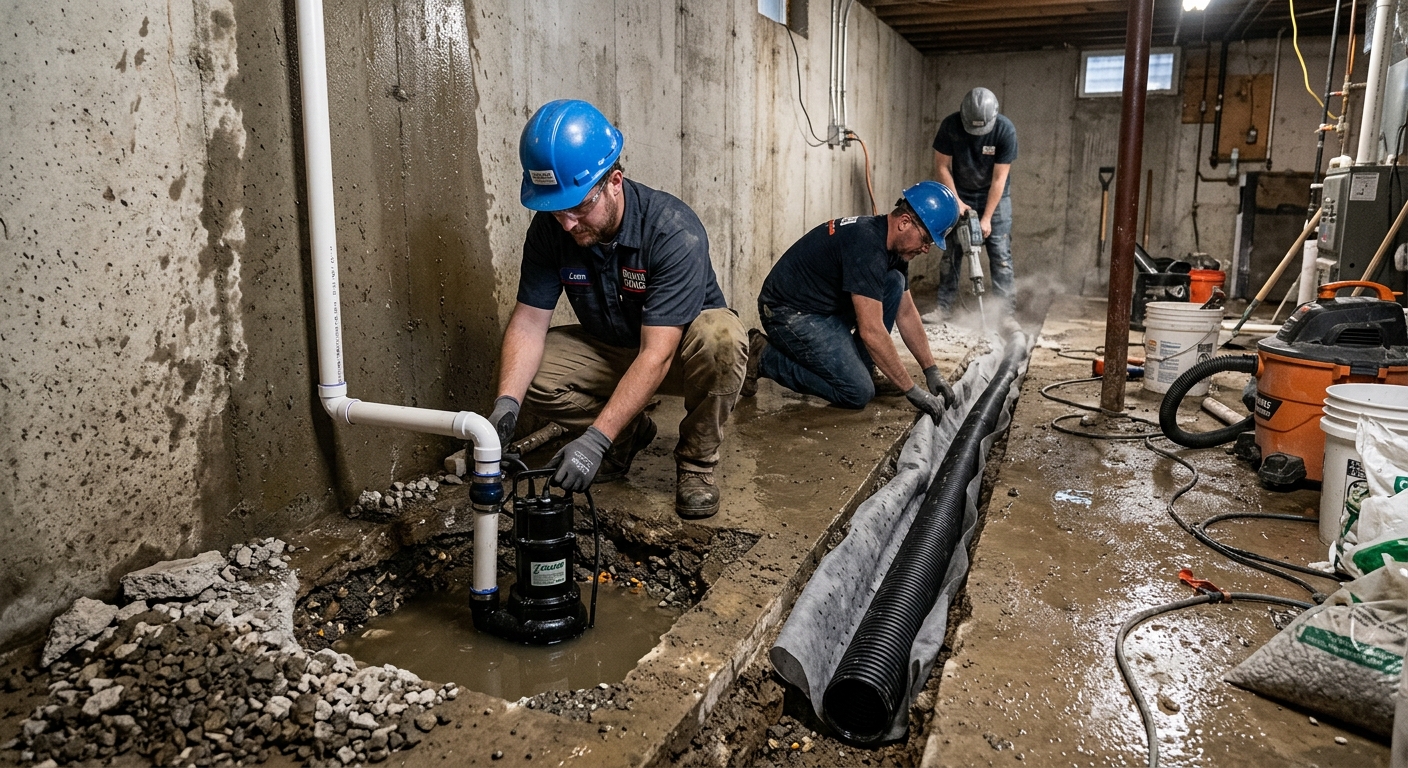
| Interior perimeter drain channel + sump pit |
Relieves water after it enters; reduces seepage at slab edges and along cold joints |
Medium (interior demolition near perimeter; typically no exterior digging) |
Very good when the pump, discharge line, and discharge route are properly designed |
$10,000–$19,500 |
| Foundation crack injection (epoxy or polyurethane) |
Stops cracks; epoxy for stable structural cracks, polyurethane for active leaks |
Low to Medium (localized drilling/injection; minor patching) |
Good to long-term when crack type is correctly matched to the product |
$1,100–$3,500 |
| Sump pump installation (primary + battery backup) |
Prevents water build-up when exterior drainage can’t fully eliminate seepage |
Low to Medium (pit excavation and discharge routing) |
High, especially with backup power during spring outages |
$3,200–$6,200 |
| Window well drain installation |
Stops rain and meltwater pooling around below-grade windows |
Low to Medium (localized exterior/infill work near window) |
Good when discharge is routed away from the foundation perimeter |
$2,000–$4,800 |
| Lot re-grading / downspout extension |
Moves roof runoff away; reduces frequency of perimeter seepage |
Low (landscape work; some surface concrete/asphalt may be affected) |
Moderate—excellent as part of a complete drainage plan |
$1,500–$4,000 |
Prices are estimates only and vary by project scope, site access and material selection.
What affects the price of waterproofing in Oliver
In Oliver and across the Thompson–Okanagan, the same “basement leak” can price 30–50% differently between quotes because contractors often discover different root causes once excavation opens up or once the wall is exposed. National comparisons can look confusing too—British Columbia pricing is heavily shaped by local labour availability, excavation access constraints on infill lots, and the way freeze-thaw and semi-arid drainage patterns interact with site soils.
The three biggest cost drivers that separate Thompson–Okanagan pricing from a simple national average are soil type, water table conditions, and freeze-thaw. Clay-heavy pockets (common where glacial deposits include finer silts or clays) can expand during freeze-thaw and exert lateral pressure on foundation walls, turning hairline cracks into recurring seepage. Where there are high-water-table pockets—especially after spring snowmelt—sump systems run longer and require more robust pumping and discharge arrangements. In heavier, localized silty conditions, backfill can stay saturated longer, increasing the volume and duration of water pressure against the wall; that often pushes a job from “crack treatment” into “full drainage + waterproofing” scope. Regions with older housing stock typically see higher frequency of failing weeping tile and seeping poured-concrete or block walls, which adds inspection, demo, and longer repair lines.
In Oliver specifically, older homes built before 1981 (43.7% of dwellings) often have older exterior drains, which can raise the need for exterior excavation in select cases—pushing work toward exterior waterproofing bands like $24,000–$40,000 when we find compromised footing drainage. Conversely, a home with a tight perimeter, good drainage routing, and only localized active leakage might stay in the interior/targeted range, such as interior perimeter drainage and sump work around $10,000–$19,500 plus a crack injection component when needed.
| Price Factor |
Why It Matters |
Cost Impact |
| Interior vs. exterior approach — interior is less disruptive but addresses symptoms |
Exterior controls the source; interior manages water after entry |
Exterior typically costs more due to excavation and reinstatement |
| Foundation type — poured concrete vs. block vs. stone vs. ICF |
Crack behavior and wall permeability differ by material |
Block and stone often require interior drainage complements more often |
| Soil type — clay expands more than sand, adding pressure |
Freeze-thaw increases lateral pressure on walls |
Clay-heavy sites can move you toward exterior waterproofing scope |
| Crack type and length — hairline vs. structural horizontal cracks |
Different product systems and prep are required; structural assessment may be needed |
Longer and structural cracks increase labour and engineering/scope items |
| Sump pump backup system — battery or water-powered backup needed |
Protects during spring outages and high-flow events |
Adds cost but reduces risk of renewed damage |
| Access — landscaping, decks, or driveways must be removed for exterior |
Excavation requires safe access and space for machinery |
Removal and reinstatement can be a major cost swing |
| Weeping tile age — original tile (60+ years) may be completely failed |
Old systems often clog or collapse, losing drainage function |
Complete replacement raises cost compared to “minor repairs” |
| Mould or efflorescence remediation required before sealing |
Water must be stabilized and surfaces prepared correctly |
Cleaning/prep increases labour and extends schedule |
Permits & regulations in British Columbia
In British Columbia, foundation excavation, structural crack repair, and changes to lot drainage typically require a building permit. If your plan involves opening up the foundation, replacing drainage components around the foundation perimeter, or making repairs that could be considered structural, assume a permit may be needed. Sump pump installations that connect to the storm system or sanitary sewer also require municipal approval—this is especially important in older Oliver neighbourhoods where discharge routing may not be straightforward.
For structural crack repair—such as horizontal cracks in block walls, or major step cracks—an assessment by a structural engineer is often required to confirm whether the wall is still structurally stable and whether underpinning or other structural measures are needed. Good contractors in BC will either coordinate engineering support or clearly explain when engineering is triggered.
To verify your contractor in Oliver, start with three checks in this order: (1) licensing/registration: find their business listing on the appropriate BC online registry for the category of work they claim to do; (2) liability insurance: request a current certificate of insurance that matches the scope and your property address; and (3) clearance/coverage for workers: verify WSIB/WCB coverage through their clearance letter or certificate, depending on how they’re registered.
Ask for copies before signing. If they can’t provide documentation quickly and clearly, that’s a red flag for both compliance and job-risk.
Interior vs exterior waterproofing — what does Oliver need?
Exterior waterproofing and interior waterproofing solve different problems. Exterior waterproofing—full excavation, new membrane, and new drainage tile—targets the source of water entry by addressing the hydrostatic pressure against your foundation wall. It’s the most “permanent” style of solution when soils hold water against the wall, but it’s also the most invasive: you remove landscaping and often concrete/asphalt, then reinstate everything after backfill and drainage are completed.
Interior waterproofing—perimeter drain channels, a sump pit, and sump pump—manages water after it enters your basement. It won’t directly stop water pressure on the wall itself, but in Thompson–Okanagan conditions it can be the practical best step when the exterior is inaccessible, when the foundation is already partially buried behind mature landscaping, or when the goal is to stop active seepage. In Oliver’s climate, repeated freeze-thaw can widen existing cracks, so interior systems often pair well with crack injection: poured-concrete walls tend to accept injection and sealing cleanly, while block foundations frequently benefit from a well-designed interior drainage plan to handle seepage through mortar joints.
British Columbia’s power-outage reality matters too. In spring, when snowmelt drives higher groundwater and roof runoff, pump failure can quickly lead to damage. That’s why we often recommend primary pumps with backup (battery or water-powered) when homeowners want peace of mind.
A common pricing justification we see: if exterior excavation is required due to failed exterior drainage on a tight lot, exterior waterproofing can land in the $24,000–$40,000 band. But if inspection shows localized active leakage and you’re a good candidate for interior perimeter drainage plus a sump system, interior work is often in the $10,000–$19,500 range; that difference can be justified when exterior excavation would require extensive deck removal or when the exterior drainage can be corrected without full wall exposure.
| Method |
Best For |
Addresses Source? |
Disruption |
Lifespan |
Price Band |
| Full exterior excavation + membrane |
Chronic seepage where exterior drainage and membrane have failed; clay pockets or poor perimeters |
Yes (source control) |
High |
Long-term when backfill, drainage, and grading are properly completed |
$24,000–$40,000 |
| Interior French drain + sump system |
Water entering through slab edges, cold joints, or perimeter seepage when exterior work is limited |
No (after-entry management) |
Medium |
Good to long-term with correct pump sizing and discharge routing |
$10,000–$19,500 |
| Crack injection — epoxy (structural) |
Stable cracks where the wall isn’t actively moving |
Partial (stops leakage through the crack) |
Low to Medium |
Good when the crack is correctly identified and cleaned/prepped |
$1,000–$3,000 |
| Crack injection — polyurethane (active leak) |
Active leaks with seepage through cracks during wet periods |
Partial (stops leakage through the crack) |
Low to Medium |
Good for active leakage; performance depends on hydrostatic conditions |
$1,200–$3,500 |
| Interior drain channel only (no sump) |
Minor moisture where water volume is low or temporary drainage is enough |
No |
Medium |
Moderate—often needs upgrades if water volume increases |
$9,000–$15,500 |
| Re-grading + downspout extensions |
Roof runoff issues and surface water pooling around the foundation |
No (helps reduce load on the foundation) |
Low |
Moderate—best when combined with perimeter drainage fixes |
$1,500–$4,000 |
How to choose a waterproofing contractor in Oliver
Choosing the right waterproofing contractor in Oliver starts with confirming three things: they’re properly licensed/registered for the work they’re doing in British Columbia, they carry liability insurance, and they have WSIB/WCB coverage for their workers. Ask for documentation and check the dates before work begins. For licensing/registration, look up their business online in the relevant BC registry for their stated service category. For liability insurance, request a certificate of insurance that lists your project/address. For WSIB/WCB, request a clearance letter or proof of coverage.
Next, get 2–3 itemised written quotes. A good quote breaks down labour and materials (excavation scope, membrane type, drainage tile and fabric, discharge line routing, pump model and backup, restoration/cleanup, and any disposal costs). Avoid lump-sum quotes with unclear exclusions. Read the scope carefully: confirm what’s included for permit pull (if required), where discharge is routed, and whether mould/efflorescence remediation is included before sealing. Ask for a clear start date and completion estimate in writing, and request the warranty details before signing.
Warranty matters in waterproofing. Get the workmanship warranty length and confirm whether it covers material defects or only installation. Ask about product/manufacturer warranty and whether it’s transferable to future homeowners. Payment schedule should be conservative: never pay more than 10–15% upfront, and hold back a portion until completion and final walkthrough.
- Request proof of BC registration/licence for the work type and confirm it matches your scope.
- Ask for a current certificate of liability insurance (project/address listed).
- Verify WSIB/WCB clearance or coverage letter before the crew starts.
- Get 2–3 itemised quotes with a line-by-line breakdown (materials + labour).
- Confirm whether disposal, concrete/asphalt removal, and reinstatement are included.
- Ask what type of drainage tile, filter fabric, and backfill approach will be used.
- Ensure crack injection includes assessment of crack type (epoxy vs polyurethane).
- Require details on pump sizing, discharge route, and back-up power type.
- Ask for written confirmation on permit responsibility (pull/support) where applicable.
- Confirm warranty: workmanship coverage term, product warranty terms, and transferability.
- Set a realistic timeline: start date, inspection milestones, and completion estimate.
- Use a conservative payment schedule (10–15% max upfront; holdback on completion).
In Oliver, red flags include: quotes that don’t inspect or explain the water entry pattern (e.g., jump straight to membrane without checking drainage), no documentation for insurance/coverage, vague “we’ll fix the problem” language without measurable scope, and warranties that limit coverage to “materials only” while excluding labour—especially if the quote is trying to stay near the low end of bands like $9,000–$19,500 for interior systems but includes no sump or pump backup discussion.
Frequently asked questions — waterproofing in Oliver
Do I need a sump pump in Oliver?
Not every home in Oliver needs a sump pump, but it’s often recommended when water volume is high enough that a passive interior drain can’t handle it reliably. In the Thompson–Okanagan, spring snowmelt and hard rain can raise seepage at slab edges and cold joints, especially where older weeping tile has failed or where localized clay holds water longer. Many quotes for interior systems land in the $10,000–$19,500 range when a properly sized perimeter drain plus sump pit and pump are included. If your issue is only occasional surface pooling, re-grading and downspout extensions may help on their own. A proper site review (and sometimes dye testing) determines whether a pump is required, rather than guessing based on symptoms alone.
How does Oliver's soil affect my foundation?
In Oliver and the wider Thompson–Okanagan, soils often mix sand, silt, and localized clay deposits from glacial and alluvial history. Clay pockets can hold water longer and exert more lateral pressure as freeze-thaw cycles expand and contract moisture in the soil. That pressure can worsen cracks over time, turning minor seepage into active leaks across a few seasons. If your basement is showing moisture along the perimeter, the soil and drainage path around the foundation are usually key contributors—not just the wall itself. Homes built before 1981 (43.7% of dwellings) commonly face higher risk of older, underperforming perimeter drains. That’s why two homes with similar-looking leaks can end up with very different scopes and price bands.
Do I need a permit for foundation work in British Columbia?
In British Columbia, foundation excavation and structural crack repair typically require a building permit, and changes to lot drainage often do as well. Sump pump installations that connect to storm or sanitary systems usually need municipal approval. If you’re dealing with horizontal cracks in block walls or major step cracking, an engineer’s assessment is often required to confirm whether structural work like underpinning is needed. The best way to confirm your specific requirements is to ask your contractor what tasks are permit-triggering and who will handle the permit steps. Before work begins in Oliver, request written clarity on whether permits are included or your responsibility, and ensure the contractor can support inspections if they’re pulled.
How long does waterproofing last?
How long waterproofing lasts depends on whether the fix controls water at the source or only manages it after entry. Exterior waterproofing (excavation, membrane, and drainage tile) is designed for long-term source control when the drainage is correctly built and backfill/grading are right—many homeowners view it as the most durable option. Interior systems can also last many years, particularly when a sump pump is sized correctly and discharge routing is correct, with backup power considered for spring outages. Crack injection longevity depends heavily on matching product to crack type: epoxy is generally used for stable cracks, while polyurethane is for active leaks. In many Oliver basements, the real longevity comes from whether the underlying drainage pathway stays functional rather than from the product alone.
Can I waterproof my basement from the inside only?
You often can waterproof from the inside only, and it can be the right choice in Oliver when access for exterior excavation is limited or when symptoms are mainly interior seepage along slab edges and cold joints. Interior perimeter drain channels and sump systems are typically less disruptive than full excavation, and they commonly fall around $10,000–$19,500 depending on scope and pump/backup requirements. However, interior work doesn’t stop hydrostatic pressure against the foundation wall; it manages water after it enters. If the main problem is failed exterior drainage or widespread water pressure against the wall (common on certain clay-heavy sites), interior-only approaches may still help but may not be the most permanent solution. A proper assessment is the deciding factor.
What causes foundation cracks in Oliver?
Foundation cracks in Oliver are usually driven by a combination of soil movement, moisture, and freeze-thaw cycling. Where soils include localized clay or dense silt, water can remain in the ground longer, expand during freeze-thaw, and increase lateral pressure against foundation walls. That movement can widen existing hairline cracks and open up joints over time, especially in homes where older drainage systems have underperformed. Poor drainage around downspouts, failing weeping tile, and undersized exterior drains can also increase water exposure near the foundation. In older housing stock (43.7% built before 1981), it’s common to see drainage components that are worn out or clogged. The crack pattern matters too—stable cracks may suit epoxy injection, while active leaking cracks may require polyurethane.