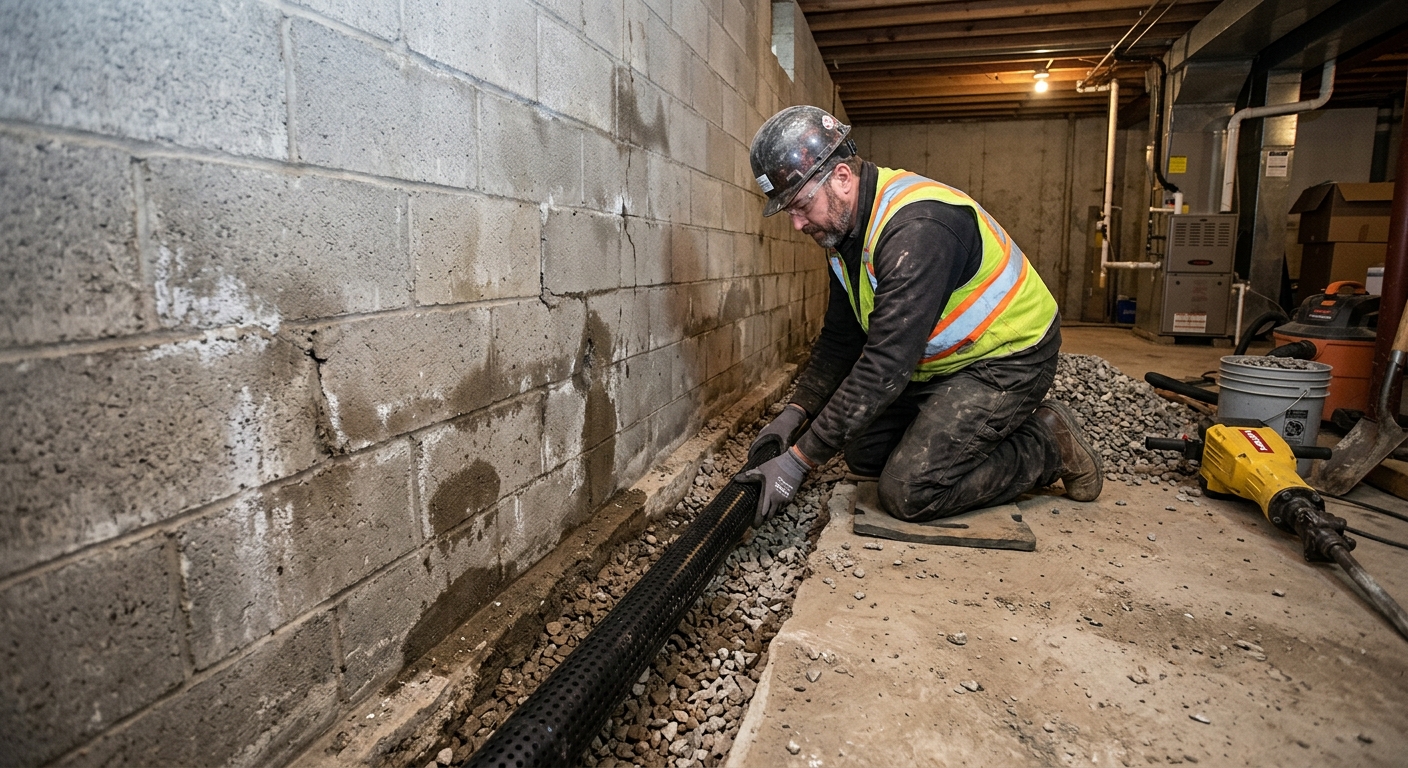
Basement waterproofing options and costs in Brockville
Brockville homeowners typically have two waterproofing pathways: address water at the foundation from the outside, or manage it once it enters from the inside. With 71.6% of homes built before 1981, many basements in older neighbourhoods are dealing with legacy waterproofing materials and original weeping tile that are often clogged, missing, or degraded (Statistics Canada, 2021 Census). That matters because failed exterior systems usually allow seepage to develop into ongoing dampness, efflorescence, and recurring floor-joint or wall leakage that interior work alone may only partially control.
In the Kingston–Pembroke economic region, waterproofing costs are strongly influenced by local soils and groundwater. Clay-rich soils can hold and expand water during freeze-thaw cycles, which increases lateral pressure on foundation walls and widens cracks over time. When drainage is inadequate, water finds the weakest points—tie holes, minor joints, or hairline cracks—so contractors plan around either active hydrostatic pressure (often calling for a sump strategy) or a source-control approach (excavation, membrane, and new drainage tile). Labour availability can also affect pricing because excavation work requires more coordination: backfill, disposal, temporary drainage, and restoration of landscaping around older properties.
In Brockville, this trade is especially in demand in areas with older housing stock and mature landscaping, such as around King Street and the waterfront-adjacent core where access constraints can turn a “simple” exterior job into more labour and restoration. The next step is understanding how the options compare, so you can align your quote with what your site actually needs.
| Method |
What It Addresses |
Disruption Level |
Durability |
Price Range |
| Exterior excavation + new membrane + drainage tile |
Stops water at the foundation perimeter; replaces failed weeping tile and improves drainage |
High (excavate around foundation; landscaping restoration) |
Long-term (source control; typically the most complete retrofit) |
$12,000 – $25,000 |
| Interior perimeter drain channel + sump pit |
Collects seepage after it enters; manages hydrostatic pressure through pumping |
Medium (interior floor/finish disruption in targeted areas) |
High when paired with good drainage and crack sealing |
$4,000 – $10,000 |
| Foundation crack injection (epoxy or polyurethane) |
Seals leaking cracks; epoxy for stable, structural cracks; polyurethane for active leaks |
Low to medium (minor interior access; typically localized) |
Good (best when underlying water entry is controlled) |
$800 – $1,800 |
| Sump pump installation (primary + battery backup) |
Improves water handling during spring storms and power interruptions; reduces basement flooding risk |
Low to medium (pit cut; discharge line work) |
High with backup power and correct discharge routing |
$900 – $2,200 |
| Window well drain installation |
Prevents pooling and lateral seepage at window wells; reduces wet window-area floors |
Low to medium (exterior window-well excavation and grading) |
Good (when tied into proper drainage) |
$1,000 – $2,800 |
| Lot re-grading / downspout extension |
Redirects surface water away from foundation; reduces the water load reaching weak points |
Low (site work; minimal basement disruption) |
Moderate (best as part of a broader plan) |
$1,200 – $3,500 |
Prices are estimates only and vary by project scope, site access and material selection.
What affects the price of waterproofing in Brockville
In Brockville and across the Kingston–Pembroke economic region, it’s common to see quotes for the “same” basement problem vary by 30–50%. The reason usually isn’t the contractor’s pricing style—it’s the site conditions that determine how much water pressure you’re fighting and how difficult access and restoration will be. Nationally, many averages assume typical soils and modern drainage patterns, but Eastern Ontario has a sharper range: clay-rich soils that hold water, older foundations, and seasonal freeze-thaw that can keep cracks active year after year.
The three biggest drivers separating regional costs from a national average are soil type, water table, and freeze-thaw. First, clay-heavy soils expand when saturated, exerting lateral pressure on foundation walls. That means small cracks that might only leak occasionally can become persistent pathways, pushing projects toward crack repair plus drainage upgrades (instead of sealing alone). Second, a higher or fluctuating water table increases sump run times and often requires better interior drainage design. Third, freeze-thaw cycles widen joints in poured concrete and block foundations, which can increase labour for prep and patching before any sealing system is applied.
Two practical examples from Brockville: (1) homes built before 1981 often have original weeping tile that has failed after decades—replacing or upgrading drainage typically brings the project closer to the $12,000–$25,000 exterior excavation band. (2) properties with heavy landscaping or a tight side yard may limit exterior excavation, so contractors steer toward interior systems in the $4,000–$10,000 range, then rely on crack injection and sump pumping to control seepage.
When masonry is stable and leaks are localized, costs can stay closer to crack repair budgets around $800–$1,800. When hydrostatic pressure is ongoing, that “small crack fix” isn’t enough—because the water load keeps reactivating pathways.
| Price Factor |
Why It Matters |
Cost Impact |
| Interior vs. exterior approach — interior is less disruptive but addresses symptoms |
Exterior removes the water source; interior manages water after entry |
Interior can be 40%–60% lower, but may need more system components to perform long-term |
| Foundation type — poured concrete vs. block vs. stone vs. ICF |
Different materials crack and leak differently; joints behave differently under freeze-thaw |
Block/stone often increases drain and sealing labour; ICF can be easier if joints are sound |
| Soil type — clay expands more than sand, adding pressure |
Saturated clay increases lateral pressure and persistent seepage |
Higher likelihood of needing sump + crack strategy, increasing total labour |
| Crack type and length — hairline vs. structural horizontal cracks |
Structural or horizontal cracks can signal movement and require engineer-led decisions |
Structural cases raise costs due to assessment and potentially more invasive repair |
| Sump pump backup system — battery or water-powered backup needed |
Reduces basement flooding risk during power interruptions |
Adds cost, but can be essential where spring flooding/power loss is a concern |
| Access — landscaping, decks, or driveways must be removed for exterior |
Exterior work often requires excavation and restoration of disturbed features |
Can materially increase cost and schedule time |
| Weeping tile age — original tile (60+ years) may be completely failed |
Older systems may be broken or disconnected |
Often pushes projects toward new drainage tile (major scope) |
| Mould or efflorescence remediation required before sealing |
Sealers don’t bond well to active contamination; moisture must be properly addressed |
Adds prep time and specialized labour/materials |
Permits & regulations in Ontario
In Ontario, some basement waterproofing-related work is straightforward, while other items typically require permits or municipal approval. As a homeowner in Brockville, you should expect a permit may be required when you make changes that affect the structure or the way water leaves the property. Common examples that typically do require a permit include: foundation excavation that affects drainage at the perimeter, structural crack repair where there’s any concern about movement, and modifications to lot drainage (for example, altering drainage routing in a way that changes how water is managed off-site).
Sump pump installations can also trigger approvals depending on how the discharge is routed. If you connect or alter discharge to storm or sanitary sewer components, municipal approval is often needed. Also, if the job involves a structural evaluation for major cracks (such as significant horizontal cracks in block walls or conditions that suggest settlement or movement), it’s common for the process to involve an engineer’s assessment before proceeding with underpinning or structural reinforcement decisions.
To verify contractor compliance in Ontario, ask for three things and check them in writing: (1) the contractor’s licensing information via appropriate online registries where applicable to their scope; (2) a certificate of liability insurance showing current coverage; and (3) WSIB/WCB clearance documentation or the equivalent clearance letter. For structural work, confirm they have engineering support and can provide project-specific documentation for engineer sign-off where required.
Interior vs exterior waterproofing — what does Brockville need?
The core difference is simple: exterior waterproofing tackles the water source by excavating down to the foundation, applying a membrane, installing or reworking drainage tile, and then rebuilding/backfilling properly. It’s the most permanent solution because it prevents water from reaching and loading the wall. Interior waterproofing (like a perimeter drain channel, sump pit, and sump pump) manages water after it enters. That can be less invasive and more realistic for tight lots, but it doesn’t stop hydrostatic pressure from building against the wall.
In Brockville, where many homes date back decades and freeze-thaw cycles can keep cracks active, the “right” approach depends on the foundation material and the ongoing water load. Poured concrete walls often respond well to a combination of interior drainage plus targeted crack injection, because stable cracks can be sealed effectively when the water load is reduced. Block foundations frequently leak through joints and cold seams, and the practical reality is that interior drainage is often necessary as a complement, even when some crack sealing is done—especially if exterior access is limited by landscaping or site constraints.
Sump pump backup systems deserve attention in Ontario because spring storms and localized outages do occur. A battery backup helps keep the basement dry when power is out and water inflow continues during heavy rain or rapid melt.
To justify cost differences: if your site has failed weeping tile and exterior excavation is feasible, it may reach the $12,000–$25,000 band because you’re replacing the underlying drainage pathway. If the same basement is leaking mostly through a few interior pathways and exterior access is restricted, a carefully designed interior system—commonly in the $4,000–$10,000 range—can be the better value, especially when paired with proper crack repair.
| Method |
Best For |
Addresses Source? |
Disruption |
Lifespan |
Price Band |
| Full exterior excavation + membrane |
Frequent seepage, high water load, failed exterior drainage, good exterior access |
Yes (primary water source) |
High |
Long-term |
$12,000 – $25,000 |
| Interior French drain + sump system |
Limited exterior access, recurring dampness, proven seepage patterns inside |
No (manages water after entry) |
Medium |
High when designed correctly |
$4,000 – $10,000 |
| Crack injection — epoxy (structural) |
Stable cracks with no active movement; commonly used for certain poured concrete crack profiles |
Partial (seals the pathway) |
Low to medium |
Good for stable conditions |
$800 – $1,800 |
| Crack injection — polyurethane (active leak) |
Cracks with active seepage, movement, or recurring wetness |
Partial (seals the pathway under wet conditions) |
Low to medium |
Good for active leak control |
$1,000 – $2,400 |
| Interior drain channel only (no sump) |
Light seepage or seasonal dampness where pumping is not required |
No (collects water internally) |
Medium to low (depends on finish removal) |
Moderate to good |
$3,000 – $7,500 |
| Re-grading + downspout extensions |
Surface-water-driven dampness, short-term pooling, minor foundation staining |
Yes (surface water source) |
Low |
Moderate (depends on foundation drainage capacity) |
$1,200 – $3,500 |
How to choose a waterproofing contractor in Brockville
Choosing the right waterproofing contractor in Brockville starts with proof, not promises. In Ontario, verify licensing for the scope they’re performing where applicable, and confirm they carry liability insurance and current WSIB/WCB coverage. Here’s how to check: request a certificate of insurance before work starts and ensure it lists the correct business name and dates; ask for the latest WSIB/WCB clearance letter (or certificate) and confirm the clearance period is current. If the project includes structural assessment recommendations, ask whether they coordinate with an engineer for major crack concerns.
Next, get 2–3 itemised written quotes. You want a labour-and-materials breakdown (excavation, membrane system, drainage tile and bedding, sump pit excavation, discharge piping, restoration, disposal), not a single lump-sum number. Pay attention to exclusions: What happens if the original weeping tile is completely broken? Is permit pulling included if required? Is demolition/restoration (drywall/flooring) included where necessary?
Warranty is critical. Ask for the length of the workmanship warranty, the product/manufacturer warranty, and whether coverage is transferable if you sell the home. For payment scheduling, never pay more than 10–15% upfront, and hold a portion (commonly until completion and final inspection). Finally, get a written start date and an estimated completion timeline.
- Ask for references from Brockville basements with similar foundation type (poured concrete vs. block).
- Confirm what’s included: excavation, drainage tile type, membrane system, backfill spec, disposal.
- Verify permit responsibility in writing (what they pull vs what you pull).
- Require an itemised quote—labour and materials separated.
- Ask how they test discharge routing (where water goes after the system runs).
- Confirm crack repair method: epoxy for stable cracks vs polyurethane for active leaks.
- Discuss sump discharge and backup (battery or water-powered backup if needed).
- Get the warranty terms in writing, including workmanship and product coverage.
- Request insurance certificate and WSIB/WCB clearance before the first day on site.
- Use a payment schedule with low initial deposit and final holdback until completion.
- Make sure restoration scope is written (flooring, drywall, grading/seed/sod if exterior).
- Confirm timelines and start date in the contract, not just in emails.
Red flags in Brockville include: contractors refusing to provide insurance/WSIB documents, quoting only a lump sum with no disposal or restoration details, dismissing active seepage without recommending polyurethane injection or proper drainage design, offering no written warranty terms, or asking for a large upfront deposit (well beyond 10–15%) before any site assessment is completed.
Frequently asked questions — waterproofing in Brockville
How do I choose a waterproofing contractor in Brockville?
Start by matching the contractor’s proposed method to your leak pattern, not just the symptom. In Brockville, many homes are older (with a large share built before 1981), and that often means the original weeping tile or perimeter drainage has failed, so you’ll want a contractor who evaluates the exterior drainage pathway and the foundation condition before recommending either exterior excavation or a sump-based interior plan (Statistics Canada, 2021 Census). Ask for 2–3 itemised quotes that list labour and materials, and confirm whether a permit is required for the work scope. Verify the contractor’s certificate of liability insurance and WSIB/WCB clearance letter before work begins, and request the workmanship warranty length and product warranty details in writing.
What is a battery backup sump pump and do I need one in Brockville?
A battery backup sump pump is a secondary pumping system powered by a battery pack that can run when the main pump loses electricity. In Brockville and across Ontario, spring flooding risk and localized outages can coincide with heavy rain or rapid melt, so backup becomes a safety layer rather than a luxury. If your basement has a history of water during storms or you rely on the sump to prevent seepage from becoming standing water, battery backup is often the right addition. Pricing varies by system details, but sump pump installation with primary plus battery backup typically falls around the $900 – $2,200 range in the local price bands. A good contractor will also confirm discharge routing is correct and free of backflow issues.
How much does basement waterproofing cost in Brockville?
Basement waterproofing cost in Brockville depends on whether you’re controlling water at the source (exterior) or managing it after it enters (interior). Exterior waterproofing (excavation plus new membrane and drainage tile) commonly lands in the $12,000 – $25,000 band when the scope includes full perimeter access and proper restoration. Interior perimeter drainage and a sump strategy typically ranges from $4,000 – $10,000, depending on how much floor finish must be removed and how complex the drainage layout is. If your issue is limited to a few active or stable cracks, foundation crack repair via injection is often budgeted around $800 – $1,800. A dependable quote will tie these ranges to your soil conditions, foundation type, and access constraints—especially important in Kingston–Pembroke where clay-rich soils and freeze-thaw can keep cracks active.
Interior vs exterior waterproofing — which is better?
“Better” depends on whether your leak source can be practically addressed outside. Exterior waterproofing is usually the most complete option because it prevents water from reaching the foundation wall—excavation, membrane, and new drainage tile control the cause. It’s also the better choice when weeping tile failure is widespread and you have enough exterior access, though the disruption is higher and total cost is typically in the $12,000 – $25,000 band. Interior waterproofing manages water after entry through drain channels and sump systems; it’s less disruptive and often fits properties where excavation is limited, commonly in the $4,000 – $10,000 range. Many Brockville basements need a hybrid approach: crack injection plus interior drainage, especially with block foundations, because freeze-thaw and joint leakage can persist.
Why is my basement leaking in Brockville?
Most Brockville basement leaks come from a combination of water pathways: surface water or groundwater reaches the foundation, then finds a weak point like a cracked joint, tie hole, or older failing weeping tile system. Clay-rich soils in the region can retain water and increase pressure on foundation walls during saturated periods, while freeze-thaw cycles widen cracks and joints over time. Older housing stock is a common driver—many basements were built before modern drainage detailing, and original drainage components may now be clogged or broken, allowing seepage to become chronic. If you notice dampness near window wells, floor-wall intersections, or specific corners, those clues help contractors determine whether you need exterior source control, interior drainage, crack injection, or a mix.
How do I know if a foundation crack is serious?
Not all cracks mean structural failure, but you should treat certain patterns as higher risk. A contractor should assess crack width, direction, and whether the crack shows signs of movement (for example, widening over time, offset/step-like movement in block, or significant horizontal cracking). In Brockville and across Ontario, freeze-thaw can keep hairline cracks active by repeatedly stressing the wall, but horizontal or structurally concerning cracks may require an engineer’s assessment to decide whether underpinning or structural reinforcement is needed. Ask the contractor how they plan to differentiate stable vs active leaks before injection—epoxy is typically used for stable structural cracks, while polyurethane is chosen for active leakage. If the plan only includes sealing without addressing ongoing water pressure, that’s a sign to ask more questions.