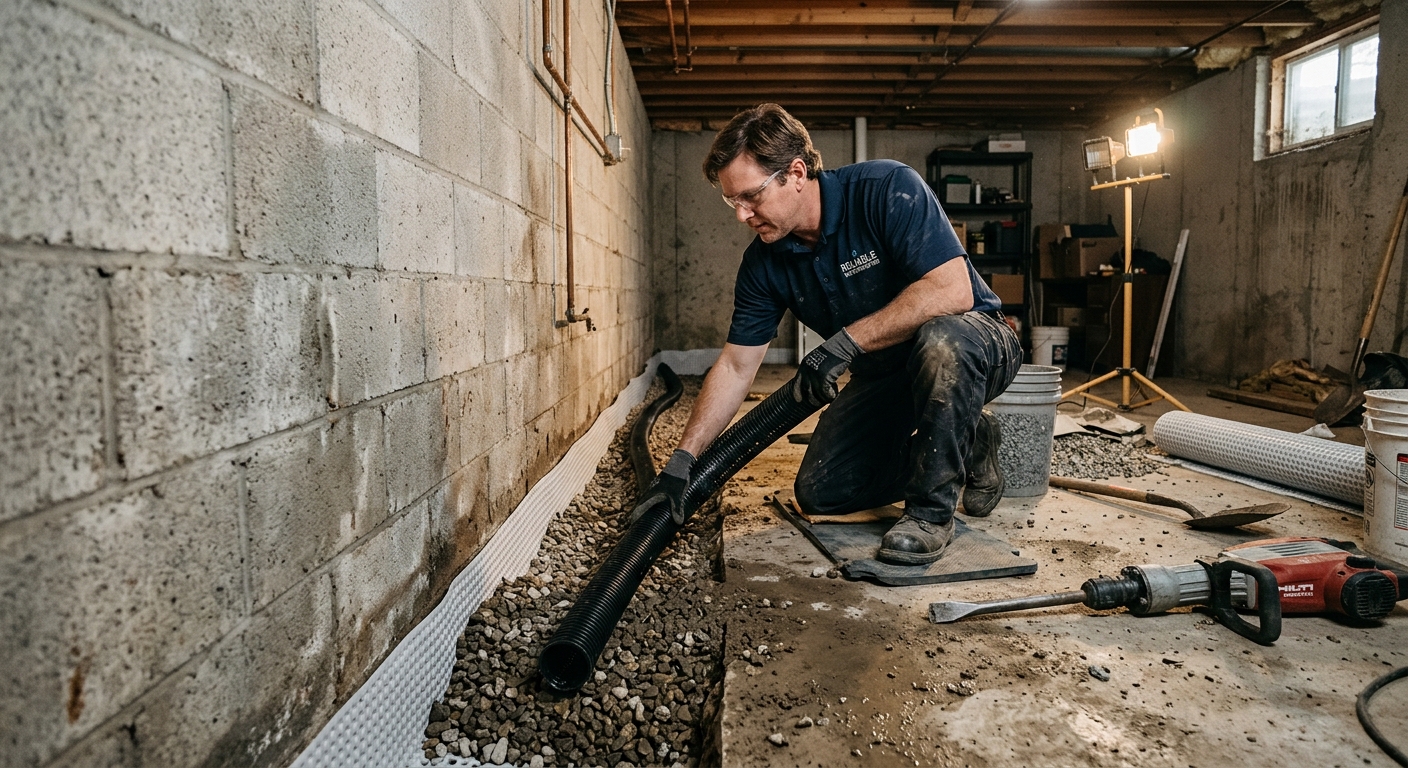
Basement waterproofing options and costs in Osgoode
In Osgoode, homeowners typically choose between exterior waterproofing (excavation and a new drainage system) and interior waterproofing (drains and pumping after water reaches the basement). With a small population of 2,578 people in the area (Statistics Canada, 2021 Census), you often see a limited number of crews available locally, so scheduling can affect pricing—especially during spring melt when demand spikes. Many older detached homes around the Ottawa area were built with early-generation waterproofing materials and older weeping tile lines, and those systems are more likely to be silted, disconnected, or completely failed, which drives up the need for full-perimeter work rather than minor “patch-and-seal” repairs.
Ottawa’s clay-rich soils and relatively high local water table are major cost drivers. Expansive clay holds water and swells during wet periods, increasing lateral pressure on foundation walls and worsening cracking and seepage. Add repeated freeze-thaw cycles—cracks that seem minor after winter can widen in spring—so contractors often price based on longer-term performance, not just immediate dryness. In Osgoode, work is especially in demand in and around the rural lanes where landscaping, mature trees, and long driveway access can complicate excavation and disposal.
Below is a practical comparison of common basement waterproofing methods you’ll see in Ottawa-area quotes, with realistic 2026 Ontario price bands to help you benchmark contractor proposals before you compare scope and warranties.
| Method |
What It Addresses |
Disruption Level |
Durability |
Price Range |
| Exterior excavation + new membrane + drainage tile |
Primary water entry by relieving hydrostatic pressure and sealing from outside |
High (excavation, landscaping removal, backfill, disposal of heavy clay) |
Longest-term approach for active seepage; often the best match for exterior-driven leaks |
$9,000–$45,000 |
| Interior perimeter drain channel + sump pit |
Water that migrates through cracks or floor joints, collected and pumped away |
Medium (limited floor drilling, core basement work, pump location planning) |
Very effective for dampness and seepage; depends on discharge reliability and maintenance |
$6,000–$20,000 |
| Foundation crack injection (epoxy or polyurethane) |
Cracks in poured concrete or block walls; polyurethane targets active leaks |
Low to Medium (minor drilling/patching; interior wall access) |
Good for properly identified crack type; not a standalone solution for failing drainage |
$600–$3,000 |
| Sump pump installation (primary + battery backup) |
Reliably controls water during spring melt, power dips, and heavy rain events |
Medium (electrical work, discharge line routing, sump pit) |
Improved resilience with backup power; system life depends on discharge and float reliability |
$2,200–$3,500 |
| Window well drain installation |
Water infiltration at egress/window areas and clogged surface runoff routes |
Low to Medium (excavation limited to window well area) |
Moderate to long-term; success depends on grading and sealing details |
$1,200–$4,000 |
| Lot re-grading / downspout extension |
Stops roof runoff and surface water from directing toward foundation |
Low to Medium (minor excavation, soil movement, grading and re-seeding) |
Good for surface-water problems; limited effect if hydrostatic pressure is the main cause |
$900–$6,500 |
Prices are estimates only and vary by project scope, site access and material selection.
What affects the price of waterproofing in Osgoode
In Osgoode and across the Ottawa economic region, you can see waterproofing quotes vary by 30–50% for what appears to be the “same” job because contractors price for the actual cause of water entry—not just the visible damp spot. Even a similar basement layout can change cost due to excavation depth, foundation type, crack length, discharge routing, and how far failed weeping tile lines have spread.
The three biggest drivers that separate regional pricing from the national average are soil type, water table, and freeze-thaw. In clay-heavy ground, water expands and increases lateral pressure on foundation walls, which can turn hairline seepage into active leakage over time. A relatively higher water table means sump systems run longer and discharge becomes more demanding, especially during spring melt. Freeze-thaw cycles repeatedly widen existing cracks, so contractors often include crack repair plus drainage controls rather than relying on sealants that may fail when movement resumes. By contrast, in better-draining soils (like sandy conditions), contractors can sometimes treat surface runoff first and reduce scope.
Concrete examples from homes in and around Osgoode: (1) a poured-concrete wall with an identified, stable crack may be addressed with crack injection in the range of $600–$3,000, while the same-looking issue on a block foundation with poor drainage often needs a perimeter drain plus sump, commonly within $6,000–$20,000. (2) Houses with landscaping or decks right up to the foundation may require more exterior labour and disposal during excavation, pushing exterior projects from the mid-range toward the top end of $9,000–$45,000. (3) If original weeping tile is 60+ years old and completely failed, partial approaches usually underperform, so more comprehensive solutions get priced to last.
| Price Factor |
Why It Matters |
Cost Impact |
| Interior vs. exterior approach — interior is less disruptive but addresses symptoms |
Interior systems manage water after entry; exterior systems reduce or stop water pressure at the source |
Exterior typically costs more; interior can be cheaper but may not prevent recurring wall movement |
| Foundation type — poured concrete vs. block vs. stone vs. ICF |
Crack behaviour and how seams/joints leak differ by foundation material and workmanship |
Poured concrete often pairs better with crack injection; block often needs interior drainage to compensate |
| Soil type — clay expands more than sand, adding pressure |
Clay holds water and swells during freeze-thaw, increasing hydrostatic and lateral pressure |
Clay can raise excavation and waterproofing expenses by about 25–50% compared with better-draining ground |
| Crack type and length — hairline vs. structural horizontal cracks |
Active or moving cracks require different injection materials and may need structural review |
Structural movement can escalate scope beyond typical injection pricing |
| Sump pump backup system — battery or water-powered backup needed |
Power stability matters during spring melt and outages; backup prevents overflow during outages |
Backup increases equipment and electrical/discharge planning costs |
| Access — landscaping, decks, or driveways must be removed for exterior |
More removal means more labour, patching, and time for careful regrading/backfill |
Can shift projects upward significantly within the exterior excavation band |
| Weeping tile age — original tile (60+ years) may be completely failed |
Failed tile can mean trapped water and ongoing seepage even after minor repairs |
Full replacement or expanded drainage scope often becomes necessary |
| Mould or efflorescence remediation required before sealing |
Moisture-related contamination must be remediated so coatings and sealants adhere properly |
Additional labour and materials for cleaning, drying time, and surface prep |
Permits & regulations in Ontario
In Ontario, certain waterproofing-related tasks commonly require permits or approvals, especially when you’re altering structures or routing drainage systems. In most Osgoode basement projects, foundation excavation and any structural crack repair that involves major crack stabilization typically trigger permit requirements. Changes to lot grading and drainage can also require municipal review, because you’re redirecting water runoff and may be altering how surface water leaves your property.
Sump pump installation often needs approvals if the discharge connects to municipal storm or sanitary systems. Contractors should confirm where the discharge line will terminate and whether a permit or municipal permission is required. For structural crack repairs—particularly horizontal cracks in block walls, stair-step cracking that suggests movement, or any crack pattern that may indicate shifting—a structural engineer’s assessment is frequently required before recommending underpinning or other structural measures. When a contractor is confident they can seal without structural involvement, they should still explain how they confirmed crack stability.
To verify a contractor in Ontario, follow a simple step-by-step approach: (1) confirm their licence/registration status through the Ontario registry for their applicable trade, (2) request a current certificate of liability insurance and confirm it matches the job address and covers waterproofing/excavation-related risks, and (3) verify WSIB/WCB coverage with documentation or a clearance letter. For structural or engineer-involved work, ask what engineering support they provide and whether they can name the engineer of record before the work begins.
Interior vs exterior waterproofing — what does Osgoode need?
The core difference is that exterior waterproofing addresses the source, while interior waterproofing manages water after it enters. Exterior excavation typically involves removing soil around the foundation, installing new membrane and drainage tile, then re-constructing backfill and grading. When clay soils and freeze-thaw pressure are actively driving seepage, this is the most permanent way to reduce hydrostatic pressure. However, it’s also the most disruptive because it requires access, landscape removal, and dealing with excavated clay—often a time and disposal driver in the Ottawa region.
Interior waterproofing focuses on capturing water at or below the foundation footprint using a perimeter drain channel, sump pit, and sump pump. It’s less invasive and often a strong fit when leaks are localized or when exterior excavation would be too costly due to hardscaping. That said, interior systems don’t stop pressure against the wall; in Osgoode’s freeze-thaw cycles, cracks can continue to move slightly, so a good interior plan usually includes crack repair and reliable pumping. For poured concrete walls, many contractors find crack injection (epoxy for non-active cracks, polyurethane for active leaks) can complement interior drainage effectively. For block foundations, interior drainage is often a practical complement because leakage can occur through joints and multiple pathways.
Power outages during spring flooding are a real concern. That’s why many homeowners in Ontario budget for primary sump pump protection plus backup. If your risk profile includes repeated spring melt and frequent utility interruptions, backup is usually a better long-term choice than “cheaper later.” For example, an interior perimeter drain plus sump system commonly lands in the $6,000–$20,000 band, while full exterior excavation and drainage replacement often moves into $9,000–$45,000. The difference is justified when the source drainage system is clearly failing or when exterior hydrostatic pressure is the dominant cause—not when the problem is simply surface runoff.
| Method |
Best For |
Addresses Source? |
Disruption |
Lifespan |
Price Band |
| Full exterior excavation + membrane |
Active seepage driven by hydrostatic pressure, failing drainage tile, or wide crack patterns |
Yes (source and pressure relief) |
High (excavation and landscaping removal) |
Long-term when installed with correct drainage and backfill details |
$9,000–$45,000 |
| Interior French drain + sump system |
Dampness, seepage, and spring melt water entry where exterior access is limited |
No (manages water after entry) |
Medium (interior floor work and pump installation) |
Long-term with proper discharge and backup planning |
$6,000–$20,000 |
| Crack injection — epoxy (structural) |
Stable, non-active cracks where water isn’t actively forcing through |
Partial (restores crack continuity, not drainage pressure) |
Low to Medium (interior drilling/patching) |
High when crack movement is confirmed stable |
$600–$3,000 |
| Crack injection — polyurethane (active leak) |
Active seepage where water pressure is pushing through the crack |
Partial (helps stop pathways, still benefits from drainage control) |
Low to Medium |
High when paired with good drainage/pumping |
$800–$3,500 |
| Interior drain channel only (no sump) |
Light seepage or localized damp spots without significant water accumulation |
No (captures and directs, but relies on gravity or limited volumes) |
Low to Medium (interior channel work) |
Moderate; may struggle in high water events typical of spring melt |
$3,000–$10,000 |
| Re-grading + downspout extensions |
Surface runoff problems and poor lot drainage directing water toward the foundation |
Yes for surface-driven issues |
Low to Medium |
Good if maintained; limited where hydrostatic pressure dominates |
$900–$6,500 |
How to choose a waterproofing contractor in Osgoode
Choosing the right waterproofing contractor in Osgoode starts with verifying the essentials the homeowner can check before signing: Ontario licence/registration for the trade (where applicable), liability insurance, and WSIB/WCB coverage for workers. How to check each: ask for the contractor’s certificate of insurance and ensure the name and address match your project; request WSIB/WCB proof or a clearance letter; and confirm their registry details through Ontario’s online records or the appropriate trade registry. If they can’t provide documents quickly, that’s a warning sign.
Next, get 2–3 itemised written quotes. You want a breakdown that shows labour, materials, and access/disposal costs separately—not a single lump sum. Ask what’s included for excavation depth, membrane type, drainage tile specifications, disposal of clay soils, and whether a permit pull is included or billed separately. Clarify exclusions in writing (for example, removal/replacement of interior finishes, mould remediation, or repairs to steps/porches). Warranty matters: confirm the workmanship warranty length, whether it covers the full scope (not just “materials”), whether product/manufacturer warranties apply, and whether warranties are transferable to the next owner.
On payment terms, never pay more than 10–15% upfront. Hold back payment until the work is complete, tested (where relevant), and cleaned. Get a written start date and completion estimate, and insist on a clear change-order process if conditions differ from inspection.
- Require proof of WSIB/WCB coverage (or clearance letter) before work begins
- Confirm liability insurance certificate includes waterproofing/excavation scope
- Ask for 2–3 references from Ottawa-region jobs with similar foundation types
- Request a written scope with measured dimensions, not just general descriptions
- Confirm whether disposal, heavy clay removal, and backfill are included
- Ask who supplies and installs the sump pump and discharge routing details
- Verify if backup power (battery) is included when recommended
- Clarify warranty start date and what constitutes a covered failure
- Confirm how they identify the leak path (detection method) before proposing injection
- Ensure engineer involvement is described if crack patterns suggest structural movement
- Put completion/testing steps in writing (pump functionality, drainage flow checks)
- Use a payment schedule that holds back 10–20% until final sign-off
In Osgoode, red flags include: (1) a quote that recommends exterior or interior work without explaining the likely water entry pathway, (2) “one-size-fits-all” crack sealing that ignores freeze-thaw movement and drainage needs, (3) missing or vague warranty terms, (4) refusal to provide insurance/WSIB/WCB documentation, and (5) unclear discharge plans for sump systems that could create recurring dampness or require approvals.
Frequently asked questions — waterproofing in Osgoode
How do I compare waterproofing quotes?
To compare waterproofing quotes in Osgoode (and across Ontario), start by matching scope line by line. Ask each contractor to list: what they will excavate or access, what drainage tile and membrane system they’ll use, how they’ll address discharge, and whether they include disposal of excavated clay soils. Don’t compare only price; compare what’s included and what’s excluded (for example, mould remediation, regrading, window well work, or interior finish repairs). For reference, interior perimeter drain plus sump systems commonly land in the $6,000–$20,000 band, while exterior excavation often sits in $9,000–$45,000. If one quote is far cheaper, it may be missing key components that matter in Ottawa’s clay and freeze-thaw conditions.
How long does basement waterproofing take in Osgoode?
Timing varies in Osgoode based on method, access, and weather. Interior waterproofing can often be completed faster than exterior because it doesn’t require full perimeter excavation; a typical interior perimeter drain and sump installation may take about several days to a couple of weeks including drying time and finishing. Exterior excavation projects take longer due to landscaping removal, careful shoring where needed, membrane/drain installation, and regrading/backfill work. Spring melt and repeated freeze-thaw can also impact scheduling and curing times, especially for membranes and crack repairs. Contractors should provide a written schedule with start date, material lead times, and how they’ll manage rain/wet clay conditions. A reasonable quote should clearly state what happens if weather delays work.
What is a weeping tile and does my Osgoode home have one?
A weeping tile is a perimeter drain system that sits around or near the foundation footing to collect groundwater and direct it away from the basement. In many older Ottawa-area homes, the original weeping tile may be present but silted, disconnected, or collapsed—especially on clay soils where water and sediment accumulate. You can’t confirm its condition without investigation because it may be buried under soil for decades. Clues include basement dampness patterns, efflorescence on walls, older sump pits, or a foundation history of spring flooding. If your home has an old sump pit or prior drainage repairs, you may have had a weeping tile at some point. In Osgoode, a contractor may recommend video inspection or selective excavation to confirm whether replacement is needed before sealing.
Can I waterproof my basement in winter in Osgoode?
Yes, you can often waterproof in winter in Ontario, but the scope may be limited by freezing ground conditions. Interior work is usually more feasible: perimeter drains, sump pit installation, and crack injection can proceed without the same excavation challenges as exterior systems. Exterior excavation in winter may be restricted because frozen clay is harder to remove and backfill around the foundation can be problematic. Ottawa-area freeze-thaw also means water conditions fluctuate—so contractors must plan for proper drainage and safe working conditions. If you’re dealing with active leaks, interior waterproofing plus crack injection and a sump pump (with backup) can still improve dryness during colder months. Ask your contractor what parts of your plan can start now and what must wait until thaw for best performance.
What is the difference between waterproofing and damp-proofing?
In Ontario, waterproofing generally means building a system designed to stop or manage water under pressure—especially water entry due to hydrostatic pressure and seasonal melt. Damp-proofing focuses on reducing moisture penetration and controlling light dampness, often with coatings or membranes that may not perform reliably during active water events. In Osgoode’s clay-rich ground and freeze-thaw cycles, damp-proofing alone can be inadequate if cracks widen or if original drainage tile has failed, because water can find and keep finding pathways. That’s why many active-seepage projects require perimeter drainage plus a sump system, or exterior work when the source drainage is the dominant issue. If your quote is only “sealant on interior walls,” ask whether it addresses source pressure and how they’ll handle discharge and pump reliability.
Will basement waterproofing affect my property value in Osgoode?
Basement waterproofing can positively affect property value in Osgoode, mainly by reducing risk and improving usable space. Buyers often look for evidence that moisture problems are addressed—dry basements, no ongoing seepage, and reliable drainage/pumping. Waterproofing also helps prevent secondary damage like mould growth, deterioration of finishes, and efflorescence that can return when water pressure increases during spring melt. However, value impact depends on whether the solution matches the cause. For example, a properly installed interior drain and sump system (often $6,000–$20,000) can be very effective for recurring dampness, while an exterior drainage replacement ($9,000–$45,000) may be justified when the water entry source is outside hydrostatic pressure from failed tile and clay saturation. Documented warranties and clear documentation of scope typically improve buyer confidence.