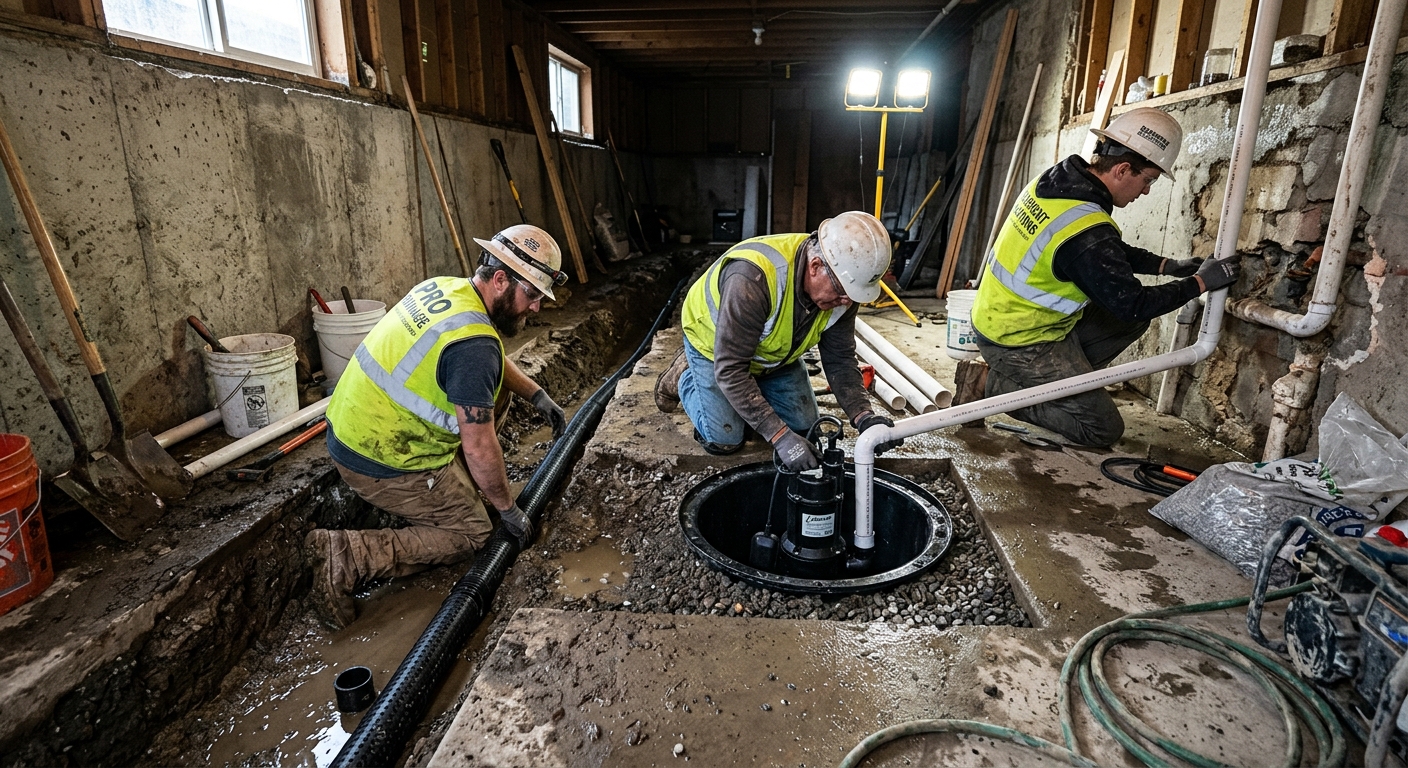
Basement waterproofing options and costs in Calgary
Calgary homeowners often face basement seepage and wall dampness because the region’s clay and clay-till soils hold water and then expand during freeze–thaw, pushing laterally against foundation walls. That matters when you compare “similar” basements across neighbourhoods: a home built in the older housing stock can have decades of wear on original tar-and-paper systems and weeping tile. In Calgary, 35.2% of homes were built before 1981, and those properties are far more likely to have failing drainage components than newer builds. As the market has grown, trades availability is generally good in the core and established communities, but pricing still shifts with excavation depth, tight access, and how much landscaping or concrete must be removed and restored. In areas like Capitol Hill and Dover, where lots are mature and finished, exterior work can mean higher labour hours and disposal costs for heavy clay spoils.
Clinically, Calgary basements also see more cycling-driven failure: cracks and joints widen in winter, then open up to spring runoff and melting snow, especially if weeping tile is clogged or undersized. That’s why a contractor may recommend exterior waterproofing (source control) or interior waterproofing (symptom control), sometimes combining them with sump capacity and crack repairs. To compare options quickly, review the table below—then match the method to your leak pattern, foundation type, and whether you’re fighting hydrostatic pressure.
| Method |
What It Addresses |
Disruption Level |
Durability |
Price Range |
| Exterior excavation + new membrane + drainage tile |
Source of water entry; reduced hydrostatic pressure |
High (excavation, landscaping, regrading) |
Long-term when done with proper perimeter drain + backfill |
$9,000–$25,000 |
| Interior perimeter drain channel + sump pit |
Water that enters; channeling to sump |
Medium (interior cutting, floor protection) |
Very effective if sump and discharge are sized correctly |
$5,000–$15,000 |
| Foundation crack injection (epoxy or polyurethane) |
Cracks in poured concrete or block joints (seal/stop flow) |
Low to medium (surface prep, access points) |
Good with correct product selection and crack prep |
$500–$1,800 |
| Sump pump installation (primary + battery backup) |
Continuous pumping during high infiltration events |
Low to medium (pit + discharge routing) |
High when paired with backup power |
$900–$3,000 |
| Window well drain installation |
Groundwater and runoff around egress/window wells |
Medium (well excavation/coring) |
Good for localized leaks when regraded and piped correctly |
$1,200–$4,500 |
| Lot re-grading / downspout extension |
Redirects roof runoff away from foundation |
Low (surface work) |
Moderate (must stay maintained to prevent ponding) |
$800–$4,000 |
Prices are estimates only and vary by project scope, site access and material selection.
What affects the price of waterproofing in Calgary
In Calgary, homeowners can see the same “basement waterproofing” concept priced 30–50% differently because contractors are often responding to different root causes—while also dealing with the realities of access, excavation, and how much water control your site truly needs. The three drivers that separate Calgary area costs from the national average are soil type, water table behaviour, and freeze–thaw intensity. Calgary’s clay and clay-till soils expand when saturated, which increases lateral pressure on foundation walls and worsens cracks over time; that can force more extensive crack prep and drainage upgrades. Where seasonal groundwater and storm events build in low pockets near river valleys and coulees, you may require a fuller perimeter system or higher-capacity sump runs to keep the hydrostatic pressure in check. Freeze–thaw also widens joints during winter cycles, so clogged weeping tile and undersized drainage become common failure points rather than rare issues.
Concrete examples help explain the cost swing. First, a basement with a failed weeping tile system from an older neighbourhood may end up in the $9,000–$25,000 exterior band because the only reliable fix is source control plus new drainage tile and membrane. Second, a newer exterior with good grading might be resolved in the $5,000–$15,000 interior band using a perimeter drain channel and sump, because water is entering after it cracks under pressure and can be managed effectively indoors. Third, some Calgary properties have tight urban lot lines and finished decks/patios that force careful excavation and disposal planning; that labour can be the difference between a “straightforward” job and a higher quote even when the foundation length is the same.
| Price Factor |
Why It Matters |
Cost Impact |
| Interior vs. exterior approach — interior is less disruptive but addresses symptoms |
Source control usually requires excavation and membrane; interior controls collected water |
Interior can reduce cost by thousands; exterior can add $9,000–$25,000 range |
| Foundation type — poured concrete vs. block vs. stone vs. ICF |
Crack behaviour and sealing method vary by material |
Poured concrete may suit injection; block often needs interior drainage complement |
| Soil type — clay expands more than sand, adding pressure |
Expanded, saturated soils increase lateral and hydrostatic pressure |
More robust drainage and sealing usually required |
| Crack type and length — hairline vs. structural horizontal cracks |
Injectable cracks differ from movement-related cracks that need engineering review |
Structural crack scenarios can push the project toward higher scopes |
| Sump pump backup system — battery or water-powered backup needed |
Backup reduces risk during spring power fluctuations |
Common add-on: increases cost within the $900–$3,000 band for sump systems |
| Access — landscaping, decks, or driveways must be removed for exterior |
Exterior requires excavation along the foundation line |
Removed hardscapes and restoration elevate labour and material costs |
| Weeping tile age — original tile (60+ years) may be completely failed |
Clogged or collapsed tile cannot relieve water pressure |
May shift you from minor fixes to full perimeter drainage |
| Mould or efflorescence remediation required before sealing |
Sealers bond poorly over contamination and salts |
Additional labour/material steps before waterproofing |
Permits & regulations in Alberta
In Alberta, certain waterproofing-related tasks are treated as building or plumbing-related changes and typically need permits. Foundation excavation along a building perimeter and structural crack repair work (especially where horizontal movement is suspected) often requires a building permit, because the work can affect structural stability and the foundation’s performance. Changes to lot drainage—such as regrading that significantly changes how surface water flows—or work that involves altering how water is managed around a foundation commonly trigger permit requirements as well. Where a sump discharge connects into an approved municipal system (storm or sanitary), homeowners should expect municipal approval and the contractor should confirm the proper connection point and method before installation.
For structural crack repair, major step cracks, or horizontal cracking in block walls, an engineer’s assessment is frequently needed to determine whether underpinning or other structural work is required. When you request waterproofing quotes in Calgary, ask whether the contractor has engineering support for structural repairs, and whether they carry liability insurance and WSIB/WCB coverage.
How to verify a contractor (step-by-step): (1) confirm their Alberta licence/registration through the relevant online registry for the trade; (2) request a current certificate of insurance and verify liability limits; (3) ask for WSIB/WCB clearance letters (or equivalent proof of coverage); (4) ensure the quote states what permits are included or who applies; and (5) confirm who’s responsible for disposal and site restoration after excavation.
Interior vs exterior waterproofing — what does Calgary need?
In Calgary, the choice between interior and exterior waterproofing is mostly about whether you need to stop water at the source or manage it after it enters. Exterior waterproofing means full excavation, installing a continuous membrane, and reconnecting/adding perimeter drainage tile so water is collected before it builds hydrostatic pressure against the wall. It’s the more permanent fix, but it’s also more expensive and disruptive because it requires removing landscaping, cutting through patios or sidewalks where needed, and properly backfilling compacted soils around the foundation line.
Interior waterproofing generally involves a perimeter drain channel at the footing line, a sump pit, and a sump pump to collect and discharge water. This approach is often less invasive and can be the better value when excavation is impractical, access is tight, or you’re addressing localized leaks. However, interior systems do not eliminate the pressure acting on the wall; they manage the water that makes its way in. In Calgary, that matters most on clay-heavy soils and during spring melt: if the source pressure is high, exterior solutions or a combined plan is often the reliability play. Poured concrete walls typically respond well to crack injection when cracks are stable and properly prepped, while block foundations frequently benefit from interior drainage as a practical complement to sealing.
Sump pump backup is also worth budgeting in Alberta. During spring events, short outages or power interruptions can occur just as infiltration peaks, so backup (battery) helps protect the system’s effectiveness. For example, if you’re seeing active seepage and have limited access to the exterior, an interior perimeter drain and sump can land in the $5,000–$15,000 band. If you’re on a mature lot with failing weeping tile and significant lateral pressure, the exterior route can justify the $9,000–$25,000 range because it targets the cause rather than relying on indoor collection alone.
| Method |
Best For |
Addresses Source? |
Disruption |
Lifespan |
Price Band |
| Full exterior excavation + membrane |
High hydrostatic pressure, failed perimeter drainage, wide spread dampness |
Yes |
High |
Long-term with correct membrane continuity + drainage |
$9,000–$25,000 |
| Interior French drain + sump system |
Limited exterior access, moderate-to-high seepage, recurring spring water |
No (manages what enters) |
Medium |
High with properly sized sump and reliable discharge |
$5,000–$15,000 |
| Crack injection — epoxy (structural) |
Stable, non-moving cracks where sealing is needed |
Partial (seals entry points) |
Low to medium |
Good when cracks are stable and properly cleaned |
$500–$1,800 |
| Crack injection — polyurethane (active leak) |
Ongoing weeping where flexibility is needed |
Partial (stops flow at crack) |
Low to medium |
Very good for active leaks when used correctly |
$500–$1,800 |
| Interior drain channel only (no sump) |
Light dampness, occasional seepage with gravity discharge feasibility |
No |
Medium |
Depends on discharge route and seasonal water volumes |
$3,500–$8,500 |
| Re-grading + downspout extensions |
Roof runoff-driven dampness and surface ponding |
No (reduces surface water input) |
Low |
Moderate; requires ongoing maintenance |
$800–$4,000 |
How to choose a waterproofing contractor in Calgary
Start by verifying coverage and licensing because waterproofing work touches foundations, drainage, and sometimes structural elements. In Alberta, confirm the contractor’s trade registration/licence through the relevant online registry, then ask for a current certificate of insurance (liability) and proof of WSIB/WCB clearance for the workers on your site. Don’t accept screenshots from years ago—ask for documents that show current dates and the correct business name. For structural crack scenarios, ensure they can coordinate engineering support when needed and clearly state what you’re paying for.
Next, request 2–3 itemised written quotes instead of a single lump sum. A good quote breaks labour and materials (membranes, drainage tile, sump components, pumps, discharge piping) and lists inclusions like permit pull (if required), disposal, and restoration of landscaping or concrete. Read exclusions carefully: ask whether cracked concrete removal, interior floor protection, and salt/mould remediation are included. Make sure the quote states the warranty details—workmanship warranty length, whether there’s a product/manufacturer warranty, and whether coverage is transferable if you sell your home.
For payment schedule, avoid paying more than 10–15% upfront. A practical approach is to hold back the final payment until the job is complete, inspected (where applicable), and you receive as-built notes and product documentation. Finally, get the start date and a completion estimate in writing so you can plan around excavation, curing time, and backfill scheduling.
- Ask for Alberta licence/registration details and confirm the business name matches the insurance.
- Request current certificate of liability insurance and verify coverage amounts.
- Get WSIB/WCB clearance proof before work starts.
- Ask whether permits are required for your scope and whether the contractor pulls them.
- Ensure quotes are itemised (labour vs materials vs restoration vs disposal).
- Confirm whether excavation includes soil removal and disposal fees for heavy clay spoils.
- Verify sump system discharge location and how it complies with local approval requirements.
- Check for sump backup options (battery) and whether power protection is recommended.
- Ask how cracks are identified as stable vs active movement before injection products are chosen.
- Review warranty terms: workmanship length, product warranty, and transferability.
- Confirm payment schedule and insist on a holdback until you sign off.
- Get a written timeline with cure/backfill sequencing and restoration plan.
Red flags to watch for in Calgary: they quote a “one-size-fits-all” solution without inspecting weeping tile or crack conditions; they won’t provide itemised labour/material breakdowns or permit responsibility; they push you to pay a large upfront deposit (beyond 10–15%); they offer warranties without details (no workmanship term or product documentation); and they skip discussing sump backup when spring melt events are part of your leak pattern.
Frequently asked questions — waterproofing in Calgary
How much does basement waterproofing cost in Calgary?
Basement waterproofing in Calgary usually ranges widely because clay-heavy soils and freeze–thaw cycles can increase how much water pressure pushes into a foundation. For many homes, interior approaches fall around $5,000–$15,000 (perimeter drain channel plus sump system), especially when exterior access is limited or the leak is mostly seepage. If your weeping tile has failed and you need full source control with excavation and exterior membrane, exterior waterproofing often lands in $9,000–$25,000. Crack injection is commonly a smaller component, often budgeted around $500–$1,800 depending on crack length and foundation type. Final cost depends on site access (decks/patios), excavation depth, disposal of clay spoils, and whether sump backup is included. (Statistics Canada, 2021 Census)
Interior vs exterior waterproofing — which is better?
Exterior waterproofing is usually the “best” long-term option when you’re dealing with high hydrostatic pressure or a failed perimeter drainage system, because it addresses the water entry at the source. In Calgary’s climate, where freeze–thaw widens joints and clay soils expand when saturated, exterior membrane continuity plus new drainage tile can be the most reliable fix. However, it’s also the most disruptive, which is why many homeowners choose interior waterproofing when excavation is impractical. Interior systems are often budgeted around $5,000–$15,000 and can be very effective at controlling what enters, especially with correctly sized sumps and discharge. If your foundation shows active leaks at cracks, injection (often $500–$1,800) may be used with an interior system, particularly for stable poured-concrete cracks.
Why is my basement leaking in Calgary?
Most Calgary basement leaks come from water finding a path through foundation cracks and joints, then being intensified by freeze–thaw cycles. Clay and clay-till soils hold water and expand when saturated, which increases lateral pressure on walls and can worsen hairline cracks over time. If original weeping tile is clogged, collapsed, or undersized (common in older neighbourhoods), it can’t relieve that pressure, so seepage and dampness become more noticeable each spring melt. Local low pockets near river valleys and coulees may also see higher seasonal groundwater effects. On top of that, roof runoff can contribute if downspouts discharge too close to the foundation or if grading has settled. In homes where 35.2% of dwellings are older than 1981 (Statistics Canada, 2021 Census), failed drainage components are a frequent root cause.
How do I know if a foundation crack is serious?
Not every crack is a structural problem, but Calgary homeowners should take certain patterns seriously because freeze–thaw can hide movement until later. Ask for an inspection and documentation: hairline shrinkage cracks that remain stable can sometimes be treated with crack injection, while horizontal cracks in block walls or step cracks that appear to “offset” may indicate movement that needs engineering assessment. Signs of active seepage—wet tracks, mineral staining that grows, or water appearing during spring melt—suggest you should address water entry immediately. If a crack has widened seasonally or is accompanied by bulging, that’s a stronger indicator of a structural or pressure-related issue. A contractor should also evaluate whether the crack aligns with a joint, a corner, or a footing area, because those locations often experience higher pressure from saturated clay soils.
How much does foundation crack repair cost in Calgary?
Foundation crack repair in Calgary is commonly priced based on the type of crack, number of ports needed, crack length, and whether the crack is actively leaking. For many homeowner situations—where the crack is localized and the foundation material supports injection—budget around $500–$1,800. Epoxy injection (often used when cracks are stable) can be less costly when the work is straightforward; polyurethane is typically used where there’s active water weeping and may require additional prep. Crack repair costs also increase if you need additional surface chiselling, interior access work, or if efflorescence/mould remediation is required before sealing. If the crack is determined to be structural movement, you’ll need engineering review, which can change the scope beyond “injection only.”
Do I need a sump pump in Calgary?
You might, depending on your infiltration pattern, soil saturation levels, and whether water is reaching the footing line. Calgary’s spring melt and freeze–thaw can increase seepage volumes, and clay-heavy soils can hold water long enough for it to accumulate in basements if there’s insufficient perimeter drainage. If inspections show ongoing water collection after a perimeter drain is installed, a sump pump becomes the reliable method to move water away from the foundation. Many Calgary sump systems are budgeted around $900–$3,000, with backup options adding value where power reliability matters. If your site can’t rely on gravity discharge or you see water during storms, backup is especially important. A contractor should assess your discharge feasibility, ask whether municipal approval is required for the connection method, and confirm sump sizing based on your leak history.