Basement waterproofing options and costs in Canmore
In Canmore, basement waterproofing decisions are shaped by a mix of older housing stock, mountain-driven seasonal melt, and the kind of soils that can hold water unevenly around foundations. With 11.6% of homes built before 1981 (Statistics Canada, 2021 Census), a meaningful share of properties were originally protected with early-generation membrane systems and weeping tile configurations that often haven’t kept up with today’s freeze–thaw cycling and modern drainage expectations. In the Banff–Jasper–Rocky Mountain House corridor, excavation and disposal can be harder than many parts of Alberta due to rocky substrates and narrow access on established lots, which pushes exterior work into higher price territory. At the same time, interior systems are often the faster route when you’re dealing with finish materials, completed landscaping, or when the contractor’s excavation crew availability is limited during the short construction season.
In neighbourhoods and areas like the Cascade, Mountain Crest, and Silvertip area pockets (where older basements and below-grade additions are common), homeowners frequently notice seepage after spring melt or heavy rain-on-snow events. That timing usually indicates hydrostatic pressure and discharge capacity issues—often linked to failing weeping tile, clogged perimeter drains, or foundation cracks that have widened during freeze–thaw.
The table below compares the main waterproofing methods you’ll see in Canmore quotes, including what each approach addresses and the expected disruption and lifespan. Use it to cross-check whether a quote is solving the source of water entry—or only managing symptoms after the fact.
| Method |
What It Addresses |
Disruption Level |
Durability |
Price Range |
| Exterior excavation + new membrane + drainage tile |
Hydrostatic pressure at the wall, source water at the perimeter, failing weeping tile |
High (excavation, landscaping restoration) |
High (when drainage is properly daylighted/discharged) |
$9,000–$25,000 |
| Interior perimeter drain channel + sump pit |
Water after entry; reduces seepage into basement; relieves pressure locally |
Medium (floor cutting/partial demo, no full excavation) |
Medium to high (depends on wall condition and discharge reliability) |
$8,000–$22,000 |
| Foundation crack injection (epoxy or polyurethane) |
Crack-related leakage—epoxy for stable structural cracks, polyurethane for active seepage |
Low to medium (drilling, surface prep) |
Medium to high (best when paired with drainage) |
$600–$2,500 |
| Sump pump installation (primary + battery backup) |
Removes accumulated water; backup protects during outages and high-water events |
Low to medium (pit/sawcuts, electrical) |
Medium to high (system quality and discharge routing matter) |
$1,600–$3,500 |
| Window well drain installation |
Bulk water entering at egress points; directs rain/snowmelt away from the window area |
Low to medium (local excavation; touches landscaping) |
Medium (improves performance when combined with perimeter drainage) |
$1,200–$4,800 |
| Lot re-grading / downspout extension |
Reduces surface runoff toward foundation; improves discharge away from perimeter |
Low to medium (minor excavation, trenching) |
Medium (helps, but typically not sufficient alone when tile is failing) |
$900–$3,900 |
Prices are estimates only and vary by project scope, site access and material selection.
What affects the price of waterproofing in Canmore
In Canmore, it’s common to see waterproofing quotes for the “same” basement come back 30–50% apart across the Banff–Jasper–Rocky Mountain House corridor, even when the stated goal is “stop the seepage.” The swing usually comes from site conditions and how much of the water-path the contractor is actually fixing—especially whether you’re addressing the source with exterior drainage or handling it internally with a perimeter drain and sump system. Another factor is crew capacity: during the short season, highly experienced crews may prioritize jobs with smoother access, and that can influence labour rates and schedule constraints.
The three drivers that separate regional costs from the national average are soil type, water table, and freeze–thaw cycling. Clay-heavy conditions in the surrounding foothills and transition areas can expand more than sand and gravel, increasing lateral pressure on foundation walls and worsening cracks over time. In our Rockies environment, seasonal water tables stay elevated during snowmelt, which means sump systems run more often and perimeter drains must be sized and routed correctly. And repeated freeze–thaw cycles can widen existing foundation cracks so that previously minor weeps become ongoing seepage.
Two practical examples from Canmore help explain the price range. First, if a home has a perimeter system from the original build era—many are 1960s–1980s vintage—the contractor may uncover collapsed or undersized weeping tile, which increases labour and excavation time for an exterior rebuild. Second, if you’re working around finished basements with a lot of tie-ins (bathroom, laundry, service penetrations), interior systems can cost more per linear foot because of patching and re-routing discharge piping. For many homeowners, a perimeter drain + sump package often falls in the interior band of $8,000–$22,000, while a full exterior excavation tends to jump into the $9,000–$25,000 band once membrane and drainage tile are replaced around the full perimeter.
| Price Factor |
Why It Matters |
Cost Impact |
| Interior vs. exterior approach — interior is less disruptive but addresses symptoms |
Interior systems manage water after entry; exterior aims to prevent water entry at the perimeter |
Interior can be 20–40% lower, but doesn’t remove hydrostatic pressure at the wall |
| Foundation type — poured concrete vs. block vs. stone vs. ICF |
Different walls respond differently to injection and require different prep and detailing |
Block/stone typically require more probing, sealing, and interior drainage design |
| Soil type — clay expands more than sand, adding pressure |
Clay movement increases crack activity and seepage after wet seasons |
Can add inspection time and increase the need for a robust drainage/sump plan |
| Crack type and length — hairline vs. structural horizontal cracks |
Structural cracks may need engineering review and additional repairs beyond injection |
Major structural work can push beyond simple crack-injection pricing |
| Sump pump backup system — battery or water-powered backup needed |
Spring melt and high runoff can coincide with outages; backup protects finished spaces |
Typically adds a meaningful add-on within the sump band |
| Access — landscaping, decks, or driveways must be removed for exterior |
Exterior excavation requires safe access and room for equipment |
Hard access can add days and restoration costs, raising exterior totals |
| Weeping tile age — original tile (60+ years) may be completely failed |
Old systems often clog or collapse, leading to higher water entry and longer runs |
More excavation and longer discharge piping increases labour/materials |
| Mould or efflorescence remediation required before sealing |
Active moisture issues must be corrected before sealing; contaminants need controlled remediation |
Adds time for cleaning, drying strategy, and sometimes additional coatings or treatment |
Permits & regulations in Alberta
In Alberta, some basement waterproofing-related work does require a building permit, especially when it affects structural integrity or drainage routing. As a general rule, foundation excavation, structural crack repair that goes beyond simple surface sealing, and changes to lot drainage (for example, major re-grading or modifications that alter how water discharges) typically require a permit. If the sump pump discharge will connect to a municipal storm or sanitary sewer, municipal approval is usually required because it changes how water leaves the property.
For structural crack repair—particularly horizontal cracks in block walls or any crack pattern that suggests movement—an engineer’s assessment is commonly needed to determine whether underpinning, steel support, or other structural work is required. A reputable contractor should be able to explain how they’ll coordinate any engineering input before starting.
Here’s a homeowner-friendly checklist to verify compliance in Canmore before you sign anything. First, ask for the contractor’s Alberta licence/registration details (and verify them using the applicable online registry). Second, request a current certificate of liability insurance showing the correct legal name and address; confirm the coverage is active and adequate for excavation and water management work. Third, ask for proof of WSIB/WCB coverage; if a contractor doesn’t provide it, don’t proceed. Finally, confirm whether the scope includes permit pulling and what trades or engineering documents are included if required.
Interior vs exterior waterproofing — what does Canmore need?
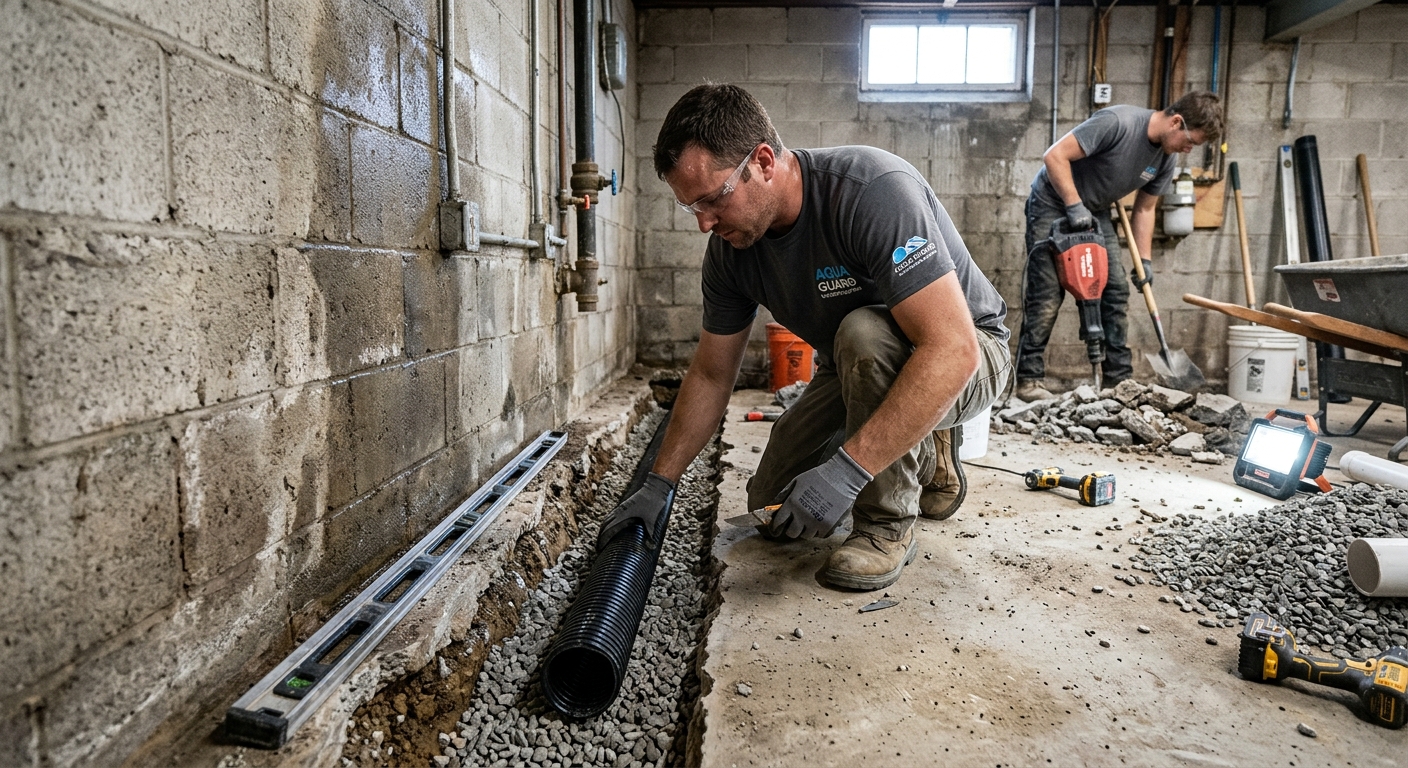
The fundamental difference is that exterior waterproofing is designed to permanently address where water enters: you excavate down the foundation, install or re-install membrane, and rebuild the drainage tile system around the perimeter before backfilling. Interior waterproofing, by contrast, manages water after it’s already entered the basement—typically through a perimeter drain channel, sump pit, and pump system. In Canmore’s mountain freeze–thaw cycle, that distinction matters. Exterior work tends to be the best long-term solution when exterior weeping tile has failed or when high seasonal water tables are feeding hydrostatic pressure against the foundation wall.
However, interior approaches are often the most practical first step when finishes are in place or access makes excavation too disruptive. Interior systems can significantly reduce seepage into living space, but they don’t stop the lateral pressure acting on the wall itself. That’s why crack injection is often paired with drainage: for poured concrete walls, injection can seal crack pathways effectively when paired with a properly designed interior drain strategy. For block foundations, interior drainage is frequently essential as a practical complement because mortar joints and block seams can transmit moisture even when surface repairs look good.
Backup sump pumps deserve extra attention in Alberta. During spring melt and wet cycles, a power interruption can turn a minor seep into a full cleanup job. If your quote includes only a primary pump, ask what backup is included—battery backup or a water-powered backup system.
A real-world cost example: for many Canmore homeowners, interior waterproofing (perimeter drain + sump) can land around $8,000–$22,000. Choosing full exterior waterproofing may land in $9,000–$25,000, but it’s usually justified when you have widespread perimeter leakage, evidence of failed weeping tile, or you need to address the water source around the whole foundation—not just one corner.
| Method |
Best For |
Addresses Source? |
Disruption |
Lifespan |
Price Band |
| Full exterior excavation + membrane |
Widespread seepage, failed exterior drainage, high seasonal water table |
Yes (perimeter source control) |
High |
High |
$9,000–$25,000 |
| Interior French drain + sump system |
Finished basements, limited exterior access, managing hydrostatic water after entry |
No (treats after entry) |
Medium |
Medium to high |
$8,000–$22,000 |
| Crack injection — epoxy (structural) |
Stable cracks in poured concrete where leakage is not actively pumping |
Partially (seals crack pathways) |
Low |
Medium |
$600–$2,500 |
| Crack injection — polyurethane (active leak) |
Active seepage and damp cracks where water is still moving |
Partially (targets active paths) |
Low |
Medium to high (depends on drainage) |
$600–$2,500 |
| Interior drain channel only (no sump) |
Light seepage with reliable gravity discharge and low accumulation risk |
No |
Low to medium |
Lower (pump relief not included) |
$6,500–$16,500 |
| Re-grading + downspout extensions |
Surface runoff issues at corners/near downspouts |
Yes (surface-water source reduction) |
Low to medium |
Medium |
$900–$3,900 |
How to choose a waterproofing contractor in Canmore
Choosing the right contractor in Canmore is mostly about proof: proof they’re licensed/eligible to do the work, insured for the risks, and experienced with mountain-climate water issues (not just generic basement fixes). Start by verifying Alberta licence/registration details using the applicable online registry, and insist on seeing the contractor’s certificate of liability insurance before work begins. For labour coverage, ask for proof of WSIB/WCB coverage; you want to see it clearly match the contractor’s legal name. If the contractor can’t provide these documents, that’s a major warning sign.
Next, get 2–3 itemised written quotes. Look for a breakdown of labour and materials (membrane, drainage tile, sump components, pumps, piping), not only a lump-sum number. Itemisation helps you compare apples-to-apples and spot exclusions like soil removal/disposal, restoration, backfill type, and whether the contractor includes the permit pull if required. Also review warranty terms: you should get a workmanship warranty length and a separate product/manufacturer warranty where applicable—and ask whether the warranty is transferable if you sell your home.
Finally, watch payment schedules. Never pay more than 10–15% upfront; hold back until completion and confirmed water testing/drying requirements are met. Ask for a written start date and completion estimate, and confirm how weather delays are handled during spring melt.
- Verify Alberta licence/registration and confirm the correct legal name matches the quote.
- Request a current certificate of liability insurance (not expired) and check limits.
- Confirm WSIB/WCB clearance/proof of coverage for the contractor and crews.
- Ask for an itemised quote: labour, materials, equipment, disposal, and restoration.
- Clarify exclusions: what happens if additional cracks or failed tile are discovered?
- Confirm whether permit pulling is included (where required) and who is responsible.
- Ensure discharge routing is specified (where sump/piping actually runs).
- Ask what pump model and backup system are included (battery or water-powered).
- Request warranty details in writing: workmanship length and manufacturer warranty terms.
- Confirm warranty transferability if you sell the home.
- Set payment milestones tied to completed phases and inspection points.
- Get a start date and realistic completion timeline considering access and spring conditions.
Red flags in Canmore to watch for: (1) a quote that promises “guaranteed dry basement” without addressing drainage and water paths; (2) skipping backup pump discussion despite seasonal melt risk; (3) no clear mention of discharge routing for sump discharge; (4) no proof of WSIB/WCB or liability insurance; and (5) vague scope language like “seal up cracks” with no injection method, crack prep, or documentation of what was tested/observed.
Frequently asked questions — waterproofing in Canmore
How do I compare waterproofing quotes?
In Canmore, compare quotes by scope, not just total price. Ask each contractor to list what they’re doing around the perimeter (or inside), what components are included (membrane, drainage tile size/type, sump pump model, check valves, discharge routing), and what’s excluded (disposal, backfill type, patching, window well work). You’ll also want to confirm whether the contractor is targeting source water with exterior excavation or controlling after-entry water with interior drains. If one quote is offering “interior only” while another includes exterior drainage replacement, the difference can explain a 30–50% swing. Use price bands as a check: interior perimeter drain + sump often lands around $8,000–$22,000, while full exterior excavation tends to be closer to $9,000–$25,000.
How long does basement waterproofing take in Canmore?
Typical timelines in Canmore depend on whether you’re doing exterior work (excavation) or interior work (perimeter drain and/or crack injection). For interior-only projects, many basements can be addressed in several days to about a couple of weeks depending on how much concrete cutting, plumbing tie-ins, and drying time are required. Exterior waterproofing commonly takes longer because excavation, membrane installation, drainage tile replacement, and safe backfilling all require careful sequencing—plus restoration. Winter conditions can also limit exterior excavation, and spring melt in the Rockies can force scheduling around high water periods. Always ask for a written start date, completion estimate, and weather-delay approach. A contractor who won’t provide timeline detail is difficult to compare fairly.
What is a weeping tile and does my Canmore home have one?
Weeping tile is the perimeter drain system around your foundation that collects groundwater and carries it away—often to a sump or a discharge point. Many Canmore homes, especially those built during the mid-to-late 20th century, originally had weeping tile installed as part of basement waterproofing. With 11.6% of Canmore homes built before 1981 (Statistics Canada, 2021 Census), it’s not unusual to find older tile that may be clogged, collapsed, or undersized. You can’t confirm by looking at finishes—proper assessment may require excavation at select points, inspection of discharge piping, and sometimes a camera inspection if accessible. If you’re seeing seepage after snowmelt, failing weeping tile is a common contributing factor, which is why interior sump systems often get designed alongside crack repairs.
Can I waterproof my basement in winter in Canmore?
It depends on the scope. In Alberta winters, exterior excavation is often limited by frozen ground and safety risks. Interior waterproofing can still be completed in winter because you’re working from inside the basement, installing perimeter drains, crack injection, and pumps without needing to dig down to the footing in freezing conditions. That said, the contractor must manage dust control, cure times for injection materials, and drying strategy—especially if you have active moisture. If a job requires exterior membrane replacement, you may be better off scheduling excavation for warmer periods. For homeowners dealing with freeze–thaw and seasonal melt cycles, the key is to understand whether the water is entering through cracks, failed drainage tile, or surface runoff, then choose the method that matches winter feasibility.
What is the difference between waterproofing and damp-proofing?
In Alberta, people often use the terms loosely, but they’re not the same. Waterproofing is intended to protect against actual water entry and ongoing seepage by addressing water pathways—typically with drainage systems (weeping tile or perimeter drains), membranes, and sometimes active drainage (sump pumps). Damp-proofing generally refers to coatings or treatments designed to resist moisture, often without the complete drainage and pressure-management system needed for true hydrostatic pressure. In Canmore’s climate, where spring melt can keep water tables elevated and freeze–thaw can widen cracks, damp-proofing alone can fail to control pressure and can leave you with recurring seepage. A contractor should explain which standard your proposed system meets and whether it’s designed for hydrostatic pressure relief.
Will basement waterproofing affect my property value in Canmore?
Usually, yes—when it’s done correctly and documented. In Canmore, waterproofing upgrades can improve marketability because buyers want assurance that the basement will not repeatedly flood or smell musty after snowmelt. If you can provide written scope details (what was installed, what was repaired, how discharge is routed) and warranty information, that documentation often matters to future buyers. While waterproofing won’t typically “add value dollar-for-dollar,” it can prevent value loss that comes from ongoing maintenance, visible cracking, efflorescence, or repeated moisture damage. The impact is stronger when the system addresses the source (for example, exterior drainage replacement) compared with symptom-only fixes. For reference, many interior projects fall around $8,000–$22,000, and properly planned exterior work can be closer to $9,000–$25,000.