Basement waterproofing options and costs in Millet
Millet, Alberta sits in the Edmonton economic region where basements often deal with moisture from two directions: groundwater pressure that pushes against the foundation and water that finds entry points during spring thaws. With 47.5% of local homes built before 1981, many properties still rely on original or aging waterproofing details, like older weeping tile and early membrane systems that can fail after decades. That’s why in Millet you’ll see a lot of homeowners pairing crack repairs with drainage upgrades rather than treating one symptom at a time.
Costs in the Edmonton-area are also shaped by climate and availability. Alberta’s pronounced freeze–thaw cycle widens foundation movement and turns minor seepage into active leaks that require more labour time for prep, patching, and higher-capacity drainage. On top of that, crew scheduling around resale turnover seasons can affect turnaround—especially for exterior excavation where equipment access matters (driveways, fences, and mature landscaping). Trades are in demand in parts of town with older housing stock and infill lots where soil disturbance is limited; this is often where homeowners ask for interior perimeter drains to keep disruption down.
Below is a practical comparison of the main approaches we use in Millet, including realistic price bands. Use this table to align expectations before you compare itemized quotes.
| Method |
What It Addresses |
Disruption Level |
Durability |
Price Range |
| Exterior excavation + new membrane + drainage tile |
Hydrostatic pressure at the wall and groundwater interception before it reaches the foundation |
High (excavate around foundation; landscaping restoration) |
Best source control when properly detailed for Alberta freeze–thaw |
$12,500 – $25,000 |
| Interior perimeter drain channel + sump pit |
Water that enters anyway (captures seepage and discharges it) |
Medium (floor/edge work; minor wall impacts) |
Long service life with correct pump sizing and discharge routing |
$9,000 – $18,000 |
| Foundation crack injection (epoxy or polyurethane) |
Stops leakage through cracks; stabilizes crack pathways |
Low to Medium (access drilling and surface prep) |
Depends on crack type and whether movement is active |
$800 – $2,500 |
| Sump pump installation (primary + battery backup) |
Prevents seepage from becoming basement flooding during peak wet periods |
Medium (pit/pipe runs; electrical work) |
High reliability when paired with backup discharge |
$2,200 – $4,200 |
| Window well drain installation |
Manages concentrated runoff and seepage near basement egress points |
Low to Medium (excavation around window wells) |
Good when graded and connected to proper discharge |
$1,200 – $2,800 |
| Lot re-grading / downspout extension |
Keeps roof water away from foundation footprint to reduce pressure cycles |
Low (sitework and minor restoration) |
Moderate (relies on drainage maintenance) |
$1,000 – $2,200 |
Prices are estimates only and vary by project scope, site access and material selection.
What affects the price of waterproofing in Millet
Even when two homeowners describe the “same” basement problem, quotes across the Edmonton area can differ by 30–50% because waterproofing scope is driven by site conditions—especially soil, water movement, and how much work is needed to reach stable drainage performance. In practice, one home may only need a controlled interior capture system, while another may require exterior source control to relieve hydrostatic pressure before it worsens freeze–thaw damage.
Three local drivers separate Edmonton-area pricing from the national average: soil type, water table behaviour, and freeze–thaw cycles. Clay-rich and silty soils hold water like a sponge and drain slowly, increasing lateral pressure on foundation walls. When saturation cycles happen, freeze–thaw widens joints and cracks, increasing labour for prep and sealing. Where the water table sits higher (or where fill creates perched water), sump pumps run more often, so you typically need larger discharge lines, pump sizing, and sometimes battery backup. In regions with older housing stock—Millet included—failing weeping tile is common; original systems can fail after long service, turning once-passive seepage into ongoing dampness.
Concrete examples we see in Millet: (1) A 1960s–1970s property with failed exterior drainage often jumps toward exterior waterproofing pricing in the $12,000 – $25,000 band because excavation and drainage tile replacement are required to stop recurring seepage. (2) A newer infill home with localized wall dampness may settle into the $8,000 – $18,000 interior range when an interior perimeter drain channel and sump can capture the water before it reaches finished areas. (3) If floor edge seepage and efflorescence appear together, expect additional prep and remediation before sealing, which increases labour even if the “mechanical” part is straightforward.
In Millet specifically, homeowners often feel these differences because a large share of the housing stock is older (47.5% pre-1981), and that aligns with higher likelihood of aged drainage components and more crack-related moisture entry.
| Price Factor |
Why It Matters |
Cost Impact |
| Interior vs. exterior approach — interior is less disruptive but addresses symptoms |
Interior systems manage water after entry; exterior systems address the source |
Interior often 30%–50% less than exterior in similar sites, but may require sump performance tuning |
| Foundation type — poured concrete vs. block vs. stone vs. ICF |
Crack behaviour and attachment of drainage details differ by foundation material |
Block and stone can require more drainage complement; poured concrete may suit injection more often |
| Soil type — clay expands more than sand, adding pressure |
Expansive soils increase hydrostatic and freeze–thaw stresses |
Higher likelihood of exterior source control or robust interior capture and discharge sizing |
| Crack type and length — hairline vs. structural horizontal cracks |
Active movement needs different materials and possibly structural review |
Structural cracks can move the scope beyond injection and add engineering or underpinning contingency |
| Sump pump backup system — battery or water-powered backup needed |
Backup prevents basement flooding during power disruptions |
Adds cost, but often recommended in Alberta due to spring wet/peak events |
| Access — landscaping, decks, or driveways must be removed for exterior |
Excavation depth and reach depend on site access |
Restoration and additional labour can materially increase exterior project costs |
| Weeping tile age — original tile (60+ years) may be completely failed |
Failed tile can force water around the foundation despite partial work |
May require full replacement of tile and re-routing |
| Mould or efflorescence remediation required before sealing |
Moisture must be controlled before coatings and sealants will perform reliably |
Prep remediation adds time and materials before waterproofing can start |
Permits & regulations in Alberta
In Alberta, many basement waterproofing jobs are treated as building maintenance, but foundation excavation, structural crack repair, and changes to lot drainage commonly trigger permit requirements—especially when the work could affect structural stability or site drainage patterns. As a practical example, digging around a foundation to replace drainage tile and apply exterior waterproofing often falls into the category that needs a building permit, because it involves foundation-related excavation and changes to subsurface water management. By contrast, purely interior finishing steps (like re-tiling or replacing drywall after moisture control) generally do not require a permit.
Sump pump installations can also require approval depending on how discharge is handled. If you’re connecting to a storm or sanitary sewer, you’ll typically need municipal authorization for the discharge route. For structural crack repair—particularly horizontal cracks in block walls or step cracking that suggests movement—an engineer’s assessment is often required so the contractor can confirm whether underpinning or other structural measures are necessary.
How to verify an Edmonton-area/Alberta contractor (including companies serving Millet) step-by-step:
- Check the contractor’s licence/registration status through the appropriate Alberta business and trades listings (verify the exact legal entity name).
- Ask for a current certificate of insurance showing general liability and limits suitable for excavation and foundation work.
- Confirm WSIB/WCB coverage (clearance letter or status documentation) before work starts.
- For structural scope, confirm engineering support in writing (engineer assessment letter and stamped recommendations where applicable).
- Request a permit plan (who pulls it, what’s included) and keep it in the project file.
When you compare bids, ensure the scope clearly states whether permits and inspections are included—this can change timelines and total project cost.
Interior vs exterior waterproofing — what does Millet need?
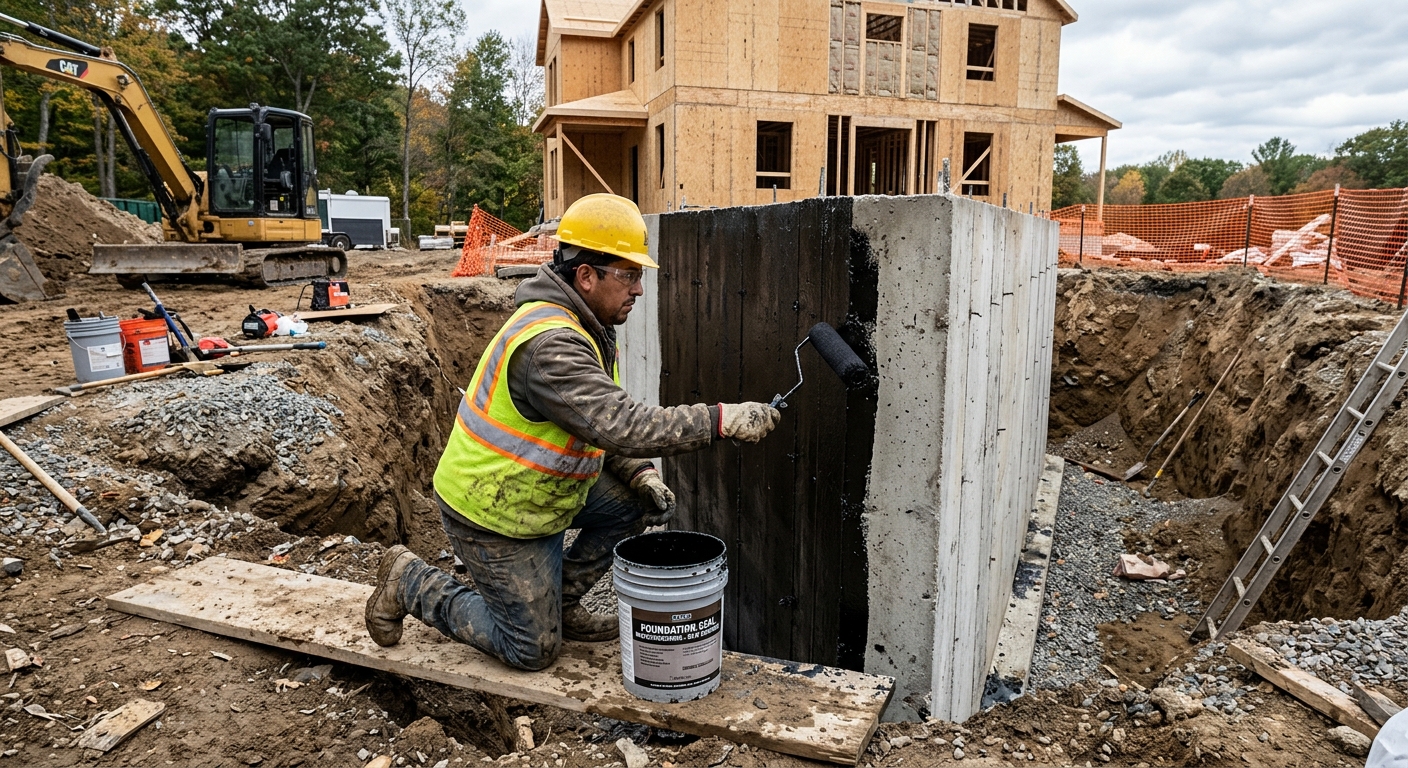
Exterior waterproofing is the “source control” option: it involves full excavation around the foundation, installation of a proper membrane system, new drainage tile, and then re-backfilling and grading to keep water moving away from the wall. It’s significantly more disruptive and expensive, but in many Millet sites it’s the most direct way to relieve hydrostatic pressure caused by clay- and silt-heavy soils and slow drainage. Interior waterproofing, on the other hand, typically captures water after it enters: perimeter drain channel, sump pit, and sump pump discharge. Interior methods are less invasive and often priced in the $8,000 – $18,000 range, but they don’t stop hydrostatic pressure from acting on the wall itself.
Given Millet’s Edmonton-region conditions, exterior work is most justified when you have signs of active seepage, recurring floor-edge wetting, or evidence that drainage systems are aged or failed. Poured concrete foundations often respond well to crack injection when the cracks are stable; polyurethane injection is typically used for active leaks, while epoxy suits certain non-moving conditions. For block foundations—commonly found in older Edmonton-area housing—interior drainage is often a practical complement, because block can allow moisture pathways that require sustained capture.
Alberta’s freeze–thaw cycles also influence the “right” choice. If water repeatedly saturates behind the wall, freeze–thaw accelerates crack widening and can turn small leaks into more expensive repairs. And because spring wet periods coincide with higher risk, sump pump backup systems become a real consideration—power interruptions can occur exactly when water loads are highest.
Dollar reality: in a typical Millet case with broad dampness along multiple wall runs, homeowners may spend closer to the $12,000 – $25,000 exterior band to replace failed drainage tile and membranes. If the issue is localized and manageable, interior perimeter drain + sump can be a better value at $8,000 – $18,000, but only when the drainage path and pump performance are engineered to your site’s water behaviour.
| Method |
Best For |
Addresses Source? |
Disruption |
Lifespan |
Price Band |
| Full exterior excavation + membrane |
Recurring seepage with probable failed exterior drainage or high hydrostatic pressure |
Yes |
High |
Long-term (when drainage is correctly designed for freeze–thaw) |
$12,500 – $25,000 |
| Interior French drain + sump system |
Basement dampness and floor/wall seepage where homeowner wants less disruption |
No (captures after entry) |
Medium |
Long service life with proper pump sizing and discharge routing |
$9,000 – $18,000 |
| Crack injection — epoxy (structural) |
Non-moving cracks where sealing and restoring continuity is the goal |
Partial (seals the pathway) |
Low to Medium |
High when crack movement is minimal |
$600 – $1,800 |
| Crack injection — polyurethane (active leak) |
Cracks with active seepage (wet cracks, changing moisture) |
Partial (controls the leak path) |
Low to Medium |
Very good for active leakage when done with correct prep |
$800 – $2,500 |
| Interior drain channel only (no sump) |
Minor dampness, low water load, or as part of a staged plan |
No |
Low to Medium |
Moderate (limited by how much water it can drain passively) |
$6,500 – $12,000 |
| Re-grading + downspout extensions |
Roof-water-driven dampness and water pooling near foundation |
Helps reduce source stress |
Low |
Moderate (depends on ongoing maintenance) |
$1,000 – $2,200 |
How to choose a waterproofing contractor in Millet
Choosing the right contractor matters as much as the method. Start by verifying Alberta coverage and credentials. Ask for the contractor’s proof of insurance and confirm WSIB/WCB status (a clearance letter or current confirmation). For liability, request a certificate of insurance that names the correct business entity and includes excavation/foundation-related work. If the scope includes structural crack repairs, confirm they have engineering support for that portion of the project.
Next, get 2–3 itemised written quotes—not lump sums. A good waterproofing quote breaks costs into labour and materials (excavation, membrane, drainage tile and pipe, backfill, sump pit/piping, pump models, discharge lines, electrical work, and restoration). It should also state what’s excluded, such as concrete cutting limitations, disposal fees, soil disposal, or landscaping restoration beyond basic grading.
Warranty deserves close reading. Look for a workmanship warranty in writing (commonly several years) and confirm manufacturer/product warranty terms. Ask whether the warranty is transferable if you sell the home—this affects long-term value. Payment schedule should be controlled: never agree to pay more than 10–15% upfront, and plan a holdback until the work is complete and inspected. Timeline matters too—request a start date and a completion estimate in writing, tied to access and weather considerations.
- Confirm Alberta licence/registration for the exact legal company name on the contract.
- Request certificate of insurance and verify coverage limits before any work starts.
- Confirm WSIB/WCB coverage with documentation (not just verbal assurances).
- Insist on an itemised quote: labour + materials + disposal + restoration scope.
- Ask who pulls permits (if required) and whether inspections are included.
- Confirm pump model, discharge routing, and whether backup power is included where warranted.
- For crack injection, ask how they determine crack movement (epoxy vs polyurethane selection).
- Verify drainage tile specs (pipe size, layout, fall/connection details) and how they handle outlets.
- Request a site plan for excavation boundaries to protect landscaping and utilities.
- Ask how they will remediate mould/efflorescence before sealing to protect indoor air quality.
- Get warranty details in writing: workmanship length, product warranty term, and transferability.
- Keep payment structured: 10–15% max upfront; holdback until completion and final walkthrough.
Red flags in Millet: vague scope descriptions (“waterproof to stop leaks” without method details), quotes that don’t specify pump discharge and backup considerations, no written warranty or unclear product vs workmanship responsibility, asking for large upfront deposits, and avoiding questions about permits/disposal/restoration responsibilities.
Frequently asked questions — waterproofing in Millet
How do I know if a foundation crack is serious?
In Millet, most homeowners notice cracks during spring thaws or after heavy freeze–thaw cycles. A crack is more likely serious if it changes over time (worsens seasonally), is horizontal (especially in block foundations), or shows step cracking along mortar joints. Efflorescence around a crack and dampness that returns after storms are also warning signs that water is moving through the crack pathway.
Best practice is to have a contractor assess crack type and evidence of movement. For active leakage, polyurethane injection is typically used; for certain non-moving conditions, epoxy may be appropriate. If there’s any sign of structural concern, request an engineer’s assessment before sealing, because sealing a moving crack without addressing movement can fail prematurely. Homeowners in older housing stock (47.5% pre-1981) often see more frequent moisture-related cracking and aged drainage conditions that make crack assessment especially important. (Statistics Canada, 2021 Census)
How much does foundation crack repair cost in Millet?
Foundation crack repair in Millet usually depends on whether the crack is active (wet) and on crack length, access, and whether there’s related wall seepage. In the Edmonton-area pricing we commonly see, crack repair often falls into the $600 – $2,500 band for typical injected sections. If multiple cracks are involved or drilling/access is tight, the upper end becomes more likely.
Crack repair may also expand in scope if waterproofing prep is needed—such as cleaning mineral deposits, addressing mould or efflorescence, or adding a complementary drainage approach. That’s why you may see crack injection included as part of a larger interior perimeter drain or exterior drainage plan rather than treated as a stand-alone fix. For comparison, interior waterproofing (drain + sump) tends to be higher, often within the $8,000 – $18,000 band, when water load is broader than a single crack. (Statistics Canada, 2021 Census)
Do I need a sump pump in Millet?
You may need a sump pump if your basement experiences recurring seepage, floor-edge wetting, or water that would otherwise accumulate during wet seasons. In Edmonton-area conditions (including Millet), sump systems are commonly recommended when there’s evidence of a higher water table behaviour, slow-draining clay or silty soils, or when interior drains can’t discharge passively at all times.
Many homeowners start with an interior perimeter drain and sump pit so water is captured and discharged reliably. If there’s high risk during spring thaws and Alberta power outages, ask about a battery backup for the pump—this is an added cost, but it can be the difference between dampness and a flood. In some minor cases, a drain channel only (no sump) may be possible, but that’s site-specific and depends on how much water enters.
Because 82.5% of households in Millet own their homes, many residents prefer solutions that reduce future interruptions and protect resale value. (Statistics Canada, 2021 Census)
How does Millet's soil affect my foundation?
Millet homes are affected by Edmonton-region soil behaviour—often clay-rich and silty soils that hold moisture and drain slowly. When soil stays saturated, it can expand during freeze–thaw and exert lateral pressure on foundation walls, pushing water through weaker points and widening cracks over time. That’s why you might see more dampness after winter freeze cycles or spring snowmelt.
Soil differences can also explain why two nearby basements behave differently. If your lot has better-draining fill or sandier zones, exterior drainage may perform better and interior capture needs can be reduced. If the backfill is poorly draining or the weeping tile is failed, water can build up behind the wall and increase pump run times.
Home age matters too. With a significant share of homes built before 1981, original drainage components may be compromised, making soil pressure feel worse even when the foundation crack pattern looks unchanged. (Statistics Canada, 2021 Census)
Do I need a permit for foundation work in Alberta?
In Alberta, permit needs depend on what you’re doing. Foundation excavation and foundation-related drainage changes often require a building permit, especially when work affects the foundation system or involves subsurface changes like replacing exterior drainage tile. Structural crack repair (for example, assessing and repairing horizontal cracking that could indicate movement) can also require permits and may involve engineering assessment before proceeding.
For sump pump installations, permit or municipal approval can be required when discharge connects to storm or sanitary sewer systems. Interior-only finishing generally doesn’t require permits, but waterproofing work that alters drains, pits, or structural elements may.
If you’re comparing contractors in Millet, confirm whether the contractor pulls the permit and includes inspection scheduling in the quote. A reliable contractor will clearly list it in the scope, rather than leaving it for you to manage later.
How long does waterproofing last?
How long waterproofing lasts depends on the method and whether it’s designed for Alberta conditions. Exterior waterproofing with a proper membrane and drainage tile typically offers the most durable source control when excavation, drainage slope, and backfill details are done correctly. Interior waterproofing can also last a long time, but it relies on continuous capture and reliable pump discharge.
Expect longevity to be limited by drainage system performance: clogged weeping tile, blocked discharge, or undersized sump capacity can lead to recurring dampness even if membranes and sealants look intact. Freeze–thaw cycles can also stress movement joints and widen cracks, which is why crack selection (epoxy vs polyurethane) matters.
As a practical homeowner reference, interior perimeter drain and sump projects are often priced in the $8,000 – $18,000 range, while exterior waterproofing is commonly in the $12,000 – $25,000 range—higher upfront work is often chosen when the goal is maximum long-term performance. For Millet’s older housing stock, proactive drainage and maintenance are key to achieving the longest service life. (Statistics Canada, 2021 Census)