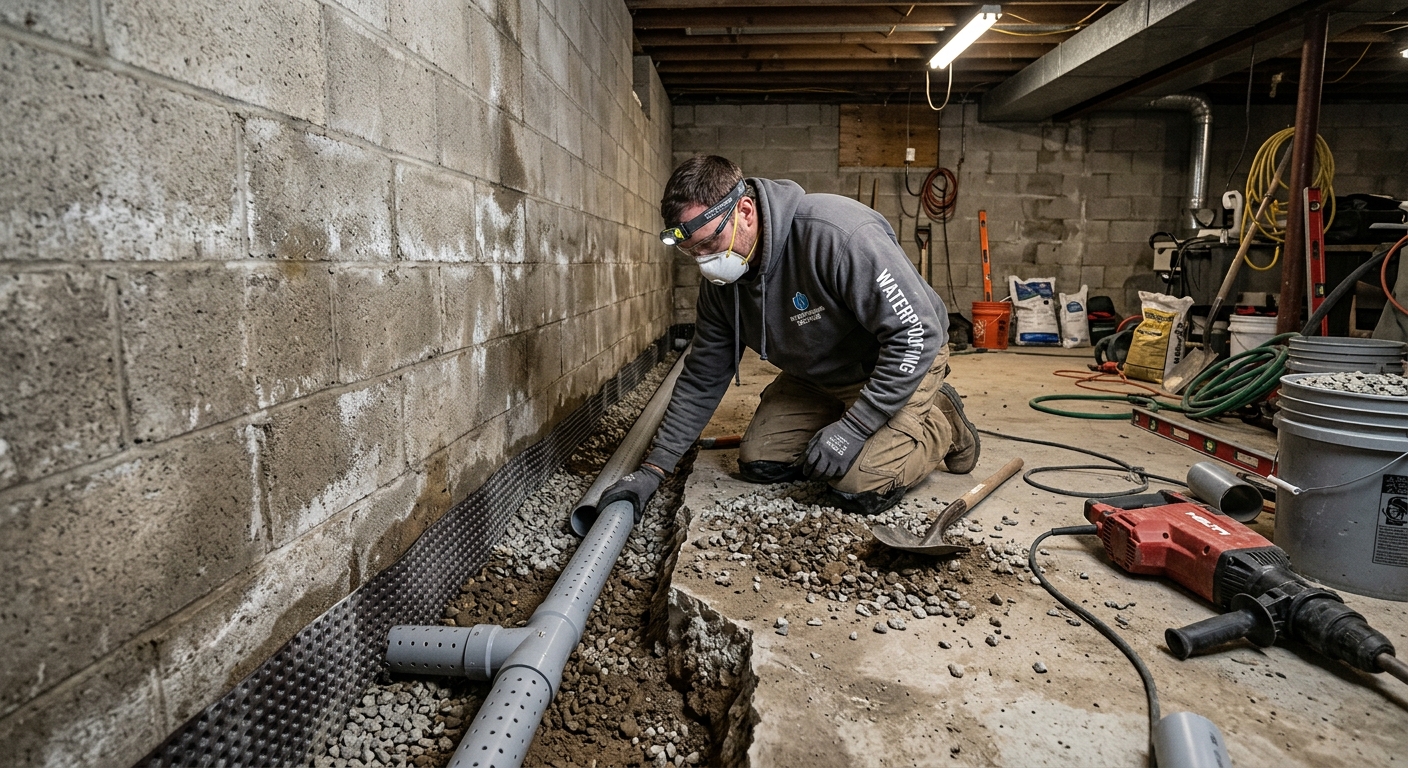
Basement waterproofing options and costs in Royal Oak
Royal Oak, Alberta is growing, but many basements there were built as the neighbourhood filled in—so homeowners often face older waterproofing details when they start noticing damp corners, musty odours, or water staining. In the 2021 Census, Royal Oak’s population sits at 11,580 (Statistics Canada, 2021 Census), and with that number of homes being maintained and renovated, waterproofing demand tends to concentrate around the older residential pockets where drainage was never upgraded. In these situations, original tar-and-paper systems and early weeping tile runs (often 60+ years old) can be completely failed, and freeze–thaw can then widen hairline joints and cracks, letting spring runoff in.
In Calgary and nearby communities, costs are shaped by clay-and-clay-till soils that hold water, then expand when saturated, increasing lateral pressure on foundation walls and footings. Add typical southern Alberta freeze–thaw cycles, and you get more labour time for crack preparation, membrane detailing, and drainage clean-out than homeowners may expect. Availability also plays a role: during peak spring inspection season, excavation crews can be booked out, which can push scheduling and site-management costs up. In Royal Oak, contractors are especially busy when leaks show up near the west and south-facing yards—areas that often collect downspout water and get heavier seasonal saturation.
Below is a practical comparison of common approaches, so you can match scope to your leak pattern before you request itemised quotes.
| Method |
What It Addresses |
Disruption Level |
Durability |
Price Range |
| Exterior excavation + new membrane + drainage tile |
Most effective for water entry: excavation to remove failed exterior system; new continuous membrane plus a properly bedded perimeter drainage tile |
High (yard/landscaping removal, regrading, backfill) |
Long-term when perimeter drains function and backfill is done correctly |
$12,500–$24,500 |
| Interior perimeter drain channel + sump pit |
Manages water after it enters; reduces hydrostatic pressure effects at the floor line and wall-footing interface |
Medium (partial interior floor work and cleanup) |
Very durable when sump discharge and seals are maintained |
$7,000–$14,500 |
| Foundation crack injection (epoxy or polyurethane) |
Stops specific cracks: epoxy for structural, stable cracks; polyurethane for active leaks that need flexible sealing |
Low (minimal demolition, localized drilling) |
Good to long-lasting when crack type is correctly matched |
$900–$3,600 |
| Sump pump installation (primary + battery backup) |
Controls collected water during wet seasons and power interruptions; reduces freeze-related pump failure risk |
Low to medium (small pit and discharge plumbing) |
High reliability with backup power and proper discharge routing |
$1,600–$4,200 |
| Window well drain installation |
Keeps water from pooling around egress windows; reduces seepage stains and mould risk near window penetrations |
Low to medium (excavation around specific window wells) |
Good when tied into perimeter drainage and regraded properly |
$1,200–$3,500 |
| Lot re-grading / downspout extension |
Redirects roof runoff away from the foundation; lowers recurring surface saturation that overwhelms older drains |
Low (light excavation, landscaping adjustments) |
Moderate—best as a complement to drainage/waterproofing systems |
$600–$2,800 |
Prices are estimates only and vary by project scope, site access and material selection.
What affects the price of waterproofing in Royal Oak
In Royal Oak and the wider Calgary area, quotes for the same general “basement leak” can vary by about 30% to 50% because waterproofing isn’t one product—it’s a matched system. Two contractors can propose different scopes (for example, interior-only water management versus full exterior water-source removal), and those differences are amplified by Calgary’s predominantly clay-and-clay-till soils and the realities of freeze–thaw. On top of that, site logistics—tight lot lines, mature landscaping, patios, and disposal trucking for heavy clay spoils—change labour hours and equipment access.
The three biggest regional drivers that separate Calgary-area costs from a national average are soil type, water table and freeze–thaw. Clay-heavy soils hold water, saturate, then expand during freeze–thaw, which increases lateral pressure and can worsen cracks over time. In pockets of low-lying areas influenced by river valleys and coulees, higher seasonal groundwater and storm events can create more hydrostatic pressure, increasing sump run times and the need for reliable perimeter drainage and discharge routing. Freeze–thaw also forces careful scheduling and membrane detailing; if materials are installed when conditions aren’t right, repairs can become more expensive later.
Concrete examples from Royal Oak projects: (1) If you’re excavating near an existing concrete patio or a narrow side yard, the exterior scope can shift from a straightforward perimeter dig into a longer, more labour-intensive access plan—often pushing an exterior band project toward the higher end of the $9,000–$25,000 excavation range. (2) If interior work includes a long floor saw-cut line and footing drain channel, labour can quickly climb into the upper $5,000–$15,000 interior waterproofing / weeping tile band. (3) If the crack is actively leaking, polyurethane injection typically needs extra preparation and verification, adding cost versus a straightforward epoxy stabilization job.
| Price Factor |
Why It Matters |
Cost Impact |
| Interior vs. exterior approach — interior is less disruptive but addresses symptoms |
Interior systems manage water after entry; exterior systems address the water source and require full excavation and membrane detailing |
Exterior can be roughly 1.5x to 3x interior depending on access and wall length |
| Foundation type — poured concrete vs. block vs. stone vs. ICF |
Sealing potential and crack behaviour differ by foundation material; block often needs perimeter drainage as a practical complement |
Block projects commonly cost more due to more failure points and interior channel requirements |
| Soil type — clay expands more than sand, adding pressure |
Clay saturation increases lateral pressure and increases the likelihood of recurring seepage |
Higher material detailing and drainage reliability needed; typically pushes costs upward |
| Crack type and length — hairline vs. structural horizontal cracks |
Structural cracks require assessment, proper prep, and sometimes engineered scope |
Long or structural cracks can add $500 to $1,800+ in repairs beyond minor injection |
| Sump pump backup system — battery or water-powered backup needed |
Backup reduces damage during spring outages and heavy wet weather when power is strained |
Can add several hundred to over $1,000 depending on chosen backup configuration |
| Access — landscaping, decks, or driveways must be removed for exterior |
More demolition means more labour, hauling, and replacement/patching coordination |
Frequently drives the biggest jump within the exterior excavation band |
| Weeping tile age — original tile (60+ years) may be completely failed |
Old tile runs can be crushed, disconnected, or clogged; replacement or tie-in is then necessary |
May convert “partial fix” work into a full perimeter system |
| Mould or efflorescence remediation required before sealing |
Moisture-damaged surfaces must be stabilized; sealed coatings over contaminated substrate can fail |
Commonly adds days to scope and increases material and labour costs |
Permits & regulations in Alberta
In Alberta, some waterproofing-related work typically requires a building permit, especially when you’re altering the foundation system, drainage that affects building services, or doing work that could be considered structural. In Royal Oak, plan on permits for foundation excavation, structural crack repair, and changes to lot drainage that affect how water is directed away from the footing and foundation. If sump pump installation includes connection to the storm or sanitary sewer system, municipal approval is usually required.
For foundation crack repair, it depends on the crack type. Structural repairs—particularly horizontal cracks in block walls, major step cracks, or any crack pattern suggesting more than shrinkage—often require a structural engineer’s assessment to determine whether underpinning or other structural work is needed before sealing. A reputable contractor should either coordinate that assessment or have engineering support available for your specific situation. Also verify they carry liability insurance and WSIB/WCB coverage (as applicable) before work starts.
How to verify as a homeowner, step-by-step: (1) Ask for the contractor’s Alberta licence/registration information (and any applicable trade documentation) and confirm it via the official provincial registry or the contractor’s own posted information. (2) Request a current certificate of liability insurance showing your project location and ask whether it includes completed operations. (3) Ask for WSIB/WCB clearance documentation, then check the certificate details match the company name. (4) For permit-requiring scopes, confirm who pulls the permit and whether drawings or engineering letters are included in the contract scope.
Interior vs exterior waterproofing — what does Royal Oak need?
The fundamental difference is that exterior waterproofing prevents water from entering by creating a continuous outside barrier: excavation, new membrane, perimeter drainage tile, and then careful backfill. Interior waterproofing doesn’t stop water at the source—it captures and manages water after it gets through, usually with an interior French drain channel, sump pit, and reliable sump pump operation. Because Royal Oak sits in a Calgary-area market where clay-and-clay-till soils retain water and freeze–thaw can widen joints, exterior systems tend to be the “best fix” when your leak is driven by saturated soil pressure against the foundation walls or when older weeping tile has failed.
That said, interior systems can be the better choice when excavation would be impractical—narrow lots, preserved landscaping, or limited access around decks and patios. Poured concrete walls in southern Alberta often respond well to correctly specified crack injection (especially epoxy where the crack is stable), but block foundation systems frequently need interior drainage as a complement because block joints can weep under pressure. In either case, sump pump backup matters. Even though many homes in Alberta don’t lose power for days, spring wet weather plus short outages can still increase the risk of backflow or a full sump—so a battery backup can be a sensible addition.
Price justification example: if an exterior excavation + membrane project is around $12,500–$24,500, the extra cost can be justified when you have recurring seepage across multiple wall segments or you’ve confirmed the perimeter drainage is failing. If the issue is isolated to a few penetrations or a single window well, an interior approach plus targeted work (like window well drainage) can keep you closer to the lower end of the bands.
| Method |
Best For |
Addresses Source? |
Disruption |
Lifespan |
Price Band |
| Full exterior excavation + membrane |
Widespread seepage, failed weeping tile, hydrostatic pressure patterns, or when you need the most permanent solution |
Yes |
High |
Long-term with proper drainage and backfill |
$12,500–$24,500 |
| Interior French drain + sump system |
Water entry already occurs; exterior excavation is difficult or not feasible; basement needs a controlled drainage path |
No (manages after entry) |
Medium |
Very good with correct pump sizing and discharge |
$7,000–$14,500 |
| Crack injection — epoxy (structural) |
Stable cracks where the foundation movement is minimal; commonly poured concrete crack stabilization |
Partially (seals the crack path) |
Low |
Good when crack prep is done correctly |
$900–$3,000 |
| Crack injection — polyurethane (active leak) |
Active seepage that needs flexible, water-reactive sealing; often used when cracks show current flow |
Partially (seals active path) |
Low |
Good when leak rate is controlled and substrate is prepared |
$1,200–$3,600 |
| Interior drain channel only (no sump) |
Light seepage where gravity discharge is practical; when collected water can be reliably managed without a sump |
No (manages after entry) |
Medium |
Moderate—depends on site drainage and discharge reliability |
$5,000–$9,500 |
| Re-grading + downspout extensions |
Surface water issues and recurring wet spots that correlate with storms; best as a complement |
No (reduces load) |
Low |
Moderate—only as good as ongoing grading and maintenance |
$600–$2,800 |
How to choose a waterproofing contractor in Royal Oak
Start by confirming Alberta coverage and trade compliance, then narrow down by scope quality. For licensing, ask the contractor for their Alberta licence/registration details (and any permit pull responsibility, when required). For insurance, request a current certificate of liability insurance and ensure the company name matches your contract and the certificate is valid for the project period. For WSIB/WCB, ask for clearance documentation before work begins—then verify the certificate information aligns with the legal business name you’re hiring.
Next, get 2–3 itemised written quotes. You want labour + materials breakdowns (for example, excavation hours, membrane system components, drainage tile size and bed material, interior drain channel labour, pump model, discharge pipe routing, and disposal haulage). Make sure exclusions are explicit: what’s not included for landscaping restoration, where crack injection does or doesn’t cover, and whether permit applications and engineering are included for structural crack scopes.
Warranty is crucial. Ask for the workmanship warranty length (often tied to a documented system approach), product/manufacturer warranty details, and whether warranties are transferable if you sell the home. Payment schedule should protect you: never pay more than 10% to 15% upfront, and consider a holdback until completion and key handover items (pump operation checks, discharge verification, and written warranty documents) are complete. Also get a start date and completion estimate in writing so you can plan around spring conditions and excavation access.
- Ask for an itemised quote (labour, materials, equipment, disposal) rather than a lump sum.
- Confirm whether they assess crack type (stable vs active) before injection material is chosen.
- Check that exterior scopes include continuous membrane detailing at corners and transitions.
- Verify discharge routing (where the water goes) is clearly described and code-compliant.
- Confirm sump pit sizing, pump rating, and alarms are included where appropriate.
- Request backup power plan (battery backup) if you’re adding a sump in wet seasons.
- Ask if mould/efflorescence remediation is included when walls show salts or bio-growth.
- Get written warranty terms: workmanship length, product warranty, and transferability.
- Require a clear “permit responsibility” statement (who pulls permits, who pays fees).
- Inspect their insurance certificate—valid dates, limits, and project coverage match.
- Confirm WSIB/WCB clearance documentation before signing.
- Use a payment schedule with 10%–15% max upfront and a completion holdback.
Red flags in Royal Oak: contractors who offer a one-size-fits-all “epoxy only” solution without checking for active leaks; vague scopes that don’t specify drainage tile, discharge routing, or how they handle failed weeping tile; missing or outdated insurance/WSIB/WCB documentation; payment terms that demand large upfront deposits; and warranties that exclude major system components or can’t be provided in writing.
Frequently asked questions — waterproofing in Royal Oak
How much does basement waterproofing cost in Royal Oak?
Basement waterproofing in Royal Oak typically lands in the same general Alberta bands as the Calgary region, but your site access and leak pattern can push you toward the higher or lower ends. For exterior excavation (dig, membrane, and drainage tile), many projects fall around $9,000–$25,000, while interior waterproofing and weeping tile/channel work is commonly about $5,000–$15,000. Smaller targeted fixes like window well drainage can be less, but they usually don’t solve widespread hydrostatic pressure on their own. If your basement shows efflorescence or recurring seepage around multiple wall segments—often tied to clay soils and freeze–thaw pressure—budget closer to the upper end and expect more time for prep and drainage verification.
Interior vs exterior waterproofing — which is better?
Exterior waterproofing is generally the most complete solution because it addresses the water source outside the foundation: excavation, new membrane, and functioning perimeter drainage tile. Interior waterproofing is often the smarter choice when excavation is difficult or when you need to control water after it enters. In Royal Oak’s Calgary-area conditions (clay-heavy soils and freeze–thaw), exterior systems are usually best for recurring seepage driven by saturated soil pressure. However, if the leak is localized—like a specific crack run, a window well, or a corner where roof runoff is overwhelming grading—interior work plus targeted crack injection can be enough. As a rough guide, exterior projects around $12,500–$24,500 may be justified when multiple wall areas are failing, while interior systems around $7,000–$14,500 can be the right fit for access-limited homes.
Why is my basement leaking in Royal Oak?
Most Royal Oak basement leaks come from water finding a pathway into joints, cracks, or penetrations. In the Calgary region, clay-and-clay-till soils hold water, then expand during freeze–thaw and increase lateral pressure on foundation walls and footings—so older cracks and mortar joints can open wider over time. If your basement shows dampness in spring or after heavy rain, failed or clogged weeping tile is a common culprit. Local drainage issues (downspouts discharging too close to the foundation, or landscaping that doesn’t shed water away) also increase saturation load. Less commonly, higher seasonal groundwater pockets in low-lying areas create hydrostatic pressure, meaning you may need a dependable interior drainage/sump system. Efflorescence and musty odours are often a sign that moisture has been recurring rather than a one-time event.
How do I know if a foundation crack is serious?
A crack’s “seriousness” depends on movement and pattern, not just width. In Alberta, horizontal cracks in block walls, step cracking that grows over time, or cracks that widen seasonally can indicate more than simple settlement and may require engineer review before sealing. Hairline vertical shrinkage cracks can be less urgent if they don’t show active seepage or ongoing change. The best practical indicator for homeowners is whether you see active moisture (wet staining, dripping, or dampness that increases during spring), plus whether cracks have shifted after freeze–thaw. If you’re unsure, ask a contractor to assess crack type and recommend epoxy versus polyurethane injection based on whether the crack is stable or actively leaking. For structural scenarios, don’t accept “standard injection only” without proper evaluation.
How much does foundation crack repair cost in Royal Oak?
Foundation crack repair in Royal Oak usually depends on crack type (stable vs active), the number of injection points, and whether the work is purely crack sealing or part of a broader drainage correction. For typical crack injection, many homeowners spend roughly $500–$1,800 for small localized repairs on a short run, but full injection jobs commonly range higher when multiple sections require preparation and sealing—often landing in the $900–$3,600 band for practical, real-world scopes. Epoxy injection is commonly used for stable structural cracks, while polyurethane is used when there’s active leaking that needs a more flexible, water-reactive seal. The key cost driver is correct diagnosis: choosing the wrong product for an active leak can lead to repeat work.
Do I need a sump pump in Royal Oak?
You may need a sump pump in Royal Oak if your basement has recurring seepage, if your interior perimeter drain system needs a controlled discharge point, or if gravity drainage isn’t reliable during wet seasons. In clay-heavy Calgary-area conditions, spring saturation can overwhelm older drainage systems, and freeze–thaw can worsen the timing of when water appears inside. If you’re adding an interior perimeter drain channel, a sump is often paired with it to keep collected water below the floor level and reduce risk of moisture re-entering cracks. For increased reliability, many homeowners choose a primary sump plus backup power—especially if spring flooding coincides with occasional power interruptions. Sump pump installation commonly falls around $900–$3,000, and adding battery backup typically increases the total within the higher end of that band depending on system design.