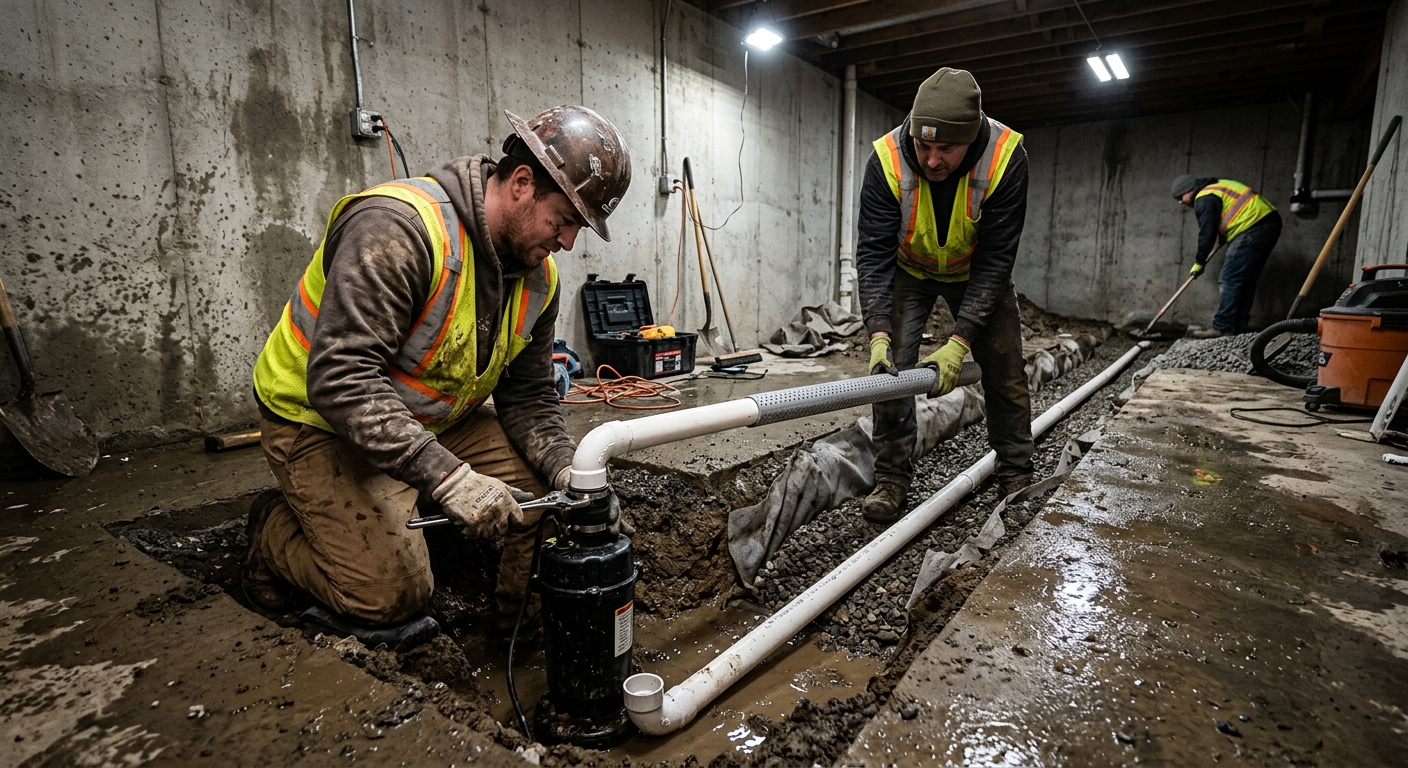
Basement waterproofing options and costs in Jasper Park
Jasper Park, Alberta is a small community (population 1,832 in 2021) where many basements were built to older standards and later upgrades often focus on drainage and crack management rather than complete prevention. In neighbourhoods across the Calgary region, older homes are far more likely to have failing original tar-and-paper style waterproofing and corroded weeping tile—failures that show up as damp corners, efflorescence, and spring seepage. That matters in Jasper Park because southern Alberta freeze–thaw cycles widen joints and cracks over time, turning “minor damp” into active water entry. At the same time, Calgary-area soils are commonly clay and clay-till, which hold water and expand when saturated, increasing lateral pressure on foundation walls and footings.
As a result, waterproofing quotes in the Jasper Park market often separate into two paths: exterior excavation systems (more excavation and higher material/disposal cost) or interior drainage systems (less disruption but focused on controlling water after it enters). Availability and pricing also swing depending on access—tight lots, concrete patios, or landscaping that needs removal can push labour hours and backfill/disposal significantly. For homeowners, the most in-demand work tends to be basement drainage retrofits and perimeter upgrades, especially in older areas with long-standing basement seepage and outdated weeping tile.
Below is a practical comparison of the options we commonly install in Jasper Park, and the budget range most homeowners can expect before we confirm site conditions.
| Method |
What It Addresses |
Disruption Level |
Durability |
Price Range |
| Exterior excavation + new membrane + drainage tile |
Primary water entry from outside the foundation; rebuilds perimeter drainage and continuous waterproofing |
High (excavation, removal of landscaping/patio, re-grading) |
High (typically long-term when drainage is correctly installed) |
$9,500–$24,500 |
| Interior perimeter drain channel + sump pit |
Controls hydrostatic water that reaches the interior; relieves wall and slab moisture |
Medium (cutting/patching inside, sump pit, interior finishing impacts) |
Medium-to-High (depends on whether exterior water entry is corrected) |
$6,000–$14,500 |
| Foundation crack injection (epoxy or polyurethane) |
Stops seepage through cracks; can also stabilize non-moving cracks |
Low-to-Medium (drilling ports, surface patching) |
Medium-to-High (best when crack movement is addressed) |
$750–$1,650 |
| Sump pump installation (primary + battery backup) |
Moves collected water out of the foundation system during heavy spring melt or outages |
Low-to-Medium (core/sump pit, discharge line, electrical) |
High (when backup and alarms are included) |
$1,450–$3,600 |
| Window well drain installation |
Prevents water pooling around basement egress window wells and reduces staining |
Low-to-Medium (excavation around window well) |
Medium (works best with good grading and weep coverage) |
$1,000–$2,900 |
| Lot re-grading / downspout extension |
Reduces how much surface water reaches foundation walls and window wells |
Low (minor excavation/landscaping) |
Medium (maintenance can be required) |
$850–$2,400 |
Prices are estimates only and vary by project scope, site access and material selection.
What affects the price of waterproofing in Jasper Park
In Jasper Park and across the Calgary economic region, two homeowners can receive quotes for the “same” damp basement problem that differ by 30–50%—and it usually isn’t because one contractor is wildly overpriced. The biggest reasons are: the actual water pathway (surface water vs exterior hydrostatic pressure), excavation complexity, and whether the repair addresses the source or just the symptoms. Even within Alberta, pricing trends separate from the national average when soil behaviour and water management requirements are more demanding.
The three local drivers that most often separate Jasper Park costs from a national baseline are soil type, water table conditions, and freeze–thaw. Clay-heavy soils common in southern Alberta expand when saturated, increasing lateral pressure on foundation walls and worsening cracks over time. When the water table is seasonally higher—especially during spring melt—interior systems may need longer pump run times and more robust discharge routing, which can push the sump and drainage portion of the budget. Freeze–thaw also widens hairline cracking and joint movement, meaning an injection approach may require the right chemistry (epoxy vs polyurethane) or it won’t hold.
Concrete examples from Jasper Park projects: (1) if we find a perimeter weeping tile line that’s blocked or fully failed, exterior excavation + membrane and drainage tile can jump into the upper part of the $9,000–$25,000 backbone because excavation depth and disposal increase with clay. (2) if a basement is finished, interior drainage can still land in the $5,000–$15,000 band, but patching, drywall removal, and flooring restoration add labour. (3) when foundation movement requires injection plus targeted crack repair (often still within the $500–$1,800 crack-repair band), homeowners may avoid a full excavation—provided the water entry is confirmed.
| Price Factor |
Why It Matters |
Cost Impact |
| Interior vs. exterior approach — interior is less disruptive but addresses symptoms |
Interior systems manage water after it enters; exterior systems prevent entry but require more excavation |
Can swing 30–50% depending on access and water source |
| Foundation type — poured concrete vs. block vs. stone vs. ICF |
Block and stone are more likely to require interior drainage complements; ICF often has different detailing |
Typical increase for block/stone complexity |
| Soil type — clay expands more than sand, adding pressure |
More saturation increases lateral load and crack re-opening risk |
Higher exterior and drainage scope in clay-heavy lots |
| Crack type and length — hairline vs. structural horizontal cracks |
Moving or horizontal cracks often require assessment; injection alone may not hold |
Structural evaluation/extra repair can add cost |
| Sump pump backup system — battery or water-powered backup needed |
Spring events and outages make backup valuable in Alberta |
Often adds to the pump portion but reduces repeat losses |
| Access — landscaping, decks, or driveways must be removed for exterior |
Excavation time and re-installation work increases labour hours |
Significant swing with tight urban-lot conditions |
| Weeping tile age — original tile (60+ years) may be completely failed |
Old tile is frequently clogged, collapsed, or detaching from the down slope |
Can move a “patch” job into a full perimeter system |
| Mould or efflorescence remediation required before sealing |
Sealers and membranes don’t bond properly over contaminated surfaces |
Adds labour and materials before the waterproofing step |
Permits & regulations in Alberta
In Alberta, many foundation-related waterproofing scopes require a permit, especially when you’re changing drainage or repairing structural elements. As a rule of thumb for Jasper Park homeowners: foundation excavation, structural crack repair that affects load paths, and changes to lot drainage (grading, drainage re-routing, or installing new foundation drainage connections where approvals are required) typically require a permit. If your sump pump discharge connects to a storm or sanitary sewer, that connection generally needs municipal approval and may require inspection documentation.
For structural crack repair—such as horizontal cracks in block walls, step cracking that suggests movement, or cracks associated with bulging—an engineer’s assessment is often needed to confirm whether underpinning or additional structural work is required. Before you sign, ask your contractor whether they include engineering support for structural repairs and whether they carry the proper liability coverage and worker protection.
How to verify a contractor in Alberta step-by-step:
- Confirm their Alberta licence/registration status using the appropriate online registry for the trade category they operate under.
- Request a current certificate of insurance (general liability) and verify the policy is active for the project dates and correct business name.
- Ask for proof of WSIB/WCB coverage (or equivalent clearance documentation) and ensure it matches the contractor installing the work.
- For structural scopes, require a written statement of who provides engineering support and when it will be delivered.
- Make sure the permit responsibility is clarified: who pulls the permit, who schedules inspections, and what inspections are expected.
Interior vs exterior waterproofing — what does Jasper Park need?
The fundamental difference is simple: exterior waterproofing is prevention; interior waterproofing is management. A full exterior excavation removes soil around the foundation, installs a continuous membrane system, adds or replaces drainage tile, then backfills and re-grades. Done correctly, it addresses the source of water entry outside the foundation. It’s also the most disruptive option—especially on tight lots where patios, landscaping, or driveways limit access.
Interior waterproofing focuses on what happens after water enters. A perimeter drain channel, sump pit, and sump pump move collected water away from walls and floors. This can be less invasive, often keeping the project closer to the mid-range of the $5,000–$15,000 interior band. However, because it doesn’t stop hydrostatic pressure on the wall itself, basements with ongoing exterior water pathways can see repeat moisture issues unless the source is corrected.
For Jasper Park’s clay-heavy, freeze–thaw driven environment, the “right” choice depends on foundation material and how water is entering. Poured concrete walls typically seal better with correct crack injection (especially when cracks are not actively moving). Block foundations often benefit from interior drainage as a practical complement, because water can migrate through the system even when crack sealing is performed.
Backup power is also a real consideration here. Alberta spring storms can cause short outages, and if the sump pump relies only on mains power, water can rise quickly during peak melt. If you’re already spending for an interior drain and sump, adding backup can be the difference between a one-time fix and recurring cleanup.
Example: if your inspection shows exterior weeping tile is failed and water is entering along the full perimeter, exterior excavation can justify the higher scope in the $9,000–$25,000 range. But if your issue is primarily localized seepage through a limited crack run, injection plus improved grading may address the problem without the full exterior cost.
| Method |
Best For |
Addresses Source? |
Disruption |
Lifespan |
Price Band |
| Full exterior excavation + membrane |
Active perimeter leakage where exterior tile/drainage has failed or needs rebuilding |
Yes (primary prevention) |
High |
Long-term when drainage outlets and backfill are correct |
$9,500–$24,500 |
| Interior French drain + sump system |
Hydrostatic water reaching the interior; finished basements needing less demolition |
No (management after entry) |
Medium |
Medium-to-Long depending on exterior source |
$6,000–$14,500 |
| Crack injection — epoxy (structural) |
Non-moving, hairline to moderate cracks where the wall is stable |
Yes (stops leakage through the crack) |
Low-to-Medium |
Longer when there’s no active movement |
$700–$1,500 |
| Crack injection — polyurethane (active leak) |
Ongoing seepage where water pressure is present through the crack |
Yes (stops active leakage) |
Low-to-Medium |
High when water conditions and surface prep are correct |
$850–$1,800 |
| Interior drain channel only (no sump) |
Very mild dampness where water can be controlled without pumping |
No (still management) |
Medium |
Shorter if seasonal inflow exceeds gravity drainage |
$5,000–$10,000 |
| Re-grading + downspout extensions |
Surface-water driven seepage near grade, stained window wells, and wet corners after storms |
Partially (reduces entry from runoff) |
Low |
Medium (depends on ongoing maintenance) |
$850–$2,400 |
How to choose a waterproofing contractor in Jasper Park
Choosing the right contractor in Jasper Park starts with verification. In Alberta, you should confirm the contractor’s trade licensing (for the scope they’re actually doing), request a current certificate of liability insurance, and verify WSIB/WCB coverage for their workers. How to check: (1) ask for the licence/registration number and verify it on the appropriate online registry, (2) request proof of insurance dated within the last 30–90 days and matching the legal business name, and (3) ask for WSIB/WCB clearance documentation and keep a copy for your records. If they can’t provide these documents right away, that’s a red flag.
Next, get 2–3 itemised written quotes—not just a lump sum. You want a breakdown that separates labour from materials (membrane, drainage board, tile, filter fabric, geotextile, sump pit, pump and backup option) and lists what’s included in prep. Carefully check exclusions: permit pull and inspections, disposal fees for clay spoils, patching/finishing allowances, and whether the discharge outlet and discharge location are specified. In southern Alberta, clogged or missing drainage outlets are a common reason waterproofing underperforms.
Warranty matters too. Ask for the workmanship warranty length, the product/manufacturer warranty details, and whether warranties are transferable if you sell. Payment scheduling should be conservative—never more than 10–15% upfront. Hold back the remainder until the completion walkthrough and any required documentation are provided. Finally, insist on a start date and a completion estimate in writing, including weather-related contingencies since excavation and membrane work must be protected.
- Ask for the project scope in writing: interior vs exterior, exact drains, pump model, and backup type.
- Confirm permit responsibility (who pulls it, when, and what inspections are included).
- Get disposal included or priced separately for heavy clay excavation.
- Require a drainage outlet plan: where the water discharges and how it avoids backflow.
- Check whether the quote includes filter fabric/ geotextile and correct drainage grading.
- Confirm crack injection method (epoxy vs polyurethane) matches the crack behaviour.
- Request proof of engineering support for any structural crack assessment.
- Get product names and thickness/specifications, not just “membrane” or “sealant.”
- Ask how they prepare surfaces (mould removal, efflorescence removal, dry times).
- Verify warranty terms in writing, including workmanship and product warranties.
- Require a payment schedule with retainage (holdback) until completion.
- Ask for a cleanup and restoration plan (patching, backfill compaction, landscaping/topsoil).
Common red flags in Jasper Park include contractors who refuse to discuss the water pathway (they talk only about “drying”); quotes that omit disposal and backfill/compaction details; mismatch between crack type and injection chemistry; guarantees that promise “no cracking ever” without addressing movement or drainage; and requests for large upfront deposits with no written schedule or warranty documentation.
Frequently asked questions — waterproofing in Jasper Park
Will basement waterproofing affect my property value in Jasper Park?
Yes, it can—and in Alberta it often matters because buyers look for signs of recurring moisture. In Jasper Park, even a small basement seepage history can translate into concerns about mould, odours, damaged finishes, and the reliability of foundation drainage. The best value impact usually comes when the work is traceable and complete: itemised scopes, pump specs, drainage routes, and warranty documentation. If your project corrects an exterior water entry pathway or rebuilds failed weeping tile, it tends to be easier to explain during a sale than “we installed a few sealers.” Even where you stay interior, a documented sump and perimeter drain system can be a strong selling point. Budget-wise, many basements fall into the $5,000–$15,000 interior range, which is often easier for sellers to justify than major structural upheaval.
What drainage issues are most common in Jasper Park homes?
The most common issues are moisture along foundation walls during spring melt and wet corners after heavy runoff. In the Calgary region, clay and clay‑till soils can hold water and saturate backfill, which increases pressure on walls and pushes water into cracks and joints. Freeze–thaw then enlarges those paths, so you can see problems recur year after year. Another frequent failure point is older weeping tile: it may be clogged, disconnected, or completely failed, so water has nowhere to go. Homeowners also report window well pooling, especially when downspouts discharge too close to the foundation or grading has settled. If you’re seeing efflorescence or dampness that changes after storms, it’s often a drainage pathway problem first, not a “single crack” problem.
How do I choose a waterproofing contractor in Jasper Park?
Start by verifying the contractor’s Alberta licensing for the work they’re doing, then request proof of general liability insurance and WSIB/WCB coverage. In practice, you should check dates and that the documents match the company doing the installation. Next, ask for 2–3 itemised quotes (labour and materials) that clearly state what’s included: excavation depth, disposal for clay spoils, pump model, whether backup is included, and how discharge will work. Make sure the scope addresses the actual water pathway—exterior membrane and drainage tile if the source is outside, or interior perimeter drains and sump if water is already entering. Finally, review the warranty: workmanship length, product/manufacturer coverage, and whether the warranty transfers if you sell.
What is a battery backup sump pump and do I need one in Jasper Park?
A battery backup sump pump is an additional power source that keeps the pump running during mains power outages. In Alberta, outages during spring storms and wind events can be short, but they can overlap with peak melt when the basement would otherwise fill. Battery backup is especially worth it if you already have an interior drain channel, a sump pit, or history of rapid water rise. Whether you “need” it depends on your discharge setup and how quickly water reaches the sump. Many homeowners who are already budgeting for a sump installation choose backup to avoid emergency cleanup and potential finish damage. As a cost reference, sump pump upgrades with primary plus backup often land in the $1,450–$3,600 range depending on the system design.
How much does basement waterproofing cost in Jasper Park?
Typical Jasper Park budgets depend on whether the scope targets the source outside the foundation or controls water after it enters. Exterior waterproofing (excavation, drainage tile, and continuous membrane) commonly falls into the $9,000–$25,000 range because excavation, access, backfill, and disposal are substantial—especially in clay-heavy soil. Interior waterproofing and weeping-tile-style perimeter drainage with a sump generally sits in the $5,000–$15,000 band, with price rising for finished basements and complex discharge routing. For targeted repairs, foundation crack injection can be in the $500–$1,800 range depending on crack length, stability, and whether it’s epoxy or polyurethane. If you only need re-grading and downspout extensions, projects can be much lower, often under the mid-range of the exterior backbone.
Interior vs exterior waterproofing — which is better?
“Better” depends on where the water is entering. Exterior waterproofing is best when water pathways are outside the foundation—failed exterior drainage tile, wall-level seepage, or cases where clay backfill and freeze–thaw pressure are pushing water through cracks. It’s more expensive and disruptive because it requires excavation and re-grading, but it permanently addresses the entry route by combining membrane and functioning perimeter drains. Interior waterproofing is best when you need a less invasive approach or when the source is localized seepage through cracks that can be managed with injection and a sump system. In Jasper Park’s freeze–thaw and clay soil context, some homes do best with a hybrid: injection for stable cracks plus interior drainage for any remaining hydrostatic pressure. If you’re deciding purely on cost, interior can be justified—especially if it’s within the $5,000–$15,000 band—provided the inspection confirms that exterior prevention isn’t required.