Basement waterproofing options and costs in Hamptons
In Hamptons, Alberta, waterproofing planning starts with a simple question: is the water problem coming from outside pressure (hydrostatic seepage and pressure through the soil), or is it mainly showing up after water gets in (condensation, weeping points, or minor seepage)? With a community population of 7,360 (Statistics Canada, 2021 Census), Hamptons homes are a mix of newer builds and older properties where original perimeter drainage has aged out—especially where clay-heavy soils hold water and then expand during freeze–thaw.
That seasonal freeze–thaw cycle is a major cost driver in southern Alberta: small cracks and joints widen, and meltwater finds its way in through penetrations and foundation seams. In Hamptons, pricing often reflects that combination—older basement systems, the need to manage lateral pressure, and excavation challenges from mature landscaping and tight lot access. In many neighbourhoods around the Calgary and Rocky View area, trades are in steady demand because repeated spring runoff and aging weeping tile systems lead to common failure points like localized wall leaks, efflorescence, and seepage at joints. Crews are also busiest near areas with established landscaping and constrained equipment access, where excavation and backfill require extra care to protect patios, fences, and trees.
Below is a practical comparison of the most common waterproofing methods contractors use in Hamptons—so you can align your quote with what your basement actually needs.
| Method |
What It Addresses |
Disruption Level |
Durability |
Price Range |
| Exterior excavation + new membrane + drainage tile |
Primary water entry through wall/footing area; creates a continuous drainage plane with perimeter tile |
High (landscaping removal, excavation, backfill) |
Long-term; typically the most comprehensive approach when installed correctly |
$9,000–$25,000 |
| Interior perimeter drain channel + sump pit |
Water that has already entered the basement; collects seepage and relieves hydrostatic pressure |
Medium (interior floor sections, targeted jackhammering) |
High when paired with a reliable sump and discharge routing |
$5,000–$15,000 |
| Foundation crack injection (epoxy or polyurethane) |
Crack control and sealing—epoxy for non-moving structural cracks; polyurethane for active leaks |
Low to Medium (minor interior prep; sometimes patching) |
Moderate to high depending on whether the crack is active and whether movement continues |
$500–$1,800 |
| Sump pump installation (primary + battery backup) |
Continuous management of collected water; improves resilience during spring surges |
Low to Medium (sump pit excavation indoors) |
High with backup power and proper discharge |
$900–$3,000 |
| Window well drain installation |
Water infiltration at window wells, surface runoff, and trapped groundwater around basement openings |
Medium (yard/access around the window well) |
Good when paired with grading and proper window well covers |
$900–$2,500 |
| Lot re-grading / downspout extension |
Reduces surface water around the foundation; directs roof runoff away from footings |
Low to Medium (light excavation, landscaping touch-ups) |
Moderate; helps prevent recurrence, especially when drainage is otherwise functioning |
$500–$3,000 |
Prices are estimates only and vary by project scope, site access and material selection.
What affects the price of waterproofing in Hamptons
In Hamptons and the wider Calgary market, it’s not unusual to see quotes for the “same” waterproofing problem vary by 30–50%. The difference usually comes down to how much of the system the contractor rebuilds (source control vs water management), how difficult excavation is on clay soils, and how much diagnostic time is spent identifying whether the water is coming from a failing weeping tile, surface runoff, or hydrostatic pressure from low-lying pockets. Labour availability also shifts seasonally, but the real pricing gap is typically scope—not just price per hour.
Three drivers separate Hamptons costs from a national average: soil type, water table conditions, and freeze–thaw. Clay-heavy soils common to southern Alberta hold water and expand when saturated, which increases lateral pressure against foundation walls. That means cracks widen faster and interior fixes alone may not last if the exterior side remains pressurized. In areas where groundwater and spring storms create higher seasonal pressure (especially near valley and low-lying pockets), sump pump run times increase and the discharge plan needs to be more robust, which pushes projects toward the interior waterproofing band of $5,000–$15,000 or higher depending on whether you’re effectively building a full perimeter system. In contrast, when the issue is primarily downspout runoff or light surface infiltration, simpler work like re-grading and extensions can keep costs closer to $500–$3,000.
Here are a few concrete Hamptons examples that change the price quickly: (1) a deeper excavation to reach footings when there’s a concrete patio close to the foundation; (2) removing and reinstalling landscaping around a tight side yard to install exterior drainage; and (3) replacing or upgrading aged weeping tile when sections are clogged or missing—often the difference between a “patch” and a long-term fix.
| Price Factor |
Why It Matters |
Cost Impact |
| Interior vs. exterior approach — interior is less disruptive but addresses symptoms |
Exterior controls the source; interior mainly captures and manages water after entry |
Exterior often lands in the $9,000–$25,000 band; interior commonly in $5,000–$15,000 |
| Foundation type — poured concrete vs. block vs. stone vs. ICF |
Different wall materials crack and move differently; sealing strategy changes |
Block and stone frequently require more comprehensive drainage; ICF may still need crack control and perimeter drainage |
| Soil type — clay expands more than sand, adding pressure |
Clay holds water and exerts lateral pressure, worsening cracks during freeze–thaw |
More risk of recurring seepage without a full drainage plan |
| Crack type and length — hairline vs. structural horizontal cracks |
Active or moving cracks need flexible/active sealing; structural issues may require engineering |
Hairline control can be lower; active/long cracks often move work toward higher bands |
| Sump pump backup system — battery or water-powered backup needed |
Spring surges plus power interruptions can cause overflow and mould risk |
Backup adds cost but can be critical; commonly adds roughly part of the $900–$3,000 sump band |
| Access — landscaping, decks, or driveways must be removed for exterior |
Excavation productivity drops with tight access and restoration needs rise |
Can move projects upward within the $9,000–$25,000 exterior range |
| Weeping tile age — original tile (60+ years) may be completely failed |
Failed tile increases water accumulation and hydrostatic pressure |
More excavation and replacement/discharge upgrades needed |
| Mould or efflorescence remediation required before sealing |
Active contaminants and salts must be addressed before membranes or coatings bond properly |
Additional labour/materials increases the interior scope |
Permits & regulations in Alberta
In Alberta, several categories of basement waterproofing work may require a building permit depending on the extent and what’s changing. As a practical rule, foundation excavation, foundation-related structural crack repair, and changes to lot drainage typically require a permit. Sump pump installations can also require municipal approval when the discharge ties into the storm or sanitary sewer system, or where the discharge point could affect drainage on adjacent property or within the municipal network.
For structural crack repair—especially horizontal cracks in block walls, major step cracks, or cracks suggesting movement—an engineer’s assessment is often needed to confirm whether underpinning or other structural measures are required before sealing. Ask your contractor whether they can coordinate engineering support for structural scopes, and ensure they carry current liability insurance and WSIB/WCB coverage for their crews. That matters in Hamptons because excavation, concrete cutting, and excavation support can create both property and safety risks.
To verify a contractor before signing, do it in order: (1) confirm the contractor’s Alberta licence details via the appropriate online registry search; (2) request a certificate of insurance that matches the company name and specific project site address; (3) ask for WSIB/WCB account coverage evidence or clearance documentation; and (4) for structural scopes, confirm they document an engineer’s findings before injection or membrane work. If they can’t provide documentation promptly, treat that as a major warning sign and ask for it in writing.
Interior vs exterior waterproofing — what does Hamptons need?
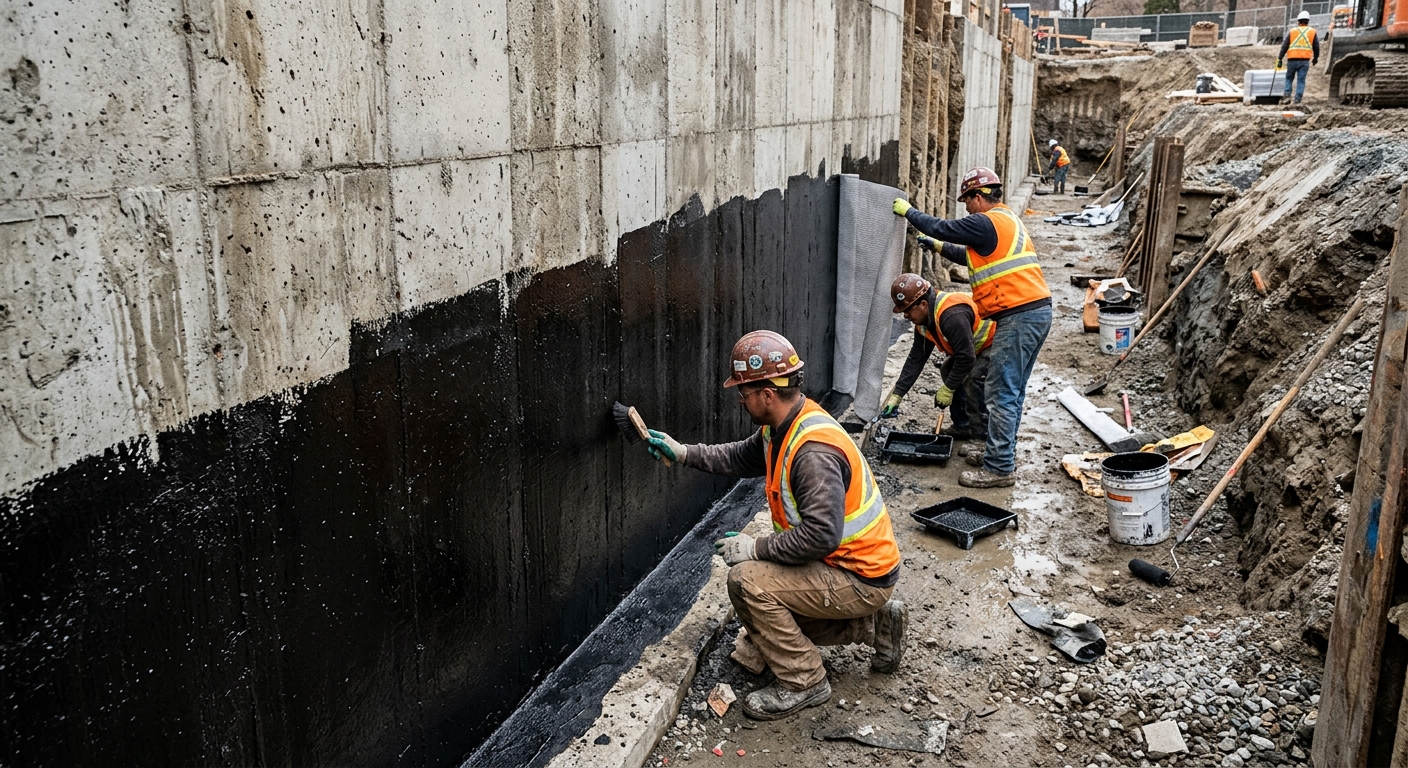
The fundamental difference in Hamptons is whether you stop water at the foundation’s exterior or capture it after it enters. Exterior waterproofing involves full excavation, installing a continuous membrane, adding or re-establishing perimeter drainage tile, and then backfilling and restoring the grade. Done correctly on clay-heavy soils, it permanently addresses the water source and reduces hydrostatic pressure before it reaches your basement walls. It is more expensive and disruptive because it requires excavation and restoration around patios, landscaping, and tight side yards.
Interior waterproofing focuses on water management: a perimeter drain channel, sump pit, and sump pump system collect seepage and relieve hydrostatic pressure from inside. This approach is less invasive, often priced in the $5,000–$15,000 band, and it can be ideal when exterior access is limited or when the foundation wall is already sealed on the outside but drains have failed. However, interior work does not remove the source of water pressure—so if the exterior system is completely compromised, interior solutions can become maintenance-heavy.
In Hamptons, poured concrete walls generally respond well to crack injection when the crack is not actively moving, while block foundations often need interior drainage as a practical complement because block joints and voids can behave differently under freeze–thaw. If you choose interior protection, sump pump backup systems matter. Spring flooding and Alberta storm events can coincide with power disruptions; a battery backup or water-powered backup helps prevent overflow, mould growth, and cleanup costs.
For example, if you have localized wall seepage at one section with minor crack activity, crack injection plus a sump upgrade might stay closer to the crack repair band of $500–$1,800 plus a sump addition. But if you have recurring seepage along multiple walls during spring melt—especially with failed or clogged weeping tile—spending toward exterior waterproofing in the $9,000–$25,000 range is often justified because it reduces the recurring load that interior-only systems must handle.
| Method |
Best For |
Addresses Source? |
Disruption |
Lifespan |
Price Band |
| Full exterior excavation + membrane |
Multiple-wall seepage, known failed weeping tile, persistent spring meltwater infiltration |
Yes—controls water at the foundation exterior |
High (excavation and restoration) |
Long-term when membrane and drainage are continuous |
$9,000–$25,000 |
| Interior French drain + sump system |
Limited exterior access, interior moisture issues, hydrostatic pressure captured from inside |
No—manages water after entry |
Medium (interior floor sections) |
High with proper sump discharge and backup |
$5,000–$15,000 |
| Crack injection — epoxy (structural) |
Non-moving or stabilized cracks in poured concrete where pressure is not actively forcing water |
Partial (seals a pathway once crack movement is addressed) |
Low to Medium |
Moderate to high if crack is stable and prepared correctly |
$500–$1,800 |
| Crack injection — polyurethane (active leak) |
Active weeping or cracks showing ongoing moisture movement |
Partial (seals active pathways, but source pressure still matters) |
Low to Medium |
Moderate when the underlying drainage plan is also functioning |
$500–$1,800 |
| Interior drain channel only (no sump) |
Light seepage where gravity drainage is reliable and water volumes are low |
No—captures water after entry |
Medium (interior demo) |
Moderate; depends on site slope and water pressure trends |
$4,000–$9,000 |
| Re-grading + downspout extensions |
Surface water problems and roof runoff pooling near foundation |
Yes for surface water pathways |
Low to Medium |
Moderate; effectiveness depends on clay saturation and subgrade drainage |
$500–$3,000 |
How to choose a waterproofing contractor in Hamptons
Choosing the right waterproofing contractor in Hamptons starts with verification, not promises. First, confirm Alberta licensing where applicable, then verify liability insurance and WSIB/WCB coverage for the actual company performing the work. To check: request the contractor’s insurance certificate and confirm the coverage is active and matches the legal business name; ask for proof of WSIB/WCB clearance or account documentation; and ensure the certificate shows job-site coverage consistent with your address. If they won’t share these documents before quoting, that’s a risk you don’t want around excavation and interior concrete work.
Next, get 2–3 itemised written quotes. You want a labour + materials breakdown so you can compare like-for-like: membrane system type, drainage tile components, sump basin and pump model (including backup), and crack injection materials. Ask whether the quote includes permit pull (if required), excavation support (where applicable), disposal fees for clay spoils, and restoration scope such as regrading and landscaping touch-ups. Avoid contractors who give only a lump sum without describing what they’ll do at the foundation or where drains and discharge will terminate.
Warranty matters too: ask for the workmanship warranty length, product/manufacturer warranty details, and whether the warranty is transferable to future owners. Payment schedules should be cautious—never more than about 10–15% upfront—and you should hold back a portion until the job is complete and tested (where practical). Finally, get a start date and completion estimate in writing so spring scheduling and basement access plans are clear.
- Confirm insurance certificate is current and matches the contractor’s legal name
- Verify WSIB/WCB clearance or account evidence before any work starts
- Ask whether permits are required and whether the contractor will pull them
- Require an itemised quote (labour, materials, disposal, restoration)
- Confirm the sump discharge route and where water will be directed
- Check whether battery backup or water-powered backup is included (if you’re doing a sump)
- Request the specific membrane and drain product system (not “equivalent” descriptions)
- Ask how they test or verify drainage flow and sump operation
- Ensure crack injection specifies whether it’s epoxy (structural) or polyurethane (active leak)
- Get warranty terms in writing, including workmanship and product coverage
- Agree on a payment schedule with a holdback until closeout
- Confirm who handles engineering requirements if structural crack indicators are present
In Hamptons, red flags include: skipping site drainage mapping and relying on guesswork, quoting exterior work without addressing access/restoration, offering a “universal” crack injection when the crack appears active, minimizing sump backup where spring surges are expected, and providing a lump-sum price with no itemised disposal or membrane/drain product specifics.
Frequently asked questions — waterproofing in Hamptons
How long does basement waterproofing take in Hamptons?
In Hamptons, timelines depend heavily on whether you’re doing exterior excavation or an interior perimeter system. Exterior waterproofing often takes longer because excavation, membrane installation, drainage tile work, and backfill must be sequenced around weather and access—typically a multi-day foundation exposure stage followed by curing and restoration. Interior French drains and sump installations are usually faster because you’re working inside with targeted concrete removal, but drying time and floor re-install steps still matter. Crack injection can be the quickest option when access is straightforward, but it may not solve the full problem if the weeping tile or exterior drainage is failed. A good contractor will include a detailed schedule and contingency plan for clay spoil handling and freeze–thaw conditions. (Statistics Canada, 2021 Census)
What is a weeping tile and does my Hamptons home have one?
Weeping tile (perimeter drainage tile) is the older-style underground drain system installed near the foundation footing to collect groundwater and seepage, then direct it away—often to a sump or a discharge location. Many older Hamptons homes have some form of it, but it may be partially failed: clogged with silt, disconnected, undersized, or simply not flowing anymore. In clay-heavy soils, siltation and poor flow are common, especially after decades of freeze–thaw and spring runoff. Your best indicator is visible discharge history, basement seepage patterns (often along wall seams), and sometimes camera inspection of accessible runs. If your home’s weeping tile is not functioning, interior drainage or exterior reconstruction becomes much more important. Contractors typically price interior drainage systems in the $5,000–$15,000 band when a full perimeter channel and sump are required.
Can I waterproof my basement in winter in Hamptons?
Yes, waterproofing can often be done in winter in Hamptons, but the “what” matters. Interior work like sump installation, crack injection, and targeted interior drainage can proceed when temperatures are manageable, because sealing and pump testing are still possible without full exterior excavation. Exterior projects are more challenging during deep cold because excavation can be harder and membranes and backfill performance depends on how the soil is handled and whether the system can be installed to design specifications. Freeze–thaw also means water behaviour may look different day-to-day in January compared to spring melt. If you have active leaking or evidence of mould/efflorescence, winter intervention can prevent damage, but the final exterior source control may still be best tackled in a more workable season. For example, crack repair and injection work often falls in the $500–$1,800 range, while full interior perimeter solutions are commonly higher depending on materials and scope.
What is the difference between waterproofing and damp-proofing?
Damp-proofing is meant for controlling minor moisture under typical conditions—it’s not designed to withstand active hydrostatic pressure from groundwater or saturated clay. Waterproofing, by contrast, is designed as a system: it addresses water entry pathways and manages or relieves pressure using properly designed drainage (interior drains and sump, or exterior perimeter drainage tile plus membrane). In Hamptons, damp-proofing alone can fail if your foundation is seeing recurring spring pressure due to clay saturation and freeze–thaw widening cracks and joints. That’s why a contractor should assess your active leak points, crack type, and likely source (surface runoff vs failing perimeter drainage vs hydrostatic pressure). When quotes only propose a coating or limited sealing without drainage provisions, it can be a mismatch for the way water behaves in southern Alberta. True waterproofing solutions typically align with the interior drainage band of $5,000–$15,000 for full perimeter management or higher for exterior source control.
Will basement waterproofing affect my property value in Hamptons?
Generally, yes—well-documented waterproofing improvements can support resale value by reducing health and maintenance concerns like recurring seepage, efflorescence, and mould risk. In Hamptons, buyers pay attention to whether the basement is dry during spring melt and whether drainage systems are functional, especially because clay-heavy soils and freeze–thaw can cause repeat problems. The value uplift isn’t guaranteed, but transferrable warranties, detailed receipts, and a clear scope (what was repaired, what drains were rebuilt, where discharge goes) strengthen buyer confidence. Exterior source control systems typically create more assurance than interior-only “symptom management,” although interior drainage can still be valuable when exterior access is constrained or the system is correctly engineered. If your project includes sump installation with backup and verified discharge, that documentation often helps. Contractors who provide itemised quotes and written warranties make it easier to demonstrate the improvement during a home sale.
What drainage issues are most common in Hamptons homes?
In Hamptons, the most common drainage issues usually fall into three buckets: surface water pooling near the foundation, failing or clogged weeping tile, and hydrostatic pressure during spring melt that finds cracks, joints, and wall penetrations. Clay-heavy soils hold water and expand when saturated, so cracks that looked minor in fall can become active paths in spring. Freeze–thaw also worsens the opening/closing of seams and enlarges routes for meltwater. Many homes show symptoms first as efflorescence on poured concrete or block seams, damp corners, or water at window wells—especially where downspouts discharge too close to the foundation. If drainage is partially working but overwhelmed, interior perimeter drains and sump systems often address it, usually within the $5,000–$15,000 band. If the problem is primarily roof runoff and grading, re-grading and extensions can be a smaller fix within the $500–$3,000 range.