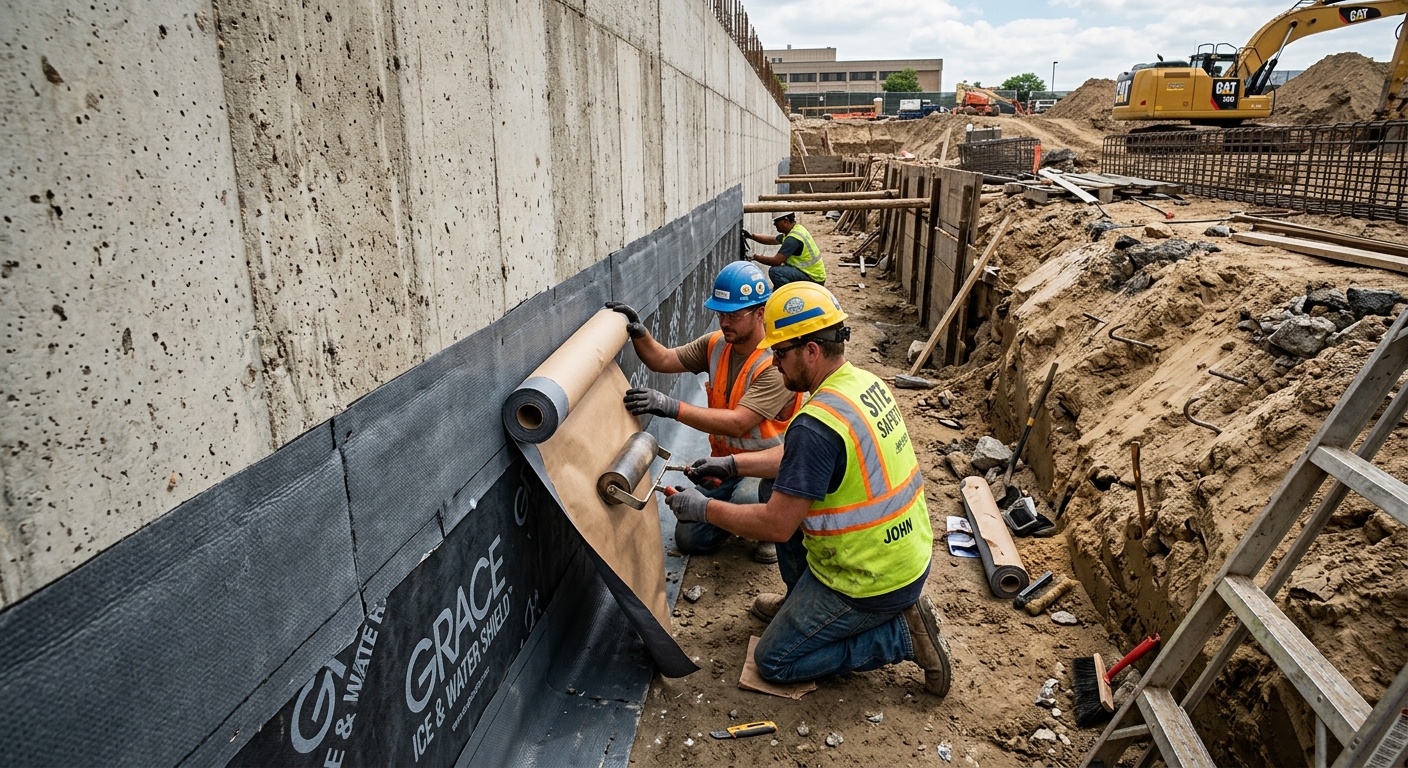
Basement waterproofing options and costs in Wetaskiwin
Wetaskiwin basements get their share of moisture issues, especially in older homes where original exterior damp-proofing has aged out. In Wetaskiwin, 55.7% of dwellings were built before 1981, and that housing age matters: many of those foundations relied on older tar-based products and weeping tile that are now corroded, plugged, or never properly sized for today’s freeze–thaw-driven crack growth. With Edmonton-area soils, many yards sit over clay-rich or silty ground that holds water and drains slowly; when that soil saturates, it can create lateral pressure against foundation walls and push seepage toward interior corners.
Cost is also shaped by the local market. In the Edmonton economic region, you’ll often see labour and equipment pricing that supports fast turnaround on excavation crews during peak spring and early fall, but interior work can be scheduled more steadily. If your house is in a neighbourhood with mature landscaping or more mature infill lots—where access is tight—exterior excavation tends to cost toward the upper end of the exterior range. In Wetaskiwin, areas such as the older residential pockets near downtown are where we most commonly see recurring dampness because the original drainage details are typically undersized or have been altered over the decades.
Below is a practical comparison of common waterproofing approaches and what they typically fix, to help you translate quotes into like-for-like scope before you compare contractors.
| Method |
What It Addresses |
Disruption Level |
Durability |
Price Range |
| Exterior excavation + new membrane + drainage tile |
Stops water at the source by relieving hydrostatic pressure and rebuilding drainage around the foundation |
High (excavation, yard restoration) |
High (long service life when drainage discharges properly) |
$12,000–$25,000 |
| Interior perimeter drain channel + sump pit |
Captures seepage after it enters and discharges it away from the basement |
Medium (partial interior demo and restoration) |
Medium-to-high (depends on pump reliability and discharge path) |
$8,000–$18,000 |
| Foundation crack injection (epoxy or polyurethane) |
Seals or stabilizes cracks; polyurethane is used for active leakage, epoxy for non-moving cracks |
Low-to-medium (minor chipping/cleaning) |
Medium-to-high (best when paired with drainage strategy) |
$600–$2,500 |
| Sump pump installation (primary + battery backup) |
Moves collected water out of the basement during saturation and power interruptions |
Low-to-medium (floor cutting for sump pit) |
High (when discharge is correct and backup is included) |
$1,800–$3,800 |
| Window well drain installation |
Stops rain-driven or snowmelt water from pooling at egress windows and migrating inward |
Low-to-medium |
Medium (depends on grading and weep/drain daylight) |
$800–$2,200 |
| Lot re-grading / downspout extension |
Reduces surface water load before it reaches foundation walls |
Low (yard work only) |
Medium (must be maintained; severe soil saturation may still require drains) |
$600–$1,900 |
Prices are estimates only and vary by project scope, site access and material selection.
What affects the price of waterproofing in Wetaskiwin
In Wetaskiwin and across the Edmonton area, two contractors can price the same general “basement waterproofing” request 30–50% apart because waterproofing is rarely one fix—it’s a matched system for soils, water entry paths, and discharge. The three biggest cost drivers that separate regional pricing from a national average are soil type, water table behaviour, and freeze–thaw movement. Clay-heavy and silty soils, common in the Prairies, expand when saturated and can exert lateral pressure on foundation walls, often turning hairline issues into active seepage over time. When water sits higher in the soil, sump pumps run longer and need properly designed discharge lines, which increases labour and material.
Freeze–thaw in Alberta matters because each winter cycle widens existing cracks and joints. In older Wetaskiwin housing stock—55.7% built before 1981—we see more frequent failure of weeping tile and more seepage through poured concrete or block joints. By contrast, if a home is on relatively better-draining fill (sandier zones or improved grading), exterior excavation can still be required, but the scope to stop the source may be narrower. In wetter saturation seasons, interior drain channels and pump systems often land in the mid-to-upper part of the interior range (for example, the $8,000–$18,000 band), while a full exterior plan can move toward the $12,000–$25,000 band when yard restoration and excavation are extensive.
Concrete examples from Wetaskiwin work: (1) a long, cracked perimeter on a clay-leaning site can require more drain footage and pump upgrades; (2) a short run of exterior tile on a better-draining lot can keep excavation and restoration modest; (3) homes with multiple egress wells often trigger added window well drainage work that increases scope without changing the “main” system.
| Price Factor |
Why It Matters |
Cost Impact |
| Interior vs. exterior approach — interior is less disruptive but addresses symptoms |
Exterior rebuilds drainage and membrane; interior manages water after entry |
Interior often $4,000–$10,000 less; exterior can jump $3,000–$15,000 depending on access and restoration |
| Foundation type — poured concrete vs. block vs. stone vs. ICF |
Crack patterns and sealing methods vary by wall material and joint behaviour |
Poured walls often respond well to crack injection paired with drainage; block may require more interior drainage planning |
| Soil type — clay expands more than sand, adding pressure |
Saturated clay increases hydrostatic pressure and seepage rate |
Clays commonly push designs toward stronger drainage (more pipe runs, better discharge, and sometimes higher pump capacity) |
| Crack type and length — hairline vs. structural horizontal cracks |
Structural cracks may indicate movement and require engineered assessment |
Structural issues typically add assessment, possible stabilization, and higher material/labour costs |
| Sump pump backup system — battery or water-powered backup needed |
Power interruptions during spring saturation can let water accumulate quickly |
Backup typically adds a measurable line item (commonly within the $1,800–$3,800 sump band when included as part of the system) |
| Access — landscaping, decks, or driveways must be removed for exterior |
More removal and restoration raises excavation time and restoration trades |
Access constraints can add thousands—especially when multiple sides need excavation |
| Weeping tile age — original tile (60+ years) may be completely failed |
Failed tile means drainage won’t relieve pressure |
Rebuilding tile and confirming outlets increases exterior scope and total cost |
| Mould or efflorescence remediation required before sealing |
Moisture damage and salts must be treated so new systems adhere and perform |
Remediation can add hours and specialty materials before waterproofing proceeds |
Permits & regulations in Alberta
In Alberta, certain basement and foundation work typically requires a building permit, particularly when the scope involves changes that can affect the structure or lot drainage management. In practice, foundation excavation around a house, structural crack repair when it involves stabilizing movement, and modifications to how water leaves or is handled at the property commonly fall under permit requirements. If your contractor plans to connect a sump discharge line to a municipal system (storm or sanitary), municipal approval is usually required.
For structural crack work—especially horizontal cracks in block walls or major step cracking—an assessment by a structural engineer is often necessary to determine whether underpinning, wall stabilization, or other structural interventions are required before waterproofing proceeds. Make sure the contractor can show engineering support for structural scopes, not just “we’ll inject and hope it holds.” Also verify they carry liability insurance and WSIB/WCB coverage for workers so you’re not exposed to risk during excavation and demolition.
Step-by-step for Wetaskiwin homeowners: (1) ask for the Alberta licence details and confirm they match the business name; check the public online registry; (2) request a current certificate of liability insurance showing adequate coverage limits; (3) request WSIB/WCB clearance documentation; (4) confirm whether a permit is pulled as part of the contract—get that stated in writing; (5) for sump discharge to municipal connections, ask for the approval process used in Alberta and what documents you’ll receive at completion.
Interior vs exterior waterproofing — what does Wetaskiwin need?
The fundamental difference is simple: exterior waterproofing removes the source of water entry by fully excavating, installing a new membrane, and rebuilding drainage tile and discharge before backfilling. It’s the most complete solution for hydrostatic pressure, but it’s also the most disruptive and expensive because you’re working around the entire perimeter and restoring landscaping afterward. Interior waterproofing, on the other hand, manages water after it enters—typically with a perimeter drain channel, sump pit, and sump pump—so you’re capturing seepage and discharging it away, without stopping the soil water pressure at the wall.
In Wetaskiwin’s Edmonton-area climate, freeze–thaw widening is a major reason homeowners should think system-first. Where poured concrete walls are present, crack injection can seal and stabilize cracks, especially when paired with interior drainage or an exterior plan. Where block foundations are involved, water often travels through mortar joints and uneven openings; interior perimeter drainage is frequently the practical complement, because it reduces how long dampness stays trapped against the wall. Based on local housing age (55.7% built before 1981) it’s common to see older foundations with compromised drainage details, so interior solutions often start as a cost-effective stabilization while you decide on whether exterior excavation is warranted for the long term.
Sump pump backup deserves special attention in Alberta. Even if power outages aren’t daily, spring saturation and storm periods can stress pumps—backup helps prevent a “missed night” from turning a manageable leak into a costly clean-up.
Price-wise, exterior can be justified when you need to stop chronic water entry. For example, if you’re facing repeated dampness and floor-edge seepage across multiple walls, an exterior approach in the $12,000–$25,000 band may cost more up front than a typical interior system at $8,000–$18,000, but it often reduces recurring interventions by rebuilding drainage and membrane performance.
| Method |
Best For |
Addresses Source? |
Disruption |
Lifespan |
Price Band |
| Full exterior excavation + membrane |
Chronic seepage, high soil saturation, and cases where you want the source addressed for the long term |
Yes (hydrostatic pressure relief + barrier) |
High |
High |
$12,000–$25,000 |
| Interior French drain + sump system |
Homes where exterior excavation is constrained, or to manage seepage while stabilizing the basement |
No (captures water after entry) |
Medium |
Medium-to-high |
$8,000–$18,000 |
| Crack injection — epoxy (structural) |
Non-moving cracks in poured concrete or stable crack patterns |
Partial (seals pathways; doesn’t rebuild exterior drainage) |
Low-to-medium |
Medium-to-high |
$600–$2,500 |
| Crack injection — polyurethane (active leak) |
Active seepage where water is still moving through the crack |
Partial (stops the active pathway; still relies on drainage control) |
Low-to-medium |
Medium |
$600–$2,500 |
| Interior drain channel only (no sump) |
Light dampness with limited water volume where gravity discharge is feasible and reliable |
No |
Low-to-medium |
Low-to-medium |
$5,000–$12,000 |
| Re-grading + downspout extensions |
Surface-water-driven wet spots, wall splashback, and seasonal puddling |
Indirectly (reduces runoff load) |
Low |
Low-to-medium |
$600–$1,900 |
How to choose a waterproofing contractor in Wetaskiwin
Choosing the right waterproofing contractor is mostly about verifying proof, not promises. In Alberta, confirm the contractor’s Alberta licence (business name and coverage match), then request a certificate of liability insurance showing it’s current and adequate for foundation and excavation work. Next, ask for WSIB/WCB clearance or equivalent proof of coverage for workers. When you’re reviewing documents, don’t accept screenshots—ask for current PDFs or certificate copies suitable for your records.
Then get 2–3 itemised written quotes that break out labour and materials line-by-line (excavation depth and length, membrane type, drainage tile and filter fabric, discharge method, interior drain channel materials, sump pit and pump model, backup system, and cleanup/disposal). Waterproofing quotes should also specify what’s included in permit pulling (if required), what’s excluded (e.g., finished basement flooring, landscaping restoration extent), and whether they include disposal of excavated material.
Warranty matters in a freeze–thaw climate. Ask for the workmanship warranty length and whether product/manufacturer warranties apply to the installed membrane and drainage components. Clarify if the warranty is transferable if you sell the home. For payment, plan to never pay more than 10–15% upfront; hold back a portion until the job is complete and tested. Finally, get the start date and estimated completion timeline in writing.
- Ask for an itemised scope: what walls/floors, what drains, what discharge route, and what patch/restoration.
- Confirm permit responsibility: who pulls permits and what permits are required for your exact scope.
- Request pump model details and whether they include a backup system (battery or water-powered).
- Look for discharge confirmation: where the water goes and how it’s protected from freezing backflow.
- Ask how they verify existing conditions (weeping tile outlet location, crack mapping, moisture checks).
- Confirm membrane specifications and thickness, and whether they use compatible drainage boards or protection.
- Require filter fabric and proper grading/backfill compaction details to prevent settlement and re-saturation.
- Get a written schedule for excavation, interior demo, waterproofing installation, cure times, and reinstatement.
- Verify engineering involvement when needed (structural cracks, horizontal movement, underpinning considerations).
- Check warranty terms in writing: workmanship coverage, product coverage, and transferability.
- Ensure disposal and site cleanup are included—especially for excess soil and construction debris.
- Use a payment holdback: retain funds until waterproofing is completed and you’ve done a final walkthrough.
Red flags to watch in Wetaskiwin: contractors who won’t put the discharge plan in writing, who refuse to provide current proof of WSIB/WCB or insurance, who claim one “universal” method for every basement without discussing soils and water entry paths, who minimize the role of freeze–thaw crack movement, or who ask for a large deposit upfront without an agreed holdback.
Frequently asked questions — waterproofing in Wetaskiwin
What is a battery backup sump pump and do I need one in Wetaskiwin?
A battery backup sump pump is a system that powers your sump pump during a power outage, so water doesn’t accumulate in your basement when the grid goes down. In Wetaskiwin and across Alberta, it’s especially relevant during spring saturation periods and heavy storm weather when pumps may run continuously and outages can happen. If you already have seepage during snowmelt or you’ve seen water on the floor edges, backup can be a smart risk-reduction step. Pricing varies by system size and wiring, but sump pump installations typically sit in the $1,800–$3,800 band when backup is included as part of a complete installation.
How much does basement waterproofing cost in Wetaskiwin?
Basement waterproofing in Wetaskiwin is commonly priced in bands because the work scope changes with soil saturation, crack types, and access. For interior perimeter drainage and pump-related work, many projects fall within $8,000–$18,000. If the source needs to be addressed with excavation—new exterior membrane and drainage tile—exterior waterproofing usually ranges from $12,000–$25,000, especially where excavation is needed on multiple sides and yard restoration is complex. Foundation crack repair often runs from $600–$2,500 depending on crack length and whether it’s epoxy (stable cracks) or polyurethane (active seepage). Your quote should itemise labour and materials so you can compare like-for-like solutions.
Interior vs exterior waterproofing — which is better?
Exterior waterproofing is usually “best” when you have chronic seepage driven by hydrostatic pressure, because it stops water at the source by rebuilding drainage and installing a membrane around the foundation. However, it’s more disruptive and costly in Wetaskiwin because excavation and yard restoration are required. Interior waterproofing is often the best practical choice when access is limited or when you need to manage existing seepage quickly with less disruption—especially when the main goal is to capture and discharge water using a perimeter drain channel and sump system. In Alberta’s freeze–thaw climate, interior systems should be designed with reliable pumps and, ideally, backup. Many homeowners with older basements (55.7% of Wetaskiwin homes built before 1981) start with an interior approach to stabilise moisture, then upgrade to exterior if water entry remains active.
Why is my basement leaking in Wetaskiwin?
Basement leaks in Wetaskiwin are usually caused by a combination of aging drainage details, saturated soils, and freeze–thaw movement. Clay-rich and silty soils can hold water and drain slowly, which increases lateral pressure on foundation walls when the ground becomes saturated. If weeping tile is plugged or undersized, water finds the next easiest pathway—often through cracks, mortar joints, or floor-wall interfaces. Freeze–thaw cycles widen existing openings each winter, turning dampness into noticeable seepage over time. Also consider surface water: if downspouts discharge near the foundation or grading slopes toward the home, runoff load can trigger seasonal leaks. A proper inspection typically identifies whether the entry is through cracks, through wall joints, or from surface-water migration so the remedy matches the cause.
How do I know if a foundation crack is serious?
Not all cracks are equal. A hairline crack can be a symptom of normal movement, but it’s often the pattern and behaviour that matters in Wetaskiwin’s freeze–thaw conditions. Cracks that are widening, have differential displacement (one side higher), or run horizontally across a block wall are more concerning and may indicate structural movement rather than just water migration. Step cracks that “stair” through blockwork can also suggest shifting. If you notice water weeping at the crack, efflorescence (white mineral staining), or recurring dampness in the same spot after snowmelt, treat it as an active pathway. For serious or potentially structural cracks, an engineer assessment is commonly needed before sealing or injection. Ask your contractor how they’ll classify the crack and whether they recommend engineered review.
How much does foundation crack repair cost in Wetaskiwin?
Foundation crack repair cost in Wetaskiwin typically depends on how long the crack is, whether it’s active (water flowing) versus stable, and how many injection ports are required. Many projects fall within $600–$2,500, with the lower end for short, accessible, stable hairline cracks and the higher end for longer cracks or more complex access. Epoxy injection is generally used for non-moving cracks, while polyurethane is used when there’s active seepage and the material needs to expand and seal in the presence of water. In Alberta, crack injection is most effective when paired with a drainage plan, because freeze–thaw can reopen pathways if hydrostatic pressure remains unchecked. A good quote will specify crack type, injection material, and whether any complementary drainage work is recommended.