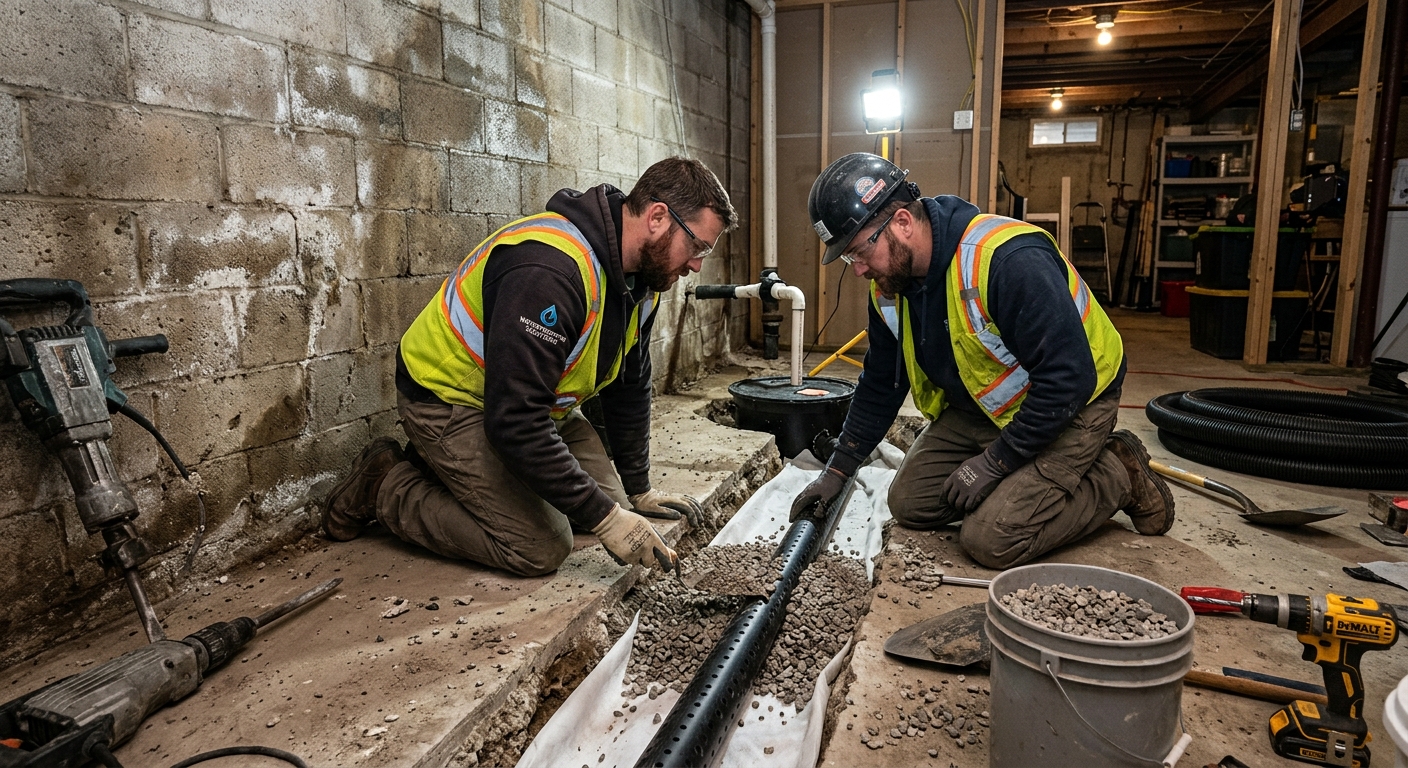
Basement waterproofing options and costs in Charleswood
In Charleswood, Alberta, basement leaks and damp smells are a common homeowner headache because most lots sit over clay and clay-till soils that hold water, then expand when saturated. In a neighbourhood built up over decades, many basements are also dealing with older original drainage—especially in homes dating back to earlier build cycles that had less robust waterproofing and weeping tile. With the broader Calgary area population at 3,595 in Charleswood (Statistics Canada, 2021 Census), demand for local waterproofing support is steady, particularly where access is tight and yards are landscaped. That’s why you’ll often see contractors book work for spring and early summer: crews need dry enough conditions to excavate, set drainage, and properly test falls before backfilling.
Calgary-area pricing typically aligns with national ranges, but rises when the job requires deeper excavation, full-perimeter systems, or managing heavy clay spoils (including disposal). Southern Alberta’s freeze–thaw cycle is also a cost driver: widening cracks and joints can turn a small seep into a seasonal pattern, meaning surface patches alone rarely last. Depending on the foundation type—poured concrete versus block—some houses respond better to crack injection and perimeter interior drainage, while others need exterior membrane and a functioning perimeter drain.
In Charleswood, services are especially in demand around the more established residential pocket near nearby arterial corridors where mature trees, patios, and side-yard constraints limit access—forcing careful staging and sometimes extra labour for removal and reinstatement. Below is a side-by-side comparison of the most common approaches before you request an itemised quote.
| Method |
What It Addresses |
Disruption Level |
Durability |
Price Range |
| Exterior excavation + new membrane + drainage tile |
Water at the source (hydrostatic entry), perimeter drainage, and wall protection |
High (excavation along perimeter; patio/landscaping impacts possible) |
High (continuous exterior membrane + properly bedded drainage) |
$9,000 – $25,000 |
| Interior perimeter drain channel + sump pit |
Water that enters through cracks/joints; reduces hydrostatic build-up inside |
Medium (interior floor lifting in targeted zones) |
Medium to high (depends on discharge quality and sump reliability) |
$5,000 – $15,000 |
| Foundation crack injection (epoxy or polyurethane) |
Sealing cracks; epoxy for non-moving cracks, polyurethane for active leakage |
Low to medium (small drilling; limited disruption) |
Medium to high (only as good as crack type, prep, and pressure conditions) |
$500 – $1,800 |
| Sump pump installation (primary + battery backup) |
Manages collected water; reduces basement seepage during power instability |
Low to medium (excavation of small sump pit; minor interior works) |
High when backup is included and discharge is correct |
$900 – $3,000 |
| Window well drain installation |
Directs water away from window openings to prevent localized infiltration |
Low to medium (targeted exterior or well area work) |
Medium to high (depends on grading and weep path) |
$1,200 – $4,000 |
| Lot re-grading / downspout extension |
Moves roof and surface water away from foundation; reduces recurring inflow |
Low to medium (landscape adjustments) |
Low to medium (helps prevent, but won’t handle deep hydrostatic pressure) |
$600 – $2,500 |
Prices are estimates only and vary by project scope, site access and material selection.
What affects the price of waterproofing in Charleswood
Homeowners in Charleswood often see quotes for the “same” waterproofing problem that vary by 30–50% because the job isn’t only about sealing—it’s about how you control water under Calgary conditions. Two contractors may both “fix the leak,” but one designs for ongoing hydrostatic pressure with a perimeter drain and reliable sump discharge, while another targets only the visible crack. The difference in approach, excavation depth, and how much of the perimeter must be opened drives labour hours and disposal costs.
The three big drivers separating Calgary-area costs from the national average are soil type, water table behaviour, and freeze–thaw. Clay-heavy soils common in parts of Alberta can expand during freeze-thaw, exerting lateral pressure and worsening cracks over time; that often increases the scope from small patch work to injection plus drainage corrections. In low-lying pockets and where downspouts or grading allow saturation, high seasonal groundwater can raise sump pump run times and require a more robust system sizing. Freeze–thaw also keeps expanding and contracting joints; even well-sealed areas can fail if the foundation movement isn’t addressed.
On the cost side, this shows up in dollars quickly. For example, an exterior waterproofing excavation that falls at the mid-to-upper band (often around the $9,000 – $25,000 range) typically becomes necessary when water is entering from multiple points or when interior drains can’t keep up. Conversely, a targeted interior perimeter system may stay closer to $5,000 – $15,000 when the leak is localized and the concrete floor plan allows efficient work.
Concrete examples in Charleswood: (1) mature landscaping and patios can force extra demolition/reinstatement during exterior excavation; (2) older weeping tile that’s clogged or disconnected can shift the “water management” problem from passive drainage to continuous pumping; (3) hairline cracks that are actually active during spring melt can require polyurethane injection rather than epoxy sealing. If you’re seeing recurring dampness after heavy snowmelt, plan for the system design to match the active seasonal pressure, not just the current dryness.
| Price Factor |
Why It Matters |
Cost Impact |
| Interior vs. exterior approach — interior is less disruptive but addresses symptoms |
Interior systems manage water after entry; exterior aims to stop it at the wall face |
Interior often costs less up front; exterior can add major labour/excavation but can be more comprehensive |
| Foundation type — poured concrete vs. block vs. stone vs. ICF |
Crack behaviour and how water migrates differs by foundation system |
Poured concrete may seal well with proper crack injection; block and stone often need complementary drainage |
| Soil type — clay expands more than sand, adding pressure |
Clay saturation increases lateral stress and seepage pathways |
Higher scope and more durable exterior membrane/drainage design may be required |
| Crack type and length — hairline vs. structural horizontal cracks |
Moving cracks generally require different materials and detailing |
Structural or longer cracks increase prep, ports/injection, and may trigger engineering review |
| Sump pump backup system — battery or water-powered backup needed |
Spring flooding and outages can stop primary pumps at the worst time |
Backup increases equipment and install labour, but reduces risk and claim probability |
| Access — landscaping, decks, or driveways must be removed for exterior |
Excavation is slower and more expensive with tight lot lines and hardscapes |
Can materially increase labour hours and reinstatement costs |
| Weeping tile age — original tile (60+ years) may be completely failed |
Old tile often clogs and fails when slopes or outlets degrade |
May require full replacement of perimeter drainage and discharge routing |
| Mould or efflorescence remediation required before sealing |
Existing moisture damage needs cleaning and sometimes controlled drying |
Adds time, materials, and sometimes temporary containment before sealing |
Permits & regulations in Alberta
In Alberta, many waterproofing-related tasks do not always require a permit, but foundation and lot-drainage changes often do. In practice, permits are commonly required for foundation excavation work, structural crack repairs, and modifications that affect how stormwater or drainage runs off the property. If your project includes altering drainage connections that may interface with municipal sewer infrastructure, you should expect municipal approval requirements.
For structural crack repair—especially horizontal cracks in block walls, major step cracks, or any situation that suggests foundation movement—an assessment by a structural engineer is often needed to confirm whether underpinning or other structural remediation is required. Before sealing or injecting, that engineer’s determination protects you from spending money on “cosmetic” repairs that won’t hold.
For a homeowner in Charleswood, verifying a contractor in Alberta is a simple step-by-step routine. First, ask for their Alberta licence details (and company business registration where applicable) and check the contractor’s online presence/registration information. Second, request a current certificate of insurance showing general liability that matches the scope of excavation, demolition, and interior works. Third, confirm WSIB/WCB coverage—either directly on the certificate or via written proof/clearance. Finally, for structural repair jobs, request evidence that they coordinate engineering support and can supply documentation you’ll need for the permit/engineer process.
If a contractor won’t tell you what requires a permit, who pulls it, and what documentation they carry, that’s usually a sign to pause and clarify before signing.
Interior vs exterior waterproofing — what does Charleswood need?
The fundamental difference is source control versus symptom control. Exterior waterproofing—full excavation, new exterior membrane, new drainage tile, and proper backfill—targets where water enters. It’s the more permanent approach for clay soils that hold saturation and for basements exposed to seasonal lateral pressure during freeze–thaw. The trade-off is disruption: you’ll typically see yard disturbance, temporary access limitations, and higher upfront costs.
Interior waterproofing—perimeter drain channel, sump pit, and sump pump—captures water after it comes in. It’s less invasive and is often ideal when you can’t excavate due to landscaping, sidewalks, or tight urban lot conditions. However, it does not stop hydrostatic pressure from acting on the wall; it manages the consequence. In Charleswood, poured concrete walls generally take injection treatments better once cracks are correctly identified (often as non-moving), while block foundations frequently benefit from interior drainage as a practical complement when seep paths are widespread.
Given Alberta’s spring conditions, sump reliability matters. Backup systems aren’t a luxury when meltwater coincides with outages; a battery backup or water-powered alternative helps keep the system active long enough to prevent water accumulation.
Here’s a cost example to keep expectations grounded: if your issue is mostly a single corner seep and a localized crack, crack injection plus a modest interior drainage upgrade may land around the lower end of the $5,000 – $15,000 band. If, instead, you’re seeing multiple active seep points after heavy snowmelt and the walls show consistent moisture lines, an exterior system can be justified even in the $9,000 – $25,000 range because it addresses the source and reduces future reliance on pumping.
| Method |
Best For |
Addresses Source? |
Disruption |
Lifespan |
Price Band |
| Full exterior excavation + membrane |
Frequent leaks after spring melt, clay saturation, multiple seep points along perimeter |
Yes (primary source control) |
High |
Long (when drainage slope, membrane continuity, and backfill are correct) |
$9,000 – $25,000 |
| Interior French drain + sump system |
Limited excavation access, localized seepage, basements where interior floor can be opened |
No (manages water after entry) |
Medium |
Medium to long with proper sump discharge and maintenance |
$5,000 – $15,000 |
| Crack injection — epoxy (structural) |
Non-moving hairline to moderate cracks in poured concrete or stabilized conditions |
Partly (seals the pathway in a stable crack) |
Low to medium |
Medium to long when crack movement is addressed/absent |
$500 – $1,800 |
| Crack injection — polyurethane (active leak) |
Active weeping where water is still moving through cracks |
Partly (sealing active pathways) |
Low to medium |
Medium (depends on active pressure and whether drainage is corrected) |
$600 – $2,200 |
| Interior drain channel only (no sump) |
Low-volume seepage where gravity discharge is feasible and safe |
No (still relies on water management rather than stopping entry) |
Low to medium |
Shorter to medium if water volume outpaces drainage |
$1,500 – $6,000 |
| Re-grading + downspout extensions |
Surface water and roof runoff problems without deep seepage |
Helps prevent (source-adjacent), not a deep hydrostatic fix |
Low to medium |
Low to medium unless grading stays correct |
$600 – $2,500 |
How to choose a waterproofing contractor in Charleswood
Start by confirming contractor credibility in Alberta. Ask for their current Alberta business registration/licence information and verify it using publicly available online records. Request a certificate of insurance showing general liability that covers excavation, demolition, and interior works; if the scope includes lifting floor slabs or cutting concrete, ensure the coverage is consistent with the job size. Next, confirm WSIB/WCB coverage—don’t accept verbal assurances. The cleanest proof is a certificate showing coverage details (or a clearance letter where applicable).
Then get 2–3 itemised written quotes. You want a breakdown of labour and materials (for example, excavation quantities, membrane type, drainage tile and sock, sump pit size, pump model, check valve, discharge routing, and disposal). Avoid “lump sum only” pricing because waterproofing failures often come from missing exclusions—like whether disposal is included, whether permits are handled, and whether landscaping restoration is part of the contract.
Warranty matters in this trade. Ask for the workmanship warranty length and what it covers (crack injection, membrane system continuity, drain performance). Also ask whether the product/manufacturer warranty applies directly to the homeowner and whether it’s transferable if you sell the house. Keep payment conservative: never pay more than 10–15% upfront, and hold back a portion until the job is fully complete and cleaned up. Finally, insist on a written start date and completion estimate so you can plan around Alberta’s spring conditions.
- Ask what exact problem they’re diagnosing: active seepage, recurring runoff, clogged weeping tile, or hydrostatic pressure.
- Require a written scope with “exclusions” listed (e.g., mould remediation, floor rebuild, landscaping reinstatement).
- Confirm disposal fees for heavy clay spoils are included or clearly itemised.
- Verify whether they’ll probe the perimeter drain route and confirm discharge location before ordering materials.
- Ask for membrane spec details (thickness/type) and whether it’s continuous at corners and transitions.
- For sump jobs, confirm check valves, discharge pipe routing, and whether a backup is included.
- Request pump model info and power failure handling (battery or water-powered backup).
- Ask how they protect against freeze-thaw (drainage fall, backfill compaction, and sealing transitions).
- Confirm who pulls any required permits and provides documentation for inspections/approvals.
- Ensure they carry WSIB/WCB and can show proof via certificate/clearance.
- Require photos during key stages: excavation, drainage tie-in, membrane installation, and before backfill.
- Get a clear workmanship warranty and product warranty terms in writing.
Red flags I see in Charleswood include contractors who (1) quote exterior work without checking access and drainage discharge, (2) promise “no disruption” while planning full-perimeter excavation, (3) skip crack evaluation before injection, (4) provide only verbal claims about permits/insurance, and (5) offer a short or vague warranty that doesn’t specify what’s covered.
Frequently asked questions — waterproofing in Charleswood
What is a battery backup sump pump and do I need one in Charleswood?
A battery backup sump pump uses a secondary power system so your sump continues running during a power outage. In Charleswood and across Alberta, spring snowmelt can create heavy basement inflow at the same time as outages, so backup isn’t just about convenience—it’s about preventing water from sitting in the basement when the primary pump is down. If your home already relies on a sump, ask your contractor whether the system includes a properly sized battery backup (or a water-powered alternative). For reference, sump pump installation with primary + battery backup is commonly in the $900 – $3,000 range depending on pit size, discharge routing, and electrical tie-ins. You may not need backup if you’ve confirmed the basement rarely collects water and you have reliable power, but in clay-heavy conditions with seasonal saturation, backup is usually a sensible risk reducer.
How much does basement waterproofing cost in Charleswood?
Basement waterproofing cost in Charleswood depends mostly on whether you’re controlling water at the source (often exterior) or managing it after it enters (interior). Exterior waterproofing with excavation, membrane, and drainage tile typically falls in the $9,000 – $25,000 range. Interior waterproofing using perimeter drainage and a sump pit is often in the $5,000 – $15,000 range, especially when disruption can be limited to the affected wall line. For smaller, targeted issues—like a defined crack pathway—foundation crack repair via injection is frequently quoted in the $500 – $1,800 range depending on crack length and whether it’s actively leaking. Always request itemised pricing so you can see what’s included for excavation depth, disposal, membrane/drain materials, and any grading/downspout work.
Interior vs exterior waterproofing — which is better?
Neither option is “always” best; the right choice depends on how your home is letting water in and what you can practically excavate in Charleswood. Exterior waterproofing is best when you have recurring seepage along the perimeter, multiple active points, or hydrostatic pressure driven by saturated clay and freeze–thaw—because it addresses the source with a continuous membrane and drainage tile. Interior waterproofing is usually the better fit when yard access is tight or disruption needs to stay limited, because it manages water after entry through a perimeter drain and sump. For typical cost expectations, exterior commonly sits in the $9,000 – $25,000 band, while interior systems commonly fall in the $5,000 – $15,000 band. If you’re debating approaches, ask for a plan that includes diagnosis of crack type, weeping tile condition, and discharge routing—those details decide which option will actually hold up through Alberta winters.
Why is my basement leaking in Charleswood?
Basement leaks in Charleswood are usually caused by one of three conditions working together: water entry pathways, saturated soil pressure, and freeze–thaw movement. Clay and clay‑till soils can hold moisture and expand when saturated, pushing water toward foundation joints and cracks. Freeze–thaw cycles then widen gaps seasonally, so leaks may seem to “appear” after snowmelt or heavy rain. Common failure points in older Calgary-area housing include clogged or undersized weeping tile and drainage that no longer captures runoff effectively, resulting in seepage and sometimes efflorescence along walls. If you’re seeing dampness near one corner or around window wells, localized infiltration and poor surface grading/downspout discharge could be contributing. If leakage is widespread along a wall line and worsens during spring, you’re more likely dealing with hydrostatic pressure—where interior drainage plus sump may help, but source control could be needed depending on foundation type and crack behaviour.
How do I know if a foundation crack is serious?
A foundation crack is more concerning when it shows signs of active movement or unusual progression. In Charleswood, freeze–thaw can stress joints, so the timing matters: if seepage occurs after melt, or if dampness/efflorescence appears along the crack, it’s likely acting as an active pathway. Hairline cracks that stay dry and stable for long periods may be lower risk, and crack injection may be appropriate for sealing. But horizontal cracks, step cracks in block, or cracks that appear to change width over seasons should be evaluated more carefully. For block or any crack pattern suggesting structural movement, an engineer’s assessment is often needed to confirm whether underpinning or other structural work is required. As a homeowner, document crack width changes with photos and measurements over time, and don’t let a contractor rush straight to injection without confirming crack type and whether water is actually moving through it.
How much does foundation crack repair cost in Charleswood?
Foundation crack repair cost in Charleswood is usually priced based on crack type (non-moving versus active leak), length, and whether the repair needs epoxy or polyurethane injection. For typical small to mid-sized injection scopes, homeowners often see quotes around the $500 – $1,800 range. If the crack is actively weeping and requires polyurethane due to ongoing water pressure, the scope can trend higher (often because more ports, more prep, and more careful sealing are required). The cheapest quote isn’t always the best—if the contractor ignores the drainage cause behind the crack or uses the wrong material for moving cracks, the repair may not last through Alberta freeze–thaw. Ask whether they’ll test which wall areas are actively leaking before injecting, and confirm what happens if water continues after the first phase.