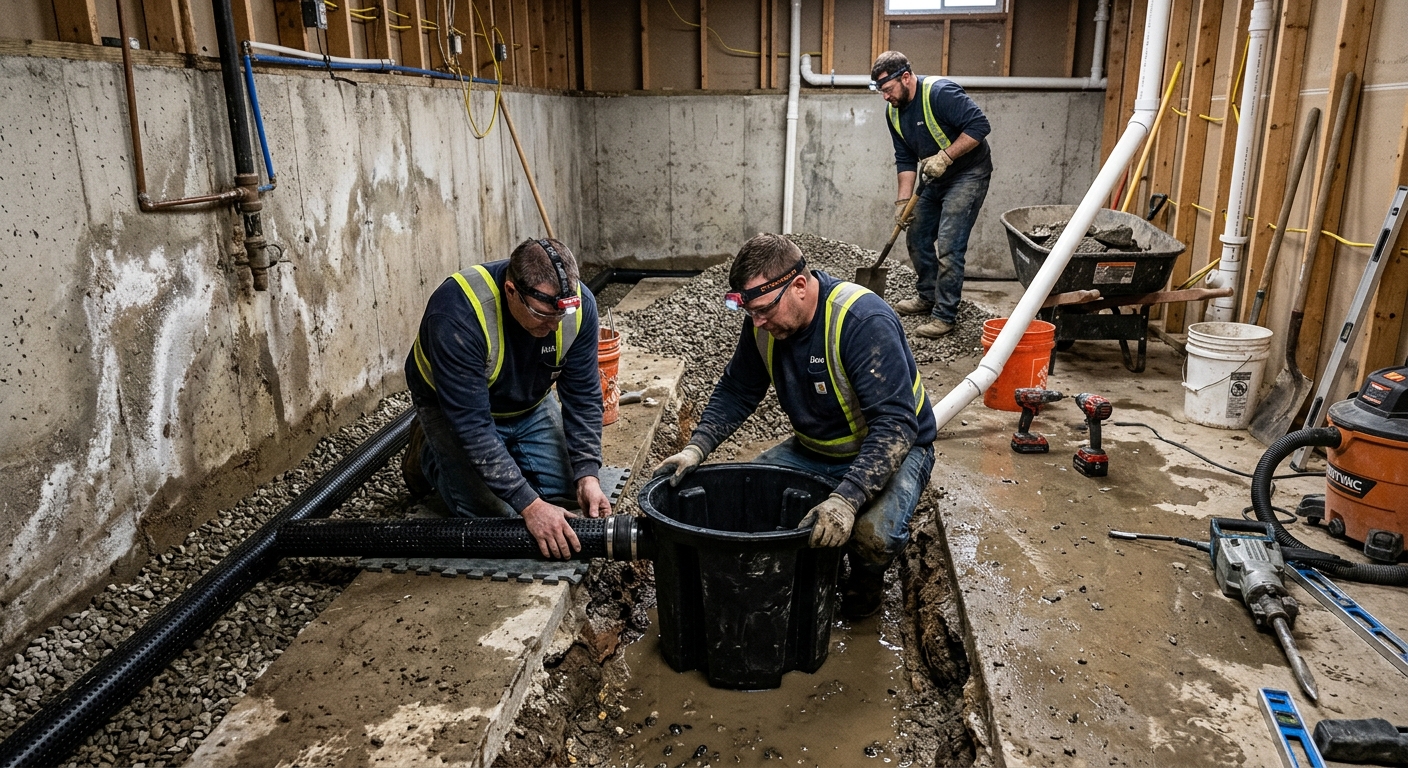
Basement waterproofing options and costs in Summerside
In Summerside, Alberta, basement waterproofing is usually about managing two problems at once: water intrusion through cracks and joints, and the hydrostatic pressure that builds behind foundation walls during spring melt and heavy rain. With a population of 7,976 (Statistics Canada, 2021 Census), Summerside may be smaller than nearby Calgary, but local soils and trades availability still follow the same Calgary-area patterns. Contractors often see the most recurring failures in older homes—many of which were originally built with early-generation waterproofing and weeping tile that can fatigue over time.
Calgary’s surrounding communities sit on predominantly clay and clay-till soils that hold water and expand when saturated. That expands lateral pressure on foundation walls, and the freeze–thaw cycles typical of southern Alberta widen existing cracks and joints. When weeping tile is clogged or undersized, seepage and efflorescence become common localized failure points rather than a single “all-at-once” breakdown. On the price side, Summerside projects can land higher than some flat-price marketing estimates when excavation is deeper, access is tight, or heavy clay spoils require disposal fees. Conversely, interior-only work can be more predictable where the leak is limited to one wall or where the foundation is already well-prepped and dry.
In practice, waterfront-adjacent and low-lying pockets—where runoff concentrates after snowmelt—tend to be where waterproofing calls spike. That’s why many homeowners around the newer infill edges and established mature streets near schools and parks prefer upfront exterior solutions when they’re already facing patio or landscaping disruption. Below is a practical comparison to help you line up scopes before you request itemised quotes.
| Method |
What It Addresses |
Disruption Level |
Durability |
Price Range |
| Exterior excavation + new membrane + drainage tile |
Water entry at foundation perimeter; rebuilds drainage path and reduces hydrostatic pressure |
High (excavate, remove landscaping/patios, backfill) |
Long-term (often the most complete fix for active perimeter water) |
$9,500 – $24,500 |
| Interior perimeter drain channel + sump pit |
Captures seepage after it enters; lowers water level around the foundation |
Medium (minor demolition; interior floor/wall access) |
Very good when paired with crack sealing and proper discharge |
$6,000 – $14,000 |
| Foundation crack injection (epoxy or polyurethane) |
Seals cracks; epoxy for structural/hairline stability, polyurethane for active seepage |
Low (core drilling/ports; localized cleanup) |
Good when the water source is controlled; limited alone under heavy hydrostatic pressure |
$600 – $1,800 |
| Sump pump installation (primary + battery backup) |
Reduces risk during power interruptions and heavy melt events |
Medium (sump pit excavation; electrical tie-in) |
High when discharge, check valves, and backup are done correctly |
$1,000 – $3,000 |
| Window well drain installation |
Prevents surface water from collecting around basement window wells |
Low to medium (excavate around wells; gravel/drain tie-in) |
Good for localized window-well leaks |
$1,200 – $3,200 |
| Lot re-grading / downspout extension |
Keeps roof runoff away from foundation; reduces recurring surcharge on perimeter soils |
Low (limited landscaping changes) |
Moderate (helps prevent, but doesn’t replace failed membranes/tile) |
$1,000 – $4,500 |
Prices are estimates only and vary by project scope, site access and material selection.
What affects the price of waterproofing in Summerside
In Summerside—and across the Calgary economic region—home waterproofing quotes for the “same” basement can vary by 30–50% because contractors price different scopes, risk levels, and site constraints rather than just the visible problem. Two crews may both call it “seepage control,” but one includes full interior drain coverage, proper sump discharge, and pre-seal remediation (mould/efflorescence), while another only treats a single wall section or assumes the drainage path is already functional.
The three biggest regional drivers versus a national baseline are soil type, water table conditions, and freeze–thaw intensity. Clay-heavy soils (common in parts of southern Alberta) expand when saturated, worsening the crack opening and lateral pressure over time. When that happens, a foundation that might look “fine” in late winter can show fresh horizontal staining after spring melt—meaning more prep and more crack work later. In pockets where groundwater and storm runoff build pressure along lower grades and coulees, sump systems can run more frequently and require more robust pump selection, discharge routing, and sometimes battery backup. Meanwhile, southern Alberta’s freeze–thaw cycles widen existing joints, so a patch that worked once can fail sooner if the underlying entry path isn’t addressed.
Concrete examples we often see in Summerside: (1) Tight side yards with mature landscaping can push exterior work into the higher end of the $9,000–$25,000 exterior band because excavation and re-grading are more labour-intensive; (2) a basement with localized efflorescence on a single wall may start around the $5,000–$15,000 interior waterproofing band, but only if the perimeter drain runs to a properly sized sump and the discharge line is cleared; (3) homes with older weeping tile (often 60+ years in mature neighbourhoods) may show chronic dampness, which typically forces a full interior perimeter approach or full exterior rebuild rather than simple crack injection alone.
| Price Factor |
Why It Matters |
Cost Impact |
| Interior vs. exterior approach — interior is less disruptive but addresses symptoms |
Interior controls water after entry; exterior reduces entry by rebuilding the perimeter drainage and membrane |
Interior often lands mid $5,000s–$15,000s; exterior often lands $9,000s–$25,000s due to excavation/backfill |
| Foundation type — poured concrete vs. block vs. stone vs. ICF |
Material dictates crack behaviour, sealing method, and how the drain ties into the foundation geometry |
Block walls commonly benefit from interior drainage; poured concrete often responds well to targeted injection when stable |
| Soil type — clay expands more than sand, adding pressure |
Saturated clay increases lateral pressure on walls and can keep foundations wet longer |
Higher labour for more complete drainage routing; may require exterior when clay pressure is persistent |
| Crack type and length — hairline vs. structural horizontal cracks |
Structural/horizontal cracks may indicate movement and require engineered assessment and/or broader remediation |
Hairline crack sealing can be modest; structural work increases labour and testing costs |
| Sump pump backup system — battery or water-powered backup needed |
Power outages during spring melt can leave basements vulnerable without backup |
Typically adds a portion of the $900–$3,000 band depending on system complexity |
| Access — landscaping, decks, or driveways must be removed for exterior |
Excavation depth and tight lot lines raise removal and re-installation labour |
Can swing exterior projects toward the upper end of the $9,000–$25,000 band |
| Weeping tile age — original tile (60+ years) may be completely failed |
Failed tile stops water from being carried away, increasing hydrostatic pressure |
Often pushes homeowners from “patch” solutions into full perimeter re-drain or full exterior rebuild |
| Mould or efflorescence remediation required before sealing |
Sealers don’t perform reliably on contaminated, powdery, or biologically active surfaces |
Adds prep time and materials; skipping it increases rework risk and warranty disputes |
Permits & regulations in Alberta
In Alberta, many waterproofing-related scopes are handled with permits because they change drainage, affect structural elements, or alter systems that connect to municipal infrastructure. In most cases, foundation excavation and work that involves structural crack repair beyond cosmetic sealing typically requires a building permit. If a contractor is repairing or modifying drainage that directs water to a different path on the property, permits and inspection documentation are commonly required as well.
Be especially cautious about sump installations that connect discharge to the storm system or sanitary system—those connections generally need municipal approval before work proceeds. For structural crack repair (for example, major step cracks, significant horizontal movement, or indications of shifting), a structural engineer’s assessment is often needed to confirm whether underpinning or other structural work is required. The waterproofing contractor should clearly state whether they will coordinate engineering support for structural repairs, and you should expect liability insurance and WSIB/WCB coverage details before signing.
What typically does not require a permit: minor cosmetic crack filling that is not structural, localized window-well drainage additions, and downspout extensions or re-grading that do not change drainage pathways into municipal infrastructure. Even then, contractors should confirm with the homeowner’s local permitting process—don’t assume.
To verify in Summerside, start with the contractor’s Alberta licence/registration where applicable, then request a certificate of insurance naming you as an interested party (if your contract requires it). Ask for WSIB/WCB clearance and keep the clearance letter on file. If the scope includes engineered structural crack work or modified drainage routing, confirm the permits will be pulled before labour starts and that inspection dates are scheduled in writing.
Interior vs exterior waterproofing — what does Summerside need?
Exterior waterproofing and interior waterproofing are fundamentally different in what they solve. Exterior waterproofing (full excavation, new membrane, new drainage tile, and backfill) targets the source of water entry by rebuilding the perimeter water-shedding and drainage path. It costs more and requires major landscape disruption, but in southern Alberta’s clay-and-freeze–thaw conditions, it’s the approach that most consistently reduces the water pressure cycle that re-opens cracks.
Interior waterproofing (perimeter drain channel, sump pit, and sump pump) manages water after it enters by lowering the water level around the foundation. It’s less invasive and often faster to start, but it doesn’t stop hydrostatic pressure from building against the wall itself. That’s why interior work performs best when leaks are primarily seepage through joints/cracks into the interior space, and when the foundation is stable. In Summerside, poured concrete walls often respond well to crack injection as a companion step, while block foundations more frequently need interior drainage as a practical complement because water pathways can travel through block joints and capillary channels.
Given Alberta’s spring power risks, a sump pump backup system matters. A primary pump with battery backup (or other approved backup method) reduces the “one outage, one flood” risk during melt events. For a home with repeating dampness, interior work can be justified—say a perimeter drain plus sump and pump backup in the ballpark of $6,000–$14,000—especially when excavation access is difficult. However, if your clay backfill is staying saturated and you have recurring efflorescence along multiple wall runs, spending closer to the $9,500–$24,500 exterior band can be the more cost-effective long-term move because it addresses entry and drainage at the perimeter instead of repeatedly capturing water indoors.
| Method |
Best For |
Addresses Source? |
Disruption |
Lifespan |
Price Band |
| Full exterior excavation + membrane |
Persistent perimeter leaks, saturated clay backfill, multi-wall efflorescence, failed or unknown drainage tile |
Yes (rebuilds perimeter water control) |
High |
Very long-term with proper backfill and drainage |
$9,000 – $25,000 |
| Interior French drain + sump system |
Seepage after entry, hydrostatic control where exterior access is limited |
No (captures and manages water after entry) |
Medium |
Long-term with well-sized sump/discharge and sealed penetrations |
$6,000 – $14,500 |
| Crack injection — epoxy (structural) |
Stable, non-active cracks; poured concrete and well-compacted foundations where movement is minimal |
Partly (seals entry paths if crack is stable) |
Low |
Good when hydrostatic pressure is controlled |
$500 – $1,800 |
| Crack injection — polyurethane (active leak) |
Active weeping at joints/cracks; minor movement and water flow through defects |
Partly (seals active pathways, but may not control bulk pressure alone) |
Low |
Good for seepage control when paired with proper drainage |
$600 – $2,000 |
| Interior drain channel only (no sump) |
Small seepage loads where continuous drainage to an existing system is reliable |
No (still depends on water pathways) |
Low to medium |
Moderate if discharge path remains functional |
$5,000 – $10,500 |
| Re-grading + downspout extensions |
Surface runoff-driven dampness, overflow from roof drainage, light recurring moisture without failed tile |
Somewhat (prevents surcharge at the perimeter) |
Low |
Moderate (prevention, not a membrane replacement) |
$1,000 – $4,500 |
How to choose a waterproofing contractor in Summerside
Start by confirming your contractor is properly set up in Alberta before you compare prices. Ask for proof of liability insurance and verify the certificate of insurance is current, with coverage that matches the risk of foundation excavation and interior demolition. For coverage under labour rules, request WSIB/WCB clearance (or the appropriate proof of coverage) and keep the document for your records. If the scope includes structural crack repair, ensure they can show engineering support for assessment and coordinate any required engineer involvement.
Next, get 2–3 itemised written quotes. You want a breakdown that separates labour, excavation/demolition, drainage tile and membrane materials, sump pit and pump, backfill and disposal, and electrical or backup system components. Avoid lump-sum quotes that don’t specify disposal included, permit pulling responsibility, or what is excluded (for example, basement repairs after membrane work, replacement of window wells, or reinstatement of flooring). Ask for the exact start date and a realistic completion estimate tied to weather, cure times, and inspection scheduling.
For payment schedule, plan to never pay more than 10–15% upfront. Use a holdback until the work is complete and the contractor provides the final closeout items (warranty paperwork, as-built notes for discharge routing, and documentation for any permits/inspections). Warranty should include both workmanship duration and product/manufacturer coverage details, and you should clarify whether the warranty is transferable if you sell your home.
- Request Alberta proof of licensing/registration relevant to the work type.
- Confirm liability insurance with current dates and coverage limits.
- Ask for WSIB/WCB clearance letter (or equivalent documentation).
- Get 2–3 itemised quotes with labour vs materials broken out.
- Confirm whether permits are pulled by the contractor or handled by the homeowner.
- Check what’s excluded: disposal, core drilling, wall/floor restoration, or engineering fees.
- Require a site plan description: where drainage tile/discharge will route.
- Ask how clay spoil disposal and backfill compaction will be handled (method matters).
- Verify sump pump specs and discharge line design (including check valves).
- Ask about backup power approach and what happens during outages.
- Confirm warranty length for workmanship and product warranty terms.
- Use a payment schedule with no more than 10–15% upfront and a holdback.
In Summerside, 4–5 red flags I’d watch for: (1) “One-size-fits-all” recommendations that skip probing crack cause and drainage condition; (2) no mention of clay backfill compaction or disposal for excavation; (3) vague quotes that don’t specify sump discharge routing, pump model, or backup method; (4) refusal to provide insurance/WSIB/WCB clearance or warranty paperwork in writing; (5) offering only interior sealing/pick-and-choose injection without explaining why exterior drainage isn’t required given freeze–thaw and recurring efflorescence.
Frequently asked questions — waterproofing in Summerside
How long does waterproofing last?
In Summerside and the wider Calgary region, waterproofing longevity depends on whether you’ve addressed the entry point or only managed water after it comes in. A properly installed exterior system (membrane + drainage tile + correctly compacted backfill) is designed for long-term performance, but it still depends on weeping tile condition, discharge route, and how freeze–thaw stresses the perimeter. Interior drainage systems can last many years when the sump pump, check valves, and discharge are maintained, but they may not stop pressure from repeatedly working at cracks. As a practical reference, exterior work typically sits in the $9,000–$25,000 band, while interior approaches commonly fall around $5,000–$15,000—cheaper solutions often require more maintenance attention in clay-heavy soils.
Can I waterproof my basement from the inside only?
Yes, interior waterproofing can be a good solution in Summerside when the main issue is seepage after water enters through cracks and joints. Interior methods—like a perimeter drain channel and sump pit—lower the water level inside the basement and reduce seepage stains and damp floors. However, with southern Alberta’s clay-and-freeze–thaw conditions, interior-only work doesn’t eliminate the hydrostatic pressure acting on walls, so it’s best when the foundation is stable and the crack pattern is consistent with non-structural or manageable seepage. If you have strong evidence of bulk water pressure on multiple walls, recurring efflorescence, or failed/unknown perimeter drainage, exterior excavation often becomes the more reliable long-term choice.
What causes foundation cracks in Summerside?
Foundation cracks in Summerside commonly come from soil moisture movement and seasonal freeze–thaw. Clay-heavy soils expand when saturated, which can increase lateral pressure on foundation walls and worsen existing cracks over time. During thaw cycles, meltwater and storm runoff can penetrate into joints, and then refreezing widens those pathways again. Older neighbourhood homes—often with aging or clogged weeping tile—may experience more persistent moisture pressure at the perimeter, which increases crack activity and staining. If you see major horizontal cracks, stair-step movement, or widening over time, treat it as a potential structural issue and don’t rely on simple sealing alone—an engineer assessment is often necessary in those cases.
How do I compare waterproofing quotes?
Compare quotes like-for-like. Ask each contractor to provide an itemised scope listing labour and materials, what’s included for disposal and backfill (for exterior), and what restoration is included after work. For interior jobs, confirm the drain layout, sump size, pump model, discharge routing, and whether backup power is included. Watch for quotes that only state a total and don’t define their approach to cracks, efflorescence remediation, or existing drainage tile condition. You can also use price bands as a sanity check: if one quote offers an “exterior solution” at an interior price (for example, $5,000–$15,000), ask what membrane and drainage tile scope is actually included. A solid contractor will explain trade-offs clearly and put assumptions in writing.
How long does basement waterproofing take in Summerside?
Timeline depends on whether you’re doing exterior excavation or interior drainage. Interior perimeter drain and sump systems often take less time than full exterior work because demolition and reinstatement are more limited. Weather can also affect scheduling in southern Alberta, because freeze conditions impact excavation, curing, and backfill work. As a general expectation, smaller interior scopes might be completed in days to a couple of weeks, while exterior projects with excavation, membrane installation, drainage tile, and landscape reinstatement can take several weeks due to access, inspections, cure times, and backfill compaction. If your job includes crack injection plus interior drainage, the installer may stage work to ensure the surface is properly remediated before sealing.
What is a weeping tile and does my Summerside home have one?
Weeping tile is a perimeter drain system installed around foundations (or within the foundation perimeter area) to collect groundwater and seepage, then carry it to a sump or discharge point. Many older homes in the Calgary region were built with original weeping tile, but those systems can fail from clogging, poor slope, collapsed sections, or undersizing—especially when clay soils stay saturated. Whether your Summerside home has weeping tile depends on your construction era and past renovations. A contractor can often verify it by reviewing original records, checking basement perimeter areas for drain outlets, and using inspection access where feasible. If the weeping tile is failed, interior drain systems with a sump or an exterior perimeter rebuild usually become the more dependable options.