Basement waterproofing options and costs in Parkview
In Parkview, Alberta, homeowners typically see basement moisture for three reasons: seasonal freeze–thaw stress on joints, water migrating through clay soils, and aging drainage systems that can’t keep up with spring runoff. With a total population of 3,327 (Statistics Canada, 2021 Census), Parkview is small enough that trades often know the recurring neighbourhood patterns—especially where yards sit on heavier clay and where original perimeter drains were never upgraded.
Pricing also reflects housing age and foundation conditions. Older homes in the area are more likely to have failing original tar-and-paper style waterproofing and corroded or collapsed weeping tile, which means “spot fixes” don’t always hold. Calgary-area costs can also skew upward because contractors must manage deeper excavation, tight lot lines, and disposal of clay spoils—common when the job requires full-perimeter work.
On the cold-weather side, southern Alberta’s freeze–thaw cycles widen existing cracks and joints, so water finds its way into the foundation and then expands the problem when it refreezes. In practical terms, that’s why you’ll see exterior waterproofing (membrane plus drainage tile) cost more—yet it most directly targets the source of water entry. Where exterior access is limited, interior solutions (perimeter drain channel, sump, and targeted crack repair) are often the smarter, lower-disruption pathway.
In Parkview, this trade is especially in demand around older pockets near established streets where driveways, mature landscaping, and concrete patios limit excavation access. Below is a clear comparison of the most common methods, their disruption level, and realistic cost bands to discuss with your installer.
| Method |
What It Addresses |
Disruption Level |
Durability |
Price Range |
| Exterior excavation + new membrane + drainage tile |
Primary water entry control by stopping infiltration at the foundation face; restores perimeter drainage |
High (excavation, backfill, landscaping reinstatement) |
High (when done to continuous exterior detail with proper backfill and connections) |
$9,000 – $25,000 |
| Interior perimeter drain channel + sump pit |
Intercepts water that enters; reduces hydrostatic pressure at the slab/wall junction |
Medium (interior footing/sump pit work; patching) |
Medium to high (depends on sump quality and discharge route) |
$5,500 – $13,000 |
| Foundation crack injection (epoxy or polyurethane) |
Stabilizes cracks; epoxy suits non-moving/hairline issues, polyurethane targets active seepage |
Low to medium (drilling ports and sealing) |
Medium (best when the crack is the main entry route) |
$700 – $1,800 |
| Sump pump installation (primary + battery backup) |
Moves collected water to keep the basement dry during high season and outages |
Low to medium (pit + discharge routing; electrical hookup) |
Medium (durability tied to pump grade, float switch, and maintenance) |
$1,100 – $3,000 |
| Window well drain installation |
Stops roof runoff/groundwater pooling near basement egress windows |
Low (localized excavation and piping) |
Medium (good when downspout routing and grading are corrected) |
$650 – $2,000 |
| Lot re-grading / downspout extension |
Redirects surface water away from foundation; reduces water load on perimeter drains |
Low to medium (soil rework, minor landscaping) |
Low to medium (can fail if site drainage still overwhelms the system) |
$500 – $3,200 |
Prices are estimates only and vary by project scope, site access and material selection.
What affects the price of waterproofing in Parkview
In Parkview, Alberta, two quotes for “the same basement issue” can differ by 30–50% because contractors price different ways of managing the root cause versus the symptoms. Some crews only add a sump and hope for the best; others assess soil saturation, crack movement, and drainage capacity, then design the full water-management pathway. In Calgary’s market, availability and crew scheduling also affect labour rates, especially in spring and early summer when everyone is booking freeze–thaw and spring-runoff repairs.
The three biggest drivers that separate Parkview costs from a typical national average are soil type, water table conditions, and freeze–thaw cycling. Clay-heavy soils common around Calgary hold water and expand as they saturate, increasing lateral pressure on foundation walls and making cracks re-open over time. Where high seasonal groundwater or storm runoff adds pressure, you’ll see longer pump run times and a stronger requirement for continuous perimeter drainage, often pushing projects toward the $9,000–$25,000 exterior band. Conversely, homes with manageable surface drainage and limited entry points may stay in the $5,000–$15,000 interior range.
Local examples that change pricing in Parkview: (1) a basement with multiple wall leaks often needs both crack injection and a drainage system rather than one standalone treatment; (2) a concrete patio at the foundation edge can require careful excavation sequencing and longer restoration work; (3) lots with downhill grading toward the house frequently need downspout extensions and re-grading before the waterproofing “holds,” otherwise the new system gets overloaded.
Older housing stock also plays a role in cost. When original weeping tile is 60+ years old, it may be completely failed or disconnected, so an “interior-only” approach can run continuously and cost more to manage long-term. If mould or efflorescence is present, remediation often must happen before sealing, adding material and labour time even though it isn’t the waterproofing membrane itself.
| Price Factor |
Why It Matters |
Cost Impact |
| Interior vs. exterior approach — interior is less disruptive but addresses symptoms |
Exterior stops infiltration at the source; interior manages water after entry |
Interior often lands around $5,000–$15,000; exterior can move to $9,000–$25,000 |
| Foundation type — poured concrete vs. block vs. stone vs. ICF |
Different crack patterns and sealability affect prep and system design |
Poured concrete crack repair may be cheaper; block often requires interior drainage support |
| Soil type — clay expands more than sand, adding pressure |
More pressure means more robust drainage and detailing are needed |
Clay conditions can increase excavation scope and sump capacity requirements |
| Crack type and length — hairline vs. structural horizontal cracks |
Active/separating cracks may demand different injection products and engineering review |
Active leaks and structural crack work can add drilling, materials, and analysis time |
| Sump pump backup system — battery or water-powered backup needed |
Reduces risk during spring outages and high run-time storms |
Backup commonly adds a meaningful equipment and installation premium |
| Access — landscaping, decks, or driveways must be removed for exterior |
Limits how quickly and how safely excavation can proceed |
Restricted access can increase labour days and restoration costs |
| Weeping tile age — original tile (60+ years) may be completely failed |
Failed tile means interior systems may become overloaded |
You may need exterior replacement or a more engineered interior drainage plan |
| Mould or efflorescence remediation required before sealing |
Moisture chemistry needs addressing before any coatings/membranes are applied |
Adds prep steps, cleaning, and drying time |
Permits & regulations in Alberta
In Alberta, some waterproofing-adjacent work is straightforward, while other portions trigger permitting because they can affect structure, drainage, or municipal services. As a rule of thumb for Parkview homeowners, foundation excavation, structural crack repair when it involves assessment/engineering-driven structural intervention, and changes to lot drainage typically require a building permit or at minimum a formal review path by the municipality. If a sump pump discharge route ties into a municipal storm or sanitary sewer, municipal approval is usually required before connection.
For major cracks—especially horizontal cracks in block walls or step cracking that may indicate movement—a structural engineer’s assessment is commonly expected to determine whether underpinning or other structural work is needed. If underpinning or structural components are included, permits are very likely.
Step-by-step, here’s how you verify contractor compliance for Alberta work:
- Ask for the contractor’s Alberta business/professional registration details and verify them through the appropriate online registry the contractor provides.
- Request a certificate of insurance showing general liability coverage and confirm the coverage is active for the project dates.
- Ask for WSIB/WCB clearance or documentation (depending on coverage requirements) and keep a copy for your records.
- For structural repair, confirm whether they have engineering support (either in-house engineering partner or contracted structural engineer) and that they will follow the engineer’s recommendations.
- Get the permit handling process in writing: who pulls permits, what triggers them, and what inspections are expected.
This is also where you protect yourself—if a contractor can’t show clear documentation for licensing, liability, and WSIB/WCB coverage, it’s hard to trust the workmanship on a problem that directly involves foundation performance.
Interior vs exterior waterproofing — what does Parkview need?
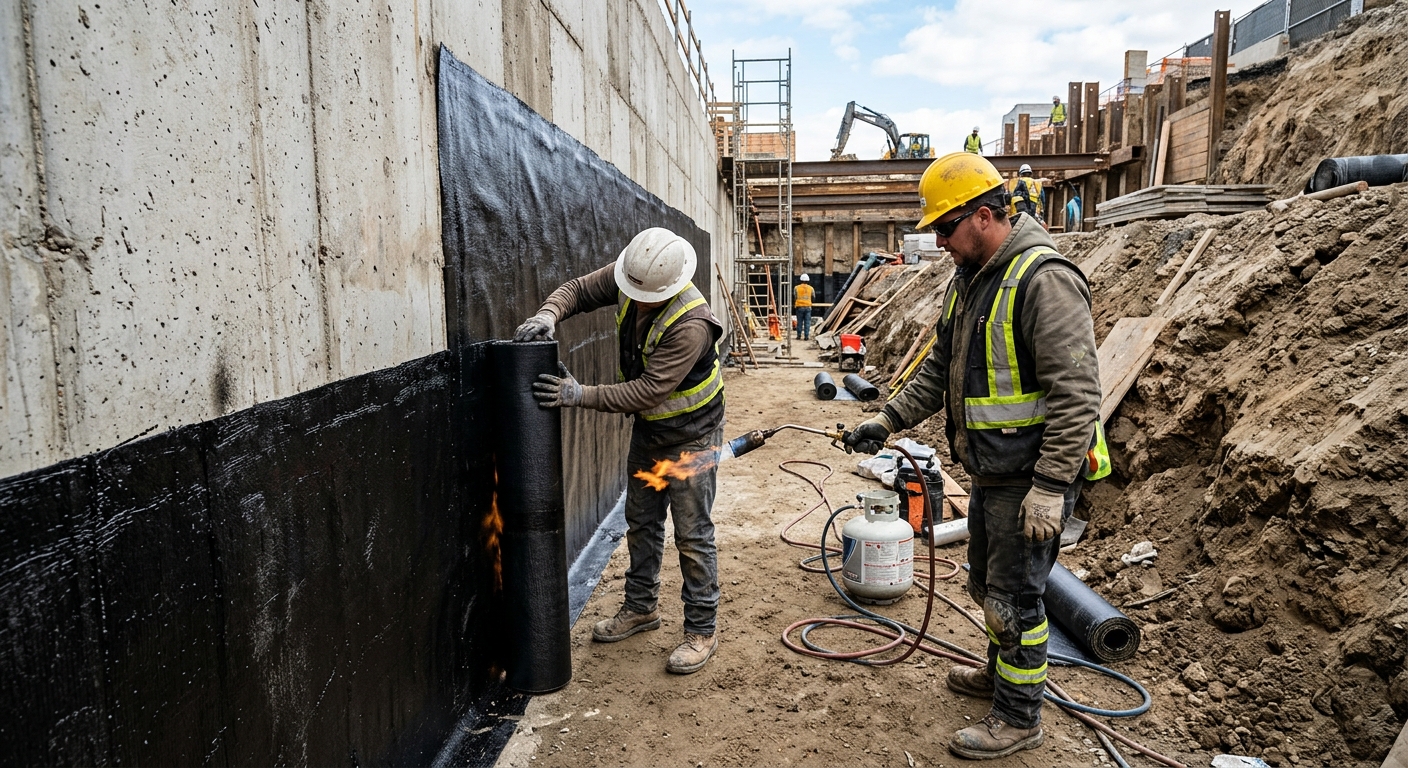
For most Parkview basements, the key difference is whether you stop water before it enters or manage it after it enters. Exterior waterproofing requires full excavation to the foundation, a continuous membrane system, new drainage tile, and properly engineered backfill. This targets the source, so it’s the most permanent solution when water pressure is coming from saturated clay and spring runoff. The trade-off is disruption: you’re removing landscaping, dealing with excavation access, and planning restoration.
Interior waterproofing—typically a perimeter drain channel, sump pit, and sump pump—captures water that already reached the basement and then reduces basement flooding and damp conditions. It’s less invasive and usually quicker to implement, but it doesn’t relieve hydrostatic pressure on the foundation wall itself. That matters in southern Alberta, where freeze–thaw widens cracks and joints. If your home is on clay soils that expand and push laterally, interior-only work can still perform, but it often needs a strong sump and, in many cases, crack injection as a complement.
Foundation type also guides the decision. Poured concrete walls often respond well to crack injection when cracks are the main entry path, while block foundations frequently benefit from interior drainage as a practical complement because joints and mortar areas can hold moisture paths. In Calgary-area power reliability during spring storms, sump pump backup systems (battery backup or water-powered options, depending on design) are a smart safety layer.
Budget reality: if you’re quoted near the interior band (around $5,000–$15,000) for a sump and perimeter drain, ask what’s being done about wall entry points. If you’re dealing with persistent water pressure, the exterior band (about $9,000–$25,000) can be justified because the added cost is directly tied to excavation, membrane continuity, and restoring perimeter drainage capacity—those are the elements that clay-and-freeze–thaw conditions tend to overpower.
| Method |
Best For |
Addresses Source? |
Disruption |
Lifespan |
Price Band |
| Full exterior excavation + membrane |
Ongoing seepage from saturated soils, higher lateral pressure, and failed perimeter drainage |
Yes |
High |
Long (when properly detailed and backfilled) |
$9,000 – $25,000 |
| Interior French drain + sump system |
Limited exterior access, manageable seepage after entry, and basements that need active water removal |
No (manages water after entry) |
Medium |
Medium to long (depends on sump capacity and maintenance) |
$5,000 – $13,000 |
| Crack injection — epoxy (structural) |
Non-moving, hairline, or stabilized cracks where water is minimal or intermittent |
Partially (stops seepage through crack paths if properly selected) |
Low |
Medium to long if the crack is stable |
$500 – $1,800 |
| Crack injection — polyurethane (active leak) |
Active seepage through cracks that reopen with freeze–thaw |
Partially (targets active pathway) |
Low to medium |
Medium (often paired with drainage/sump for best results) |
$700 – $1,900 |
| Interior drain channel only (no sump) |
Very mild moisture, occasional condensation, or situations where water volume is low |
No |
Low to medium |
Short to medium (may be overwhelmed during spring runoff) |
$2,500 – $7,500 |
| Re-grading + downspout extensions |
Surface-water driven wet walls, pooling near window wells, and short-term fixes before deeper work |
Source control for surface water |
Low to medium |
Short to medium (depends on yard slope and maintenance) |
$500 – $3,200 |
How to choose a waterproofing contractor in Parkview
Choosing the right contractor in Parkview means verifying coverage, then matching the scope to your actual water path. Start by confirming Alberta requirements: ask for proof of liability insurance (a current certificate naming you as certificate holder where possible), and request WSIB/WCB clearance or documentation that shows the contractor is compliant to work in Alberta. For licensing, don’t just accept “we’re insured”—ask where to check their status and get the reference number if applicable.
Next, get 2–3 itemised written quotes. You want a labour-and-material breakdown, not a single lump sum. The best quotes list excavation scope (if exterior), pipe sizing, membrane/product type, discharge location, crack prep and injection method, and whether disposal and restoration are included. Watch the exclusions section: if they don’t mention soil disposal, permit pulling, or restoration of sod/patio/steps, pricing gaps often show up later.
Warranty matters. Ask for a workmanship warranty length and confirm whether it covers labour only or also includes parts. Also ask about product/manufacturer warranty and whether the warranty is transferable to future owners if you sell. Payment schedule should be conservative: typically no more than 10–15% upfront, then staged payments based on completed milestones. Hold back a portion until the job is complete and cleaned up.
Finally, request a written timeline with an estimated start date, drying/curing expectations, and completion targets. Waterproofing isn’t just materials—it’s sequencing, inspection readiness, and protecting the membrane/system during backfill.
- Verify liability insurance is current and project-specific.
- Confirm WSIB/WCB clearance or documentation before work begins.
- Ask which permits they pull (and what triggers them for your specific scope).
- Get an itemised quote: labour, materials, excavation, disposal, and restoration.
- Confirm discharge route for sump discharge (and freezing considerations).
- Request sump pump specs and whether backup is included (battery vs water-powered).
- Ensure injection product matches crack behaviour (epoxy for stable cracks, polyurethane for active leaks).
- Ask how they protect landscaping and how restoration is handled for exterior jobs.
- Make sure mould/efflorescence remediation steps are included when present.
- Confirm the warranty length, what it covers, and whether it’s transferable.
- Set a milestone-based payment schedule with a holdback until final walk-through.
- Insist on written timelines and site access planning (patios, decks, driveways).
Red flags in Parkview: (1) they refuse to inspect the exterior/yard drainage or won’t discuss soil and crack type; (2) they suggest an interior-only sump without addressing active crack pathways; (3) they can’t show insurance/WSIB/WCB documentation; (4) they quote without disposal/restoration line items for exterior excavation; (5) they promise “guaranteed dryness” without discussing hydrostatic pressure and backup power considerations.
Frequently asked questions — waterproofing in Parkview
What is a weeping tile and does my Parkview home have one?
A weeping tile is the underground perimeter drainage pipe that sits around (or near) the foundation footprint and collects seepage water, then carries it away—either by gravity to a discharge point or into a sump. Many older Parkview homes had original weeping tile installed when the basement systems were built; however, clay soils and freeze–thaw cycles can cause tiles to collapse, become disconnected, or clog, which is why you may still get dampness or localized wall seepage even if a “tile” was once installed. The easiest way to confirm is through the basement wall penetrations and cleanout locations (if visible) or by video inspection from an accessible cleanout, combined with an exterior look for discharge outlets. If you’re budgeting, ask for whether a failed weeping tile is driving the issue—repairs can change whether your project fits closer to interior bands (around $5,000–$15,000) or requires exterior reconstruction.
Can I waterproof my basement in winter in Parkview?
In Parkview, you can often do interior waterproofing in winter, but full exterior excavation is commonly limited by ground conditions and curing needs. Interior work like perimeter drains, sump pit installation, and foundation crack injection can be scheduled when the basement is accessible and temperatures allow proper installation and curing. For exterior waterproofing, frozen soil, hard excavation conditions, and short window for backfill detailing may delay the membrane and drainage tile installation. A competent contractor will also consider freeze risk for discharge lines and ensure water can be managed safely. If spring runoff is your main concern, many homeowners prioritize interior measures ahead of freeze–thaw peaks—especially sump systems, which can still be within the $1,100–$3,000 range for pump installation (with backup if specified). For full exterior work, plan around when excavation and backfill quality can be maintained so the membrane detail performs as intended.
What is the difference between waterproofing and damp-proofing?
In Alberta residential basements, “damp-proofing” usually refers to basic surface protection designed to reduce minor moisture—think of it as a barrier for light seepage or condensation. “Waterproofing” typically means a more robust system intended to manage active water entry and hydrostatic pressure, such as a continuous exterior membrane with proper drainage tile and engineered backfill, or an interior drainage-and-sump design that intercepts water after it enters. In Parkview, dampness is often a symptom of a deeper drainage problem: clay soils hold water, and freeze–thaw can widen cracks and joints so water migrates through them. That’s why damp-proofing alone may not fix repeating wall leakage during spring melt. If you’re comparing quotes, ask what their system is designed to handle—intermittent seepage versus steady seepage. If the plan is only a coating, you may still be facing another round of work; stronger solutions usually land in the interior ($5,000–$15,000) or exterior ($9,000–$25,000) price bands depending on scope.
Will basement waterproofing affect my property value in Parkview?
Usually, yes—when it’s done properly and documented. In Parkview, prospective buyers often want reassurance that moisture issues won’t damage finishes or lead to recurring odours and mould risk. A waterproofing system with a clear scope, receipts, and a workmanship warranty can be a positive selling point, especially if you’ve had visible seepage or recurrent efflorescence. That said, value impact depends on the cause and the solution: a thorough exterior membrane plus perimeter drainage replacement (often in the $9,000–$25,000 band) tends to carry more confidence for buyers because it addresses water at the source. Interior drainage and sump systems (often in the $5,000–$15,000 band) can still be very effective, but they should be presented as a designed response to hydrostatic pressure and clay-heavy soil behaviour. Keep documentation—inspection notes, product specs, and warranty terms—so you can show the work was engineered for Calgary-area freeze–thaw conditions.
What drainage issues are most common in Parkview homes?
The most common issues in Parkview tend to be drainage capacity problems and foundation-water pathways rather than sudden “structural collapse” events. Clay-heavy soils can hold water and expand when saturated, which increases lateral pressure and makes cracks widen during freeze–thaw. Older weeping tile systems may be clogged or disconnected, so water no longer drains effectively, leading to seepage and efflorescence along basement walls. Another frequent problem is surface water management: downspouts that discharge too close to the foundation, uneven grading that directs runoff toward the basement, and pooling at window wells. Homeowners often also notice localized leakage at slab/wall junction areas where drainage detail and interior water interception matters. If you’re seeing spring-time wall moisture, it’s important to diagnose whether the issue is mainly surface runoff, interior interception, or exterior infiltration pressure—because that diagnosis is what determines whether you’re closer to exterior excavation ($9,000–$25,000) or an interior perimeter drain and sump approach ($5,000–$15,000).
How do I choose a waterproofing contractor in Parkview?
Start with compliance: ask for a current certificate of liability insurance and WSIB/WCB clearance or documentation, then verify licensing/registration details through the appropriate online channels the contractor provides. Get 2–3 itemised quotes that separate labour and materials, including disposal and restoration for exterior jobs. Read the scope line-by-line: ask if permits are included, whether sump discharge will be handled with freezing-safe routing, and whether they’ll remediate mould or efflorescence before sealing. Confirm the product approach matches the crack behaviour—epoxy for stable cracks versus polyurethane for active leaks. Warranty should be in writing, including workmanship coverage and product terms, and ask whether warranties are transferable. On payment, avoid paying more than 10–15% upfront and negotiate holdback until the final walk-through. For Parkview specifically, also ask how they design for Calgary-area freeze–thaw and clay soil pressure, and whether backup sump power is recommended; a proper plan can be the difference between a short interior fix and a longer-term solution.