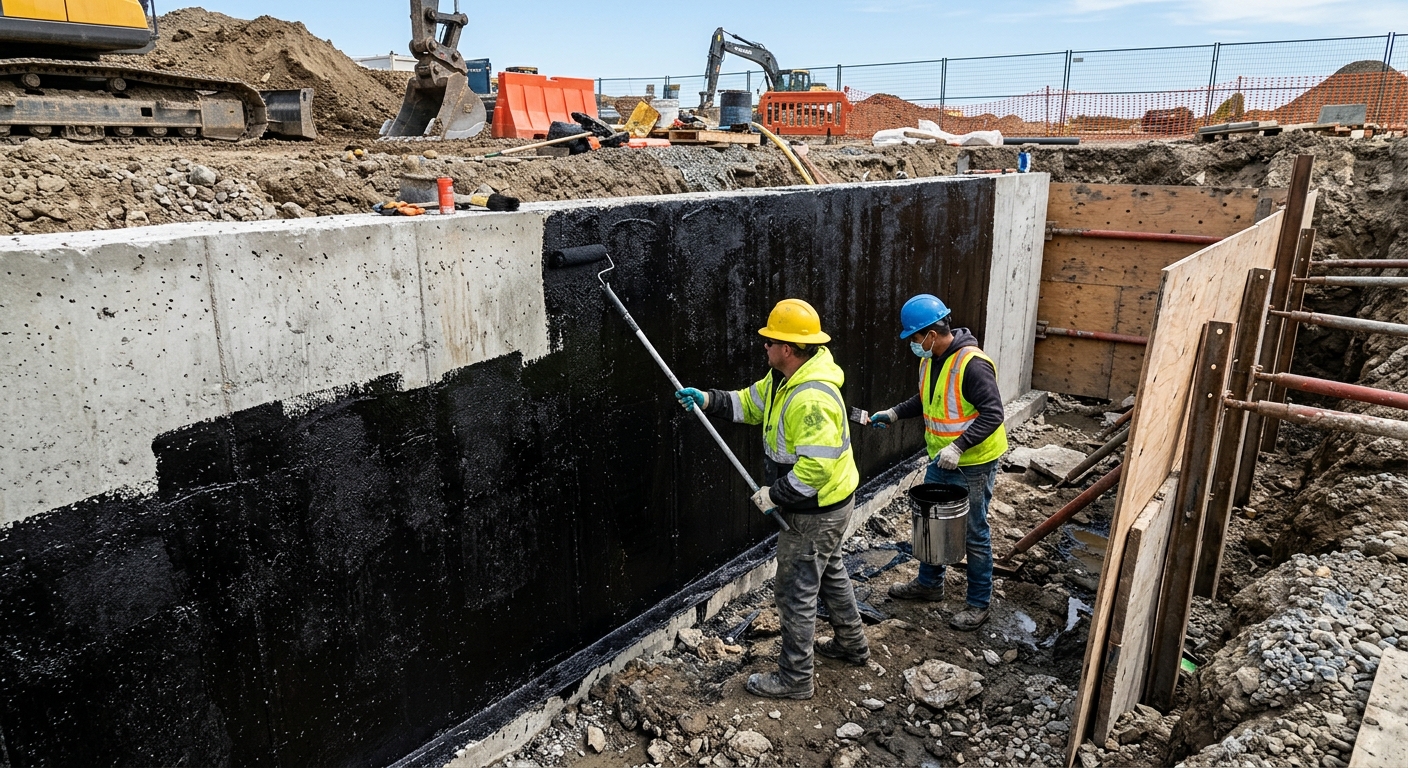
Basement waterproofing options and costs in Wildwood
In Wildwood, Alberta, homeowners usually face basement moisture issues that start small (damp corners, musty odours, seasonal seepage) and then worsen when spring melt and freeze–thaw cycles keep widening foundation cracks and joints. With a population of 2,765 (Statistics Canada, 2021 Census), the local contractor pool is smaller than in Calgary, so scheduling can be tighter—but experienced crews still travel regularly for exterior excavations. If your home is older, you’ll often see failures in the original waterproofing system: corroded or clogged weeping tile and worn membranes that stop being continuous around penetrations and footing edges. On clay-heavy sites, water is retained near the foundation longer, increasing lateral pressure on basement walls and pushing water through hairline pathways.
Calgary-area pricing in Wildwood typically tracks national ranges but rises when the job needs a full-perimeter system or deep excavation. Southern Alberta’s freeze–thaw environment makes it especially important to restore drainage function (weeping tile, sump discharge, and downspout routing) rather than just “patch and paint.” In neighbourhoods near newer infill pockets around the Wildwood area where lots are tighter and access is more constrained, we frequently see costs driven by excavation staging, spoil disposal, and backfill compaction requirements. That’s why comparing methods matters—some options manage the water after it enters, while others address the source.
Use the table below to compare common approaches and realistic cost ranges, then match the method to your foundation type and the pattern of leaks.
| Method |
What It Addresses |
Disruption Level |
Durability |
Price Range |
| Exterior excavation + new membrane + drainage tile |
Hydrostatic pressure at the footing, continuous water barrier, perimeter drainage to sump |
High (excavation, landscaping removal, backfill) |
High (system-level continuity with proper backfill and compaction) |
$9,000–$25,000 |
| Interior perimeter drain channel + sump pit |
Water that has entered or is migrating through the footing zone; controls weeping and seepage |
Medium (limited interior concrete work) |
Medium to High (depends on sealing strategy and maintenance) |
$5,000–$15,000 |
| Foundation crack injection (epoxy or polyurethane) |
Hairline seepage pathways and crack movement (epoxy for structural/active-crack controlled scenarios; polyurethane for active leaks) |
Low to Medium (small drilling and patching) |
Medium (best when paired with drainage control) |
$500–$1,800 |
| Sump pump installation (primary + battery backup) |
Prevents interior flooding during peak spring runoff and power outages |
Low to Medium (cutting/finishing around sump location) |
High when discharge, check valves, and backup are installed correctly |
$900–$3,000 |
| Window well drain installation |
Localized water entry at below-grade windows (heavy clay sites often collect water around penetrations) |
Low (targeted excavation/pipework) |
Medium to High (depends on grading and discharge route) |
$800–$2,400 |
| Lot re-grading / downspout extension |
Redirects surface water away from foundation; reduces recharge of saturated soils |
Low to Medium (soil/landscaping changes) |
Medium (works best with existing drainage) |
$600–$3,500 |
Prices are estimates only and vary by project scope, site access and material selection.
What affects the price of waterproofing in Wildwood
Two waterproofing quotes for the “same” basement in the Wildwood area can differ by 30–50% because Calgary-area work isn’t only about materials—it’s about excavation difficulty, drainage system design, and how much concrete and landscaping must be removed to get reliable results. In Alberta, contractors also price in seasonal risk: crews schedule around spring ground saturation and freeze periods because excavation in heavy clay can turn a one-week job into a two-week job when soils won’t support safe excavation or proper compaction.
The three biggest drivers that separate local costs from the national average are soil type, water table conditions, and freeze–thaw. Clay-heavy soils common around Calgary retain water and expand when saturated, which increases lateral pressure on foundation walls and worsens cracks over time. When there are pockets of higher seasonal groundwater, sump pumps run more often and require discharge planning, check valves, and reliable power (including backup). Freeze–thaw widens existing joints and allows meltwater and spring runoff to penetrate along crack lines; that’s why a simple crack patch often costs less at first but can fail sooner. In older housing stock, especially where weeping tile has been installed decades ago, clogged or failed tile can turn a “dry basement” plan into an active seepage fix.
In Wildwood specifically, costs can be higher when exterior access is tight (driveways, patios, or landscaped beds near side lot lines), or when excavation reaches footing depth in clay spoils that require careful disposal and re-compaction. Costs can drop when you can concentrate work on a single wet wall with targeted interior drainage and crack injection; for example, a small injection scope might sit near the $500–$1,800 band, while a full exterior membrane approach typically falls in the $9,000–$25,000 band. The age of your foundation and the pattern of leaks (corner dampness vs. long wall seepage) often determine which end of the price range you land on.
| Price Factor |
Why It Matters |
Cost Impact |
| Interior vs. exterior approach — interior is less disruptive but addresses symptoms |
Interior drainage manages water after entry; exterior addresses the water pathway at the source |
Interior often costs less initially, but exterior can prevent repeat failures on clay sites |
| Foundation type — poured concrete vs. block vs. stone vs. ICF |
Block and older wall systems often need interior drainage as a practical complement to any sealing |
Poured concrete may respond better to crack injection; block can require more excavation/drain work |
| Soil type — clay expands more than sand, adding pressure |
Clay saturation increases hydrostatic pressure and crack reopening during freeze–thaw |
Higher likelihood of active leakage controls and sump/backup planning |
| Crack type and length — hairline vs. structural horizontal cracks |
Structural movement changes the repair strategy (engineering assessment vs. routine injection) |
Structural repairs can push costs up quickly beyond basic injection scopes |
| Sump pump backup system — battery or water-powered backup needed |
Power reliability matters during spring runoff and outage events |
Adding backup increases pump system cost but can prevent damage during outages |
| Access — landscaping, decks, or driveways must be removed for exterior |
Exterior waterproofing requires excavation and staged removal of obstacles |
More site prep and restoration can add significant labour and disposal costs |
| Weeping tile age — original tile (60+ years) may be completely failed |
Old tile often clogs or separates, causing water to bypass drainage |
Replacement and re-routing increases labour and material quantities |
| Mould or efflorescence remediation required before sealing |
Sealing over active salts or contamination reduces long-term performance |
Additional prep adds time and materials before membrane or coatings can be applied |
Permits & regulations in Alberta
In Alberta, certain foundation-related work typically requires a building permit, particularly when the scope involves structural elements or changes to how water is directed away from the lot. Foundation excavation and structural crack repair often fall under permit requirements because the work can affect load paths or involve trade skills that must be inspected. If your project includes changes to lot drainage—such as redirecting downspouts, altering grading near foundation walls, or installing systems that affect how water leaves the property—expect that a permit or municipal approval may be required depending on how it’s executed and where it discharges.
Sump pump installations can also trigger municipal approval if the discharge connects to storm or sanitary sewer systems. If the discharge is routed properly to daylight or to an approved infiltration/discharge point (as permitted for your site), it may be simpler—still, your contractor should confirm the route and approvals before work starts. For structural crack repair—especially horizontal cracks in block walls or major step cracks—an engineer’s assessment is often required to determine whether underpinning or additional structural work is needed. Before you proceed, verify the contractor has engineering support for structural scopes, carries liability insurance, and has WSIB/WCB coverage where applicable.
To verify in Wildwood, ask for: (1) proof of Alberta business licence/registration details (as applicable), (2) a current certificate of liability insurance, and (3) WSIB/WCB clearance. You can cross-check the licence details and insurance information by requesting certificates directly and reviewing the certificate’s named insured and coverage dates. For approvals tied to discharge or structural changes, confirm the permit pull responsibility in writing—don’t assume it’s included.
Interior vs exterior waterproofing — what does Wildwood need?
Wildwood basements usually need a decision between source control and symptom control. Exterior waterproofing—full excavation, new membrane, new drainage tile/perimeter drain, then backfill—targets the water entry point at the foundation exterior. It’s the most permanent approach when soil is clay-heavy and holds water against basement walls for long periods, because it restores continuity and lets gravity carry water to the drainage system. The trade-off is cost and disruption: exterior work often requires removing landscaping, patios, or sections of hardscape, and it’s labour-intensive because proper backfill compaction is critical in freeze–thaw conditions.
Interior waterproofing—perimeter drain channel, sump pit, and sump pump—addresses the water after it enters the basement. It reduces disruption and can perform extremely well in the right scenarios, especially when exterior access is constrained or when the foundation shows signs of seepage through the footing zone rather than widespread exterior membrane failure. However, interior solutions don’t stop hydrostatic pressure from stressing the wall; they just relieve it by collecting and pumping infiltrated water. For poured concrete walls, crack injection can be a practical complement, while block foundations often benefit from interior drainage as a practical complement to sealing because water can migrate through masonry joints and micro-paths.
Alberta spring outages and power dips make sump backup systems a major quality differentiator. A basic sump may manage most days, but in a heavy melt or extended rain, backup helps protect finishes and flooring. For example, when you’re deciding between a focused interior solution and exterior excavation: if exterior excavation is limited to a single area, the job may sit nearer the interior bands ($5,000–$15,000), but a full-perimeter exterior membrane system can be justified when repeated seepage shows ongoing water entry—especially in clay soil—where costs commonly fall in the $9,000–$25,000 range. Choose based on leak pattern, foundation type, and whether water is entering consistently around the perimeter or only from isolated spots.
| Method |
Best For |
Addresses Source? |
Disruption |
Lifespan |
Price Band |
| Full exterior excavation + membrane |
Widespread seepage, evidence of failed exterior waterproofing, high seasonal moisture in clay soils |
Yes (at the foundation exterior water entry point) |
High |
High (system-level if drainage and compaction are correct) |
$9,000–$25,000 |
| Interior French drain + sump system |
Water migration into basement, older tile failures where exterior isn’t feasible, episodic spring seepage |
No (manages water after entry) |
Medium |
Medium to High (improves with proper pump/discharge/backup) |
$5,000–$15,000 |
| Crack injection — epoxy (structural) |
Non-active, structurally appropriate cracks in poured concrete where water has stopped or is controlled |
Partial (seals crack pathway, but relies on drainage control) |
Low to Medium |
Medium |
$500–$1,800 |
| Crack injection — polyurethane (active leak) |
Active weeping cracks where water pressure is finding a way through joints |
Partial (stops the crack pathway, still benefits from drainage) |
Low to Medium |
Medium to High when paired with interior or exterior drainage |
$500–$1,800 |
| Interior drain channel only (no sump) |
Minor seepage, lower-risk moisture, where gravity drainage is possible and discharge is controlled |
No (manages water after entry) |
Medium |
Low to Medium (performance depends on discharge reliability) |
$4,000–$10,000 |
| Re-grading + downspout extensions |
Surface-water driven dampness and overflowing roof runoff that saturates clay near the foundation |
Yes (reduces recharge at the perimeter) |
Low to Medium |
Low to Medium (best as part of a fuller waterproofing plan) |
$600–$3,500 |
How to choose a waterproofing contractor in Wildwood
Start by verifying the essentials. In Alberta, confirm the contractor is properly registered to do the work they’re proposing and carries liability insurance—ask for a current certificate of insurance showing your contractor as the named insured. Next, request WSIB/WCB clearance or proof of coverage (not just a statement). Then, for any structural scope, make sure they either provide engineering support directly or will coordinate with an engineer, and that this is written into the proposal.
Get 2–3 itemised written quotes instead of lump sums. You want a labour + materials breakdown that clearly lists excavation depth (for exterior), membrane type and coverage details (for exterior), drain and sump specifications (pipe size, pump model tier, check valves, discharge route), and concrete repair or patch scope. Read the exclusions: confirm whether the quote includes permit pulling (if required), disposal fees for clay spoils, restoration of landscaping/hardscape, and concrete reinstatement to a specified finish level. Warranty matters too: ask for workmanship warranty length and whether the product/manufacturer warranty applies to your installation—and whether it’s transferable if you sell your home.
For payment, never allow more than 10–15% upfront. Use a holdback tied to completion and final inspection of the system components. Finally, get the start date and an estimated completion window in writing, including seasonal realities in Wildwood’s freeze–thaw cycle.
- Request contractor registration details and verify them before signing.
- Confirm current certificate of liability insurance with coverage dates.
- Ask for WSIB/WCB clearance documentation (not a verbal guarantee).
- Require itemised quotes showing labour, materials, and disposal/restoration.
- Check whether permit pull is included for excavation/structural changes.
- Ensure the proposal includes discharge routing for sump pumps (where it goes and how it’s protected).
- Ask about check valves and backup power (battery or water-powered backup).
- Confirm drainage pipe type, slope, and how outlets are protected from freezing.
- For crack injection, require a plan identifying crack type and the correct injection material.
- Get warranty details in writing: workmanship and manufacturer/product warranty terms.
- Use a payment schedule with a holdback until the system is fully verified.
- Clarify site restoration scope: topsoil, grading, sod/seed, and hardscape reinstatement.
In Wildwood, common red flags include: a contractor who quotes exterior waterproofing without discussing compaction and drainage tie-in; ignoring sump discharge routing details; offering crack injection without addressing ongoing water pressure (no drainage plan); providing only a vague scope with no manufacturer details or warranty terms; and asking for a large upfront payment before any site protection or inspections are complete.
Frequently asked questions — waterproofing in Wildwood
How does Wildwood's soil affect my foundation?
Wildwood homes commonly sit on soils that can behave like clay-and-clay-till: when they saturate, they hold water longer and expand during freeze–thaw. That expansion increases lateral pressure on basement walls and can reopen cracks or loosen joints, especially around the footing where water has multiple pathways. In practice, that means a “dry” basement in late summer can turn into spring seepage once snowmelt and heavy rains saturate the ground again. If your weeping tile is older or clogged, the saturated soil may push water inward even when the problem seems minor at first. For homeowners, the fix isn’t only sealing—reliable drainage and, when needed, a sump with backup becomes part of the long-term solution (Statistics Canada, 2021 Census).
Do I need a permit for foundation work in Alberta?
Often, yes—especially when the work involves foundation excavation, structural crack repair, or changes to lot drainage practices that could affect how water leaves the property. In Alberta, contractors typically coordinate permits for foundation-related work that has inspection requirements, and structural scopes may require an engineer’s assessment before any repair plan is approved. A sump pump installation may also require municipal approval depending on where discharge is routed (for example, to storm or sanitary systems). For Wildwood homeowners, the simplest verification step is to ask your contractor to state in writing whether a permit is required and who pulls it. You should also confirm the contractor carries the correct engineering support when structural cracks are involved, and that the scope matches what the permit (if any) covers.
How long does waterproofing last?
With the right method for your conditions, waterproofing can last many years, but the “lifespan” depends heavily on whether you addressed the source of water entry and whether drainage stays functional. Exterior membrane systems paired with new perimeter drainage and properly compacted backfill generally perform the longest on clay sites. Interior solutions can also last a long time when they’re designed correctly (proper perimeter drain slope, correct sump sizing, and reliable discharge), but they may not fully prevent wall stress caused by hydrostatic pressure. Crack injection can be effective too, especially with the correct material (epoxy vs. polyurethane), though it works best when paired with drainage control. In Wildwood, if you’re choosing between a targeted fix near $500–$1,800 and a more complete drainage strategy in the $9,000–$25,000 band, think about whether you’re treating a symptom or stopping recurring water entry.
Can I waterproof my basement from the inside only?
Yes, you can often improve a basement from the inside—especially if the main issue is seepage through the footing zone and your exterior access is limited. A perimeter drain channel and sump pit can capture infiltrating water and prevent standing moisture, which is crucial for preventing mould and mineral staining. However, interior-only waterproofing doesn’t remove hydrostatic pressure acting on the wall; it manages what gets in. In Wildwood’s freeze–thaw climate, that’s why interior work is frequently paired with crack injection or targeted sealing, particularly for poured concrete where cracks can be injected effectively. If your leak pattern is widespread around the perimeter or you have signs the exterior membrane has failed, interior-only approaches may be a temporary relief. For higher-risk situations on clay-heavy soils, exterior waterproofing is usually the more durable long-term option.
What causes foundation cracks in Wildwood?
In Wildwood and the wider Calgary region, foundation cracks are commonly driven by soil moisture cycling and freeze–thaw movement. Clay soils can expand when saturated, exerting pressure on basement walls and footings. As winter arrives, repeated freezing and thawing can widen existing cracks and compromise joint seals, allowing meltwater and spring runoff to penetrate. Older neighbourhoods also tend to have aging drainage systems; when weeping tile clogs, water can build up against the foundation more frequently. Cracks can be hairline (often more responsive to crack injection when active leakage is controlled) or structural (such as horizontal or major step cracks), which requires a different approach—often including an engineer’s assessment. If you see step cracks in block walls or a crack that changes over seasons, don’t assume injection alone is the solution.
How do I compare waterproofing quotes?
Compare quotes like you would compare a construction schedule: look past the bottom-line number and focus on scope, materials, and responsibilities. Ask for itemised details (labour + materials), whether disposal and restoration are included, and who pulls permits if needed. For interior work, confirm the sump plan: pump spec tier, discharge route, check valves, and whether backup power is included. For crack injection, make sure the contractor identifies crack type and uses the appropriate injection material—epoxy for structural/controlled scenarios and polyurethane where there’s active leak seepage. Also check warranty terms: workmanship length and whether manufacturer warranty applies to your install. If one quote suggests only a small repair near $500–$1,800 while another proposes a full system closer to $9,000–$25,000, ask what evidence supports the difference (leak pattern, soil drainage, and whether exterior source control is feasible).