Basement waterproofing options and costs in Broadmoor
In Broadmoor, homeowners usually start by comparing basement waterproofing options that fit both their budget and the kind of water problem they’re seeing. Broadmoor’s population is 23,050 (Statistics Canada, 2021 Census), and like many Lower Mainland communities, a meaningful share of homes are older enough to have original drainage components that can fail—especially weeping tile systems installed decades ago. When those perimeter drains stop working, you often get recurring seepage at the foundation-to-slab seam, damp concrete corners, or puddling in low spots.
Lower Mainland–Southwest costs are shaped by persistent hydrostatic pressure from high groundwater and intense, prolonged rainfall. Even when temperatures are mild, the frequent freeze-thaw cycles common to coastal BC can widen existing cracks and joints, letting water find a way in and then accelerating deterioration. That’s why excavation-based waterproofing can be labour-intensive here: tight lots, landscaping removal, and sometimes mechanical breaking through rocky sections can raise labour hours and equipment costs. At the same time, the region’s older housing stock—particularly around older residential pockets in/near Broadmoor’s central neighbourhood streets—creates steady demand for both exterior drain tile replacement and interior retrofits.
Below is a practical comparison of common approaches and typical Broadmoor price ranges so you can benchmark contractor quotes, then we’ll dig into what drives those differences.
| Method |
What It Addresses |
Disruption Level |
Durability |
Price Range |
| Exterior excavation + new membrane + drainage tile |
Stops water at the source by replacing/relining the drainage path and installing exterior waterproofing system |
High (excavation, landscaping removal, backfill) |
High (system designed for long-term hydrostatic conditions) |
$15,000–$30,000 |
| Interior perimeter drain channel + sump pit |
Collects seepage after water enters; reduces interior hydrostatic pressure |
Medium (floor cutting, minor wall work) |
Medium-High (depends on sump maintenance and drainage performance) |
$8,000–$18,000 |
| Foundation crack injection (epoxy or polyurethane) |
Seals cracks and channels flow; polyurethane is used when there’s active leakage |
Low-Medium (surface prep, localized drilling) |
Medium (best when combined with drainage control) |
$500–$2,000 |
| Sump pump installation (primary + battery backup) |
Manages groundwater inflow and prevents overflow during heavy rain/backup power loss |
Low-Medium (sump pit, electrical work) |
Medium-High (backup improves reliability during power events) |
$1,000–$5,000 |
| Window well drain installation |
Stops water intrusion at basement window wells and reduces dampness near egress points |
Low-Medium (excavate around window well) |
Medium (requires clear outlet/drainage path) |
$2,500–$6,500 |
| Lot re-grading / downspout extension |
Moves surface water away from the foundation to reduce ongoing saturation |
Low (light excavation/landscaping changes) |
Low-Medium (helps, but may not solve high groundwater) |
$2,000–$8,500 |
Prices are estimates only and vary by project scope, site access and material selection.
What affects the price of waterproofing in Broadmoor
Even when two homeowners describe the “same” basement problem in Broadmoor, quotes can vary by 30–50% across the Lower Mainland–Southwest region and compared with other parts of British Columbia because waterproofing isn’t a one-size job. The biggest reasons are (1) how much water pressure you’re fighting, (2) how you’ll manage it, and (3) how difficult the site is to access. In practice, contractors may propose different scopes: an exterior system to control water at the source, an interior drainage solution to manage entry, or a hybrid approach when conditions are mixed.
The three most important drivers that separate regional costs from the national average are soil/water, freeze-thaw, and foundation performance. First, soil type: Lower Mainland soils more often create problems through persistent saturation and drainage challenges rather than extreme seasonal expansion. Still, if you have heavier, moisture-retentive soils, the constant wetting can increase seepage at joints. Second, water table and hydrostatic pressure: high groundwater in the Lower Mainland keeps hydrostatic pressure active longer, so sumps may need more capacity and backup readiness. Third, freeze-thaw cycles: coastal BC rainfall saturates backfill quickly when drainage fails, and then freeze-thaw widens micro-cracks and joints—accelerating leakage paths. Regions with older housing stock also see more frequent failing weeping tile and dampness at poured-concrete or block foundation walls.
Here are a few concrete Broadmoor examples that move the price up or down. If the original perimeter drain is 60+ years old and is no longer flowing, replacing exterior drainage can push projects toward the $15,000–$30,000 band. If the leak is mostly at a specific joint and the foundation is stable, crack injection can be a smaller-ticket fix around the $500–$2,000 band—but only after drainage controls are confirmed. Conversely, an interior drain channel plus sump can land in the $8,000–$18,000 range when access rules make full excavation impractical, such as decks, mature landscaping, or tight urban grading lines. Finally, if you require mould or efflorescence remediation before sealing, materials and labour rise because surfaces must be properly cleaned and dried for coatings or membranes to bond.
| Price Factor |
Why It Matters |
Cost Impact |
| Interior vs. exterior approach — interior is less disruptive but addresses symptoms |
Exterior controls water at the source; interior manages water after it enters |
Interior can be 30–50% less disruptive, but may not eliminate hydrostatic pressure against the wall |
| Foundation type — poured concrete vs. block vs. stone vs. ICF |
Different materials crack differently and accept repairs differently (seal/fit varies) |
Block and older walls often require complementary drainage; costs tend to be higher for combined systems |
| Soil type — clay expands more than sand, adding pressure |
Moisture-retaining soils can increase saturation and lateral effects at joints |
More active seepage typically increases the need for sump capacity and exterior measures |
| Crack type and length — hairline vs. structural horizontal cracks |
Structural cracks may indicate movement and require engineering or underpinning discussions |
Structural repairs can move pricing upward beyond simple injection |
| Sump pump backup system — battery or water-powered backup needed |
BC weather can create high inflow events and power disruptions; backups reduce failure risk |
Backup increases equipment and wiring costs, but can prevent costly overflow damage |
| Access — landscaping, decks, or driveways must be removed for exterior |
More demolition and restoration increases labour and disposal |
Can be a major swing factor when excavation is required on tight Broadmoor lots |
| Weeping tile age — original tile (60+ years) may be completely failed |
Non-functioning drainage increases saturated backfill and ongoing inflow |
Replacement pushes exterior projects toward the high end of the band |
| Mould or efflorescence remediation required before sealing |
Sealers and membranes need clean, dry substrates to bond and perform |
Adds cleaning, drying time, and sometimes temporary containment |
Permits & regulations in British Columbia
In British Columbia, foundation excavation, structural crack repair, and changes to lot drainage typically require a building permit. If a contractor proposes work that meaningfully affects structural integrity—such as addressing horizontal cracks in block walls or step cracks that could indicate movement—planning an evaluation with the right professionals is essential. In many cases, the homeowner’s permit path will involve a structural engineer’s assessment to determine whether underpinning, wall stabilization, or other structural measures are needed before sealing or drainage work proceeds.
Sump pump installations that connect to the storm or sanitary sewer generally need municipal approval and must be installed to meet applicable drainage requirements. Installing a standalone sump discharge that’s routed within the parameters of local direction may be simpler, but “tie-in” and discharge location rules still need confirmation.
For a Broadmoor homeowner, the best step-by-step verification is to ask the contractor for three things and check them before signing: (1) licence/registration information relevant to their trade—confirm the status on the applicable BC online registry or in their business documentation; (2) certificate of insurance naming you (or your property as required) for general liability and any specified additional insured wording; and (3) clearance evidence for WSIB/WCB coverage (or an equivalent clearance letter and current account proof, where applicable). Then, for any structural crack work, confirm they have engineering support available and can provide the engineer’s involvement plan in writing.
Interior vs exterior waterproofing — what does Broadmoor need?
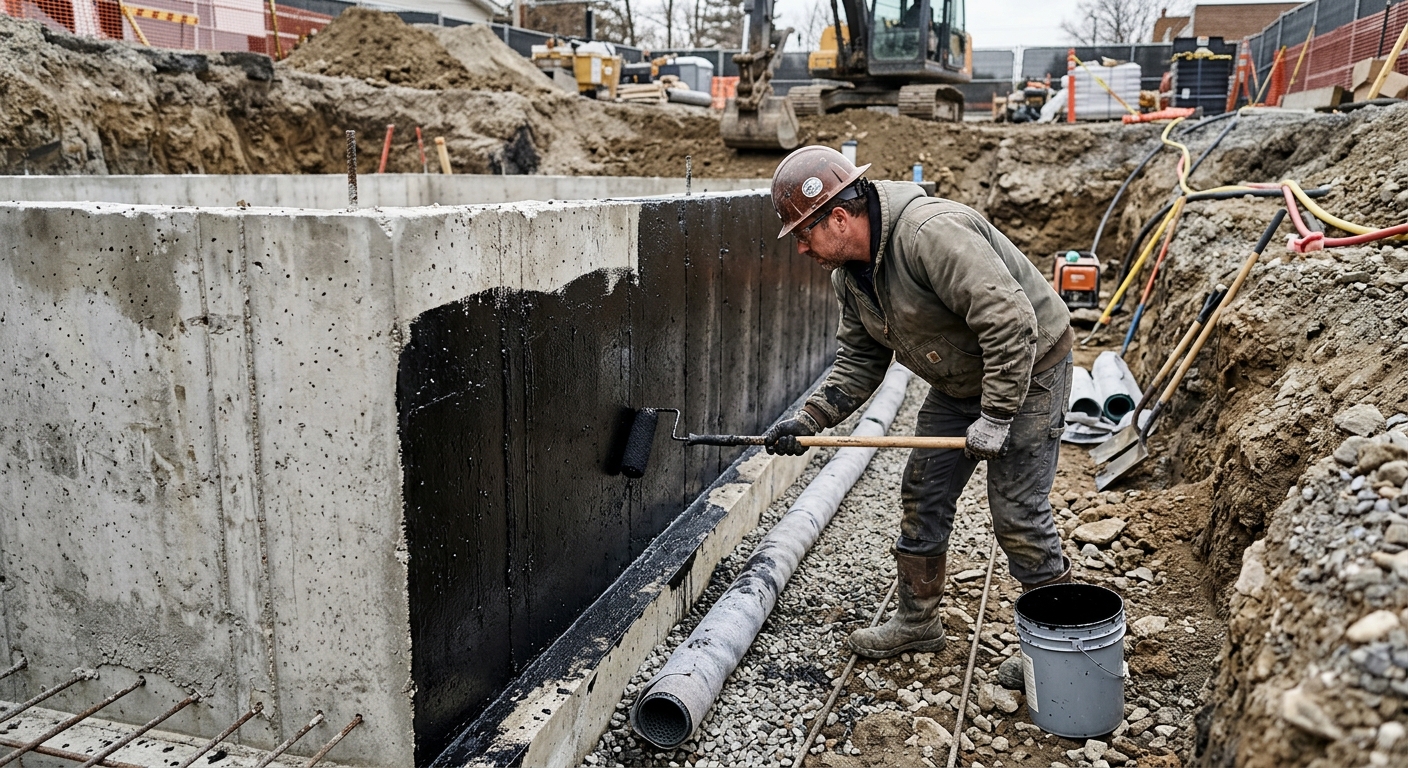
The fundamental difference is that exterior waterproofing aims to stop water at the source, while interior waterproofing manages it after it enters. Exterior work involves full excavation along the foundation, installing membrane and a new drainage tile system, then backfilling and reinstating landscaping. In Broadmoor’s Lower Mainland–Southwest conditions—high groundwater pressure, frequent heavy rainfall, and freeze-thaw—this is the most comprehensive way to reduce hydrostatic pressure. The trade-off is cost and disruption: excavation on tight lots and dealing with rocky sections can push labour hours higher.
Interior waterproofing typically includes a perimeter drain channel, sump pit, and sump pump, sometimes with battery backup. It’s less invasive and often fits when homeowners can’t afford extensive landscape removal. However, because interior systems collect water after it penetrates, they don’t eliminate the pressure pushing against the foundation wall itself. That matters most in poured-concrete wall basements, where crack patterns may benefit from injection after water control is addressed, and where interior drainage may be a practical complement rather than the full solution. For block foundations, interior drainage is often essential because block joint seepage can persist unless you capture and direct water effectively.
Power outages are an added concern in BC during major storm or spring flooding periods. A sump pump with a backup system improves reliability and reduces the chance of overflow during the worst hours.
Price-wise, if your investigation shows a failed perimeter drain and persistent seepage, the justification for exterior work becomes clearer. For example, a typical exterior excavation + membrane + new drainage tile range is about $15,000–$30,000, while an interior perimeter drain + sump system is commonly $8,000–$18,000. If the source is active hydrostatic pressure from high groundwater, spending closer to the higher band can prevent repeated interior-only interventions. If the water entry is limited and you can control grading and downspouts, interior solutions may be sufficient—especially when the alternative requires heavy deck removal and long mechanical excavation.
| Method |
Best For |
Addresses Source? |
Disruption |
Lifespan |
Price Band |
| Full exterior excavation + membrane |
High groundwater seepage, long-running perimeter issues, failed weeping tile |
Yes |
High |
High (system-level exterior control) |
$15,000–$30,000 |
| Interior French drain + sump system |
Interior moisture, seeping corners, homeowners needing less invasive work |
No (manages entry after it occurs) |
Medium |
Medium-High (depends on sump capacity and maintenance) |
$8,000–$18,000 |
| Crack injection — epoxy (structural) |
Stable, non-moving cracks; sealing for poured concrete where movement is not active |
No (seals a path, doesn’t replace drainage) |
Low-Medium |
Medium (best with effective drainage) |
$500–$2,000 |
| Crack injection — polyurethane (active leak) |
Cracks with active seepage or joint leakage where water is moving through |
No (treats the leak path; still benefits from drainage) |
Low-Medium |
Medium (often paired with drainage/sump) |
$600–$2,500 |
| Interior drain channel only (no sump) |
Minor dampness, localized drainage capture where pump is not warranted |
No |
Low-Medium |
Lower-Medium (risk increases when inflow is higher) |
$4,000–$10,000 |
| Re-grading + downspout extensions |
Surface-water runoff issues and overflow from roof water near foundation |
Partially (reduces source, but not groundwater hydrostatic pressure) |
Low |
Low-Medium (works best when water pressure isn’t high) |
$2,000–$8,500 |
How to choose a waterproofing contractor in Broadmoor
Choosing the right waterproofing contractor in Broadmoor starts with verifying credentials and protecting yourself from scope gaps. In British Columbia, ask for proof of the contractor’s applicable licence/registration status (check the online registry associated with their trade), plus a current certificate of liability insurance. For workers’ coverage, confirm WSIB/WCB status—don’t accept verbal assurances. Request documentation showing clearance or active coverage and keep a copy for your records.
Next, get 2–3 itemised written quotes. A fair quote breaks costs into labour and materials (membrane/drainage components, excavation or floor cutting, pump and backup, disposal, and restoration), rather than only providing a lump sum. Read the scope for exclusions: is permit pulling included, is debris disposal included, and who restores landscaping, sod, patios, or driveways? Waterproofing failures often come from “small exclusions” (like missing backfill specification or no allowance for drainage pipe outlet confirmation).
Warranty should be explicit: ask for the workmanship warranty length, the product/manufacturer warranty for membranes/drainage components, and whether warranties are transferable to future owners. Payment scheduling matters too—never pay more than about 10–15% upfront. Hold back until the job is complete and confirmed. Finally, demand a written timeline with a start date and realistic completion estimate, plus how weather delays will be communicated.
- Request their licence/registration number and check status online before signing.
- Get a certificate of liability insurance and verify the effective dates.
- Confirm WSIB/WCB clearance or active coverage with proof documentation.
- Ask whether they subcontract structural assessment work when cracks suggest movement.
- Use itemised quotes (labour vs materials vs disposal vs restoration).
- Confirm whether permit pulling is included, or clearly excluded in writing.
- Ensure the scope states the drainage outlet plan and where discharge occurs.
- Ask what happens if water levels remain high after installation (contingency).
- Verify sump pump specs: basin size, check valve type, and backup option.
- Confirm warranty terms: workmanship length, product warranty, and transferability.
- Set a payment schedule with a holdback until punch-list items are complete.
- Require a job schedule and weather-delay plan in writing.
In Broadmoor, watch for red flags: (1) a quote that recommends interior drainage while ignoring the condition of the exterior weeping tile or discharge path; (2) no written warranty details for workmanship and materials; (3) vague scopes like “seal and waterproof” without specifying membrane/drainage components; (4) refusal to provide insurance/WSIB/WCB documentation; and (5) demanding large upfront payments beyond about 10–15%.
Frequently asked questions — waterproofing in Broadmoor
How much does foundation crack repair cost in Broadmoor?
In Broadmoor, foundation crack repair cost depends on crack type, length, and whether it’s actively leaking. For typical epoxy or polyurethane injection repairs, many homeowners budget around $500–$2,000 for straightforward, localized crack sealing—assuming the foundation is stable and the water entry is controlled by drainage or grading. If the crack is longer, requires more ports, or the job includes additional surface prep and remediation for efflorescence or mould, pricing can move upward within the broader range of crack repair scopes. Because Lower Mainland–Southwest conditions include persistent saturation and freeze-thaw, contractors should verify whether the crack is merely “sealed” or is actively moving water through; active leaks often call for polyurethane and a drainage plan, not injection alone. (Statistics Canada, 2021 Census)
Do I need a sump pump in Broadmoor?
You may need a sump pump in Broadmoor if your basement shows recurring seepage, water pooling, or high inflow after heavy rain. In coastal BC conditions, hydrostatic pressure can keep the problem active for longer stretches, and a sump helps collect water reliably so it doesn’t accumulate along slab edges or around wall seams. Many projects bundle interior perimeter drainage with a sump system and often include backup—especially during spring flooding events. Sump pump installation typically budgets around $1,000–$5,000 depending on pump size, check valves, discharge routing, and whether you add battery or water-powered backup. If your issue is primarily surface runoff, re-grading and downspout extension might be the right first step rather than a sump, but contractors should confirm groundwater conditions before deciding.
How does Broadmoor's soil affect my foundation?
Broadmoor’s foundation risks are usually driven less by aggressive seasonal swelling (more common in parts of Ontario and the Prairies) and more by persistent saturation and drainage challenges typical of the Lower Mainland–Southwest. Even when soils aren’t “expansive clay” in the extreme sense, ongoing wetting can maintain seepage pressure against basement walls and floors, especially when original perimeter drainage has failed or outlets are restricted. Freeze-thaw in coastal BC can also widen micro-cracks and joints, making older foundations more vulnerable over time. Practically, this means interior solutions often rely on sump pumping and perimeter drainage, while exterior solutions focus on restoring the full water path through new drainage tile and membrane. Because Broadmoor has an established residential base—population 23,050 (Statistics Canada, 2021 Census)—there’s frequent demand for retrofits in homes with older perimeter systems and recurring moisture problems.
Do I need a permit for foundation work in British Columbia?
In British Columbia, many homeowners need a building permit when work involves foundation excavation, structural crack repair, or changes that affect lot drainage patterns near the foundation. If the repair involves conditions that could indicate structural movement—such as certain horizontal or step cracks—an engineer’s assessment is often required to confirm whether underpinning or other structural work is necessary before proceeding. For sump pump installations, municipal approval may be needed when discharge routes connect to storm or sanitary sewer systems. To verify, ask your contractor what permits they will pull (and whether they handle it) before work begins. A reputable Broadmoor contractor should provide permit documentation details upfront as part of the written scope, because missing permits can delay timelines and affect insurance coverage in the event of future inspections or claims.
How long does waterproofing last?
When installed correctly and matched to the true water source, waterproofing can last many years. Exterior waterproofing systems (membrane + drainage tile + proper backfill) are generally the longest-lasting because they address hydrostatic pressure at the perimeter. Interior systems typically last as long as the sump and drainage components perform and the discharge path remains clear; periodic maintenance—like ensuring pumps aren’t clogged and backup power is functional—matters. Crack injection by itself is usually shorter-lived as a standalone “fix” if groundwater pressure continues to push water through nearby joints; it often performs best when combined with drainage controls. As a ballpark for budgeting in Broadmoor: if the job is scoped and executed as a full source-control system, you’ll generally be targeting durability in the high range of waterproofing projects. Interior drainage and sump packages commonly target medium-to-high durability, and many homeowners also add backup for reliability during BC weather events.
Can I waterproof my basement from the inside only?
Yes, you can often waterproof from the inside only in Broadmoor—especially for dampness symptoms, localized seepage, or when exterior excavation is limited by decks, mature landscaping, or tight lot access. Interior perimeter drains, sump pits, and sump pump systems manage water after it enters, reducing interior water accumulation and helping prevent damage. However, interior-only work doesn’t stop hydrostatic pressure on the foundation wall the way an exterior membrane and drainage tile system does, so it’s not always sufficient when groundwater is actively pushing against the exterior perimeter. When homeowners have persistent seepage, weak or failed weeping tile systems, or recurring corner leaks after heavy rainfall, a full exterior approach may be the more reliable long-term choice. A common interior budget for many homes is $8,000–$18,000 for interior drainage plus sump, but a contractor should confirm conditions first rather than assuming the inside-only solution will fully eliminate future leaks.