Basement waterproofing options and costs in Delta
Delta, British Columbia has the same waterfront reality as much of the Lower Mainland–Southwest: water doesn’t just “show up,” it pressures foundations through persistent saturation and hydrostatic load. That matters because, in Delta, many homes were built before waterproofing best-practices became standard—about 53.6% of dwellings were built before 1981 (Statistics Canada, 2021 Census). When original systems age, tar-and-paper style membranes and corroded weeping tile can fail quietly for years, then finally present as damp walls, musty odours, or active leaks.
In the Lower Mainland–Southwest, labour and material costs are elevated by access constraints on tight lots, and excavation can require mechanical breaking when rocky sections are encountered. Wet, mild winters also create frequent freeze‑thaw conditions, which widen existing cracks and joints so water finds its way inward faster. As a result, comprehensive exterior systems and comprehensive interior drainage installations usually price at the higher end of Canadian ranges for foundation work.
In Delta, demand is especially strong in neighbourhoods with older housing stock and frequent basement moisture complaints—Grandview Heights and Ladner proper are two areas where we commonly see failing perimeter drainage and recurring interior dampness tied to older weeping tile setups. From there, the right repair plan typically depends on where the water enters and whether you need to manage water at the source (exterior) or at the perimeter interior (interior).
Below are the most common waterproofing methods contractors propose, with typical cost bands to help you compare scopes.
| Method |
What It Addresses |
Disruption Level |
Durability |
Price Range |
| Exterior excavation + new membrane + drainage tile |
Primary water entry at foundation exterior; installs new perimeter drainage and waterproofing layer |
High (landscaping, slab/sidewalks may be affected) |
High (source control) |
$15,500 – $29,500 |
| Interior perimeter drain channel + sump pit |
Collects seepage after it enters; reduces wall/side slab moisture and hydrostatic pressure on interior finishes |
Medium (interior floor disturbance at drain run) |
Medium-to-High (depends on drainage capacity and root cause) |
$8,500 – $17,500 |
| Foundation crack injection (epoxy or polyurethane) |
Seals cracks; epoxy for dry/stable cracks, polyurethane for active leaks |
Low (targeted drilling) |
Medium (best when water entry is controlled or limited) |
$700 – $2,000 |
| Sump pump installation (primary + battery backup) |
Pumps accumulated seepage to the discharge line; backup reduces risk during power interruptions |
Medium (sump pit excavation; minor interior work) |
High when paired with correct drainage |
$1,500 – $5,000 |
| Window well drain installation |
Controls water around egress/window areas and reduces overflow into basements |
Medium (excavation near windows) |
Medium-to-High (when discharge path is correct) |
$2,500 – $6,500 |
| Lot re-grading / downspout extension |
Redirects surface water away from foundation; reduces saturation load |
Low-to-Medium (yard work) |
Low-to-Medium (works best with drainage correction) |
$3,000 – $8,000 |
Prices are estimates only and vary by project scope, site access and material selection.
What affects the price of waterproofing in Delta
In Delta and the wider Lower Mainland–Southwest, two quotes that look similar can still differ by 30–50% because the “hidden” parts of the scope are often where costs move: excavation conditions, how far drainage must be run, whether a sump discharge line must be upgraded, and how much remediation is needed before anything gets sealed. Compared with the national average, our regional pricing is pushed up by labour rates and constrained access on urban lots, plus persistent groundwater issues that keep foundations under load through much of the year.
The three biggest drivers that separate Lower Mainland–Southwest costs from the national average are soil conditions, water table behaviour, and freeze‑thaw. In many Ontario and Prairie areas, clay-heavy soils can expand dramatically during freeze‑thaw and create powerful lateral forces; in Delta we see a different pattern—high groundwater saturation plus rainfall-driven backfill wetting creates sustained hydrostatic pressure even when temperatures are mild. When seepage paths open up, interior moisture problems can appear faster. In addition, frequent freeze‑thaw still widens cracks and joints, so once drainage fails, deterioration accelerates.
Here are concrete examples we commonly see in Delta. First, older homes (over half built before 1981, per Statistics Canada, 2021 Census) often have original weeping tile that is undersized or fully failed; replacing it shifts a job from an “interior-only” plan in the $8,000 – $18,000 band into a full excavation scope in the $15,000 – $30,000 band. Second, cracked poured concrete foundations can sometimes be stabilized with crack injection plus upgraded interior drainage, lowering excavation needs; block foundations, however, often benefit from an interior perimeter drain because water can travel through mortar joints and seams. Third, if the site has tight landscaping or a driveway that must be removed for exterior access, excavation becomes more labour-intensive and disposal costs rise.
| Price Factor |
Why It Matters |
Cost Impact |
| Interior vs. exterior approach — interior is less disruptive but addresses symptoms |
Exterior targets water at the source; interior manages seepage after entry |
Exterior can cost ~2x–3x interior for the same home |
| Foundation type — poured concrete vs. block vs. stone vs. ICF |
Different crack/water pathways; different prep and repair methods |
Block/stone often increases interior drainage scope |
| Soil type — clay expands more than sand, adding pressure |
Expansive soils intensify lateral stress; saturation varies with texture |
More stress can mean longer repairs and more sealing points |
| Crack type and length — hairline vs. structural horizontal cracks |
Active or structural cracks require different materials and may need engineering |
Structural/seeping cracks raise labour and material usage |
| Sump pump backup system — battery or water-powered backup needed |
Prevents basement flooding during outages common in storm periods |
Typically adds thousands when fully integrated |
| Access — landscaping, decks, or driveways must be removed for exterior |
Extra demolition, careful reinstatement, and higher excavation labour |
Can move a project from mid to high price band |
| Weeping tile age — original tile (60+ years) may be completely failed |
Older systems often collapse or clog, requiring full replacement |
Usually increases excavation and drainage material quantities |
| Mould or efflorescence remediation required before sealing |
Sealers often won’t bond over active salts/mould; surfaces must be stabilized |
Adds inspection, cleaning, and prep time |
Permits & regulations in British Columbia
In British Columbia, certain waterproofing and foundation-related work typically requires permitting, especially when it involves excavation that may affect drainage patterns, structural elements, or how services connect. In Delta, homeowners should expect that foundation excavation and any structural crack repair can trigger permit requirements. Structural repairs—such as addressing horizontal cracking in block walls, major step cracking, or any work that could involve underpinning or load-bearing changes—often require a structural engineer’s assessment before the contractor proceeds.
Where a sump pump discharge connects to municipal services (or requires modifications to how water is routed), municipal approval is commonly part of the process. Because requirements vary by site and the exact discharge method, the safest approach is to have your contractor confirm whether permits are required for your specific scope in writing before work begins.
Step-by-step, here’s how a Delta homeowner verifies the contractor’s British Columbia compliance. First, ask for the contractor’s licence information and check it against the appropriate provincial licensing registry online using the company name and licence number. Second, request a certificate of liability insurance showing coverage amounts and effective dates. Third, verify WSIB/WCB coverage: ask for documentation showing the firm is registered and in good standing. Finally, for structural repair jobs, ask whether they have engineering support (or can coordinate an engineer assessment) and that the plan aligns with what is permitted for your site.
Interior vs exterior waterproofing — what does Delta need?
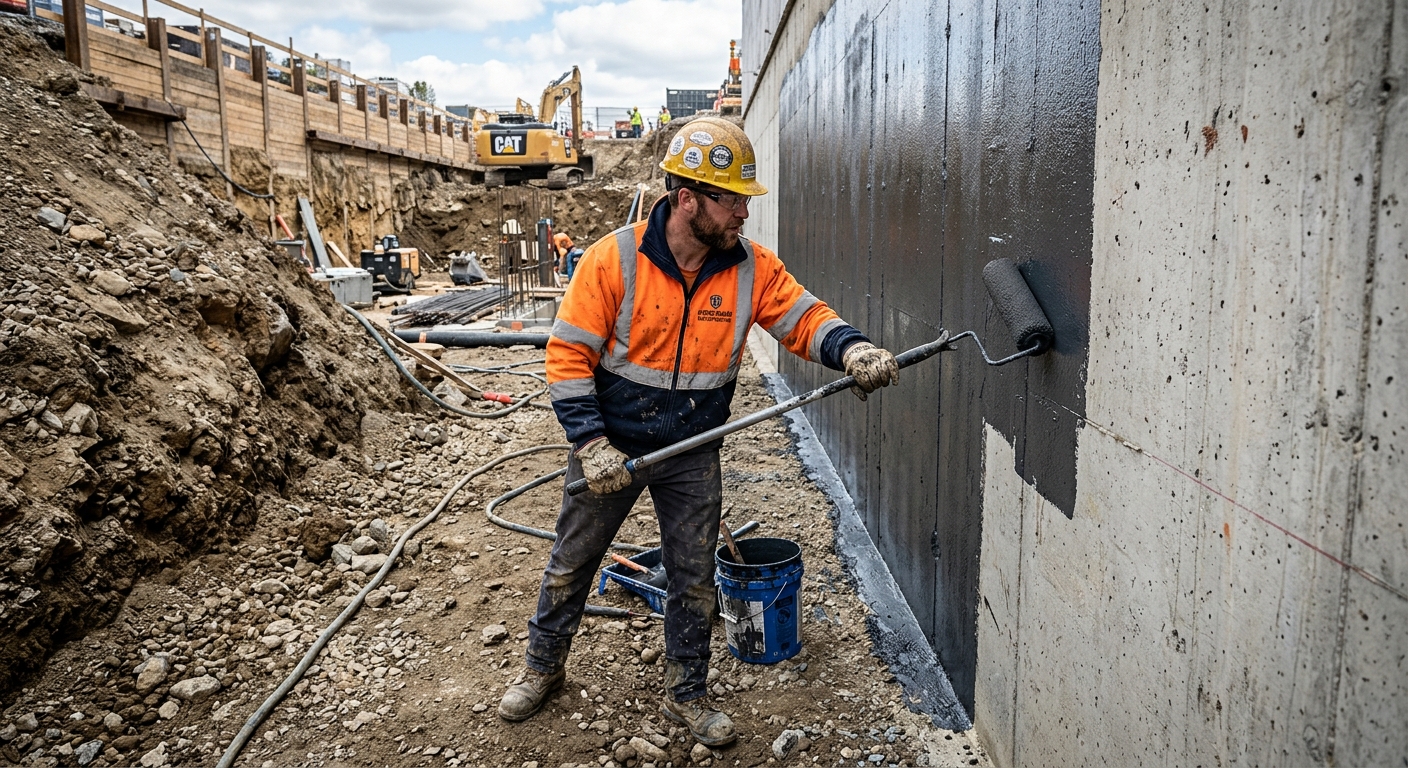
The core difference between exterior and interior waterproofing is source control versus water management. Exterior waterproofing—full excavation, new membrane, new perimeter drainage tile, and backfill—addresses water entry on the outside. It’s more expensive and disruptive because contractors must excavate along the foundation and restore landscaping, but it typically offers the most direct long-term control in wet Lower Mainland conditions. Interior waterproofing—perimeter drain channels, a sump pit, and sump pump operation—collects water after it enters. It can be less invasive, often with fewer yard impacts, but it does not relieve hydrostatic pressure acting on the wall itself.
In Delta’s climate, where basements can experience long periods of saturation and where freeze‑thaw widens cracks, the right answer depends on foundation type and how water is getting in. Poured concrete walls often respond well when crack injection is paired with a drainage plan, because you can stabilize the seepage pathways and reduce new leak points. Block foundations more often need an interior system as a practical complement, since water can migrate through mortar joints and seam details even when cracks are partially sealed.
Sump pump backup is a smart consideration in British Columbia because outages and storm periods can coincide with heavy spring moisture loads. A battery backup or other approved backup reduces the risk of interior flooding while the exterior or interior drainage is doing its job.
For example, if your site requires partial yard removal, you might compare an interior perimeter drain plus sump system in the $8,000 – $18,000 range against a full exterior solution in the $15,000 – $30,000 range. The higher exterior cost is justified when the perimeter drainage is failing, the foundation has multiple leak points, or you want the lowest chance of repeat interior moisture complaints.
| Method |
Best For |
Addresses Source? |
Disruption |
Lifespan |
Price Band |
| Full exterior excavation + membrane |
Active seepage with failing perimeter drainage; multiple exterior leak points |
Yes (targets water entry) |
High |
Long (often decades with correct discharge) |
$15,000 – $30,000 |
| Interior French drain + sump system |
When exterior access is limited; interior moisture management is the practical first step |
No (manages water after entry) |
Medium |
Medium-to-Long (depends on pump capacity and drainage) |
$8,000 – $18,000 |
| Crack injection — epoxy (structural) |
Dry, stable cracks with minimal active seepage |
Sometimes (depends on whether water entry continues) |
Low |
Medium (best with drainage corrections) |
$500 – $1,500 |
| Crack injection — polyurethane (active leak) |
Cracks with active seepage where flexible sealing is needed |
Limited-to-Moderate (stops leaks if injection reaches source) |
Low |
Medium-to-Long (when paired with drainage plan) |
$800 – $2,000 |
| Interior drain channel only (no sump) |
Light seepage with gravity discharge possibility and limited hydrostatic pressure |
No (collects water inside) |
Low-to-Medium |
Short-to-Medium (higher risk during heavy saturation) |
$6,500 – $13,000 |
| Re-grading + downspout extensions |
Surface water issues contributing to perimeter saturation |
Partial (reduces water load) |
Low-to-Medium |
Variable (depends on yard drainage success) |
$3,000 – $8,000 |
How to choose a waterproofing contractor in Delta
Start by verifying British Columbia licensing and insurance before you compare prices. Ask for the contractor’s licence details and check them online using the company name and licence number. Next, request a certificate of liability insurance and confirm the coverage amounts match the scale of your excavation and interior work. Also verify WSIB/WCB coverage: request proof of registration/status, not just a verbal statement. Waterproofing failures are expensive—insurance and proper coverage protect you if something goes wrong during demolition, excavation, or after reinstatement.
Get 2–3 written, itemised quotes. In Delta, a good quote breaks labour and materials down (excavation limits, drain tile route, sump pit and pump model, discharge method, membrane type, crack prep and injection quantities). Avoid lump sums that don’t show what’s included. Carefully read exclusions: is disposal included, are permits included if required, and will they manage grading for proper run-off? Ask who is responsible for reinstating landscaping and finishes.
Warranty matters in this industry. Confirm the workmanship warranty length (how long they stand behind installation) and whether there’s a manufacturer/product warranty. If you sell the home, ask if warranties are transferable. On payment, never pay more than 10–15% upfront; a holdback until completion is a reasonable control. Finally, get a start date and completion estimate in writing so you can plan around wet-season risk.
- Confirm BC licence details and match them to the company name on the contract.
- Request a current certificate of liability insurance and verify effective dates.
- Verify WSIB/WCB coverage documentation for the trade involved.
- Ask for a written inspection method (where they probe, camera locations, moisture test approach).
- Get an itemised scope: excavation extent, drain tile layout, membrane system, and discharge plan.
- Ensure permits (if required) are identified clearly—who pulls them and what they cover.
- Confirm disposal and haul-away are included, especially for exterior excavation.
- Check warranty wording: workmanship vs product/manufacturer, and transferability.
- Review pump specs and backup plan (battery type, capacity, and integration with controls).
- Insist on a payment schedule with a meaningful holdback until the job is complete.
- Ask for timeline details: mobilization date, excavation duration, waterproofing completion window.
- Get a clear reinstatement plan for landscaping, walkways, and any decking removed for access.
Red flags in Delta waterproofing sales calls: (1) they won’t explain where water is entering or how they verified it, (2) they offer “one-size-fits-all” membrane or crack injection without assessing drainage, (3) they avoid discussing permits/municipal discharge requirements, (4) they ask for large upfront deposits (more than 10–15%), and (5) they provide no specific warranty terms or only marketing claims instead of written coverage.
Frequently asked questions — waterproofing in Delta
What is the difference between waterproofing and damp-proofing?
In Delta, homeowners often use the terms interchangeably, but they’re not the same. Damp-proofing is meant to resist minor moisture and control dampness; it usually assumes limited hydrostatic pressure. True waterproofing is designed to handle water intrusion pressures—especially the kind we see when backfill stays saturated from prolonged coastal rainfall and groundwater levels. In practice, that means the systems are different: exterior waterproofing typically includes a membrane system and a functioning perimeter drainage tile, while interior approaches usually include a drain channel, sump pit, and pump strategy to manage seepage. If your home has active leaks or persistent seepage, damp-proofing alone is often insufficient, and that’s where costs can move toward the exterior or interior sump solution bands commonly quoted in Delta.
Will basement waterproofing affect my property value in Delta?
Basement waterproofing can support property value, mainly by improving livability and reducing risk of recurring water damage—especially in homes where older drainage systems are failing. With Delta’s mix of housing stock (including many homes built before 1981, per Statistics Canada, 2021 Census), buyers often worry about moisture history, odours, and finished-basement damage. A documented, properly installed waterproofing system with an itemised scope and written warranty can be a selling advantage. It also helps prevent secondary issues like mould remediation, efflorescence, and deteriorating finishes. That said, value gains are strongest when the repair targets the cause (e.g., perimeter drainage and source control) rather than only treating symptoms. If you’re comparing options, the right “match” for your foundation and water-entry point usually matters more than choosing the most expensive band.
What drainage issues are most common in Delta homes?
In Delta and the Lower Mainland–Southwest, the most common drainage problems we see are failing or undersized perimeter weeping tile, poor discharge routing, and downspouts that effectively feed water toward the foundation. Coastal BC rainfall can keep backfill saturated, so even small drainage failures become persistent seepage sources. On older homes—again, many built before 1981 (Statistics Canada, 2021 Census)—we frequently find original weeping tile that’s clogged, detached, or partially collapsed. We also see interior moisture caused by cracks and construction joints widened by freeze‑thaw, letting water bypass whatever was originally sealed. The result is often damp walls, musty odours, and floor dampness that worsens during wet seasons. Contractors typically address this with either exterior excavation and drainage replacement, or interior perimeter drainage and sump management when exterior access is limited.
How do I choose a waterproofing contractor in Delta?
Start with proof—not promises. In British Columbia, verify the contractor’s licence details, request a certificate of liability insurance, and confirm WSIB/WCB coverage (ask for documentation you can review). Then request 2–3 itemised written quotes so you can compare labour and materials line-by-line (excavation limits, drain tile route, membrane system, pump model, and disposal). Make sure the scope clearly states what’s included: permits (if required), discharge method, and reinstatement of landscaping. Review warranty terms: a workmanship warranty length should be written, and the product/manufacturer warranty should match the system they’re installing. Watch for contractors who only quote a single method without explaining where water is entering. Good contractors in Delta will tie recommendations to site conditions and climate risks, and they’ll outline a realistic timeline and payment schedule with a holdback.
What is a battery backup sump pump and do I need one in Delta?
A battery backup sump pump is an additional power source that runs the sump pump during electrical outages. In Delta and across British Columbia, spring storms and heavy rain periods can coincide with short power interruptions, and when seepage continues during an outage, basements can flood even if the drainage system is otherwise working. Battery backups are especially helpful when you have a finished basement, a history of active seepage, or a sump that runs frequently during wet seasons. Whether you “need” one depends on the severity of seepage and how quickly the sump runs when power drops, but it’s commonly recommended for homes with recurring moisture or active leaks. If your contractor offers a sump system in the $1,000 – $5,000 range, ask whether backup is included or an add-on, and confirm the performance expectations in writing.
How much does basement waterproofing cost in Delta?
Cost in Delta depends on whether the repair addresses the water entry point (often exterior) or manages seepage after it enters (often interior). For exterior waterproofing with excavation, new membrane, and drainage tile, you’ll commonly see estimates around the $15,000 – $30,000 band, depending on access, excavation conditions, and how much drainage has to be replaced. For interior waterproofing with perimeter drain work and a sump pit, budgets often land in the $8,000 – $18,000 range. Smaller scopes—like sump pump installation alone—can fall in the $1,000 – $5,000 range, while crack repair varies based on crack type and length. Because Lower Mainland groundwater and rain-driven saturation can keep hydrostatic pressure present, the total scope matters more than the title “waterproofing” on the invoice.