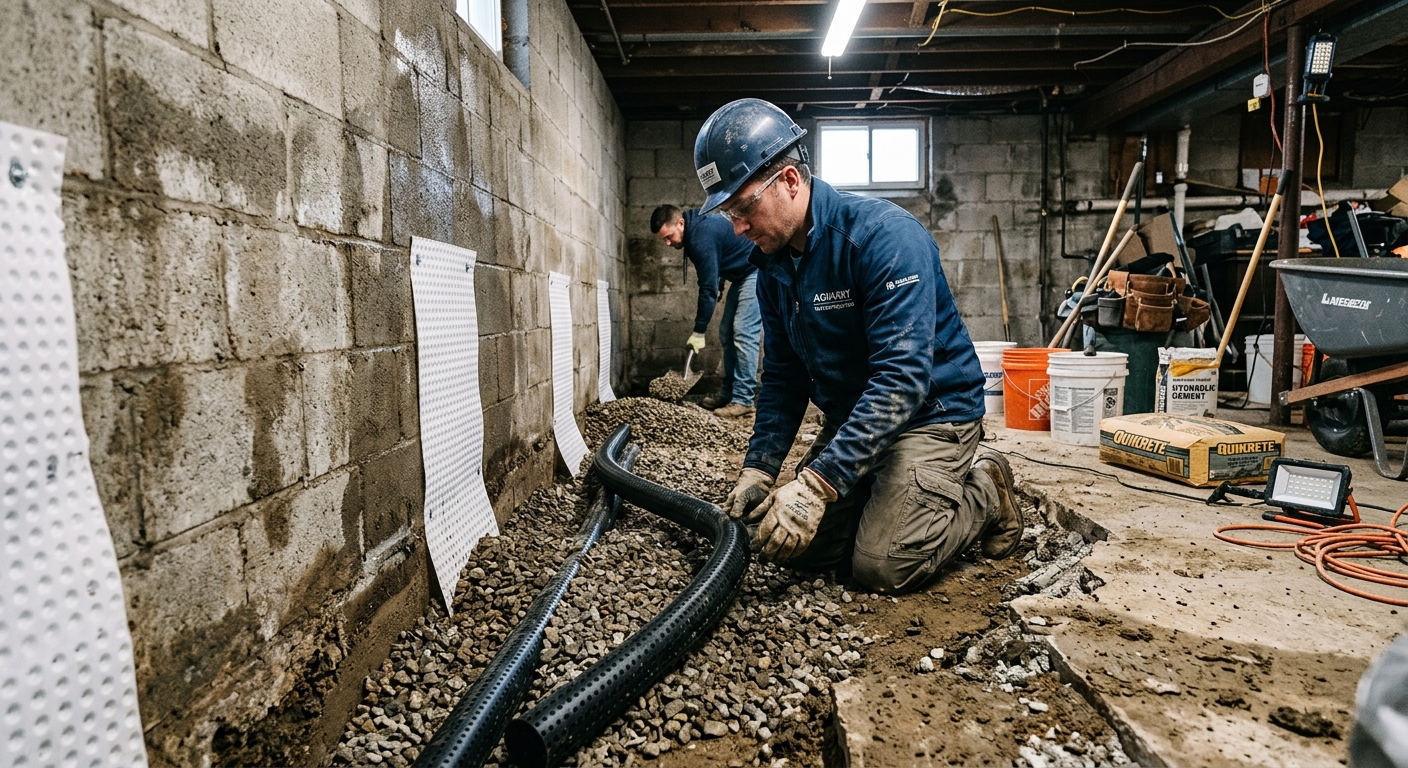
Basement waterproofing options and costs in Hope
Hope, British Columbia has a distinctive waterproofing problem: not just occasional wet weather, but persistent ground saturation and hydrostatic pressure that can keep basement walls and slabs “wet from the outside in.” That matters in Hope because almost half of local homes were built before 1981 (48.0%), when many properties relied on older tar-based membranes and early drainage practices. Add in that Hope has a homeowner-heavy market—2,330 homeowner households (79.3% of households own)—so homeowners often invest in full system upgrades once moisture is confirmed. In the Lower Mainland–Southwest region, groundwater conditions and drainage limitations are primary cost drivers, and wet mild winters plus freeze-thaw can widen existing cracks and joints. Even when a home is newer, prolonged rainfall can saturate backfill quickly if original weeping tile performance has declined. In practice, costs stay higher here because access can be constrained by landscaping, decks, and tight lots, and some excavation sections are rocky or require mechanical breaking. Contractors also see consistent demand in areas like the downtown core and the closer-to-water lots around the Fraser Canyon influence, where older drainage layouts and grading issues are common.
Below are the most common basement waterproofing options contractors use in Hope. Your best choice typically depends on whether the source water is getting in through perimeter walls, through a floor crack, or through failed surface drainage—then we match that to disruption tolerance and budget.
| Method |
What It Addresses |
Disruption Level |
Durability |
Price Range |
| Exterior excavation + new membrane + drainage tile |
Source water entry behind and below foundation walls; replaces failing perimeter drain |
High (excavation, landscaping/grading restoration) |
High (often the most complete long-term solution) |
$15,000–$30,000 |
| Interior perimeter drain channel + sump pit |
Collects seepage after it enters; reduces hydrostatic pressure at the interior face |
Medium (floor cutting around perimeter) |
Medium to high (depends on sump performance and maintenance) |
$8,000–$18,000 |
| Foundation crack injection (epoxy or polyurethane) |
Stops cracks; polyurethane targets active leaks, epoxy targets non-moving cracks |
Low (controlled drilling and patching) |
Medium (best when combined with drainage) |
$500–$2,000 |
| Sump pump installation (primary + battery backup) |
Moves collected water away during wet weather and power interruptions |
Low to medium (mechanical install and discharge routing) |
Medium to high (backup improves reliability) |
$1,000–$5,000 |
| Window well drain installation |
Manages water around basement egress windows and prevents pooling |
Low to medium (localized excavation) |
Medium (depends on downspout/grade control) |
$2,000–$6,000 |
| Lot re-grading / downspout extension |
Directs surface water away from foundation before it reaches weeping tile/fill |
Low (outdoor works) |
Medium (works best with working perimeter drainage) |
$1,500–$4,500 |
Prices are estimates only and vary by project scope, site access and material selection.
What affects the price of waterproofing in Hope
In Hope and across the Lower Mainland–Southwest, it’s common to see quotes for the “same” waterproofing problem vary by 30–50%—even before you factor in contractor availability. The reason is that exterior work is driven by physical site conditions (excavation, soil stability, drainage effectiveness), while interior work is driven by what’s actually leaking (crack movement, slab/wall interface performance) and how well your sump system is sized. In colder regions of Canada, clay-heavy soils can swell during freeze-thaw and increase lateral pressure on foundations; in contrast, Lower Mainland–Southwest costs are separated from the national average more often by persistent saturation and hydrostatic pressure during prolonged wet periods. That said, freeze-thaw still matters in British Columbia because it widens hairline pathways and aggravates failed mortar joints.
Three drivers separate regional pricing: soil/water table, freeze-thaw performance, and the age/frequency of failing weeping tile. High groundwater means longer sump run times and bigger system requirements; when backfill is saturated for long stretches, drainage solutions have to be more robust to handle peak inflow. In older housing stock—remember, 48.0% of homes in Hope were built before 1981—the likelihood of completely failed original perimeter weeping tile increases, which can turn a “simple interior fix” into a comprehensive perimeter solution. For example, a homeowner might see an interior-only system priced in the $8,000–$18,000 range, but if dye testing shows the source is mainly exterior wall leakage, the correct plan can quickly move toward the $15,000–$30,000 exterior band. Conversely, if the issue is localized pooling corrected by downspout extension and re-grading, the cost may stay in a much smaller range because you’re preventing recharge rather than fighting active seepage.
Two practical Hope examples we see often: (1) homes with older weeping tile that is collapsed or disconnected—interior drain channels become overwhelmed and need a properly sized sump; (2) properties with poor grade toward the foundation—surface water keeps re-saturating backfill, so adding a downspout extension can reduce how often the sump cycles and improve system longevity.
| Price Factor |
Why It Matters |
Cost Impact |
| Interior vs. exterior approach — interior is less disruptive but addresses symptoms |
Interior systems manage water after it enters; exterior targets the source |
Often shifts you between the $8,000–$18,000 band and the $15,000–$30,000 band |
| Foundation type — poured concrete vs. block vs. stone vs. ICF |
Crack behavior and how water finds pathways differs by wall material |
Poured walls may respond better to injection combined with drainage; block often needs more perimeter strategy |
| Soil type — clay expands more than sand, adding pressure |
More lateral pressure at joints and cracks during wet/cold cycles |
Can increase crack preparation and drainage capacity requirements |
| Crack type and length — hairline vs. structural horizontal cracks |
Moving or structural cracks may require engineer input and more invasive work |
May move a $500–$2,000 injection into a larger engineered repair package |
| Sump pump backup system — battery or water-powered backup needed |
British Columbia spring storms can coincide with outages; backup prevents basement flooding |
Typically increases sump scope toward the higher end of the $1,000–$5,000 band |
| Access — landscaping, decks, or driveways must be removed for exterior |
Excavation depth and working room dictate labour time and restoration |
Can add days of labour and increase exterior costs significantly |
| Weeping tile age — original tile (60+ years) may be completely failed |
Failed weeping tile changes where water is entering and how fast it accumulates |
Often pushes projects from localized repair to full-perimeter replacement |
| Mould or efflorescence remediation required before sealing |
Moisture-driven salts and contaminants should be addressed before coatings/injections |
Adds removal, drying time, and sometimes additional material steps |
Permits & regulations in British Columbia
In British Columbia, foundation excavation, structural crack repair, and changes to lot drainage typically require a building permit. If the work includes reconnecting or altering sump pump discharge to municipal infrastructure (such as storm or sanitary systems), municipal approval is often required. For structural crack repair—especially horizontal cracks in block walls, major step cracks, or any sign of wall movement—a structural engineer’s assessment is commonly needed to confirm whether underpinning, wall stabilization, or other structural actions are required.
Step-by-step for homeowners in Hope: first, ask the contractor which specific tasks trigger a permit for your address (they should be able to cite the exact scope item-by-item). Second, verify the contractor carries liability insurance and WSIB/WCB coverage where applicable—request a current certificate of insurance and a clear statement of coverage for the crews on your project. Third, if structural work is proposed, confirm they have engineering support available (either in-house or via a partnered engineer) and that they will provide the necessary reports before permitting. Finally, look for proof of appropriate licensing/registration through the relevant BC online registry tools and ensure the certificate number matches the legal company name on your quote/contract. If a contractor can’t provide documentation or won’t identify what permits they’ll pull, treat it as a major red flag before you sign.
Don’t assume: “small interior drainage” can still require permits if it alters structural elements (such as cutting and replacing parts of the foundation or making changes to drainage routing).
Interior vs exterior waterproofing — what does Hope need?
The fundamental difference is that exterior waterproofing (full excavation, new membrane, and replacement drainage tile) addresses the source of water entry by stopping seepage at the foundation exterior and relieving hydrostatic pressure outside. It costs more and requires landscape disruption, but it’s the most permanent, systems-level solution when perimeter drainage has failed. Interior waterproofing (perimeter drain channel, sump pit, sump pump) manages water after it enters; it reduces interior accumulation and helps protect finishes, but it does not stop hydrostatic pressure from acting on the wall itself.
In Hope’s Lower Mainland–Southwest conditions—mild wet winters with freeze-thaw—both approaches have a place. If you have poured concrete walls with cracking that’s more “static” and limited in movement, crack injection (properly matched to crack behaviour) can be highly effective when paired with interior drainage to catch residual seepage. If you have block foundations, interior drainage is often the practical complement because block joints and mortar pathways can keep passing water even after localized sealing.
Where sump pumps come in: backup capability matters. During spring flooding and power interruptions, a sump running without backup can still leave you with water intrusion. In British Columbia, it’s smart to plan for backup so your drainage system continues working through outages.
Here’s a dollar example to guide expectations: if testing shows the source is primarily from failing exterior weeping tile, exterior systems are commonly priced in the $15,000–$30,000 band. If the same home is instead responding mainly to interior seepage and surface grading issues (with limited exterior failure), a well-designed interior approach often lands in the $8,000–$18,000 band and can be the more cost-justified option—provided the sump capacity and discharge plan are sized correctly.
| Method |
Best For |
Addresses Source? |
Disruption |
Lifespan |
Price Band |
| Full exterior excavation + membrane |
Widespread perimeter seepage; confirmed failed exterior drainage |
Yes (targets exterior entry) |
High (excavation and landscape restoration) |
Long (system-level correction) |
$15,000–$30,000 |
| Interior French drain + sump system |
Interior dampness/seepage; failed exterior tile suspected; homeowner wants less disruption |
No (manages water after entry) |
Medium (perimeter floor work) |
Medium to long with proper sump sizing |
$8,000–$18,000 |
| Crack injection — epoxy (structural) |
Non-moving cracks in poured concrete or stable foundation walls |
Partial (seals pathways but relies on drainage) |
Low (drill/patch) |
Medium (best with confirmed crack stability) |
$500–$2,000 |
| Crack injection — polyurethane (active leak) |
Cracks with active seepage that require flexible sealing |
Partial (stops leakage at crack line) |
Low (drill/patch) |
Medium (often needs ongoing drainage) |
$500–$2,000 |
| Interior drain channel only (no sump) |
Very minor seepage where water can be routed safely without pumps |
No (still manages water after it enters) |
Medium (perimeter cuts) |
Shorter risk if inflow exceeds routing |
$6,000–$12,000 |
| Re-grading + downspout extensions |
Surface water management; pooling around downspouts |
Yes for surface water (prevents recharge) |
Low (outdoor works) |
Medium (depends on drainage system health) |
$1,500–$4,500 |
How to choose a waterproofing contractor in Hope
Start by verifying the contractor’s credentials before you compare price. In British Columbia, you want proof of liability insurance (certificate of insurance naming the correct legal company), confirmation of WSIB/WCB coverage for their workforce where applicable, and clear documentation of the company’s ability to perform the stated scope (especially if structural crack repair, excavation, or any permit work is involved). Ask for: (1) a current certificate of insurance, (2) proof of workers’ compensation coverage, and (3) the contractor’s licensing/registration details through the relevant BC online registry tools. Then match those documents to the name on your written quote and contract—if it doesn’t line up, pause.
Next, request 2–3 itemised written quotes rather than a lump sum. The best quotes break down labour versus materials, list what will be removed/replaced, and show whether disposal, permit support, and restoration are included. Read exclusions carefully: for example, some quotes say “waterproofing” but omit sump discharge routing, backup power, or the required drying period before sealing. For warranty, look for two layers: a workmanship warranty (commonly several years), plus product/manufacturer warranty details, and whether warranties are transferable if you sell your home.
Payment should be conservative: never pay more than 10–15% upfront, and hold back funds until key milestones are complete. In Hope, you should also get a written start date and a completion estimate so wet-weather delays are planned, not surprises.
- Ask for a written scope with testing steps (dye test, moisture mapping, crack assessment).
- Confirm whether they include permit pulling or permit support for BC.
- Request an itemised breakdown of excavation, drainage tile, membrane, and backfill.
- Verify sump pump specs: capacity, discharge route, and backup type.
- Confirm disposal is included (soil and construction debris removal).
- Require clear exclusions (what they will not repair/replace).
- Ask about cleanup and restoration (grading, topsoil, re-seeding, concrete/landscape reinstatement).
- Get the warranty length and product warranty details in writing.
- Ask whether warranties are transferable to the next homeowner.
- Use a milestone-based payment schedule; keep the holdback until walkthrough completion.
- Insist on a timeline with dates or weather-buffer assumptions.
- Meet the site lead before work starts and ensure communication contacts are documented.
Red flags in Hope: vague scopes that don’t mention perimeter drainage or sump capacity; quotes that treat every crack the same without checking crack movement; refusing to provide a COI or proof of WSIB/WCB coverage; offering “guaranteed dry basement” promises without discussing hydrostatic pressure and drainage; and asking for large upfront payments (more than about 10–15%).
Frequently asked questions — waterproofing in Hope
How does Hope's soil affect my foundation?
In Hope, the bigger driver is usually sustained saturation rather than extreme seasonal swelling. Even when soils aren’t highly clay-expansive like some parts of Canada, persistent groundwater can keep pressure against basement walls and slab edges during rainy periods. That pressure can find pathways at joints, mortar lines, and foundation cracks—then freeze-thaw cycles in British Columbia help widen those entry routes. If your home is older (48.0% of Hope dwellings were built before 1981), the original perimeter drainage may also be undersized or simply failed after decades, which increases how often interiors seep. A good contractor will confirm whether the main water is coming from perimeter recharge (grading/downspouts) or from a failing weeping tile system, then match the plan to that source.
Do I need a permit for foundation work in British Columbia?
Often, yes—especially for work involving foundation excavation, structural crack repair, or changes to lot drainage in British Columbia. If the scope affects the foundation structure, includes major crack repairs that may require engineering input, or alters how water is discharged, expect permit requirements. Also, if a sump pump discharge ties into municipal infrastructure (storm or sanitary), municipal approval is typically required. The practical approach in Hope is to ask your contractor to specify which scope items need permits and to confirm whether they will support the permit process. You can also verify what’s required through your municipality’s planning/building information resources. If a contractor won’t clarify permit expectations, you should pause—this is one of the fastest ways to run into delays and compliance issues.
How long does waterproofing last?
Durability depends on whether you addressed the source (exterior drainage and membrane) or mainly managed water after it entered (interior drains and sump). In Hope’s Lower Mainland–Southwest climate, the wet seasons and freeze-thaw cycles put stress on aging drainage and cracked joints, so maintenance and correct system sizing matter. A well-installed exterior perimeter system is typically the longest-lasting approach, while interior solutions can last a long time when the sump is properly sized and discharge/backup are reliable. If you’re comparing options, it helps to think in terms of risk reduction rather than “magic.” For example, exterior waterproofing often falls in the $15,000–$30,000 range, reflecting the more complete correction. Interior waterproofing and weeping tile-style retrofits often land in the $8,000–$18,000 band, which can still be durable when matched to your actual leak source.
Can I waterproof my basement from the inside only?
You can, and many Hope homeowners do—particularly when they want less disruption or suspect the source is mainly interior seepage. Interior waterproofing usually uses a perimeter drain channel, a sump pit, and a sump pump to collect water after it enters. The limitation is that interior systems don’t stop hydrostatic pressure acting on the exterior wall itself. If exterior weeping tile has failed or grading continually recharges the backfill, interior-only work can become a “band-aid” and the sump may run more often than expected. That’s why testing and scope clarity are crucial. If interior-only is the right choice, include a correctly sized sump and consider battery backup—power interruptions during spring storm periods can happen, and backup prevents the basement from becoming a storage tank while you wait for electricity to return.
What causes foundation cracks in Hope?
In Hope and across British Columbia, foundation cracks can come from several mechanisms: settlement, water-related pressure, and freeze-thaw effects. Persistent saturation can push water through and around masonry joints, then repeated wetting and cooling can widen pathways. If interior drainage is weak or the perimeter weeping tile is failing, hydrostatic pressure can stress the wall at cracks and the wall/slab interface. Older homes (48.0% built before 1981) are more likely to have decades-old drainage that may no longer manage groundwater effectively. Also, if you have hairline shrinkage cracks that are stable, injection may be sufficient; if you have structural horizontal cracking in block walls or step cracks, you may need an engineering assessment first. A contractor should assess crack type and movement—otherwise you can end up sealing the wrong problem and still see moisture return.
How do I compare waterproofing quotes?
Compare quotes like you’re comparing treatments, not just totals. Ask for an itemised scope with what’s included: testing, excavation depth (if exterior), drainage tile details, membrane type, sump capacity, discharge routing, disposal, and whether permit support is included where required in British Columbia. Make sure the quote states what happens if they uncover additional failures (for example, completely failed weeping tile sections). Confirm warranty terms: workmanship length, product/manufacturer warranty, and whether warranties transfer if you sell your home. Price alone can mislead—some interior projects may look “cheap” but omit sump discharge or backup power. As a reference point, many Hope waterproofing baselines sit in the $8,000–$18,000 range for interior perimeter drainage and $15,000–$30,000 for full exterior excavation, so a quote outside these bands should have a clear reason tied to your conditions.