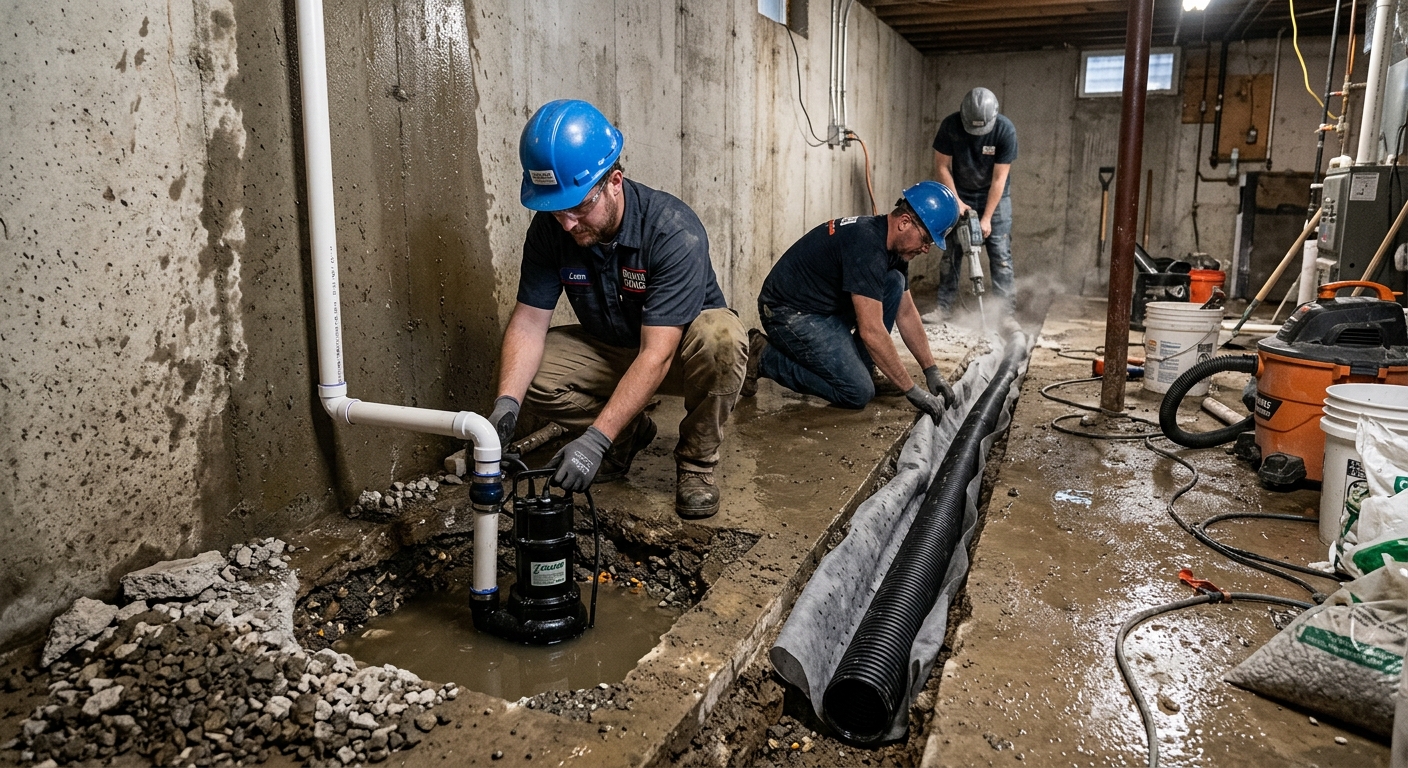
Basement waterproofing options and costs in Mary Hill
Basement waterproofing in Mary Hill is typically shaped by ongoing soil saturation and groundwater behaviour, not just the age of your home. With a population of 3,974 residents (Statistics Canada, 2021 Census), Mary Hill is smaller than the larger Lower Mainland centres, but homeowners still face the same regional realities: high groundwater periods, prolonged wet stretches, and persistent moisture that can keep hydrostatic pressure against foundation walls. In many older neighbourhoods across the Lower Mainland–Southwest, original perimeter drainage systems (often called weeping tile) can be undersized, disconnected, or simply failed after decades, making interior moisture issues more likely even when the concrete looks intact.
In the Lower Mainland–Southwest, contractors often price waterproofing higher than many national averages because excavation is frequently more labour-intensive (tight urban lots, decks/driveways, and mechanical breaking where rocky sections slow trenching). The wet, mild winters and frequent freeze-thaw also widen existing joints and cracks, so “patch-and-go” approaches don’t last. Demand is especially common around older housing pockets near the Mary Hill area’s established residential corridors, where foundation drainage retrofits are repeatedly required as original drainage underperforms.
Choosing between exterior excavation and interior drainage usually comes down to where the water is entering, how failed the original drainage is, and whether you need to remove landscaping for a full perimeter solution. Use the comparison table below to match the right method to the problem—and to sanity-check your quote before the scope is finalized.
| Method |
What It Addresses |
Disruption Level |
Durability |
Price Range |
| Exterior excavation + new membrane + drainage tile |
Stops water at the foundation, replaces failed perimeter drainage, reduces hydrostatic pressure |
High (excavation, landscaping restoration) |
High (often the most comprehensive exterior system) |
$15,000–$30,000 |
| Interior perimeter drain channel + sump pit |
Collects seepage and relieves water inside the basement |
Medium (interior demo, limited exterior work) |
High (when paired with proper sump pumping and routing) |
$8,000–$18,000 |
| Foundation crack injection (epoxy or polyurethane) |
Seals cracks to reduce leakage; polyurethane is used for active seepage pathways |
Low to Medium (small drilling/demo) |
Medium to High (depends on crack type and wall condition) |
$500–$2,000 |
| Sump pump installation (primary + battery backup) |
Keeps water levels down during high groundwater and heavy rain periods |
Medium (drilling/basin work, discharge routing) |
High (backup helps during outages and storm surges) |
$1,000–$5,000 |
| Window well drain installation |
Redirects water away from window wells to prevent localized seepage and mould |
Medium (excavation at window area) |
Medium to High (when drainage discharges correctly) |
$1,200–$6,000 |
| Lot re-grading / downspout extension |
Moves roof and surface water away from the foundation footprint |
Low to Medium (minor landscaping work) |
Medium (best as a complement, not a sole fix for hydrostatic pressure) |
$900–$4,500 |
Prices are estimates only and vary by project scope, site access and material selection.
What affects the price of waterproofing in Mary Hill
In Mary Hill and across the Lower Mainland–Southwest, you may see quotes for the “same” basement leak that differ by 30–50% because the hidden scope is rarely identical. One contractor may include full drainage testing, interior humidity/mould remediation, correct discharge routing, and proper backfill drainage; another may propose a smaller fix that only manages symptoms. In British Columbia, excavation access constraints, labour rates, and the frequent need for mechanical breaking in excavation work (especially on tighter lots) also raise project costs compared with some parts of Canada.
Three core drivers separate Lower Mainland–Southwest costs from the national average: soil conditions, water table behaviour, and freeze-thaw. First, while Ontario and the Prairies can have clay-heavy, highly expansive soils, Lower Mainland issues often come from sustained saturation—backfill can remain waterlogged and lose its ability to drain. Second, higher groundwater periods mean sump pump run times can be longer and more components may be required to handle peak inflow. Third, wet, mild winters with freeze-thaw cycles widen cracks and joints over time, so a small seal today can fail sooner if the underlying leak path isn’t properly addressed.
Concrete examples in Mary Hill: (1) a poured-concrete wall with hairline cracks may only need targeted crack injection, often aligning with the foundation crack repair band, which can be as low as $500–$2,000. (2) an exterior perimeter system that’s partially collapsed typically pushes the job toward the higher end of exterior waterproofing excavation, often in the $15,000–$30,000 range. (3) a basement with interior moisture plus a failing weeping tile can land in the interior waterproofing band of $8,000–$18,000 because you’re installing a perimeter drain channel and sump to keep the basement dry between heavy rain events.
| Price Factor |
Why It Matters |
Cost Impact |
| Interior vs. exterior approach — interior is less disruptive but addresses symptoms |
Interior systems manage water after it enters; exterior targets the source and reduces hydrostatic pressure at the wall |
Exterior typically +$5,000 to +$12,000 due to excavation and restoration |
| Foundation type — poured concrete vs. block vs. stone vs. ICF |
Crack behaviour and sealing methods differ; block often needs interior drainage as a practical complement |
Poured concrete can reduce sealing labour; block can increase prep, detailing and drainage work |
| Soil type — clay expands more than sand, adding pressure |
More expansive soils can worsen crack movement during freeze-thaw cycles |
Higher pressure usually means broader waterproofing scope (+10% to +25%) |
| Crack type and length — hairline vs. structural horizontal cracks |
Structural horizontal cracks require assessment and may need engineering or additional works |
Structural cases can add engineering, additional repairs, and extended scheduling |
| Sump pump backup system — battery or water-powered backup needed |
Helps during power outages during storms or spring flooding conditions |
Backup can add roughly $1,000 to $3,500 depending on system choice |
| Access — landscaping, decks, or driveways must be removed for exterior |
Tight sites increase labour and require careful reinstallation |
Can push an “average” exterior job into the higher range (+$3,000 to +$10,000) |
| Weeping tile age — original tile (60+ years) may be completely failed |
Failed tile can keep water routing trapped against the foundation |
More extensive replacement, higher excavation and disposal time (+$5,000 to +$15,000) |
| Mould or efflorescence remediation required before sealing |
Sealing over active contamination often leads to recurring odours and deterioration |
Added remediation labour and materials (+$500 to +$4,000) |
Permits & regulations in British Columbia
In British Columbia, foundation excavation, structural crack repair, and changes to how lot drainage is routed typically require a building permit. Sump pump installations that connect into the storm or sanitary sewer also need municipal approval, since discharge location and routing must be compliant with local servicing requirements. For structural crack repair—especially horizontal cracks in block walls, major step cracking, or any sign of wall movement—a structural engineer’s assessment is often required to determine whether underpinning or additional structural work is needed.
For homeowners in Mary Hill, a practical way to verify compliance is to check the contractor can provide proof of the right qualifications before work starts. Step 1: request the contractor’s licence number (or registration details, where applicable) and confirm it matches the company name you’re hiring. Step 2: ask for a certificate of insurance showing general liability coverage and confirm the effective dates cover the project window. Step 3: obtain proof of WSIB/WCB coverage (for the correct coverage type) and ensure it’s valid for the crew performing the work. Step 4: for structural scopes, request written confirmation that engineering support is available and that they’ll coordinate any required assessments. Step 5: ask whether permits are pulled by the contractor or by the homeowner, and confirm who is responsible for inspections and compliance documentation.
When reviewing paperwork, look for clear dates, company identifiers consistent with the quote, and a scope that specifically references drainage routing and structural repair requirements—these are the areas most likely to trigger permitting needs in British Columbia.
Interior vs exterior waterproofing — what does Mary Hill need?
The fundamental difference is simple: exterior waterproofing permanently addresses where water enters by excavating around the foundation, installing a membrane, and re-establishing drainage (new drainage tile and backfill drainage), then restoring the landscaping. Interior waterproofing does not stop hydrostatic pressure against the wall; instead, it captures water after it seeps in using a perimeter drain channel, sump pit, and sump pump. In Mary Hill’s Lower Mainland–Southwest climate, where prolonged wet periods can saturate backfill and maintain pressure against foundations, exterior systems tend to perform best when original perimeter drainage has failed or when multiple seepage points indicate broader water pathways.
That said, interior solutions are often the right first step when the leak is localized, excavation is impractical, or you’re dealing with foundation types that benefit from staged measures. Poured concrete walls frequently respond well to properly selected crack injection (with the right product for the crack condition) followed by interior drainage to manage seepage during peak rainfall. Block foundations, on the other hand, commonly need interior drainage as a practical complement because block joints can wick water even when surface sealing is attempted.
Because British Columbia spring storms and heavy rain can coincide with power interruptions, sump pump backup systems are worth considering where you have recurring seepage. A battery backup (or water-powered backup where appropriate) can keep the basement dryer during outages, reducing the chance of mould and damaging finishes.
A real-world pricing example: if an exterior excavation scope is quoted at $15,000–$30,000, but your investigation shows only a handful of active seepage cracks plus a failing interior moisture pathway, an interior perimeter drain and sump system in the $8,000–$18,000 range may be justified—provided your drainage discharge and pump capacity are designed for Mary Hill’s wet-weather conditions.
| Method |
Best For |
Addresses Source? |
Disruption |
Lifespan |
Price Band |
| Full exterior excavation + membrane |
Multiple leaks, failed weeping tile, or persistent hydrostatic pressure where exterior access is feasible |
Yes (targets exterior entry points) |
High (excavation + landscape restoration) |
High (long-term exterior protection) |
$15,000–$30,000 |
| Interior French drain + sump system |
When you need a reliable “dewatering” strategy or exterior excavation is too disruptive |
No (manages water after entry) |
Medium (interior demo, sump location work) |
High (when pump capacity and discharge are correct) |
$8,000–$18,000 |
| Crack injection — epoxy (structural) |
Non-moving, dry-to-damp cracks in poured concrete where sealing is feasible |
Partially (seals pathways when selected correctly) |
Low to Medium |
Medium to High |
$500–$2,000 |
| Crack injection — polyurethane (active leak) |
Active seepage through cracks where water is still finding a route |
Partially to Yes (stops flow through crack pathway) |
Low to Medium |
Medium to High (depends on underlying pressure and crack stability) |
$700–$2,500 |
| Interior drain channel only (no sump) |
Light seepage where gravity drainage to a suitable outlet is workable |
No (relies on capturing water without pump) |
Medium |
Medium (less reliable during high groundwater peaks) |
$3,500–$9,500 |
| Re-grading + downspout extensions |
Surface water problems, oversaturated soil from roof drainage, or early-stage dampness |
No (doesn’t relieve hydrostatic pressure) |
Low to Medium |
Medium |
$900–$4,500 |
How to choose a waterproofing contractor in Mary Hill
Choosing the right contractor in Mary Hill starts with verifying credentials. In British Columbia, ask for your contractor’s licence/registration information and confirm the company name matches the quote and invoice. Request a certificate of insurance and look for general liability coverage that covers waterproofing/excavation work, plus coverage dates that include your planned schedule. Also confirm WSIB/WCB coverage for the workers assigned to your job—this matters because waterproofing crews often perform both interior demo and exterior excavation.
Next, get 2–3 itemised written quotes. You want labour + materials breakdowns (membrane details, drainage tile specs, filter fabric, pump model, pipe/discharge plan, disposal), not a single lump-sum number. Read the scope carefully for exclusions: is demolition included? Is disposal included? Will they pull permits where required? If sump discharge routing needs approval, your scope should state how routing will be handled. Confirm warranty terms too—look for both workmanship warranty length and product/manufacturer warranty details, and ask whether the warranty is transferable if you sell the home.
Payment schedule should be controlled. As a rule, never pay more than 10–15% upfront, and use a holdback until the job is fully complete, including final sealing and cleanup. Finally, demand a written timeline with a start date and estimated completion date, plus what weather conditions could delay work (important in the wet Lower Mainland).
- Ask for proof of insurance and WSIB/WCB coverage before signing.
- Confirm the quote includes drainage discharge routing (where water will go) and not just “install drain tile.”
- Request a room-by-room scope for interior demo, not just “make it dry.”
- Verify pump spec: primary pump model, discharge diameter, and switch level design.
- Confirm whether backup power is included (battery/water-powered) and under what conditions it triggers.
- Ensure muck/excavation disposal is included for exterior work (often excluded if not stated).
- Ask about membrane type and how they detail transitions at corners and joints.
- Check that crack injection product matches crack behaviour (epoxy for non-moving vs polyurethane for active seepage).
- Ask how they will manage efflorescence or mould before sealing—no shortcuts.
- Confirm re-grading and downspout extensions are addressed if surface water is contributing.
- Request a site access plan (what gets protected, removed, or temporarily staged).
- Get warranty paperwork in writing before payment milestones.
Red flags in Mary Hill: a quote that doesn’t explain where the water is entering; vague scope language like “sealed and monitored” without specifying products; refusing to provide insurance/WSIB/WCB documentation; promising “permanent waterproofing” without discussing hydrostatic pressure or drainage; and requiring a large upfront deposit (beyond 10–15%) without a clear holdback for completion.
Frequently asked questions — waterproofing in Mary Hill
What drainage issues are most common in Mary Hill homes?
In Mary Hill and the broader Lower Mainland–Southwest, the most common drainage issues are failed or undersized perimeter drainage (weeping tile that no longer routes water properly), downspouts discharging too close to the foundation, and backfill that stays saturated after heavy rain. Homeowners also frequently see damp corners, recurring “track” moisture along joints, and efflorescence on concrete surfaces that indicate water movement through tiny pathways. In older basements, interior moisture often worsens when the original drainage can’t keep up, meaning water backs up and migrates inward. If you’re seeing repeated seepage during wet periods, a full interior perimeter drain with a properly sized sump is often the quickest reliable option, while exterior excavation is considered when the original exterior drainage is beyond repair (Statistics Canada, 2021 Census).
How do I choose a waterproofing contractor in Mary Hill?
Start by comparing itemised written quotes from at least two contractors in Mary Hill. The best quotes specify materials and methods: membrane type (if exterior), drainage tile and filter fabric specs, pump model, and how discharge will be routed. Ask for proof of liability insurance and WSIB/WCB coverage before work begins, and verify the scope references permits where needed for excavation or drainage routing in British Columbia. A good contractor will also discuss the likely water entry points and explain whether the plan is addressing the source (exterior) or managing seepage after entry (interior). Warranty matters too—confirm the workmanship warranty length, product warranty details, and whether the warranty transfers to future owners. Be wary of lump-sum pricing with no exclusions list or no completion holdback.
What is a battery backup sump pump and do I need one in Mary Hill?
A battery backup sump pump is a secondary power system that runs the sump during a power outage, typically using a battery controller and pump activation when the electricity goes out. In Mary Hill, this can be valuable because spring flooding-like rain events and storm conditions can coincide with electrical disruptions, and you don’t want the basement to “catch up” with water while power is down. Whether you need backup depends on how actively your basement leaks during heavy rain, whether you have a finished basement you want protected, and how your sump system is designed. If you already need a sump in the first place, many homeowners choose primary plus backup for peace of mind. In budget terms, sump pump installation (including backup options) can land in the $1,000–$5,000 band depending on equipment choice and discharge complexity.
How much does basement waterproofing cost in Mary Hill?
Basement waterproofing cost in Mary Hill varies with soil saturation, foundation type, and whether exterior excavation is required. For a targeted approach like foundation crack repair, you may see costs around $500–$2,000 for crack injection, depending on crack type and length. For interior drainage—commonly an interior perimeter drain channel plus sump pit—pricing often sits in the $8,000–$18,000 range when designed to handle wet-weather seepage. If the leak source requires full perimeter excavation with new membrane and drainage tile, exterior waterproofing typically falls into $15,000–$30,000. The same home can land at different points within these bands depending on access constraints (decks/driveways), disposal requirements, and how failed the original drainage system is.
Interior vs exterior waterproofing — which is better?
“Better” depends on where the water is entering and how much of the original drainage system has failed. Exterior waterproofing—full excavation, new membrane, and new drainage tile—generally performs best for persistent hydrostatic pressure because it targets the source of water at the foundation. It’s also the more disruptive option. Interior waterproofing—perimeter drain channel, sump pit, and pump—often costs less and can be less invasive, but it manages water after it enters rather than preventing exterior pressure from building. In Mary Hill’s wet Lower Mainland–Southwest conditions, I often see interior systems succeed when exterior excavation is impractical, or when the problem is confined and crack pathways can be addressed. For example, if exterior work is $15,000–$30,000 but you only need a reliable dewatering system plus targeted sealing, an interior plan around $8,000–$18,000 can be the right value.
Why is my basement leaking in Mary Hill?
Basement leaks in Mary Hill are usually caused by water reaching the foundation and finding pathways through cracks, joints, or failed drainage. In the Lower Mainland–Southwest, prolonged wet weather can keep backfill saturated, which maintains pressure against walls and slabs. Common culprits include failing weeping tile, downspouts that discharge near the foundation, blocked or undersized exterior weeping tile sections, and cracks that open and widen with freeze-thaw cycles. If your basement shows moisture along specific seams or a corner, that often indicates a localized entry pathway; if it’s widespread, it may point to broader exterior drainage or hydrostatic pressure. Finally, if you see mould or persistent dampness even after surface adjustments, it usually means you need an engineered drainage response—either full exterior waterproofing or an interior perimeter drain and sump system.