Basement waterproofing options and costs in New Westminster
New Westminster basements need waterproofing that matches the way Lower Mainland–Southwest water moves through soil and foundations. In this city, 41.0% of homes were built before 1981, which matters because older original drainage and membrane systems are more likely to be failing or undersized. With 54.7% of households owning their homes, many homeowners are upgrading aging perimeter drain setups around older poured-concrete or block foundation walls before moisture becomes mould or recurring seepage.
In the Lower Mainland–Southwest region, high groundwater tables and persistent rainfall keep hydrostatic pressure against basement walls and slabs for long periods. That constant pressure is why comprehensive exterior work—excavation, membrane, and new drainage tile—typically sits at the higher end of national ranges. The wet, mild winters also mean freeze-thaw cycles can widen existing joints and cracks, letting water reach the interior even if the exterior surface looks “fine” at first glance. Access constraints on tight urban lots, and mechanical breaking where rocky sections are encountered during excavation, also push labour costs upward in New Westminster.
Local demand is especially common in areas such as Sapperton and the Downtown waterfront corridor, where older housing stock and limited lot space often make drainage failures show up quickly. The right scope depends on where the water is coming from and whether the original weeping tile system has stopped performing—so use the comparison below as a roadmap for what contractors usually include.
| Method |
What It Addresses |
Disruption Level |
Durability |
Price Range |
| Exterior excavation + new membrane + drainage tile |
Active seepage from below-grade walls, hydrostatic pressure, failed weeping tile |
High (excavation, landscaping restoration) |
High (source control) |
$15,000–$30,000 |
| Interior perimeter drain channel + sump pit |
Water that enters through wall/slab perimeter; reduces interior moisture |
Medium (floor/trim work) |
Good (collector system + pumping) |
$8,000–$18,000 |
| Foundation crack injection (epoxy or polyurethane) |
Crack leakage path; structural stabilization (epoxy) or active leak control (polyurethane) |
Low to Medium |
Medium to High (depends on crack type and movement) |
$500–$2,000 |
| Sump pump installation (primary + battery backup) |
Relief of collected groundwater; keeps sump functional during power events |
Low to Medium |
Good (with backup) |
$1,000–$5,000 |
| Window well drain installation |
Water pooling at window wells, surface runoff infiltration |
Low to Medium |
Good (when graded and connected properly) |
$1,500–$4,500 |
| Lot re-grading / downspout extension |
Surface water management to reduce water at foundation face |
Low (minor landscaping work) |
Medium (works best with functioning perimeter drainage) |
$3,000–$7,500 |
Prices are estimates only and vary by project scope, site access and material selection.
What affects the price of waterproofing in New Westminster
In New Westminster and across the Lower Mainland–Southwest, quotes for the same basic waterproofing goal can vary by 30–50% because the “cause” of the leak is rarely identical. Two homes might both show dampness, but one may have an intact drainage route while the other has failed weeping tile, saturated backfill, and a foundation crack that is actively channeling water during prolonged rain. That difference drives whether a contractor can rely on interior systems or must excavate externally to take water away before it reaches the wall.
The three biggest drivers that separate Lower Mainland–Southwest costs from a national average are soil/water behaviour, water table pressure, and freeze-thaw. Regions with clay-heavy soils in other parts of Canada can exert seasonal expansion forces; in Lower Mainland–Southwest, the more consistent issue is saturation. High water tables raise sump pump run times and increase the need for a reliable pump plus discharge routing. Heavy coastal rainfall saturates backfill quickly when original drainage fails, and wet winters plus freeze-thaw widen joints and cracks, which can require additional crack injection steps after excavation or during interior work.
Here are a few realistic New Westminster examples. A homeowner with failing exterior drainage often ends up in the exterior band of $15,000–$30,000 because excavation may be required to replace perimeter drainage and reset membrane. Another homeowner with moisture only along the slab perimeter may be managed with interior work in the $8,000–$18,000 range using a drain channel and sump—especially where exterior access is limited by decks or driveways. Finally, foundation crack work may look “small,” but if a crack is structural or actively leaking, the scope can shift quickly from a repair to a combined drainage-and-injection approach.
| Price Factor |
Why It Matters |
Cost Impact |
| Interior vs. exterior approach — interior is less disruptive but addresses symptoms |
Interior collects water after entry; exterior removes water before it reaches the wall |
Can shift costs by roughly 30–60% depending on access and extent |
| Foundation type — poured concrete vs. block vs. stone vs. ICF |
Surface condition and cracking behaviour differ; seals and crack injection methods vary |
Poured concrete often responds well to targeted injection; block may require more drainage |
| Soil type — clay expands more than sand, adding pressure |
More movement can enlarge cracks and reduce the effectiveness of patch-only fixes |
Higher movement risk often increases labour for excavation and sealing |
| Crack type and length — hairline vs. structural horizontal cracks |
Structural or horizontal cracks may signal movement and need engineered assessment |
Structural scenarios can add engineering and additional remedial steps |
| Sump pump backup system — battery or water-powered backup needed |
Power disruptions during wet-weather events can cause collected water to back up |
Adds equipment and installation complexity but reduces failure risk |
| Access — landscaping, decks, or driveways must be removed for exterior |
Tight lots increase labour, disposal, and restoration costs |
Often the difference between mid-range and upper-range pricing |
| Weeping tile age — original tile (60+ years) may be completely failed |
Older systems may be collapsed, clogged, or disconnected |
Replacement pushes the job toward full exterior scopes |
| Mould or efflorescence remediation required before sealing |
Sealers won’t bond well over contaminated or actively scaling surfaces |
Extra labour/materials and drying time can add days and cost |
Permits & regulations in British Columbia
In British Columbia, foundation-related work often requires a building permit, especially when you’re doing excavation near foundations, altering foundation components, or making changes that affect how water leaves the property. In practice, foundation excavation, structural crack repair, and changes to lot drainage typically need a permit. If your sump pump ties into a municipal sewer system, you may also need municipal approval for the discharge connection.
Structural crack repair is the area where homeowners should slow down. For horizontal cracks in block walls, major step cracking, or any sign that the wall may have moved, a structural engineer’s assessment is commonly required to determine whether underpinning or other structural work is necessary before waterproofing proceeds. A reputable contractor should be able to coordinate engineering support for structural repairs, and they should carry appropriate liability insurance plus WSIB/WCB coverage (as applicable) for their crews.
To verify compliance in New Westminster, start by asking the contractor for: (1) their BC licence details (and the licence number used for the work), (2) a certificate of insurance showing liability coverage, and (3) WSIB/WCB clearance information. You can then cross-check licence status using the appropriate online public registries, and confirm insurance wording matches the stated scope and job site. Finally, confirm who is pulling the permit and what is included in that permit process (inspection timing, engineering documentation if needed, and any discharge approvals for sump systems).
Interior vs exterior waterproofing — what does New Westminster need?
The fundamental difference is source control versus symptom management. Exterior waterproofing—full excavation, new membrane, new drainage tile, and backfill—addresses the water entry point by creating a path for groundwater away from basement walls. It costs more and is more disruptive because contractors must remove landscaping and sometimes break through rocky sections during excavation. Interior waterproofing—perimeter drain channel, sump pit, and sump pump—manages water after it enters, typically with less landscape disruption. However, it does not stop hydrostatic pressure from pressing on the wall itself.
In New Westminster’s Lower Mainland–Southwest climate, the decision often comes down to how persistent the hydrostatic pressure is and whether the exterior drainage system can be restored. Where poured-concrete walls show leaking cracks, crack injection can be effective as part of a plan; when the crack is structurally stable, epoxy injection helps restore integrity. Where block foundations are involved, interiors are often the practical complement because block joints and movement patterns can allow water into the perimeter more readily, making an interior perimeter drain and sump a reliable way to keep the basement dry.
Sump pump backup systems matter in British Columbia. During spring wet periods and localized outages, a primary sump without backup can fail, leaving collected groundwater to rise. That’s why homeowners often choose battery backup alongside the main pump, particularly if they’ve already experienced “sudden” wet floors after storms.
For a dollar example: an exterior system in the $15,000–$30,000 range may be justified when original weeping tile is failed and excavation is feasible. If your issue is limited to perimeter seepage and you can’t practically access the exterior, interior waterproofing in the $8,000–$18,000 range can be the better value—provided the sump design and discharge are correct.
| Method |
Best For |
Addresses Source? |
Disruption |
Lifespan |
Price Band |
| Full exterior excavation + membrane |
Widespread seepage and failed perimeter drainage in higher groundwater conditions |
Yes |
High |
Long (often 20+ years with proper restoration) |
$15,000–$30,000 |
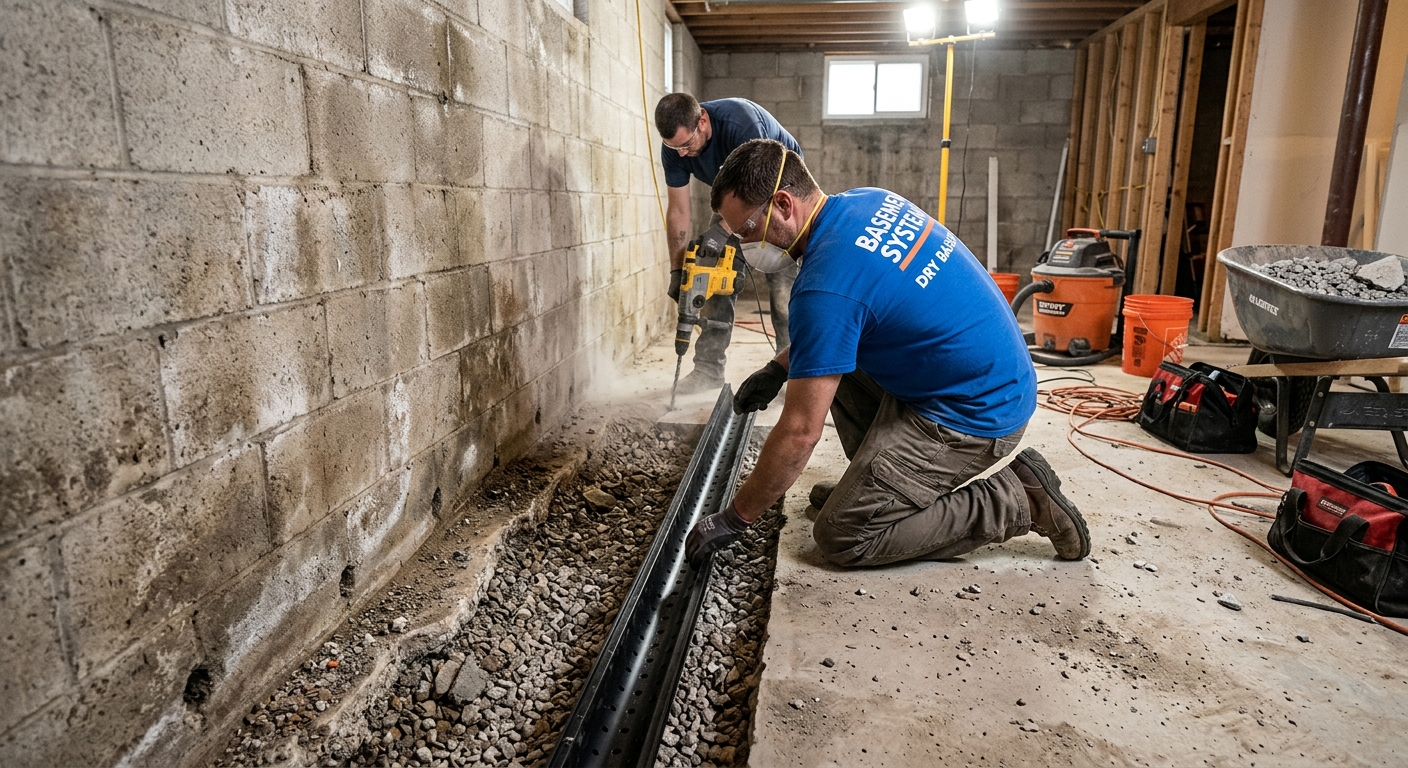
| Interior French drain + sump system |
Interior moisture where exterior access is limited or exterior drainage can’t be fully restored |
Not directly (collects after entry) |
Medium |
Good (depends on pump reliability and maintenance) |
$8,000–$18,000 |
| Crack injection — epoxy (structural) |
Stabilized, non-moving cracks in poured concrete |
Partial (seals crack pathway when stable) |
Low |
Medium to long if crack movement is not active |
$500–$2,000 |
| Crack injection — polyurethane (active leak) |
Active seepage where the crack is still allowing water flow |
Partial (seals active pathway) |
Low to Medium |
Medium (can require additional drainage if hydrostatic pressure is high) |
$800–$2,500 |
| Interior drain channel only (no sump) |
Very minor seepage where gravity drainage is possible and water volumes are low |
No |
Low to Medium |
Shorter if groundwater is persistent |
$4,000–$10,000 |
| Re-grading + downspout extensions |
Surface water issues, splashback, and minor perimeter dampness from runoff |
No (helps reduce load) |
Low |
Medium (best with functioning drainage) |
$3,000–$7,500 |
How to choose a waterproofing contractor in New Westminster
Choosing a waterproofing contractor in New Westminster is about verifying credentials and confirming the scope matches your specific water pathway. In British Columbia, ask the contractor for their licence details for the work they’re doing, plus proof of liability insurance and WSIB/WCB coverage for their crews (as applicable). To check: (1) look up licence status through the relevant BC public registry using their licence number, (2) request a certificate of insurance and confirm it includes the job site address and the type of work, and (3) obtain WSIB/WCB clearance or proof of coverage documentation before any excavation starts.
Next, request 2–3 itemised written quotes rather than a single lump-sum. The best quotes break labour and materials down by line item—demo, excavation, membrane, drainage tile, sump and backup, crack injection, mould/efflorescence prep, disposal, and restoration. Scope clarity prevents surprises: ask whether the contractor pulls the permit, includes disposal, includes backfill and compaction standards, and whether landscaping restoration is allowance-based or fixed.
Warranty matters too. Confirm workmanship warranty length, what exactly is covered, whether product/manufacturer warranties are tied to specific materials used, and whether coverage is transferable if you sell. Payment scheduling should be conservative: don’t pay more than about 10–15% upfront, and hold back a meaningful portion until the job is complete and inspected. Finally, get the start date and estimated completion in writing, along with how they manage weather delays and drying time in Lower Mainland conditions.
- Verify BC licence number matches the scope (exterior excavation vs interior retrofit).
- Request certificate of insurance with job-site address and confirm coverage is active.
- Confirm WSIB/WCB clearance/proof of coverage before crew mobilization.
- Ask for a written scope showing what’s included and excluded (permit, disposal, restoration).
- Require a site visit that includes basement inspection and exterior drainage review.
- Get an itemised quote (labour + materials) for membrane, tile, pump, and crack injection.
- Confirm how they test discharge routing for sump pumps (and backup plan).
- Ask for product names/specs and whether manufacturer warranty is documented.
- Review warranty details for workmanship and whether it’s transferable to a new owner.
- Confirm payment schedule: limited upfront, holdback until completion and cleanup.
- Ask for estimated schedule and what happens during heavy rain/freeze-thaw periods.
- Request photos of existing conditions before work starts and after completion.
Red flags in New Westminster include: quotes that blame “condensation” with no drainage/pump plan; skipping a drainage assessment of existing weeping tile; vague scopes with no permit responsibility stated; warranties that cover materials but exclude installation or leak performance; and crews demanding large upfront payments without a detailed, itemised contract.
Frequently asked questions — waterproofing in New Westminster
How long does basement waterproofing take in New Westminster?
In New Westminster, typical timelines depend on whether you’re doing interior or exterior waterproofing and how much site prep is required. Interior projects (like a perimeter drain channel and sump pit) are often faster—commonly a few days of active work plus drying/curing time—while full exterior excavation can take longer due to excavation, membrane installation, drainage tile replacement, backfill compaction, and landscaping restoration. Lower Mainland wet weather also affects scheduling because contractors may need to pause if the ground is saturated or if there’s freezing at the time of curing/sealing. If your scope includes crack injection and remediation of efflorescence or mouldy areas, that can add days. Many homeowners choose interior first when access is tight, but for long-term source control, exterior scopes are usually planned for a longer window.
What is a weeping tile and does my New Westminster home have one?
A weeping tile (often called perimeter drain tile) is the underground drainage system installed around the foundation to collect groundwater and direct it to a sump pit or an outlet. In many New Westminster homes built before 1981, the original drainage systems were installed earlier with different design standards, and the tile may now be clogged, disconnected, crushed, or simply undersized for today’s persistent rain conditions. With 41.0% of local homes built before 1981, it’s common to find either failing original tile or patchy drainage routes. You can’t confirm it by sight alone in most cases; contractors usually inspect the basement perimeter, check for outlet locations, and may use probing/inspection methods near likely tile runs. If you see recurring dampness during heavy storms, a failing weeping tile is a frequent cause.
Can I waterproof my basement in winter in New Westminster?
Yes, many waterproofing steps can be done in winter in British Columbia, but not every portion is ideal. Crack injection and interior drain installation are often workable as long as the foundation surfaces can be prepared properly and materials can cure under suitable conditions. Exterior excavation is the most weather-sensitive: saturated soils and freeze-thaw can complicate digging, drainage tie-ins, and backfill compaction, and the contractor may need to manage freezing around working areas. This is especially important in New Westminster, where mild winters still include periodic freeze-thaw cycles that can widen existing cracks. If you’re aiming for a complete exterior system in the $15,000–$30,000 band, a contractor may schedule around forecasted conditions. For interior retrofits, many homeowners can proceed sooner—interior drainage typically falls in the $8,000–$18,000 range and can start earlier depending on site conditions.
What is the difference between waterproofing and damp-proofing?
Waterproofing is designed to manage active water entry and hydrostatic pressure—meaning the plan anticipates groundwater reaching basement surfaces and includes drainage and/or sealing to stop or control seepage. Damp-proofing is more limited; it’s often used for minor moisture and may not be intended for sustained groundwater pressure. In New Westminster’s Lower Mainland–Southwest climate, persistent rainfall and high groundwater levels can create conditions that go beyond “damp” and become true water intrusion, especially in basements with older perimeter drainage systems. A good waterproofing scope usually includes either exterior source control (membrane + new drainage tile) or interior collection (drain channel + sump with a reliable discharge route and backup). If the contractor only applies coatings without a drainage path, you may still have moisture returning when the hydrostatic pressure builds after heavy storms.
Will basement waterproofing affect my property value in New Westminster?
Usually, it helps. In New Westminster, visible basement moisture often scares buyers and can reduce perceived quality even if the rest of the home is well maintained. Correct waterproofing—especially when it includes both drainage and a documented repair approach—can provide peace of mind and reduce ongoing maintenance concerns. The biggest value uplift comes when you solve the real water pathway: replacing failed perimeter drainage, upgrading sump capacity/backup, and sealing the cracks that act like channels. If you only do cosmetic fixes or damp-proofing without addressing drainage, value impact is often limited because the underlying issue can reappear. Buyers also like clear documentation: itemised scope, photos, permits, warranties, and proof of engineering assessment when structural crack repair is involved.
What drainage issues are most common in New Westminster homes?
The most common issues are perimeter drainage failure and interior water pathways that form when groundwater can’t be routed away effectively. In older homes—especially those built before 1981—original weeping tile systems can be clogged, disconnected, or undersized, which is why basement dampness often shows up after prolonged rain. Freeze-thaw can widen joints and crack edges, creating new infiltration routes, while poor grading and ineffective downspouts can add surface water load near the foundation. Many homeowners also experience recurring seepage along slab edges or around wall-floor junctions, which makes interior French drains or perimeter drains with a sump more effective than spot sealing alone. If moisture is concentrated in window wells, a dedicated window well drain and proper backfill/gravel arrangement can be part of the solution.