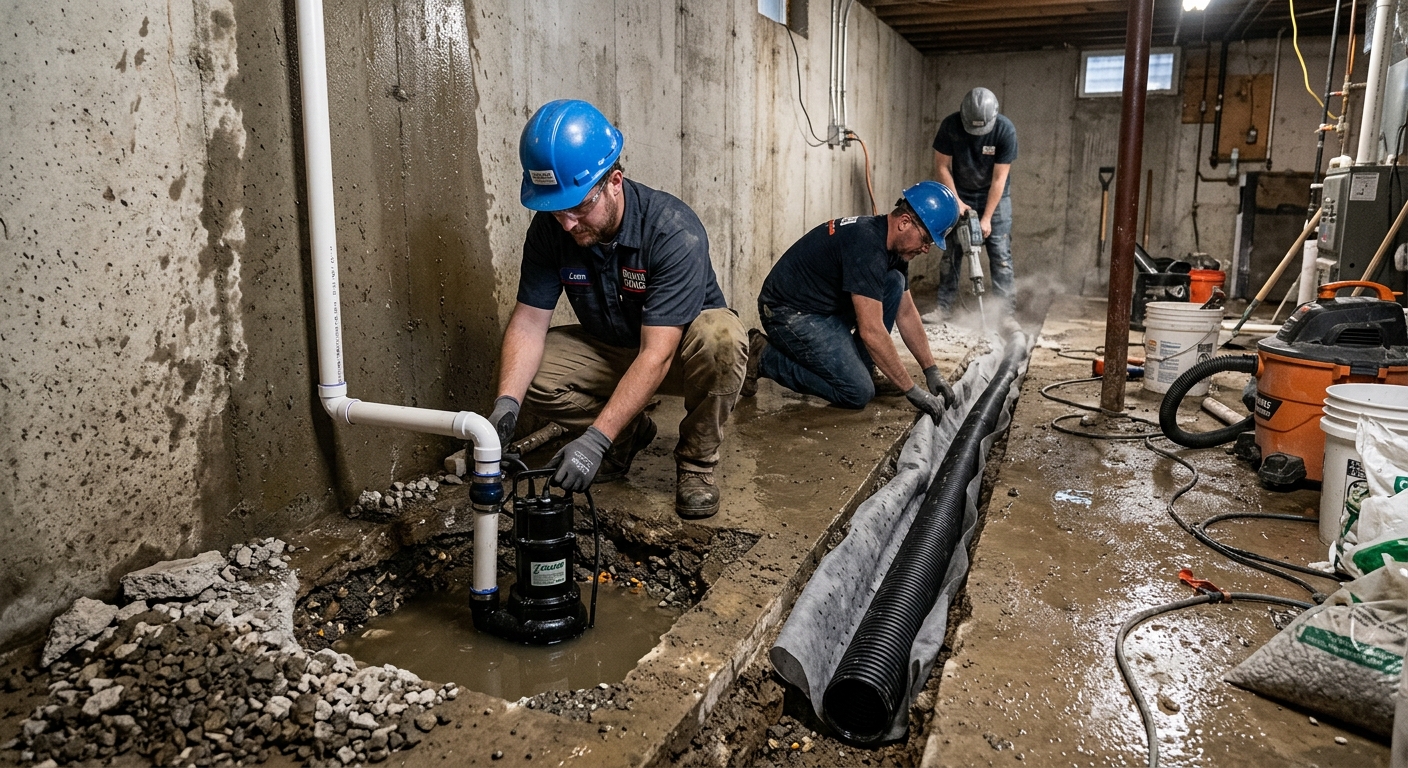
Basement waterproofing options and costs in Mackenzie
Mackenzie homeowners typically notice basement dampness in spring melt and during freeze-thaw swings, and the right waterproofing approach depends on whether the water is getting in through the foundation wall, around penetrations, or via failed weeping tile. In Mackenzie specifically, most homes are older—77.3% were built before 1981—and that matters because early waterproofing systems (and original weeping tile) can be well past service life. With 3,281 people and 1,280 homeowner households (80.8% of households own), there’s steady demand for repair work in long-established neighbourhoods, especially near the more established residential pockets where lots have limited room for wide excavation.
In the Cariboo region, pricing is often driven by site conditions: excavation depth to reach the foundation, soil behaviour, drainage capacity, and access. Freeze-thaw can widen existing cracks, turning a minor seep into recurring water entry, while clay-rich or moisture-retaining soils can hold water against foundation walls and increase pressure. If the job is in an area with limited vehicle access or landscaping (trees, fences, retaining walls), contractors must plan excavation and backfill carefully—sometimes raising labour time and disposal costs.
Because scope can change quickly once an excavator exposes the foundation and drainage system, comparing options side-by-side helps you understand typical cost ranges before you request itemised quotes for your property. Below are common methods and what they address.
| Method |
What It Addresses |
Disruption Level |
Durability |
Price Range |
| Exterior excavation + new membrane + drainage tile |
Water entry at foundation wall and failed perimeter drainage; restores the exterior water path |
High (excavation, landscaping disruption, regrading) |
High (source control when executed to spec) |
$7,000–$18,000 |
| Interior perimeter drain channel + sump pit |
Managed seepage after it enters; reduces hydrostatic pressure inside |
Medium (minor floor work; limited exterior disruption) |
Medium to high (depends on drainage layout and pump capacity) |
$3,500–$12,000 |
| Foundation crack injection (epoxy or polyurethane) |
Crack-specific repair to stop leakage through targeted cracks/voids |
Low to medium (access holes, surface prep) |
Medium (epoxy suits non-active cracks; polyurethane suits active leaks) |
$500–$1,800 |
| Sump pump installation (primary + battery backup) |
Continuous pumping of collected water; battery backup for outages |
Medium (pit/electrical work) |
Medium (maintenance matters; backup improves resilience) |
$1,200–$2,900 |
| Window well drain installation |
Bulk water near window wells; reduces seepage around egress areas |
Medium (excavation around wells) |
Medium (works best with clean drainage discharge) |
$1,000–$3,500 |
| Lot re-grading / downspout extension |
Redirects surface water away from foundation |
Low (site adjustments) |
Low to medium (depends on soil/drainage capacity) |
$700–$2,500 |
Prices are estimates only and vary by project scope, site access and material selection.
What affects the price of waterproofing in Mackenzie
Two quotes for the “same” waterproofing problem can differ by 30–50% in the Cariboo and across British Columbia because the contractor’s actual scope changes once the foundation and drainage system are exposed. In practice, waterproofing isn’t only membrane or pipe—it’s excavation logistics, how deep the work must go, what’s found behind the wall, and whether drainage upgrades are needed. That’s why a job that starts as a crack repair can turn into a drainage and pumping upgrade once failed weeping tile or blocked outlets are uncovered.
The three drivers that most separate local Cariboo costs from the national average are soil type, water table conditions, and freeze-thaw effects. Clay-heavy soils (common in many inland Canadian regions with moisture-retaining behaviour) can expand during freeze-thaw and press laterally against foundation walls, worsening cracks over time. In Mackenzie, that usually means contractors plan for more careful crack prep and sealing, and they often recommend drainage work rather than relying on interior fixes alone. When water levels are high or groundwater doesn’t drain well, the sump may need higher capacity, more discharge planning, and longer run time—moving the job toward the higher end of the interior range (for example, $3,000–$12,000 for interior perimeter drainage and weeping tile-style drainage solutions). Separately, foundation-wall repairs on older homes can be more complex because original systems can be failing simultaneously—77.3% of homes built before 1981 are more likely to have outdated drainage and sealing details.
Concrete examples from Mackenzie-area jobs: (1) excavating only 1 to 2 feet versus digging down 4 to 6 feet changes labour time and disposal, often shifting an exterior project toward the upper end of the $7,000–$18,000 band; (2) if the foundation is blocked or heavily cracked, crack injection may need multiple injection ports and verification, which can add material and technician time beyond a basic repair.
| Price Factor |
Why It Matters |
Cost Impact |
| Interior vs. exterior approach — interior is less disruptive but addresses symptoms |
Interior manages water after entry; exterior targets the source at the foundation wall |
Exterior typically runs ~2x to 3x interior depending on excavation and drainage needs |
| Foundation type — poured concrete vs. block vs. stone vs. ICF |
Different materials behave differently with cracking and sealing; block joints often seep |
Block and older materials usually increase labour for prep and drainage detailing |
| Soil type — clay expands more than sand, adding pressure |
Moisture-retaining soils hold water and increase hydrostatic pressure |
May push the scope toward exterior drainage and stronger crack stabilization |
| Crack type and length — hairline vs. structural horizontal cracks |
Active leaks and horizontal movement require different repair strategies |
Structural concerns can add engineering or underpinning discussions and increase costs |
| Sump pump backup system — battery or water-powered backup needed |
Reduces risk during power outages, especially during spring flooding events |
Adds equipment and installation complexity to the pump system |
| Access — landscaping, decks, or driveways must be removed for exterior |
More removals increases labour, disposal, and reinstatement |
Can shift projects toward the upper end of excavation pricing |
| Weeping tile age — original tile (60+ years) may be completely failed |
Old systems can be collapsed, disconnected, or blocked |
Often increases scope to replace tile and upgrade discharge |
| Mould or efflorescence remediation required before sealing |
Sealing over contamination can trap moisture and prevent proper adhesion |
Requires extra cleaning, drying time, and sometimes surface preparation products |
Permits & regulations in British Columbia
In British Columbia, foundation excavation, structural crack repair, and changes to lot drainage typically require a building permit. Sump pump installations that connect to the storm or sanitary sewer usually need municipal approval, because that ties into the local drainage system and discharge rules. For structural crack repair—particularly horizontal cracks in block walls or evidence of structural movement—an engineer’s assessment is often required to confirm whether underpinning or other structural work is needed.
For work that typically does not require a permit, many “like-for-like” interior waterproofing measures (such as installing an interior perimeter drain channel within an unfinished basement area) may be handled without a permit, but you should still confirm with the local building office for your exact scope. Light surface crack repairs, localized drainage tweaks, and downspout extensions are often treated as maintenance or site drainage improvements, yet the moment you’re excavating the exterior, altering foundation elements, or changing drainage discharge, permits are commonly involved.
How to verify your contractor in Mackenzie, step-by-step: (1) Request their company licence details and contractor registration documents (confirm they’re appropriately registered for the work they’re advertising); (2) ask for a certificate of liability insurance and verify the policy is active and covers the scope; (3) confirm WSIB/WCB coverage documentation for workers on site; (4) for structural work, request proof that engineering support is available—either through in-house relationships or a referenced structural engineer.
Interior vs exterior waterproofing — what does Mackenzie need?
In Mackenzie, the key decision is whether you’re stopping water before it enters (exterior waterproofing) or managing water after it gets in (interior waterproofing). Exterior waterproofing involves full excavation along the foundation, installing a proper membrane system, adding or replacing drainage tile, and restoring backfill and regrading. That is the most permanent option because it addresses the source—water is directed away before hydrostatic pressure builds against the wall. The trade-off is higher disruption: excavation, landscaping reinstatement, and sometimes dealing with older service runs.
Interior waterproofing—like an interior French drain or perimeter drain channel with a sump pit—collects seepage after entry and reduces water pressure at the inside face. It’s usually less invasive, which matters when access is tight around older properties. However, interior systems don’t remove the cause of water pressure against the foundation; they reduce the consequences. That’s why foundation type matters: poured concrete walls often respond well to crack injection combined with a drainage plan, while block foundations frequently benefit from interior drainage because water can pass through joints and mortar lines more readily.
Given British Columbia’s spring flooding patterns and power-outage risk during wet periods, homeowners should consider sump systems with backup. If you’re choosing between interior and exterior, a real cost justification looks like this: an interior perimeter drain plus sump may land in the $3,000–$12,000 band, but if failed perimeter drainage is clearly pushing water against the exterior wall, the long-term solution can justify moving toward exterior excavation and membrane in the $7,000–$18,000 band—especially on homes built before 1981 where original systems are commonly failing.
| Method |
Best For |
Addresses Source? |
Disruption |
Lifespan |
Price Band |
| Full exterior excavation + membrane |
Recurring seepage where exterior drainage and membrane have failed; larger-scale source control |
Yes |
High |
Long (when drainage discharge and backfill are correct) |
$7,000–$18,000 |
| Interior French drain + sump system |
When exterior access is limited, or as a practical complement to minor exterior issues |
No (manages water after entry) |
Medium |
Medium to long (depends on pump reliability and discharge) |
$3,500–$12,000 |
| Crack injection — epoxy (structural) |
Non-active cracks in poured concrete where the crack is not actively leaking under pressure |
Partial (stops passage through the crack) |
Low to medium |
Medium (best when water entry is otherwise controlled) |
$500–$1,200 |
| Crack injection — polyurethane (active leak) |
Active leaks or cracks showing moisture flow where a flexible seal is needed |
Partial (blocks active pathways) |
Low to medium |
Medium (often paired with drainage/pumping for best results) |
$700–$1,800 |
| Interior drain channel only (no sump) |
Light seepage where gravity drainage and low water volumes are expected |
No (manages limited water entry) |
Medium |
Short to medium (depends on discharge condition and seasonal water) |
$2,500–$7,500 |
| Re-grading + downspout extensions |
Surface water issues and overflow around foundation, especially during heavy rain events |
No (redirects water away; doesn’t stop wall seepage) |
Low |
Low to medium (can fail if underlying drainage is clogged) |
$700–$2,500 |
How to choose a waterproofing contractor in Mackenzie
Start with licensing and insurance verification. In British Columbia, ask your contractor for evidence of appropriate registration for the scope they’re proposing, plus a certificate of liability insurance showing it’s active and covers residential work. Next, confirm WSIB/WCB coverage for workers who will be on site—don’t accept “we’re covered” without documents. For structural crack repairs or any work that could relate to foundation stability, ensure they either have engineering support on hand or will coordinate assessment with a qualified engineer.
Then request 2–3 itemised written quotes. You want labour and materials broken out (membrane products, drainage components, excavation/backfill, concrete cutting, disposal, pump and backup equipment), not just a single “lump sum.” Scope exclusions are critical: ask whether the quote includes permit handling (if required), excavation spoil disposal, restoration of landscaping/grade, and how they protect existing services. Make sure the warranty is clear—workmanship warranty length, product/manufacturer warranty details, and whether the warranty transfers if you sell the home.
Payment schedule should be cautious: never pay more than 10–15% upfront. Hold back a portion until the job is complete and you’ve received as-built details (especially for drainage routing and sump discharge). Finally, get the start date and estimated completion in writing, including weather considerations common in the Cariboo during spring melt.
- Ask for municipal/permit responsibility in writing (who pulls permits if required).
- Verify liability insurance and request the current certificate before work begins.
- Confirm WSIB/WCB coverage for workers on your site with documentation.
- Require an itemised quote showing labour vs materials and disposal/restoration items.
- Clarify what “waterproofing” includes: membrane, drainage tile, discharge plan, and backfill specs.
- Ask whether they will test/verify drainage outlets (not just install pipe).
- Confirm warranty terms: workmanship length, product warranty details, and transferability.
- Request a pump spec if a sump is included (capacity, discharge route, and backup type).
- Make sure crack injection type matches conditions (epoxy vs polyurethane) and is documented.
- Discuss protection for interior finishes during cutting/break-out and the cleanup standard.
- Set a realistic timeline and confirm what happens if weather delays excavation.
- Keep payment to 10–15% upfront and use a holdback until punch-list completion.
Red flags in Mackenzie: a quote that doesn’t describe excavation depth or drainage discharge; vague “warranty” language without workmanship/product terms; no proof of insurance/WSIB/WCB; pressure to pay a large deposit upfront; and promising a one-size-fits-all fix (for example, only injecting cracks) without inspecting soil conditions and the existing weeping tile.
Frequently asked questions — waterproofing in Mackenzie
How does Mackenzie's soil affect my foundation?
In Mackenzie and the wider Cariboo area, soil behaviour can make a big difference in whether water pressures build against the foundation. When soils retain moisture (often behaving like clay-rich or silty mixes), they can hold water after snowmelt and freeze-thaw, which increases lateral pressure and can worsen existing cracks. That’s one reason older homes—77.3% built before 1981—often see repeated seepage: original drainage details may be insufficient, and cracks can open wider over time. If your downspouts discharge near the foundation or the lot has settled, moisture can stay against the wall longer, raising the chance you’ll need interior pumping or, in more severe cases, exterior drainage upgrades. (Statistics Canada, 2021 Census)
Do I need a permit for foundation work in British Columbia?
Often, yes—especially for anything involving foundation excavation, structural crack repair, or changes to lot drainage in British Columbia. Typical examples that frequently require a building permit include excavation to the foundation for membrane or drainage tile replacement, and structural-oriented repairs where a crack suggests movement. Sump pump installations that connect to storm or sanitary systems usually require municipal approval because it affects discharge. Jobs that are more often treated as maintenance—like downspout extensions and re-grading—may not need a permit, but you should confirm with your local building office before signing.
How long does waterproofing last?
Longevity depends on which part of the water path you fix. Exterior excavation and membrane systems generally last the longest when the drainage discharge and backfill are done correctly—often measured in decades rather than years. Interior systems (like perimeter drains and a sump) can also work for many years, but their lifespan is tied to pump reliability, sump maintenance, and whether they’re properly sized for seasonal run-off. Crack injection can last a long time when the crack is stable, but it may not hold if the crack continues to move or if water pressure keeps pushing. On older Mackenzie homes (built before 1981), the biggest risk is that multiple components fail at once—so repairs that don’t address drainage can shorten overall performance. If you’re budgeting, interior waterproofing commonly falls in the $3,000–$12,000 band, while full exterior projects can reach $7,000–$18,000, reflecting the longer-term “source control” benefit.
Can I waterproof my basement from the inside only?
Yes, interior-only waterproofing can be an effective choice in Mackenzie when exterior access is limited or when you’re dealing with minor-to-moderate seepage that’s already entering the basement. Typical interior approaches include installing a perimeter drain channel, building a sump pit, and pairing it with a sump pump (often with battery backup). However, interior work does not remove hydrostatic pressure at the outside face of the foundation; it manages the water after it enters. That means it’s best when the primary issue is seepage through cracks/joints that can be captured, rather than a clear exterior drainage failure pushing high water against the wall. If you’re seeing significant recurring dampness during spring melt, full exterior excavation may be the more reliable fix, even though it’s a larger investment—often in the $7,000–$18,000 range.
What causes foundation cracks in Mackenzie?
Foundation cracks in Mackenzie are commonly tied to movement from freeze-thaw and moisture changes. As water in the soil and foundation cycles between freezing and thawing, expansion and contraction can widen existing cracks, especially hairline cracks that become active during spring melt. Soil moisture retention can increase pressure against the foundation wall, which is why clay-like soils and poor lot drainage often show up in trouble investigations. In older homes (many built before 1981), you may also see cracks that were never corrected when the original drainage system began failing. Other contributors include settlement, differential movement, and water around penetrations. If the crack is actively leaking, repairs typically need active-leak-compatible sealing (often polyurethane injection), not just a hard epoxy stop.
How do I compare waterproofing quotes?
Comparing waterproofing quotes is easiest when you insist on itemised scopes and clearly defined outcomes. Ask each contractor for labour and material breakdowns, and confirm what’s included for excavation depth, drainage tile replacement, disposal, and restoration. Make sure they state whether the work addresses the source (exterior membrane + drainage) or manages water after entry (interior drain channel + sump). Compare warranty terms and whether the workmanship warranty is separate from product warranty. Also verify permits and approvals: in British Columbia, foundation excavation and certain drainage changes often need permits, and sump pump discharge connections may require municipal approval. Finally, sanity-check the price against typical bands: interior perimeter drainage projects are often in the $3,000–$12,000 range, while exterior excavation and membrane commonly fall within $7,000–$18,000. If a quote sits far outside the band without explaining why, ask for a written scope clarification.