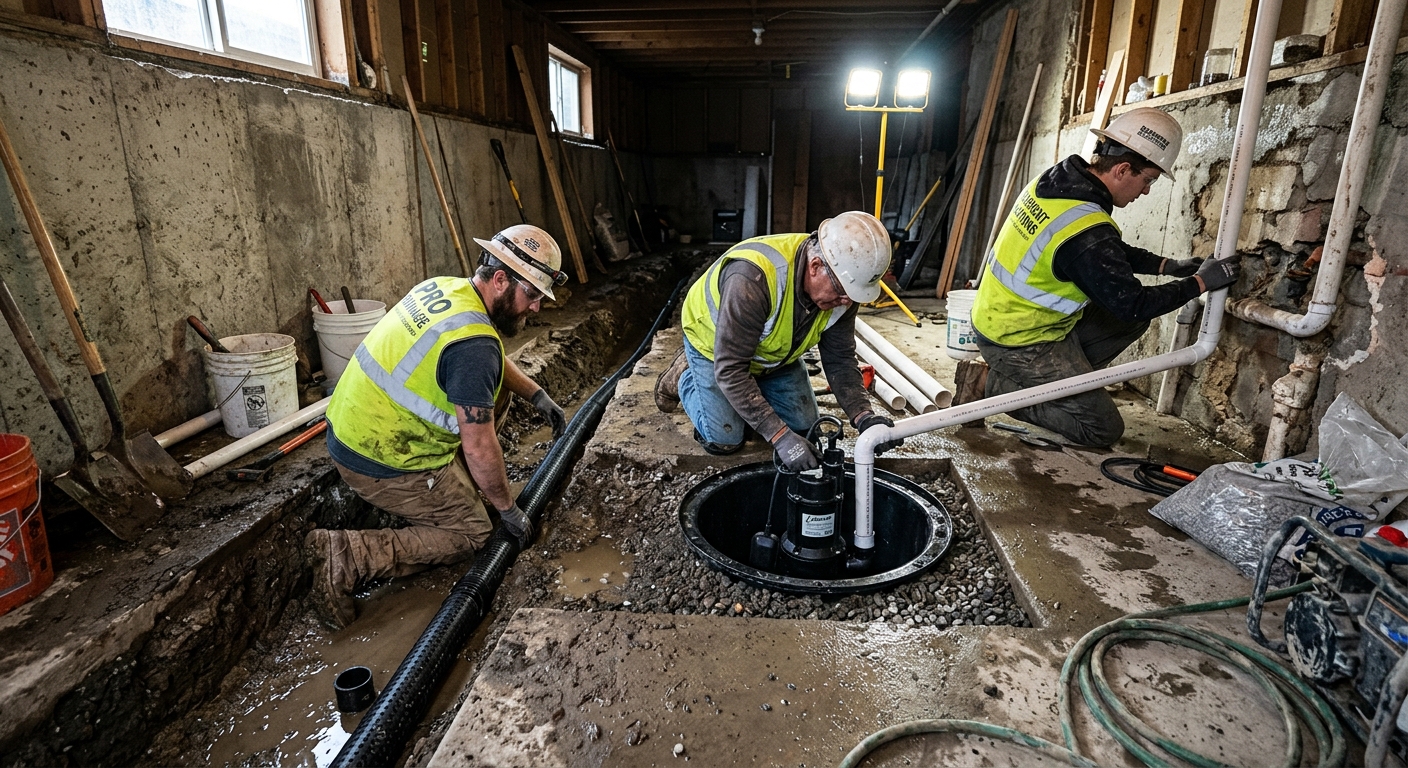
Basement waterproofing options and costs in South Granville
South Granville homeowners usually start by asking one simple question: “How do we keep water out—and what will it cost?” The answer depends on whether you’re correcting the water entry point outside the foundation or managing water after it enters your basement. In South Granville, the housing mix matters: with a local population of 24,820 people (Statistics Canada, 2021 Census), turnover and maintenance demand are steady, and older basements are common. Older homes are far more likely to have original tar-and-paper-type waterproofing and aging weeping tile that has been working under constant hydrostatic pressure for decades.
In the Lower Mainland–Southwest, soil saturation and water-table conditions are the primary cost drivers. Coastal BC’s prolonged rainfall maintains pressure against perimeter walls and slabs, so seepage often shows up even where foundations look “fine” on the surface. On top of that, wet, mild winters and freeze-thaw cycles widen existing cracks and joints, increasing leak risk and the amount of prep needed before sealing. Access constraints on tight urban lots in South Granville can also push costs higher—excavation may require mechanical breaking of sections of pavement, stairs, or hardscape.
Demand is especially steady around the West Broadway/Granville corridor and the older, more densely serviced lanes where gardens and patios sit close to foundation walls. From there, the decision usually comes down to which system you choose, which is why the comparison table below uses local price bands for exterior excavation and interior drainage.
| Method |
What It Addresses |
Disruption Level |
Durability |
Price Range |
| Exterior excavation + new membrane + drainage tile |
Water entry at foundation exterior; replaces failed weeping tile and restores drainage |
High (landscape, hardscape removal and regrading) |
Long-term when done to spec with proper backfill and drainage |
$15,000–$30,000 |
| Interior perimeter drain channel + sump pit |
Captures seepage after it enters; lowers hydrostatic pressure at the interior |
Moderate (concrete saw cutting, minor floor disruption) |
Good to long-term; depends on sump capacity and maintenance |
$8,000–$18,000 |
| Foundation crack injection (epoxy or polyurethane) |
Seals cracks to stop leakage; improves water tightness around defects |
Low to moderate (prep and surface finishing) |
Strong for appropriate crack types; may need complementary drainage if pressure persists |
$700–$2,500 |
| Sump pump installation (primary + battery backup) |
Moves collected groundwater to the discharge line; backup protects during power outages |
Low to moderate (pit + discharge routing) |
Good; battery life and pump capacity matter |
$1,800–$5,000 |
| Window well drain installation |
Prevents water pooling near basement windows; manages runoff at vulnerable openings |
Low to moderate (well modification) |
Good; relies on correct grading and drainage outlet |
$1,000–$3,000 |
| Lot re-grading / downspout extension |
Redirects roof runoff away from foundation; reduces future saturation around walls |
Low (surface work) |
Moderate; needs ongoing maintenance to hold performance |
$3,000–$7,000 |
Prices are estimates only and vary by project scope, site access and material selection.
What affects the price of waterproofing in South Granville
Even when two contractors quote on the “same” basement, it can look wildly different—often 30–50% apart in the Lower Mainland–Southwest—because waterproofing is not just materials, it’s site conditions, access, and whether the system matches how water actually enters your home. In South Granville and across British Columbia, pricing commonly lands toward the higher national end due to elevated labour rates, tight lot layouts, and excavation constraints. The climate amplifies the problem: wet, mild winters and freeze-thaw cycles keep cracks active and backfill soils saturated longer than many other parts of Canada.
Three drivers most clearly separate South Granville costs from the national average. First, soil and saturation: Lower Mainland soils more often create problems through persistent saturation and drainage challenges rather than extreme clay expansion; however, where clay pockets exist, freeze-thaw can still widen joints and add lateral stress. Second, water table and drainage capacity: in high-groundwater conditions, sump systems cycle more frequently and may require additional pumping capacity. Third, freeze-thaw effects: cycles widen existing cracks and joints, increasing the amount of prep, crack mapping, and often the need for crack injection plus drainage.
Here are practical South Granville examples that change the dollar figure quickly. If your perimeter drain is original (often 60+ years), it may be blocked or collapsed, and exterior excavation can move from basic replacement to full rework—pushing projects toward the higher end of exterior waterproofing at $15,000–$30,000. If the issue is isolated seepage, interior drainage may be enough, commonly within $8,000–$18,000, and can avoid removing patios or re-building steps. Conversely, a basement with active seepage plus visible efflorescence may require remediation before sealing, extending labour and materials.
| Price Factor |
Why It Matters |
Cost Impact |
| Interior vs. exterior approach — interior is less disruptive but addresses symptoms |
Exterior corrects the source; interior manages water after entry |
Interior can be substantially cheaper; exterior often adds excavation and landscaping restoration |
| Foundation type — poured concrete vs. block vs. stone vs. ICF |
Crack behaviour and sealing method differ by wall material |
Poured concrete often responds well to targeted injection; block may need more drainage and flexible sealing strategy |
| Soil type — clay expands more than sand, adding pressure |
Soil behaviour influences lateral pressure and how fast cracks reopen |
Clay pockets and poorly draining soils increase product consumption, labour time, and drainage requirements |
| Crack type and length — hairline vs. structural horizontal cracks |
Structural cracks can require engineering review and different repair scope |
Horizontal/step/structural patterns typically cost more due to assessment and more intensive repairs |
| Sump pump backup system — battery or water-powered backup needed |
Ensures continued pumping during outages |
Backup adds cost, but it prevents severe flooding during peak spring wet periods |
| Access — landscaping, decks, or driveways must be removed for exterior |
Tight lots often require mechanical breaking and careful re-build work |
High access constraints push exterior work toward the upper band |
| Weeping tile age — original tile (60+ years) may be completely failed |
Failure can mean collapsed lines and widespread seepage |
May convert a “repair” into a full replacement project |
| Mould or efflorescence remediation required before sealing |
Sealing over active contamination often leads to ongoing odours and deterioration |
Remediation increases labour/materials and can delay sealing until surfaces are properly treated |
Permits & regulations in British Columbia
In British Columbia, foundation excavation, structural crack repair, and changes to lot drainage typically require a building permit. In practical terms for South Granville homeowners, that usually means: if the work involves opening the foundation exterior, altering how runoff leaves your property, or performing structural-level repairs, plan on a permit process. Sump pump installations may also need municipal approval when the discharge ties into storm or sanitary sewer systems, or when discharge locations require compliance with local servicing rules.
For structural crack repair—especially horizontal cracks in block walls, major step cracking, or any crack pattern that suggests movement—a structural engineer’s assessment is often required to determine whether underpinning or structural reinforcement is needed before sealing. A good contractor will not just “inject and go”; they’ll confirm the crack type and provide documentation that supports the chosen repair strategy.
To verify your contractor in South Granville, do it in order: (1) confirm the contractor’s licence status through the provincial contractor registry tools your contractor should link in their proposal or email; (2) ask for a current certificate of insurance showing liability coverage—review dates and confirm the named insured matches the company on the contract; (3) request evidence of WSIB/WCB coverage (or clearance letter, where applicable) and keep it with your project file. For permit-related work, ask who pulls the permit and who is responsible for inspections, and request written confirmation.
Interior vs exterior waterproofing — what does South Granville need?
Exterior waterproofing is the “source control” option. It involves full excavation, new waterproofing membrane, new drainage tile, proper backfill, and regrading. It costs more because it’s labour-intensive and disruptive, but it permanently addresses where water enters by rebuilding the exterior drainage pathway that Lower Mainland conditions overwhelm—especially in saturated seasons. Interior waterproofing is “contain and manage.” It usually uses a perimeter drain channel, sump pit, and sump pump to capture groundwater after it penetrates the foundation and then relieve interior hydrostatic pressure. It costs less and is less disruptive, but it does not stop the pressure against the wall itself.
South Granville homes commonly benefit from an interior approach when exterior access is constrained (paved patios, decks, or narrow side yard) or when moisture is intermittent and driven by localized seepage. However, foundation material changes the best-fit strategy. Poured concrete walls often respond well to crack injection—when combined with interior drainage—because the wall can be made substantially water-tight at defined defects. Block foundations, on the other hand, frequently need interior drainage as a practical complement because seepage paths can be more complex through mortar joints and voids.
Sump pump backups are worth budgeting for in British Columbia because power interruptions can happen during high-demand weather windows in spring. If you’re choosing between options, consider this dollar example: a full exterior system may land in the $15,000–$30,000 range, while interior drainage and a properly sized sump system often fits within $8,000–$18,000. The higher cost is justified when the exterior drainage has failed broadly (collapsed or blocked weeping tile), when water is actively pushing during heavy rain, or when multiple leak locations appear along the same wall.
| Method |
Best For |
Addresses Source? |
Disruption |
Lifespan |
Price Band |
| Full exterior excavation + membrane |
Widespread seepage, failed weeping tile, persistent hydrostatic pressure |
Yes |
High |
Long |
$15,000–$30,000 |
| Interior French drain + sump system |
Interior moisture, localized seepage when exterior access is limited |
No (controls water after entry) |
Moderate |
Good to long-term |
$8,000–$18,000 |
| Crack injection — epoxy (structural) |
Stabilized cracks where movement is not active |
Partially (seals crack pathway) |
Low to moderate |
Long, if crack movement is truly resolved |
$700–$2,000 |
| Crack injection — polyurethane (active leak) |
Cracks with active seepage or minor movement |
Partially (stops leaking through the crack) |
Low to moderate |
Good; performance depends on water pressure control |
$900–$2,500 |
| Interior drain channel only (no sump) |
Light seepage with reliable gravity discharge route |
No |
Moderate to low |
Limited by discharge conditions |
$6,000–$12,000 |
| Re-grading + downspout extensions |
Roof runoff issues and surface pooling near foundation |
No (prevents added water at the surface) |
Low |
Moderate; depends on maintenance |
$3,000–$7,000 |
How to choose a waterproofing contractor in South Granville
Choosing a waterproofing contractor in South Granville is less about the lowest number and more about whether the company can prove the scope will actually match your water entry conditions. Start with British Columbia verification: request the contractor’s current licence information (and confirm it matches the legal business name that will perform the work), then ask for a certificate of liability insurance and check expiry dates. Finally, verify WSIB/WCB coverage—either through an up-to-date clearance letter or documentation—before any excavation begins. If a contractor can’t provide these quickly, treat it as a red flag.
Next, get 2–3 itemised written quotes rather than a single lump sum. A proper quote breaks out labour, materials, excavation/disposal (if exterior), prep steps like mould/efflorescence remediation (if needed), and exactly what drainage components are included. Confirm whether the permit pull is included (or who is responsible), and whether excavation reinstatement covers sod/landscaping restoration or only a “backfill and grade” finish. On warranty, look for a clear workmanship warranty length, the product/manufacturer warranty details, and whether warranties are transferable to future owners.
For payment schedule, avoid paying more than 10–15% upfront. Hold back a portion until completion and final walkthrough. Ask for a written start date and estimated duration, including curing times for injection products and any concrete patching.
- Verify BC licensing against the legal company name on the contract.
- Request and review certificate of liability insurance (active dates, correct insured).
- Confirm WSIB/WCB clearance/coverage before work starts.
- Demand an itemised scope: excavation, drainage materials, discharge routing, disposal, reinstatement.
- Ask what is excluded (e.g., underpinning, engineer fees, permit fees, landscaping replacement).
- Confirm whether contractors will inspect after crack injection and before closing.
- Get warranty in writing: workmanship length and manufacturer product warranty terms.
- Ask if warranties are transferable and who holds the warranty paperwork.
- Use a payment schedule with a holdback until final completion.
- Confirm sump pump type and backup system plan (battery vs water-powered) when proposed.
- Clarify disposal and reinstatement responsibility for excavation and concrete saw cutting.
- Obtain an estimated timeline including curing/inspection steps.
In South Granville, common red flags include: proposals that promise “stop all leaks” without diagnosing whether hydrostatic pressure persists, no mention of sump pump capacity/backup when groundwater is active, vague exclusions in the contract (especially disposal and reinstatement), and contractors who skip engineering review when cracks suggest structural movement.
Frequently asked questions — waterproofing in South Granville
Do I need a permit for foundation work in British Columbia?
In British Columbia, permits are commonly required for foundation excavation, structural crack repair, and changes to lot drainage. If a contractor plans to open the exterior around the foundation, alter discharge routes, or perform structural-level work (for example, major horizontal/step cracking), a building permit is typically part of the process. For South Granville homeowners, sump pump discharge can also trigger municipal approval requirements, especially when tying into storm or sanitary sewer connections. The best way to confirm is to ask the contractor, in writing, what specific items require permits and whether they pull the permit themselves. Also verify the contractor carries the right coverage (liability and WSIB/WCB) before any trenching begins.
How long does waterproofing last?
When installed correctly to match the water source, waterproofing systems in the Lower Mainland–Southwest can last many years, but “lifespan” depends on the approach and ongoing site conditions. Exterior systems that replace failed weeping tile and restore membrane and drainage typically provide the longest performance window, often aligning with the higher exterior budget of $15,000–$30,000. Interior drainage systems (often $8,000–$18,000) can also perform well for a long time, especially if the sump pump is sized for your conditions and you maintain the basin and check discharge. The climate matters: prolonged rainfall and freeze-thaw cycles keep cracks active, so preventive drainage at downspouts and grading also affects how long the system stays effective.
Can I waterproof my basement from the inside only?
Yes, many South Granville basements can be managed using interior waterproofing, particularly when exterior access is limited by patios, driveways, or landscaping close to the foundation. Interior methods typically include a perimeter drain channel and a sump pit, which reduces hydrostatic pressure after water penetrates. However, inside-only work usually doesn’t stop water pressure against the wall itself; it controls what enters. That’s why interior-only approaches work best when leaks are intermittent, localized, or clearly tied to saturated conditions that you can capture reliably with drainage and pumping. For active seepage along multiple points, or when original weeping tile is completely failed, exterior correction may be the more durable choice.
What causes foundation cracks in South Granville?
In South Granville and the wider Lower Mainland–Southwest region, foundation cracks often result from a combination of moisture pressure and movement at the foundation interface. Wet winters and freeze-thaw cycles can widen hairline cracks and joints, letting water follow the path and accelerating deterioration. Persistent saturation from prolonged rainfall increases hydrostatic pressure against basement walls and slabs, which can enlarge existing defects. Soil-related movement can also play a role: where soils retain moisture or contain clay pockets, pressure may build more than in sandier areas. Older homes are especially prone because original drainage systems (like perimeter weeping tile) may be undersized or failed, so water pressure stays elevated longer.
How do I compare waterproofing quotes?
To compare quotes in British Columbia, insist on itemised scopes, not just totals. Ensure each proposal includes the same key elements: drainage approach (interior vs exterior), crack prep and type of injection (epoxy vs polyurethane), sump pump capacity and whether backup is included, and how discharge will be routed. Confirm if remediation for mould or efflorescence is included before sealing. Check whether the quote includes permit handling for excavation/structural work and whether disposal and reinstatement are covered. It’s also important to compare systems, not marketing—an interior drain + sump plan may cost around the $8,000–$18,000 range, while a full exterior excavation with membrane and new drainage tile typically starts much higher, often $15,000–$30,000, because it corrects the water entry pathway outside.
How long does basement waterproofing take in South Granville?
Timelines vary with scope, access, and cure/inspection steps. Interior perimeter drain + sump work often takes days to a couple of weeks depending on concrete cutting, drainage layout, curing, and finishing. Crack injection projects can be shorter—often about a few days on site plus prep—so long as surfaces are properly prepared and the crack type is confirmed. Exterior excavation generally takes longer due to excavation, membrane installation, drainage tile placement, backfill/compaction, and then landscape regrading. In the Lower Mainland–Southwest, scheduling also depends on weather because sustained rain can affect excavation conditions and drainage performance testing. Ask your contractor for a written start date and a realistic completion estimate, including how long you’ll be without sump operation during commissioning.