Basement waterproofing options and costs in Trail
In Trail, British Columbia, basement leaks are rarely caused by one thing—usually it’s water pressure from outside (hydrostatic pressure) meeting older drainage that can’t keep up anymore. With 87.4% of homes built before 1981, a large share of local foundations were installed around mid‑20th‑century waterproofing standards, when original damp-proofing and perimeter drains were often undersized or never designed for today’s heavier rainfall. That matters because Kootenay soils and groundwater conditions can shift what “average” waterproofing costs look like: glacial and alluvial deposits can range from well‑drained gravels to moisture-holding silts and clays, and freeze–thaw cycles widen aging joints in concrete and block.
In practice, that’s why a job that looks similar on paper can land in different price bands. Exterior excavation typically runs higher because you’re removing landscaping, digging to the foundation, installing new drainage tile, applying a full membrane system, and then rebuilding grades. Interior work is generally less disruptive and is often selected when you need a faster path to control active seepage—especially in areas like downtown Trail and parts of the West Trail corridor where access and landscaping tend to be tight. Still, interior solutions manage water after it enters; they don’t eliminate the source of pressure.
Below are the most common waterproofing options contractors use in Trail, with realistic price ranges and the trade-offs homeowners usually notice when they compare quotes.
| Method |
What It Addresses |
Disruption Level |
Durability |
Price Range |
| Exterior excavation + new membrane + drainage tile |
Source control for hydrostatic pressure; exterior water management |
High (excavation, backfill, landscaping reinstatement) |
Long-term when drainage discharges correctly |
$18,000–$35,000 |
| Interior perimeter drain channel + sump pit |
Intercepts seepage and manages groundwater inside the basement |
Medium (minor floor/utility disruption) |
Very good when sump discharge and power are reliable |
$9,000–$20,000 |
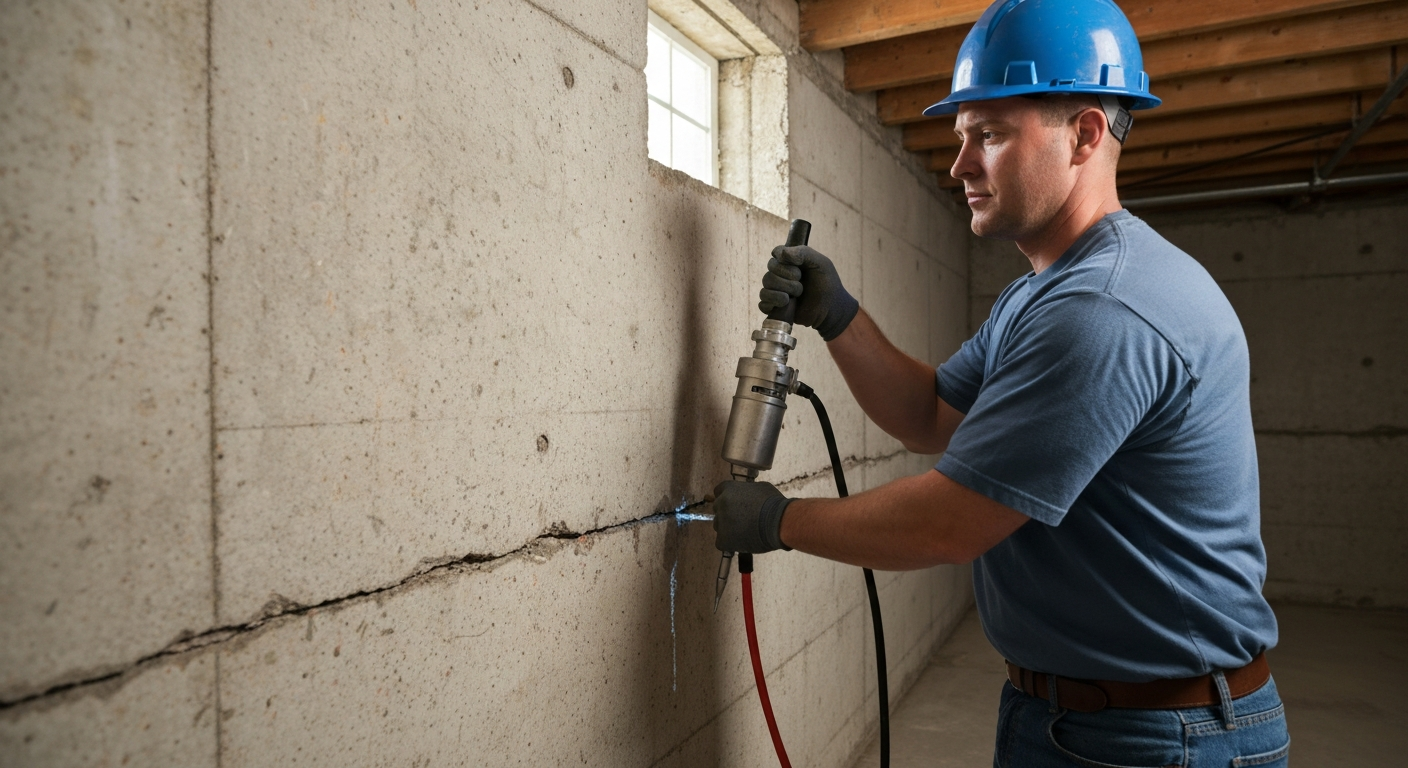
| Foundation crack injection (epoxy or polyurethane) |
Sealing cracks to stop or reduce active infiltration |
Low to Medium (chasing ports/cleaning required) |
Good to long-term depending on crack type |
$800–$2,500 |
| Sump pump installation (primary + battery backup) |
Reduces basement water accumulation during high inflow periods |
Low to Medium (pit, plumbing, electrical tie-in) |
High with backup power and properly sized discharge |
$2,500–$5,500 |
| Window well drain installation |
Prevents surface water from entering below-grade window areas |
Low (localized excavation and grading) |
Good (when tied into exterior/interior drainage correctly) |
$1,200–$4,000 |
| Lot re-grading / downspout extension |
Reduces roof runoff and directs water away from foundation |
Low to Medium (spot excavation/landscaping) |
Good as a first line of defence when done correctly |
$1,500–$6,500 |
Prices are estimates only and vary by project scope, site access and material selection.
What affects the price of waterproofing in Trail
In the Kootenays, waterproofing quotes can differ by 30–50% for the same headline repair because the real drivers are site-specific: soil behaviour, groundwater conditions, and freeze–thaw impacts on cracks and joints. National “average” numbers rarely capture how quickly water can build up against a basement wall when valley-bottom soils hold moisture, or how often older drains need replacement rather than minor tweaks. That’s why Kootenay costs often sit above the national baseline when exterior drainage and excavation are required, and they can come in closer to the lower end when the source can be corrected with re-grading and localized drainage.
Three local factors separate Kootenay pricing from typical averages. First, soil type: clay-heavy conditions expand during freeze–thaw and can push laterally on foundation walls, aggravating cracks over time—especially on older poured concrete and block foundations. Second, water table: where groundwater sits higher near river/lowland areas, sump systems run longer and require properly sized discharge and reliable check valves. Third, freeze–thaw: repeated cycles widen existing cracks, so repairs that might last a few seasons elsewhere often need deeper crack mapping and a more appropriate sealant here.
Two concrete examples from Trail: (1) If your weeping tile is the original 1960s/1970s type, it may be completely failed or clogged, which pushes the project toward interior perimeter drainage or full exterior excavation—moving you from a $9,000–$20,000 interior range toward the $18,000–$35,000 exterior range. (2) A home with downspouts dumping too close to the foundation can often be stabilized with re-grading and extensions, but if the basement also has frequent floor-level seepage, you usually need drainage interception—not just surface control. With a median household income of $68,000 (Statistics Canada, 2021 Census), many homeowners plan in phases; the key is matching the phase to the water source.
| Price Factor |
Why It Matters |
Cost Impact |
| Interior vs. exterior approach — interior is less disruptive but addresses symptoms |
Exterior targets the water before it reaches the foundation |
Interior can be ~40–60% less disruptive cost-wise; exterior often carries higher excavation costs |
| Foundation type — poured concrete vs. block vs. stone vs. ICF |
Different wall systems crack differently and accept different repair methods |
Block and older poured concrete often require more labour for crack prep and sealing |
| Soil type — clay expands more than sand, adding pressure |
Clay holds moisture and increases lateral loads during freeze–thaw |
Higher likelihood of recurring leaks without exterior drainage correction |
| Crack type and length — hairline vs. structural horizontal cracks |
Active/separating cracks need different products and sometimes structural evaluation |
Structural/horizontal cracks typically increase engineering and labour time |
| Sump pump backup system — battery or water-powered backup needed |
Reduces risk during spring power interruptions and high inflow events |
Generally adds cost, but often prevents basement damage during outages |
| Access — landscaping, decks, or driveways must be removed for exterior |
More demolition and reinstatement increases labour and disposal costs |
Can swing the quote significantly when full perimeter excavation is required |
| Weeping tile age — original tile (60+ years) may be completely failed |
Failed tile means water doesn’t get relieved through the old perimeter drain |
Can move scope from localized repair to full replacement or interior interception |
| Mould or efflorescence remediation required before sealing |
Moisture-impacted surfaces can’t be sealed properly without prep |
Additional containment, cleaning and time before membranes or sealants |
Permits & regulations in British Columbia
In British Columbia, foundation excavation, structural crack repair, and changes to lot drainage typically require a building permit. If waterproofing work involves structural concerns—like major horizontal cracks in block walls or step cracking that suggests movement—an evaluation by a structural engineer is often needed to confirm whether underpinning, helical piles, or other structural measures are required before sealing. Sump pump installations can also trigger municipal approval when the discharge connection route ties into storm or sanitary services, so your contractor should confirm your discharge plan before work begins. For basement waterproofing, the “right answer” is not just waterproofing products; it’s compliance, because improper tie-ins or unapproved drainage alterations can create recurring problems for neighbours and for your own foundation.
To verify a contractor in Trail, start with their licensing and credentials. Ask for their Certificate of Insurance (general liability) and confirm WSIB/WCB clearance if they perform labour in the province. Then check that they have engineering support available for structural assessments: for example, they should know when to bring in an engineer for horizontal crack cases, and they should be able to explain who designs any structural follow-up. Look for proof of coverage directly on their insurance certificate (company name matching the invoice, correct coverage period, and jobsite location where applicable). Finally, request the permit allocation: whether the contractor will pull the permit, what they include in their scope, and who is responsible if the city requires revisions to drainage or discharge plans.
Interior vs exterior waterproofing — what does Trail need?
The fundamental difference is where the water gets controlled. Exterior waterproofing—full excavation, new membrane, and new drainage tile—addresses the source by preventing water from getting behind the foundation in the first place. It costs more and causes more yard disruption, but when the drainage is designed correctly for local groundwater and discharge, it can be the most permanent solution. Interior waterproofing (perimeter drain channel, sump pit, and sump pump) manages water after it enters. It’s typically less invasive and can be faster to install, but it doesn’t remove the hydrostatic pressure on the wall itself; the wall still experiences wetting cycles and freeze–thaw stressing.
In Trail’s Kootenay climate, exterior drainage design is often justified when soils hold moisture and when groundwater pressure causes recurring floor seepage or wall staining along multiple sections of the basement. Interior work is often a smart fit when you need to stabilize the basement first—especially in areas with limited excavation access around older properties. Poured concrete walls usually respond well to targeted crack injection when combined with proper water management, while older block foundations often benefit from interior drainage as a practical complement because jointing and mortar can let water track. With BC power reliability during spring wet periods varying by neighbourhood, backup pumping matters: battery backup or a water-powered backup reduces the chance of damage if inflow overwhelms a single pump during an outage.
A common cost justification example in Trail: if exterior waterproofing is quoted in the $18,000–$35,000 range but the interior-only plan is $9,000–$20,000, exterior can be worth it when you have multiple seepage points, failed perimeter drainage, and you want to reduce future cycles. If you have one localized leak channel and stable conditions elsewhere, interior solutions may be sufficient—at least as a first phase—provided the sump discharge and perimeter drainage are engineered properly.
| Method |
Best For |
Addresses Source? |
Disruption |
Lifespan |
Price Band |
| Full exterior excavation + membrane |
High hydrostatic pressure, widespread seepage, failed original drainage |
Yes |
High |
Long (when drainage/discharge is correct) |
$18,000–$35,000 |
| Interior French drain + sump system |
Water entry below grade with limited exterior access |
No (it intercepts after entry) |
Medium |
Long (with proper sizing and backup) |
$9,000–$20,000 |
| Crack injection — epoxy (structural) |
Non-moving cracks and certain structural crack conditions |
Partial (depends on active water presence) |
Low to Medium |
Good (for suitable crack types) |
$800–$2,500 |
| Crack injection — polyurethane (active leak) |
Active seepage or water that wants to find a path |
Partial (focuses on sealing entry points) |
Low to Medium |
Good to long (when crack movement is stable) |
$1,000–$3,000 |
| Interior drain channel only (no sump) |
Occasional dampness or minor seepage where inflow stays low |
No |
Low to Medium |
Variable (depends on how often water arrives) |
$6,000–$14,000 |
| Re-grading + downspout extensions |
Surface water issues and early-stage seepage linked to runoff |
Yes (for roof runoff contribution) |
Low to Medium |
Medium to Long (when maintained) |
$1,500–$6,500 |
How to choose a waterproofing contractor in Trail
Choosing the right waterproofing contractor in Trail comes down to proof: proof they can do the work correctly, and proof they’re insured to protect you. In British Columbia, verify their business licence status through the appropriate provincial online resources, then confirm they carry liability insurance and WSIB/WCB coverage (ask for the clearance letter or current WSIB/WCB documentation). When the scope includes structural crack repair, ask how they handle engineering support—who assesses the crack pattern and who signs off if underpinning or structural measures are needed.
Get 2–3 itemised written quotes, not lump sums. A good quote separates labour and materials (excavation hours, membrane system components, drainage tile and filter fabric, sump basin and discharge piping, disposal, and reinstatement). Make sure the scope clearly states inclusions and exclusions: permit pull included or not, disposal included or not, and whether electrical work is included (or performed by an appropriate trade). Read the warranty details too: workmanship warranty length, whether the product/manufacturer warranty applies to your installation, and whether it’s transferable to future owners if you sell.
Finally, payment scheduling should be conservative. Never pay more than about 10–15% upfront; hold back a portion until you’ve confirmed tests, clean discharge, and final grade restoration are complete. Also insist on a start date and completion estimate in writing, including weather-related contingencies—important in the Kootenay freeze–thaw shoulder seasons.
- Ask for an on-site visit and a written water-source explanation (not just “we’ll seal it”).
- Confirm insurance documents (general liability) and WSIB/WCB clearance before work starts.
- Require an itemised breakdown: labour, excavation, drainage components, membrane, pumps, and reinstatement.
- Check whether permits are included and who pulls them for drainage/discharge changes.
- Verify the sump discharge route and anti-backflow/check valve plan.
- Confirm if they recommend battery or water-powered backup for your basement risk level.
- Ask how they determine crack type and whether epoxy vs polyurethane is selected appropriately.
- Request photos of similar completed projects in Trail or the Kootenays.
- Insist on clear disposal and hauling inclusions for excavated soils/materials.
- Get warranty terms in writing: workmanship and product/manufacturer warranty details.
- Confirm payment milestones and holdback—especially for waterproofing success criteria.
- Schedule a final walk-through with testing (pump run test, discharge confirmation, and grade checks).
Red flags to watch for in Trail: (1) “One-size-fits-all” pricing with no site inspection; (2) no written scope for discharge direction (especially sump discharge tie-ins); (3) vague warranty language (no workmanship duration or product exclusions); (4) pressure to pay the majority upfront; and (5) failure to discuss freeze–thaw and crack behaviour when recommending injection type.
Frequently asked questions — waterproofing in Trail
What is a weeping tile and does my Trail home have one?
A weeping tile is the perimeter drainage system around a foundation that captures groundwater and directs it to a lower outlet—often a sump, a gravity discharge point, or a ditch system. Many Trail homes built before 1981 are more likely to have older weeping tile that may still exist but can be clogged, broken, or undersized, particularly after decades of silt and freeze–thaw movement (Statistics Canada, 2021 Census). Homeowners typically can’t confirm condition without inspection: a contractor may check basements for a visible collector line, test for discharge flow, or use camera inspection of accessible sections. If your basement shows recurring seepage along multiple walls or floor edges, you may have failed tile even if the system was installed originally.
Can I waterproof my basement in winter in Trail?
Yes, but it depends on what’s being done. In Trail, winter conditions mean the ground may be frozen, and exterior excavation for full membrane and drainage tile can be delayed or more difficult due to frozen backfill and limited working time. Interior work is often more feasible in cold months because installing a perimeter drain channel, sump pit, and pump equipment is usually possible indoors with controlled access. That said, crack injection and surface prep still require proper cleaning and conditions so sealants bond effectively. Many homeowners choose winter as a planning window and schedule exterior work for thaw season, especially when you’re targeting the source of water entry. Interior projects often land in the $9,000–$20,000 range, while full exterior work is commonly higher, around $18,000–$35,000.
What is the difference between waterproofing and damp-proofing?
Damp-proofing is generally meant to resist minor moisture transfer and is often used as a light barrier approach, particularly on older foundations. Waterproofing is a more robust system designed to handle water intrusion under pressure—what you commonly see in the Kootenays when heavy shoulder-season rain and spring snowmelt push groundwater against basement walls. In Trail, the distinction matters because many older homes were built when damp-proofing was the expectation rather than a fully engineered drainage solution. If you only treat symptoms (for example, sealing a stain without fixing drainage), freeze–thaw can reopen paths and you may still get periodic moisture. True exterior waterproofing typically includes membrane plus correctly installed drainage tile; interior waterproofing includes a perimeter drain channel and sump to manage water after it enters.
Will basement waterproofing affect my property value in Trail?
It often helps, especially when it’s documented and targeted to the real water entry mechanism. Buyers in Trail and the Kootenays tend to view active leaks, sump failures, and recurring musty odours as major risk factors, even if the basement is currently “usable.” A properly installed system—whether interior (French drain and sump) or exterior (membrane and drainage tile)—can reduce those risks and provide evidence of remediation through permits, warranties, and installation records. While it won’t guarantee a specific resale increase, it can prevent future damage that would otherwise reduce value. For context, interior waterproofing projects are frequently in the $9,000–$20,000 band, while exterior/source control is commonly $18,000–$35,000. The bigger reason value improves is usually risk reduction and confidence in long-term performance.
What drainage issues are most common in Trail homes?
Common issues in Trail include failing or undersized perimeter drains, roof downspouts that discharge too close to the foundation, and interior seepage that shows up during spring melt when hydrostatic pressure is highest. In older homes (Statistics Canada, 2021 Census), weeping tile can be completely failed or clogged with fine sediment, and foundation joints can widen as freeze–thaw cycles repeat. Many homeowners also discover that basement floor-level dampness is more than “a little seepage”—it’s often groundwater interception failure, where a sump system either wasn’t installed or can’t handle inflow volume. Window well areas can also create localized entry when water is funnelling toward basement openings. The best fixes usually combine correct exterior grading/downspout direction and either interior perimeter drainage or full exterior source control, depending on how widespread the water entry is.
How do I choose a waterproofing contractor in Trail?
Start by verifying credentials before you sign anything. In British Columbia, ask for proof of liability insurance and WSIB/WCB coverage, then confirm the contractor’s approach to permits for foundation excavation, drainage changes, and any structural crack work. Get 2–3 itemised quotes so you can compare labour and materials (not a single lump sum) and confirm what’s excluded (permit pull, disposal, landscaping reinstatement). A reputable contractor should explain the water source and why they recommend epoxy versus polyurethane injection, or whether exterior drainage is necessary. Look for warranty details with workmanship terms and product/manufacturer coverage, and ensure payment is staged (never the majority upfront; holdback until completion). Finally, require written start/completion timing, since Kootenay freeze–thaw can influence when exterior excavation is practical. Many homeowners compare bids around $9,000–$20,000 for interior solutions and $18,000–$35,000 for exterior excavation.