Basement waterproofing options and costs in Williams Lake
Basement waterproofing in Williams Lake often comes down to matching the right repair to how water is entering and where the water pressure is building. With 62.8% of homes in the area built before 1981, many properties were originally protected with older drainage details and membranes—and those systems can fail quietly over time. That’s especially common where original weeping tile has aged out or where cracks in poured concrete and block foundations have widened from repeated freeze-thaw.
In the Cariboo, waterproofing costs are shaped by excavation depth, soil drainage, and access. Clay-rich or moisture-retaining soils can hold water against foundation walls and raise hydrostatic pressure, which typically pushes the scope toward exterior excavation and new drainage tile. At the same time, Cariboo neighbourhoods with established landscaping—like parts of downtown Williams Lake and areas close to the lake where lots are tighter—often see higher labour and disposal costs because contractors have to work around mature shrubs, retaining walls, or driveways.
Contractor availability can also affect pricing: when the ground is saturated in spring melt or when freeze-thaw is active, crews may prioritise drainage upgrades that reduce callbacks. As a result, two homes with the “same leak” can land at very different totals depending on site conditions and how far excavation must go to reach the foundation wall. Use the options below as a starting point before you request an itemised quote and scope.
| Method |
What It Addresses |
Disruption Level |
Durability |
Price Range |
| Exterior excavation + new membrane + drainage tile |
Stops water at the foundation wall; captures seepage with new weeping tile and improves drainage around the footing |
High (excavation, backfill, landscaping restoration) |
Long-term when installed to full detail and with proper backfill/compaction |
$7,000–$18,000 |
| Interior perimeter drain channel + sump pit |
Collects water that enters through seepage/cracks and directs it to the sump to manage hydrostatic pressure |
Medium (floor/footing area work) |
Very good for many cases, especially as a complement to crack repair |
$3,000–$12,000 |
| Foundation crack injection (epoxy or polyurethane) |
Seals leaking cracks; epoxy is best for stable, non-moving cracks, while polyurethane is used for active seepage |
Low to medium (drilling/patching) |
High when the crack condition is correctly diagnosed |
$500–$1,500 |
| Sump pump installation (primary + battery backup) |
Keeps the sump basin clear and reduces risk during power interruptions; backup helps during spring surges |
Low to medium (basement floor/sump excavation) |
Good—performance depends on discharge routing and backup type |
$800–$2,500 |
| Window well drain installation |
Redirects surface/groundwater from under/around egress window wells |
Low (targeted exterior/interior at window area) |
Good for localised leaks when grading and downspout routing are corrected |
$900–$3,000 |
| Lot re-grading / downspout extension |
Reduces water load on the foundation by shedding runoff away from the building |
Low to medium (surface work, minor site restoration) |
Good when water is properly redirected and surfaces are maintained |
$650–$2,000 |
Prices are estimates only and vary by project scope, site access and material selection.
What affects the price of waterproofing in Williams Lake
In Williams Lake and across the Cariboo economic region, waterproofing quotes for “the same” basement problem can differ by 30% to 50% because the drivers are mostly outside the basement: soil behaviour, drainage pathways, how much digging is required, and whether water management is improved alongside sealing. National averages don’t fully reflect this, because many other regions don’t see the same combination of freeze-thaw stress plus older housing stock. In British Columbia’s interior and Cariboo areas, the practical scope often expands once the contractor identifies failed weeping tile, saturated backfill, or a foundation wall that’s been exposed longer than expected.
Three major factors separate Cariboo costs from the national average. First, soil type: clay-heavy soils can hold moisture and expand with freeze-thaw, increasing lateral pressure and worsening cracks. Second, water table behaviour: higher seepage risk means more pumping demand and more drainage detail, sometimes requiring an interior sump even when crack sealing is planned. Third, freeze-thaw: repeated expansion and contraction can widen joints, turn a small leak into recurring efflorescence, and force additional prep work before membranes or injections can perform.
Concrete examples in Williams Lake: a home with failing original weeping tile can move a repair from a $500–$1,500 crack injection into a broader interior perimeter drain plus sump scope. Another example is a basement with window well leakage during melt—re-grading and downspout extension might solve it at the low end (often under $2,000), but only if the surface water is actually being redirected away from the foundation. Finally, properties built before 1981 are more likely to have older drainage layouts, and with 2,840 homeowner households in the city (Statistics Canada, 2021 Census), the volume of established-neighbourhood repairs means contractors frequently coordinate around existing landscaping and mature yards.
| Price Factor |
Why It Matters |
Cost Impact |
| Interior vs. exterior approach — interior is less disruptive but addresses symptoms |
Interior work manages water after it enters; exterior aims to stop the source |
Interior is usually cheaper, but may not prevent future hydrostatic pressure—often shifts you toward complementary repairs |
| Foundation type — poured concrete vs. block vs. stone vs. ICF |
Different walls respond differently to crack injection and drainage details |
Concrete may benefit more from injection; block foundations often require stronger interior drainage plans |
| Soil type — clay expands more than sand, adding pressure |
Clay retains moisture and increases lateral hydrostatic pressure during freeze-thaw |
Can push cost toward exterior drainage and deeper excavation |
| Crack type and length — hairline vs. structural horizontal cracks |
Structural cracks may indicate movement and need engineering assessment |
Structural cracks can raise scope quickly (testing, additional materials, or underpinning planning) |
| Sump pump backup system — battery or water-powered backup needed |
Backup reduces flood risk during outages during spring surges |
Adds cost but can prevent significant damage; often a worthwhile upsell in wet cycles |
| Access — landscaping, decks, or driveways must be removed for exterior |
Excavation is more complex on occupied or landscaped lots |
Access constraints can add labour and restoration, increasing totals materially |
| Weeping tile age — original tile (60+ years) may be completely failed |
Old drainage often collapses or becomes disconnected |
Failed tile commonly turns “spot” work into full interior drainage or exterior replacement |
| Mould or efflorescence remediation required before sealing |
Moisture-contaminated surfaces need treatment so coatings and patches bond |
Can add several steps and materials before sealing, extending labour time |
Permits & regulations in British Columbia
In British Columbia, some waterproofing and foundation-related work requires a permit, particularly when you’re altering the structure or changing how water is managed on or around the lot. In general terms, foundation excavation near the building, structural crack repair that affects structural elements, and changes to lot drainage typically require a building permit. If your sump pump discharges to the storm system (or sanitary system) rather than to an approved onsite discharge route, municipal approval is usually required.
For structural crack repair—especially horizontal cracks in block walls or major step cracks—a structural engineer’s assessment is often needed to determine whether additional structural work (such as underpinning or other supports) is required. Before you sign, ask whether engineering support is included in the contractor’s process for structural scenarios, and request proof of liability insurance and coverage appropriate for the crew doing the work.
How to verify a contractor in Williams Lake: first, check the contractor’s licensing information on the Province’s online registry. Second, ask for a current certificate of insurance—liability coverage should name the job site and the correct legal entity. Third, ask for clearance or documentation showing workers’ coverage status (WSIB/WCB coverage depending on the arrangement). Finally, request the permit handling plan in writing: confirm who pulls the permit, what’s included (drawings, field reviews, inspections), and what exclusions apply if the municipality requests additional details.
Interior vs exterior waterproofing — what does Williams Lake need?
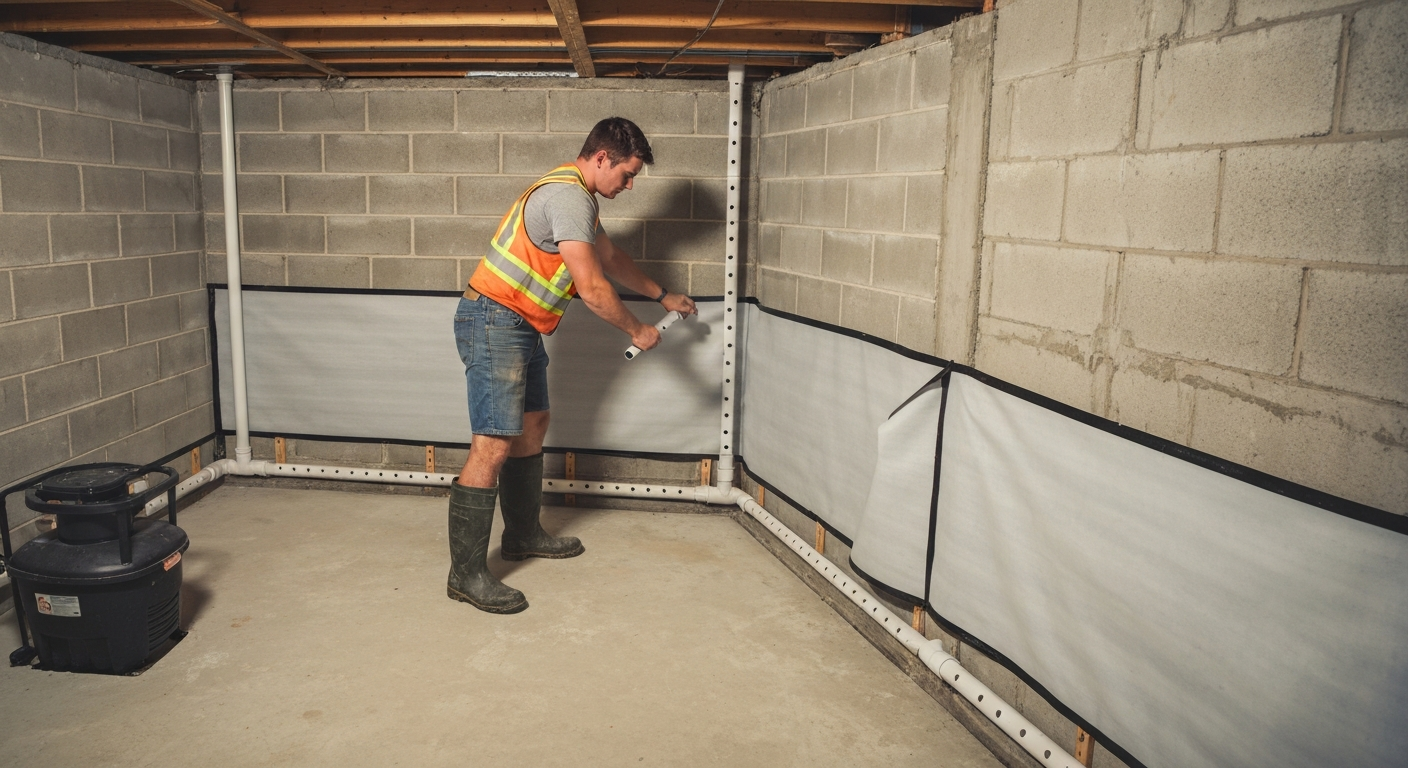
The fundamental difference is that exterior waterproofing tackles water at the source by fully excavating to the foundation wall, installing a continuous membrane and new drainage tile, and then rebuilding the backfill properly. This is the most durable solution when hydrostatic pressure is pushing water through foundation walls or when original drainage has failed. Interior waterproofing—perimeter drain channel, sump pit, and a sump pump—manages water after it enters the basement and helps reduce standing water, but it does not remove the pressure against the foundation wall itself.
In Williams Lake and much of the Cariboo, the right approach is strongly influenced by soil and freeze-thaw cycles. Poured concrete walls often respond well to crack injection when the crack is stable, but when freeze-thaw and saturated backfill are driving ongoing seepage, pairing injection with an interior drainage system (or moving to exterior) can be the safer long-term plan. Block foundations are frequently best treated with interior drainage as a practical complement, because block joints and mortar bedding can continue to weep if the external drainage is no longer effective.
Sump pump systems matter because spring melt and wet seasons can increase run time. In British Columbia, power disruptions do happen, and for basements in established neighbourhoods with limited backup planning, a battery backup can be the difference between a nuisance leak and a flooded basement. As a dollar example, if an exterior dig is required due to clay-heavy soil and failed weeping tile, homeowners are commonly budgeting in the $7,000–$18,000 range. If the leak is localized and site grading/downspouts are the main cause, a less invasive re-grading plan may keep you closer to the $650–$2,000 range—provided the discharge path truly directs water away from the footing.
| Method |
Best For |
Addresses Source? |
Disruption |
Lifespan |
Price Band |
| Full exterior excavation + membrane |
Widespread seepage, failed drainage, high hydrostatic pressure conditions |
Yes (source of seepage is addressed) |
High (excavation and landscape restoration) |
Long-term when detailed correctly with proper backfill/compaction |
$7,000–$18,000 |
| Interior French drain + sump system |
Water entry through cracks/seepage; when exterior excavation is limited by access or landscaping |
No (it collects/manage water after it enters) |
Medium (floor work at perimeter) |
Very good with correct pump sizing, discharge routing and backup planning |
$3,000–$12,000 |
| Crack injection — epoxy (structural) |
Stable, non-moving cracks where water is not actively flowing through |
Limited (seals the crack pathway, but depends on pressure source) |
Low to medium |
Good to long-term if crack movement is ruled out |
$500–$1,500 |
| Crack injection — polyurethane (active leak) |
Active seepage through cracks/joints |
Limited to direct sealing of leak pathway (still may need drainage management) |
Low to medium |
Good when injection targets the correct pathways |
$600–$1,800 |
| Interior drain channel only (no sump) |
Minor seepage that can be safely managed without active pumping |
No (manages intruding water internally) |
Medium to low |
Moderate—performance depends on gravity drainage and seasonality |
$2,000–$7,000 |
| Re-grading + downspout extensions |
Surface water runoff around the foundation is the primary cause |
Yes (reduces water load near the foundation) |
Low to medium |
Good, assuming ongoing maintenance and correct discharge |
$650–$2,000 |
How to choose a waterproofing contractor in Williams Lake
Choosing the right contractor matters because waterproofing is as much about diagnosis and workmanship detail as it is about materials. Start by verifying British Columbia licensing through the provincial online registry, and confirm the contractor’s business name matches what appears on invoices and insurance documents. Next, request a certificate of insurance for liability coverage and confirm it includes work at your address. For workers doing the job, ask for proof of workers’ coverage (WSIB/WCB clearance documentation, depending on the arrangement). If you’re booking structural crack repairs, ask how engineering support is handled when needed and whether they will coordinate inspections or any permit requirements.
Then get 2–3 itemised written quotes. You should see a breakdown of labour and materials, including excavation depth (if exterior), drain pipe and membrane products, sump pump model (and discharge route), and disposal/landscaping restoration. A proper scope should state what’s excluded—for example, whether disposal of excavated soil is included, whether permit pulling is included, and what happens if additional cracks or failed drainage are uncovered during excavation.
Warranty is another big differentiator. Ask for the workmanship warranty length, product/manufacturer warranty terms, and whether coverage is transferable if you sell the house. For payment scheduling, avoid paying more than 10%–15% upfront; hold back the remainder until the job is complete and any final water-management elements are finished. Finally, ask for a written start date, sequencing plan, and a completion estimate that accounts for drying/backfill timelines in Cariboo conditions.
- Confirm BC licence in the provincial registry and match the licence/biz name on the quote.
- Require liability insurance certificate before work begins.
- Ask for WSIB/WCB clearance documentation for the crew doing installation.
- Get 2–3 itemised quotes (labour + materials), not lump sums.
- Request a written scope: exact methods, product types, and number of crack injection ports/linear feet.
- Clarify inclusions: permit pull, disposal, compaction/backfill method, and landscaping restoration.
- Confirm drainage details: downspout routing, sump discharge location, and where the tile daylights.
- Ask what happens if more damage is found during excavation (change-order approach).
- Verify sump pump type and backup option (battery or water-powered) if power interruption risk matters.
- Ask for warranty details: workmanship term, product term, and transferability on sale.
- Payment schedule: no more than 10%–15% upfront; hold back until completion.
- Timeline in writing, including inspection milestones if a permit is required.
Red flags in Williams Lake include: quotes that don’t include a diagnosis/explanation of water pathway; no mention of soil drainage or freeze-thaw; vague scopes with no measurements (no linear footage or excavation depth); warranty language that only covers materials but not workmanship; and contractors who ask for large upfront payments or refuse to provide proof of licensing, insurance, or workers’ coverage.
Frequently asked questions — waterproofing in Williams Lake
Do I need a permit for foundation work in British Columbia?
In British Columbia, foundation excavation, structural crack repair when it involves structural elements, and changes to lot drainage commonly require a building permit. For waterproofing, the permit trigger depends on the scope: simple interior sealing may not always require one, but anything that alters how water is routed on the property or involves structural crack repairs should be reviewed before work starts. If a sump pump connects to storm or sanitary sewer systems, municipal approval is typically required. In Williams Lake, always ask your contractor what permits they will pull and whether inspections are included. A reputable contractor will put this in writing and confirm who is responsible for compliance.
How long does waterproofing last?
With proper workmanship, waterproofing can last many years. Exterior systems—new membrane and drainage tile installed to full detail with correctly compacted backfill—are usually the longest-lasting approach because they reduce water pressure at the foundation wall. Interior systems last well too, especially when they’re paired with crack repair and a correctly sized sump. That said, the lifespan depends heavily on site conditions: clay-rich, moisture-retaining soils and freeze-thaw in the Cariboo can increase stress on cracks over time. If your home is built before 1981, original drainage details may already be near failure, so “patching” without managing water load can reduce longevity. For budgeting, many homeowners see exterior work in the $7,000–$18,000 range when a long-term solution is the goal.
Can I waterproof my basement from the inside only?
Yes, in many Williams Lake basements, interior waterproofing is a practical and less disruptive option. Interior perimeter drains and sump pits collect water that enters through seepage and cracks, reducing water accumulation and protecting finishes. However, interior-only work generally does not remove hydrostatic pressure against the foundation wall, which can matter if the soil is clay-heavy or drainage has failed externally. In those cases, interior work is often paired with crack injection and may still be complemented later by exterior drainage upgrades. If the problem is mainly surface runoff or window-well leakage, interior work may be unnecessary. Compare scopes carefully: a quote that looks like “just a sump” might need additional drainage fixes to avoid recurrent problems. Interior perimeter drain projects often land in the $3,000–$12,000 band depending on conditions and pump/backup selection.
What causes foundation cracks in Williams Lake?
Foundation cracks commonly come from a combination of movement and water-related stress. In the Cariboo, freeze-thaw cycles can expand and contract moisture in soil and within concrete joints, which can widen hairline cracks and gradually turn them into repeating seepage paths. Soil type matters: moisture-retaining or clay-rich soils can hold water near the foundation and increase lateral pressure, especially when drainage details have failed. Poor grading and downspout discharge that directs runoff toward the house can also add water load. In older Williams Lake homes (many built before 1981), original drainage systems and waterproofing membranes were not designed for today’s maintenance realities, so cracking and seepage can show up after years of wear. If the crack is horizontal or shows step-movement, it may require an engineer’s assessment.
How do I compare waterproofing quotes?
Start by confirming you’re comparing the same problem and the same scope. Ask each contractor how they diagnosed the water entry pathway and what exact method addresses it. Quotes should be itemised: labour, materials, linear footage of drains, pump model, membrane type, and excavation depth if exterior work is proposed. Watch for missing inclusions—disposal of excavated soil, permit pulling, landscape restoration, and discharge routing for a sump. Also compare disruption: an interior-only plan may look cheaper, but if the soil and drainage conditions indicate high hydrostatic pressure, the interior plan may not fully solve the source. Pricing can differ by 30% to 50% across the region because site conditions drive excavation and drainage upgrades. Use price bands as context: exterior waterproofing (excavation) often falls around the $7,000–$18,000 range, while crack repair is commonly far lower (for example, $500–$1,500).
How long does basement waterproofing take in Williams Lake?
Timelines depend on whether the plan is interior-only or involves exterior excavation. Interior work can often be completed in days to a week, depending on drying times, the extent of drain channel installation, and how much floor/footing prep is required. Exterior excavation typically takes longer because contractors must excavate to expose the foundation, install membrane and drainage tile, properly backfill and compact, then allow restoration. In the Cariboo, wet spring ground and freeze-thaw conditions can slow progress, particularly for exterior backfill and compaction. Your contractor should provide a written start date and completion estimate that includes weather contingencies. If permits are required in British Columbia for structural or drainage changes, factor in inspection scheduling. A well-prepared crew with clear staging often reduces delays and change-orders.