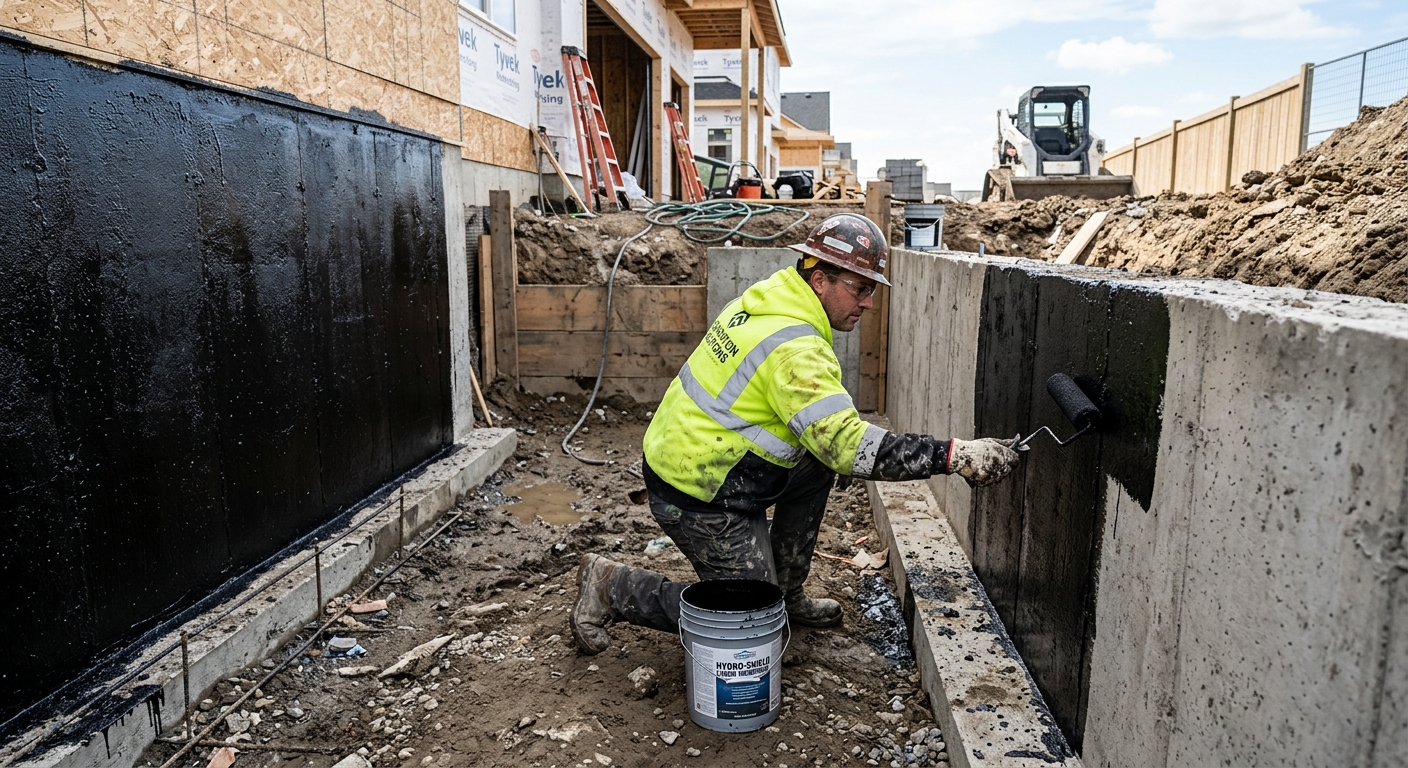
Basement waterproofing options and costs in Brookhaven-Amesbury
In Brookhaven-Amesbury, basement waterproofing usually comes down to how and where water is getting in—plus how aggressive the soil forces are once the ground saturates. With a Brookhaven-Amesbury population of 17,757 (Statistics Canada, 2021 Census), we see a steady mix of older and mid-age homes, and that matters because many original weeping tile systems are now long past their useful life. In particular, post-war and 1960–1980s foundations in the Toronto area often have drainage that’s partially collapsed, clogged, or disconnected, so water migrates inward through cold joints, tie holes, and cracks rather than pushing outward through obvious wall failure.
Toronto-area pricing also reflects site constraints. Tight lots, additions, deck footings, and shared driveways around neighbourhood pockets create labour time and disposal complexity for excavation. At the same time, mixed glacial till and clay soils—often dense—hold water against foundation walls, and Toronto’s freeze–thaw cycles can enlarge small defects over a few winters. In demand areas, contractors are especially busy in parts of Brookhaven-Amesbury where mature trees and established landscaping limit access for excavation and where older drainage was installed with less modern materials.
Below is a homeowner-friendly comparison of common waterproofing approaches, what they target, and typical cost bands—then you can match the method to your symptoms before requesting itemised quotes.
| Method |
What It Addresses |
Disruption Level |
Durability |
Price Range |
| Exterior excavation + new membrane + drainage tile |
Stops bulk water at the source; replaces failed perimeter drainage and upgrades waterproofing on foundation walls |
High (excavation, backfill, landscaping restoration) |
High (typically designed to last decades with proper installation and drainage maintenance) |
$7,000 – $25,000 |
| Interior perimeter drain channel + sump pit |
Collects water inside and manages it away from the foundation before it enters the basement |
Medium (partial interior work; concrete cutting near perimeter) |
High with pump maintenance and proper discharge routing |
$3,500 – $15,000 |
| Foundation crack injection (epoxy or polyurethane) |
Seals isolated cracks; epoxy for stable, non-moving cracks, polyurethane for active seepage |
Low to Medium (drilling and patching; less disruption than excavation) |
Medium to High (depends on crack movement and whether drainage is corrected) |
$600 – $3,000 |
| Sump pump installation (primary + battery backup) |
Prevents hydrostatic water from flooding during high water events and during power interruptions |
Low to Medium (pit, discharge lines, electrical work) |
High (especially when paired with backup power) |
$800 – $3,500 |
| Window well drain installation |
Stops rainwater pooling and overflow at basement egress/window wells |
Medium (excavation around wells; grading adjustments) |
Medium to High (depends on drainage routing and grading) |
$1,200 – $4,500 |
| Lot re-grading / downspout extension |
Reduces surface runoff and directs roof water away from the foundation |
Low (common exterior adjustments) |
Low to Medium (great as maintenance; limited if interior hydrostatic pressure remains) |
$800 – $6,000 |
Prices are estimates only and vary by project scope, site access and material selection.
What affects the price of waterproofing in Brookhaven-Amesbury
In Brookhaven-Amesbury and across the Toronto economic region, it’s not unusual to see waterproofing quotes for the “same” basement issue vary by 30% to 50%. The difference comes from what the contractor determines is actually driving water movement: soil saturation and lateral pressure, failing drainage systems, crack activity, and how much excavation or concrete cutting is required to reach the problem correctly.
Three local drivers typically separate regional pricing from the national average: soil type, water table conditions, and freeze–thaw. Dense clay pockets in many parts of the Toronto area expand when saturated, which increases lateral pressure on foundation walls and can turn hairline cracks into active seepage over a few freeze seasons. High local water tables in many neighbourhoods also raise sump run times and the amount of drainage capacity needed. When original weeping tile or early plastic drains are clogged or collapsed, contractors often must add an interior perimeter system even if the exterior looks “mostly fine.”
Cost examples you’ll recognize in Brookhaven-Amesbury: (1) If your home has a blocked original weeper and the basement is getting interior dampness plus efflorescence, interior perimeter drainage and sump work can start around the $3,500 band, but may escalate toward $15,000 if the discharge route and basin construction are complex. (2) If the leak is isolated and confirmed stable, targeted crack injection can land near the $600 to $3,000 range—but if the crack is moving due to clay pressure, injections alone may not be the best value. (3) Exterior work can jump toward the $7,000–$25,000 band when excavation must occur around additions, retaining walls, or deck footings to install proper drainage and membrane continuity.
| Price Factor |
Why It Matters |
Cost Impact |
| Interior vs. exterior approach — interior is less disruptive but addresses symptoms |
Interior systems manage water after it enters; exterior addresses source water pressure and drainage around the footing |
Interior often costs less upfront; exterior commonly adds significant excavation/backfill labour and landscaping restoration |
| Foundation type — poured concrete vs. block vs. stone vs. ICF |
Different wall materials respond differently to cracks, seepage paths, and membrane adhesion |
Block and stone often require more attention to seepage control; poured concrete may suit crack-focused solutions more often |
| Soil type — clay expands more than sand, adding pressure |
Clay can hold water against walls and intensify lateral pressure during freeze–thaw |
Higher risk of active leaks; may require sump/interior drainage even if cracks seem small |
| Crack type and length — hairline vs. structural horizontal cracks |
Long, moving, or horizontal cracks can indicate significant movement and may need engineering/structural remediation |
Structural evaluation and more invasive repairs can move the job into higher-cost tiers |
| Sump pump backup system — battery or water-powered backup needed |
Backup reduces flood risk during spring power interruptions |
Adds material and testing time; can push total cost toward the upper part of pump bands |
| Access — landscaping, decks, or driveways must be removed for exterior |
Excavation is time-consuming when access is tight or when hardscapes must be temporarily removed and restored |
Can significantly increase exterior project labour and restoration costs |
| Weeping tile age — original tile (60+ years) may be completely failed |
Old drains are frequently collapsed or disconnected, causing water to bypass intended pathways |
Often necessitates full drainage replacement or interior catch systems |
| Mould or efflorescence remediation required before sealing |
Active moisture encourages microbial growth; mineral salts indicate ongoing water movement |
Remediation, drying time, and material allowances add cost and scheduling |
Permits & regulations in Ontario
In Ontario, foundation excavation, structural crack repair, and changes to lot drainage typically require a building permit. Specifically, when work affects the structural integrity of a foundation—such as repairing major step cracks in block walls, addressing horizontal cracks, or doing underpinning—permits are commonly required, and an engineering assessment is often part of the process to confirm stability and the correct repair method.
Sump pump installations can also trigger municipal approval depending on how the discharge is routed. Connecting a sump discharge to the storm or sanitary sewer usually requires the appropriate approvals and may involve inspections. Even when the pump ties into an existing approved system, contractors should document the routing method so you know where the water legally goes.
Step-by-step, here’s how a Brookhaven-Amesbury homeowner can verify a contractor before signing:
- Ask for the contractor’s Ontario licence/registration details (and confirm they’re in good standing through the appropriate online registry).
- Request a current certificate of liability insurance and verify the policy covers waterproofing/foundation work and is not expired.
- Confirm WSIB/WCB clearance (or the equivalent coverage documentation) and save a copy for your records.
- For structural repairs, confirm they have engineering support and that the plan addresses stability—not just sealing.
- Ask whether permits are pulled by the contractor or required separately, and who pays.
- Get the permit number/inspection plan in writing before work begins.
This keeps you protected if repairs uncover hidden conditions like failed drainage behind the footing or evidence of active movement in older block or poured-concrete walls.
Interior vs exterior waterproofing — what does Brookhaven-Amesbury need?
Exterior waterproofing is the “source control” approach: it involves full excavation, applying a continuous waterproofing membrane to the foundation, installing or replacing perimeter drainage tile, then backfilling and restoring the lot. It’s more expensive and disruptive, but in Toronto-area clay conditions it’s often the most reliable way to reduce hydrostatic pressure and lateral water forces at the wall. Interior waterproofing, by contrast, manages water after it enters the basement. Typical systems include a perimeter drain channel, a sump pit, and sump pump operation, which can prevent flooding even if the exterior drainage has failed.
For Brookhaven-Amesbury homes, the best choice usually depends on soil saturation and foundation material. Where clay-heavy soils expand and exert pressure, exterior drainage and membrane continuity can be worth the added excavation because it reduces the ongoing stress that reopens cracks during freeze–thaw. Poured-concrete walls often seal well with crack injection when leaks are isolated and cracks are stable; however, if clay pressure is actively pushing water, injections alone can be a temporary fix. Block foundations frequently require interior drainage as a practical complement because block joints and mortar paths can transmit moisture even when exterior grading looks acceptable.
Sump pump backups are also a smart consideration in Ontario. During spring high-water periods, power reliability matters, especially when clay keeps the ground saturated and water remains on the property for longer stretches. A primary pump plus backup (battery or water-powered) helps prevent the “no power, basement floods” scenario.
A real cost example: if exterior excavation in your lot access conditions lands near the $7,000–$25,000 band, it may be justified when the original weeping tile is failed and clay saturation is clearly contributing to active leaks. If instead you only have localized dampness and confirmed stable cracks, an interior drainage strategy or targeted crack repair may be a better-value starting point—often far closer to the $3,500–$15,000 interior band, depending on basin size and discharge complexity.
| Method |
Best For |
Addresses Source? |
Disruption |
Lifespan |
Price Band |
| Full exterior excavation + membrane |
Chronic seepage where exterior drainage and waterproofing are failing; clay-heavy sites with lateral pressure |
Yes |
High (excavation, backfill, landscaping restoration) |
Long-term (designed for decades with correct drainage continuity) |
$7,000 – $25,000 |
| Interior French drain + sump system |
Basements with persistent seepage/efflorescence, failed exterior weepers, or limited access for excavation |
No (manages water after entry) |
Medium (concrete cutting and perimeter work) |
High if pump sizing and discharge routing are correct |
$3,500 – $15,000 |
| Crack injection — epoxy (structural) |
Stable, non-moving cracks in poured concrete or well-supported foundations |
Partial (seals the crack path) |
Low to Medium |
Medium to High when crack movement is ruled out |
$600 – $3,000 |
| Crack injection — polyurethane (active leak) |
Active seepage where water pressure is pushing through cracks |
Partial (seals the leak path; won’t fully control hydrostatic pressure) |
Low to Medium |
Medium to High when paired with drainage management |
$600 – $3,000 |
| Interior drain channel only (no sump) |
Light seepage and slow water that can be routed without pumping (rare in clay-saturation scenarios) |
No |
Medium (perimeter channel and routing) |
Limited if water table rises or entry becomes active |
$2,500 – $8,000 |
| Re-grading + downspout extensions |
Surface-water problems where roof runoff is dumping toward the foundation |
No (mitigates one source) |
Low |
Low to Medium (needs maintenance and doesn’t address hydrostatic pressure) |
$800 – $6,000 |
How to choose a waterproofing contractor in Brookhaven-Amesbury
Choosing the right waterproofing contractor in Brookhaven-Amesbury starts with verifying coverage and then matching the scope to what your home actually needs. Confirm Ontario licensing/registration first: ask for the contractor’s licence details and check the listing online in the relevant provincial registry for trades/contractors. Next, request a certificate of liability insurance and ensure it’s current and specifically covers work similar to basement waterproofing and foundation repairs. Then verify WSIB/WCB clearance—don’t accept “we’re covered” verbally; ask for the clearance letter/documentation and keep it with your contract.
After that, get 2–3 itemised written quotes. Look for a breakdown that separates labour, materials, disposal, pump/equipment (if included), and any site restoration. A lump sum with vague language is a warning sign. Read exclusions carefully: is permit pulling included? Is engineering included for structural cracks? Is mould remediation part of the work scope if efflorescence is present? Confirm whether they’ll dry and test before sealing, and whether they include discharge routing and tie-in approval documentation where required.
On warranty, insist on two layers: workmanship warranty length and manufacturer/product warranty terms. Ask whether the warranty is transferable to future owners (often overlooked when you sell). For payment, never pay more than 10%–15% upfront; use a holdback until completion, including final clean-up and documentation. Finally, require a start date and a completion estimate in writing so delays and seasonal weather don’t become billable surprises.
- Ask what testing they’ll do first (inspection, moisture mapping, crack movement assessment).
- Require a written scope of work with access/disposal/restoration listed.
- Confirm whether they’ll handle permits and inspections or if you must.
- Verify insurance certificate dates and named coverage types.
- Verify WSIB/WCB clearance with documentation.
- Get warranty details in writing: workmanship + product/manufacturer terms.
- Confirm discharge routing method (and backup pumping if suggested).
- Ask what happens if they uncover collapsed weeping tile or voids.
- Request proof of prior similar projects in Toronto-area clay conditions.
- Don’t proceed if the quote ignores foundation type and crack behaviour.
- Use a payment schedule tied to milestones, not vague “phases.”
- Get timeline commitments and a weather contingency plan.
Red flags we see in Brookhaven-Amesbury include: (1) promises of a “permanent fix” without addressing drainage or water pressure, (2) quotes that omit pump discharge routing details, (3) no clarification on permits for foundation or drainage changes, (4) workmanship warranties that are shorter than what’s typical for comparable scopes, and (5) refusal to provide insurance/WSIB/WCB documentation before signing.
Frequently asked questions — waterproofing in Brookhaven-Amesbury
Why is my basement leaking in Brookhaven-Amesbury?
In Brookhaven-Amesbury and the broader Toronto area, basement leaks commonly come from a combination of clay-heavy soil saturation, failed or clogged weeping tile, and freeze–thaw expansion that enlarges small defects. Many homes here have older drainage systems that are partially collapsed or disconnected, so water can track through cold joints, tie holes, and cracks instead of draining away. If you also notice efflorescence (white mineral deposits) or damp carpet near the perimeter, that often points to ongoing moisture transfer rather than a one-time runoff event.
If the leak appears after heavy spring rain or snowmelt and worsens during freeze cycles, you may need interior perimeter drainage and possibly sump management. A typical interior perimeter drain plus sump scope often starts around $3,500 – $15,000, depending on how much concrete needs to be cut and how complex the discharge route is.
How do I know if a foundation crack is serious?
In Ontario, the seriousness of a crack depends on whether it’s moving and on the crack pattern. Hairline cracks in poured concrete that stay the same year over year can be candidates for crack injection, especially when drainage is corrected. By contrast, horizontal cracks in block or cracks that are opening/stepping can indicate structural movement or active water pressure—situations where you should pause and request an engineered assessment.
Practical checks: look for widening over seasons, bulging areas, water seepage through the crack during wet weather, and cracking at corners where movement concentrates. Also note if the crack is paired with ongoing dampness or efflorescence—this suggests active moisture entry, not just cosmetic shrinkage.
When cracks are stable and isolated, crack injection commonly falls in the $600 – $3,000 range. If the crack is structural or horizontal, the repair plan may cost more because you may need engineering and additional remediation beyond sealing.
How much does foundation crack repair cost in Brookhaven-Amesbury?
Foundation crack repair cost in Brookhaven-Amesbury depends on crack length, whether it’s actively leaking, and how many injection points are needed. For isolated, stable cracks—especially in poured concrete—epoxy injection is often appropriate, and pricing commonly fits within the $600 – $3,000 band for typical residential repairs. If the crack is actively seeping due to hydrostatic pressure, polyurethane injection is usually used to stop the flow, and the job can still land in a similar range, but it may increase with added preparation and patching.
Costs can also rise if the contractor must address nearby drainage issues first, because sealing a crack without correcting the water pressure can lead to repeat leakage. For that reason, reliable contractors in the Toronto market will inspect the surrounding conditions before pricing injection alone.
Do I need a sump pump in Brookhaven-Amesbury?
A sump pump is often recommended when you have recurring water entry, signs of a higher water table effect, or interior leakage that can’t be controlled with grading alone—particularly in clay-heavy areas that hold water against foundations. In Brookhaven-Amesbury, many basements with long-standing dampness benefit from perimeter drainage that routes water to a sump pit, where a pump removes it before it accumulates.
If your basement floods during spring melt or heavy rain, or if you’re installing an interior drainage channel, a pump is typically part of the system. A sump pump installation (primary with optional backup) commonly falls in the $800 – $3,500 band.
Because Ontario power interruptions can occur during severe weather, consider a battery backup or water-powered backup when feasible—especially if your basement has finished areas or valuable utilities near the floor. A good contractor will also confirm discharge routing and any required approvals.
How does Brookhaven-Amesbury's soil affect my foundation?
Brookhaven-Amesbury sits in the Toronto region where many properties rest on mixed glacial till and clay, including pockets of dense clay. Clay has a strong ability to hold water when it becomes saturated, which increases lateral pressure on foundation walls. During freeze–thaw cycles, that trapped moisture expands and can widen small cracks over time, turning slow seepage into active leaks.
This soil behaviour also helps explain why some homes experience interior dampness even when the exterior wall “looks fine.” If original weeping tile or early drainage systems are clogged or collapsed, water simply accumulates around the foundation and finds pathways through cold joints, tie holes, and mortar lines.
Depending on severity, remedies range from targeted crack injection in the $600 – $3,000 band (when the crack is stable and isolated) to interior perimeter drainage and sump systems near $3,500 – $15,000 or exterior excavation and membrane work in the $7,000 – $25,000 band when source control is necessary.
Do I need a permit for foundation work in Ontario?
Often, yes. In Ontario, foundation excavation, structural crack repair, and changes to lot drainage typically require a building permit. If your repair involves structural concerns—like major step cracks in block walls, horizontal cracks, or anything that could affect foundation stability—an engineering assessment is commonly needed, and permits are generally part of the process.
Sump pump installations may also require municipal approval depending on where the discharge goes. Connecting to storm or sanitary systems typically involves approval and inspections. Because requirements can vary with how and where the water is redirected, your contractor should clarify the permit path in writing before work begins.
To verify compliance in Brookhaven-Amesbury, ask the contractor to state whether they will pull permits and provide proof of insurance and WSIB/WCB clearance. If they can’t discuss permits clearly, that’s a practical red flag—especially when you’re addressing issues tied to hydrostatic pressure and drainage changes.