Basement waterproofing options and costs in Queenswood Heights
Queenswood Heights homeowners usually start waterproofing decisions after noticing recurring dampness, efflorescence, or musty odours—often long before a wall looks “failed.” With Queenswood Heights sitting within the Greater Toronto Area’s mixed glacial till and clay pockets, many basements experience higher lateral soil pressure when the soil saturates. That matters because older drainage systems can be partially clogged or collapsed, and freeze–thaw can widen small defects over a few winters. While Queenswood Heights has a population of about 12,000 (Statistics Canada, 2021 Census), the bigger driver for cost is the age of the housing stock and the age of the weeping tile or drainage piping serving those foundations.
In practice, post-war and 1960–1980s homes in and around Queenswood Heights are more likely to have drainage that’s reached the end of its service life, which pushes many homeowners toward exterior excavation + membrane and drainage tile. Where access is tight—common along additions, decks, or shared driveways—contractors often propose interior perimeter drains with a sump pit as the most workable first step, then verify whether localized crack injection will solve the specific leak pathways.
Contractor availability also changes pricing: the more labour and hand-digging required (especially around deck footings or where clay must be removed carefully), the more the job moves toward the upper end of the exterior band. In this neighbourhood, waterproofing demand can be especially high in older pocket developments closer to the main collector roads, where lots are tighter and regrading is harder. That’s why the “best” option is often the one that matches the water source and the foundation details—see the comparison table below to set expectations.
| Method |
What It Addresses |
Disruption Level |
Durability |
Price Range |
| Exterior excavation + new membrane + drainage tile |
Stops water at the source by removing pressure and creating new drainage paths; replaces failed weeping tile and cold-joint leakage risk |
High (yard excavation, landscaping restoration) |
Long-term when properly detailed for clay soils and water table conditions |
$7,000–$25,000 |
| Interior perimeter drain channel + sump pit |
Manages water after it enters; reduces hydrostatic pressure effects and interior dampness |
Medium (interior demo in basement) |
Highly reliable if sump sizing and discharge routing are correct |
$3,500–$15,000 |
| Foundation crack injection (epoxy or polyurethane) |
Seals isolated leak paths through cracks; stabilizes nuisance seepage or active flow depending on resin choice |
Low to Medium (surface prep and patching) |
Good for correctly identified crack type and preparation |
$600–$3,000 |
| Sump pump installation (primary + battery backup) |
Keeps the sump from overflowing during high water and power interruptions; reduces recurring flooding risk |
Low to Medium (basement cutting and mechanical fit-out) |
Strong protection when paired with a properly designed drain system |
$800–$3,500 |
| Window well drain installation |
Prevents rainwater and groundwater from saturating window wells and migrating inward |
Low (targeted exterior/grade work around wells) |
Best as a localized fix paired with gutter downspout control |
$1,000–$5,000 |
| Lot re-grading / downspout extension |
Redirects surface water away from foundation; lowers how often interior systems get overwhelmed |
Low to Medium (yard work) |
Depends on consistent maintenance and correct slope |
$900–$6,500 |
Prices are estimates only and vary by project scope, site access and material selection.
What affects the price of waterproofing in Queenswood Heights
In Queenswood Heights and across Toronto’s inner ring, quotes for the “same” waterproofing job can swing by 30–50% because the true scope is often driven by what’s happening below grade—not just what you can see in the basement. Three local variables separate the Toronto market from many national averages: soil type, water table conditions, and freeze–thaw. Mixed glacial till with clay pockets holds water against foundations and expands when saturated, which increases lateral pressure and stresses cracks over repeated winters.
In many Toronto-area basements, the water table is high enough that interior systems run longer, so contractors may need proper sump sizing, a reliable discharge route, and in some cases a battery backup. In the freeze–thaw cycle, small defects that seem “fine” in fall can become active leaks after a few seasons, requiring either expanded crack injection or a more comprehensive perimeter drainage plan. Housing age also matters: older weeping tile lines—often clay or early plastic—may be partially failed, causing interior dampness, efflorescence, or basement flooding even without dramatic exterior wall movement.
Two quick examples from typical Queenswood Heights scenarios: if your basement already has a workable interior drain but the sump lacks backup, adding battery backup usually sits closer to the lower band (from about $800–$3,500). If the exterior excavation is required because the clay backfill is pressurizing the wall and the weeping tile is failing, the project can climb into the higher exterior range (often $7,000–$25,000) once hand-digging and membrane detailing are included. Conversely, if leaks are limited to a few isolated cracks with clear evidence of active seepage, targeted crack injection can keep costs closer to $600–$3,000.
| Price Factor |
Why It Matters |
Cost Impact |
| Interior vs. exterior approach — interior is less disruptive but addresses symptoms |
Exterior targets water at the source; interior typically manages water after entry |
Interior can be 40–70% less than full exterior excavation on comparable leak patterns |
| Foundation type — poured concrete vs. block vs. stone vs. ICF |
Crack behavior and sealing strategy differ by foundation material |
Block and stone often require more drain management; poured concrete may respond well to crack injection |
| Soil type — clay expands more than sand, adding pressure |
Clay increases lateral pressure and can worsen seepage through joints and cracks |
Higher excavation/membrane detailing costs in clay-heavy pockets |
| Crack type and length — hairline vs. structural horizontal cracks |
Structural horizontal cracks can indicate movement and may require engineered assessment |
Can shift a repair from a smaller injection scope to a larger structural plan |
| Sump pump backup system — battery or water-powered backup needed |
Toronto-area power interruptions during wet spring periods can increase flood risk |
Backup typically adds cost but reduces catastrophic loss risk during outages |
| Access — landscaping, decks, or driveways must be removed for exterior |
Time and disposal increase when excavation is constrained |
Costs rise quickly when decks, steps, fences, or shared driveways must be disturbed |
| Weeping tile age — original tile (60+ years) may be completely failed |
Old tile can collapse or clog, leaving groundwater no longer routed away |
May require full replacement and membrane tie-in work |
| Mould or efflorescence remediation required before sealing |
Sealers won’t perform reliably if salts/microbial growth remain |
Adds prep and material costs prior to membrane, coatings, or injections |
Permits & regulations in Ontario
In Ontario, some basement waterproofing-adjacent work does require permits, especially when excavation affects foundation conditions, alters lot drainage, or involves structural repair. As a rule of thumb, foundation excavation, structural crack repair (particularly where there are signs of movement or where the crack pattern suggests more than a surface defect), and changes that meaningfully affect how water leaves the property typically fall under permit requirements. If your sump pump installation connects discharge to municipal storm or sanitary systems, you usually need municipal approval before that connection is made.
For structural crack repair—such as major step cracking in block walls or horizontal cracking that suggests movement—an assessment by a structural engineer is often required to determine whether underpinning or other structural remediation is necessary. Make sure your contractor can provide engineering support or, at minimum, can coordinate it.
To verify a Queenswood Heights contractor is properly set up in Ontario, check three items in this order:
- Ontario licensing: confirm the specific trades licence they claim to hold (and that it matches the type of work being performed).
- Liability insurance: request a certificate of insurance showing coverage limits appropriate for excavation, concrete work, and property damage risk. Verify the company name matches the contract.
- WSIB/WCB coverage: obtain a clearance letter or proof of account coverage, and ensure it is valid for the period the job will run.
Finally, ask whether the permit (if required) is included in the scope and who is responsible for filing—your contract should say it clearly before any work starts.
Interior vs exterior waterproofing — what does Queenswood Heights need?
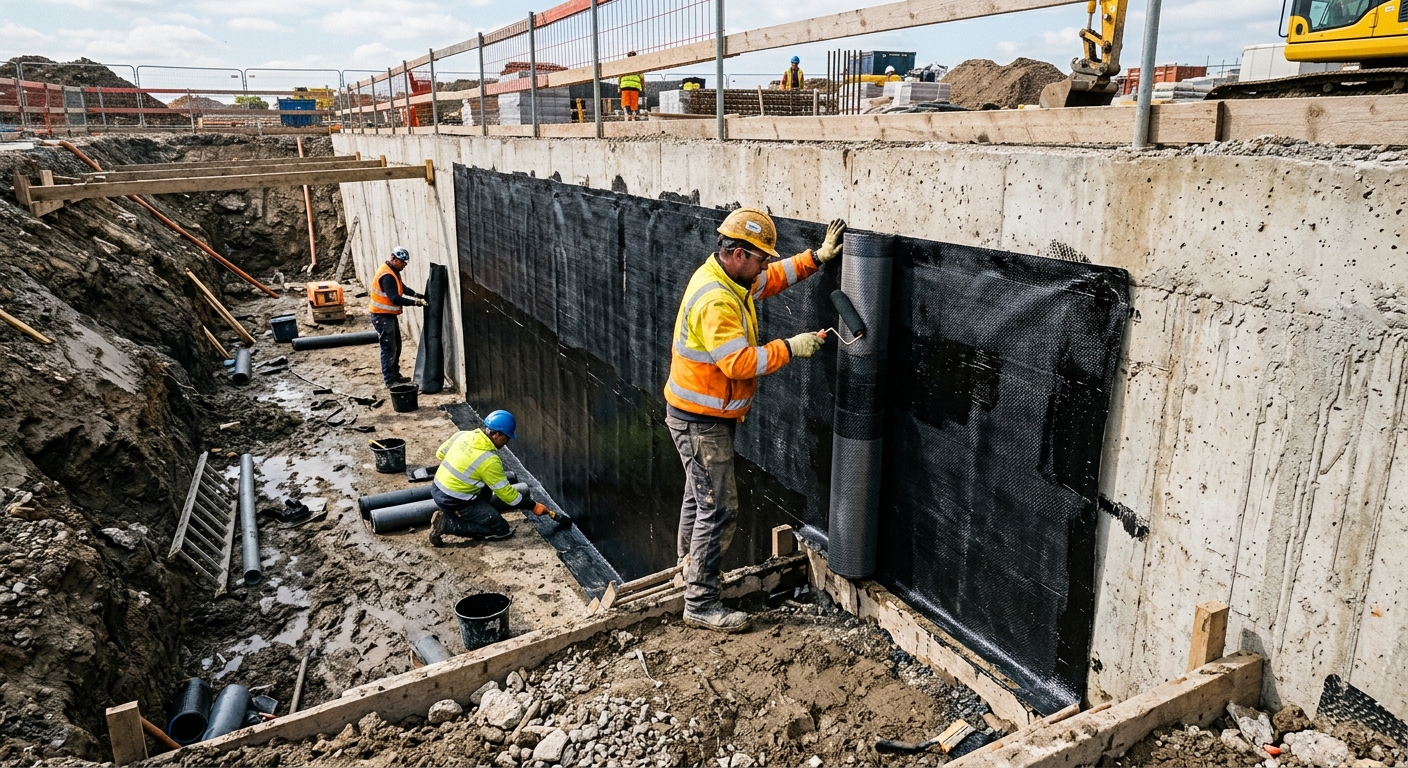
Exterior waterproofing is the “source-control” option: it involves full excavation, new waterproofing membrane, installation of drainage tile, and careful backfill detailing. When clay soils and high water pressure are present in Queenswood Heights, this method can permanently reduce the chance of water pushing through cold joints, tie holes, and cracks. The trade-off is disruption and cost—full exterior work typically means landscaping removal and restoration, and it can be limited by deck footings, fences, or tight lot lines.
Interior waterproofing is different: it manages water after it enters by capturing it through a perimeter drain channel and directing it to a sump pit and sump pump. This approach is often less invasive and can be the best fit when excavation is impractical or when the homeowner needs to address interior dampness quickly. However, interior systems do not eliminate hydrostatic pressure on the wall; they reduce the buildup by collecting seepage and lowering groundwater levels near the foundation.
In Toronto’s freeze–thaw climate, sump reliability becomes critical during spring melt and heavy rain. That’s why many Queenswood Heights homeowners upgrade to a sump pump installation with battery backup when they have a history of power interruptions or when groundwater loads are high. Poured concrete walls often respond well to crack injection when the main leak pathway is isolated, while block foundations commonly benefit from interior perimeter drainage as a practical complement, because block joints and hairline gaps can sustain seepage even after localized fixes.
For example, if your main issue is a few active seepage cracks near a corner, targeted crack injection (commonly in the $600–$3,000 range) may be justified without full excavation. But if you’re seeing recurring dampness across multiple wall sections during wet seasons—typical in clay pockets—then interior drainage and sump planning (often within the $3,500–$15,000 band) can be the step that prevents repeat flooding, and full exterior excavation may be the long-term resolution (frequently within the $7,000–$25,000 band).
| Method |
Best For |
Addresses Source? |
Disruption |
Lifespan |
Price Band |
| Full exterior excavation + membrane |
Clay-heavy pressure conditions, high water table seepage, failed weeping tile, widespread dampness |
Yes—targets water before it reaches the wall |
High |
15–30+ years with correct detailing and drainage control |
$7,000–$25,000 |
| Interior French drain + sump system |
Chronic seepage, clogged/failed exterior drainage where excavation is limited |
No—manages water after entry |
Medium |
10–20+ years depending on pump maintenance and discharge route |
$3,500–$15,000 |
| Crack injection — epoxy (structural) |
Non-moving cracks in poured concrete where the leak is minimal or controlled |
Partial (seals crack pathway) |
Low to Medium |
10–20 years when prep and crack behaviour are correct |
$600–$3,000 |
| Crack injection — polyurethane (active leak) |
Active weeps and ongoing seepage through cracks/joints |
Partial (seals active pathway, helps control water entry at the crack) |
Low to Medium |
10–20 years when applied to the correct leak conditions |
$600–$3,000 |
| Interior drain channel only (no sump) |
Mild dampness or limited seepage where water volumes are low |
No—collects and routes water but without active pumping |
Medium |
5–12 years (performance depends on groundwater load) |
$2,500–$8,000 |
| Re-grading + downspout extensions |
Surface water issues (splash-back, poor slope), localized window-well saturation |
No—reduces surface contribution rather than groundwater pressure |
Low to Medium |
5–10 years (requires consistent maintenance) |
$900–$6,500 |
How to choose a waterproofing contractor in Queenswood Heights
Choosing the right contractor in Queenswood Heights comes down to proof, not promises. Start by verifying Ontario licensing for the trades involved, then confirm liability insurance and WSIB/WCB coverage. The practical way to do this is straightforward: request updated clearance documentation (WSIB/WCB) and a certificate of insurance before signing, then compare that documentation to the legal business name on your contract and invoices.
Next, get 2–3 itemised written quotes. You want labour and materials broken out (membrane, drainage tile, sump components, disposal, restoration), not a single “lump sum” number. Review what’s excluded: is permit pulling included where required, is excavation spoil removal included, and are landscaping restoration and disposal clearly listed? In Toronto-area projects, costs often change based on disposal and hand-digging around deck footings or constrained access, so the quote should reflect actual site conditions—not assumptions.
Warranty matters too. Ask for the workmanship warranty length, the product/manufacturer warranty details, and whether the warranty transfers to a new owner if you sell the home. For payment, avoid paying more than 10–15% upfront; set a holdback to cover final completion and punch-list items. Finally, demand a written timeline with a start date and a completion estimate—waterproofing is a sequence (prep, drainage, membrane, backfill, tie-ins), so you want commitments that protect you from mid-project delays.
- Confirm the quote includes site inspection and identifies drainage type and foundation material (poured vs block).
- Ask how they test for active seepage before selecting epoxy vs polyurethane injection.
- Ensure discharge routing for the sump is specified (where water goes) and not left “to be determined.”
- Require a written scope for removal and reinstatement of landscaping, stairs, or deck interfaces if exterior work is quoted.
- Check that disposal/excavation spoil removal is included, especially with clay soils.
- Verify whether a permit is required and who files it; it should be explicit in the contract.
- Request insurance documents (liability) and WSIB/WCB clearance before work begins.
- Confirm manufacturer details for membrane/drainage products and the expected installation method.
- Ask what happens if additional cracks or failed sections are discovered during excavation.
- Review the warranty: workmanship period, product period, exclusions, and transferability.
- Set payment terms with a small deposit, then progressive draws tied to milestones.
- Get the start date and projected completion schedule in writing.
Red flags specific to Queenswood Heights waterproofing contracts: (1) quotes that promise “guaranteed dryness” without describing drainage and foundation details; (2) recommending exterior excavation when the leak is clearly isolated to one crack but without confirming crack type and resin choice; (3) missing insurance/WSIB/WCB documentation when asked; (4) unclear discharge plans for sump pumps or vague backfill/membrane specs; and (5) no mention of freeze–thaw detailing or cold-joint/tie-hole sealing where relevant.
Frequently asked questions — waterproofing in Queenswood Heights
How does Queenswood Heights's soil affect my foundation?
Queenswood Heights is surrounded by areas of mixed glacial till with clay pockets, and that combination can hold water against foundation walls. Clay-heavy soil tends to expand when it’s saturated, which increases lateral pressure and can push seepage through cold joints, tie holes, and cracks. Then Ontario’s freeze–thaw cycle takes over: moisture trapped in small defects expands during freezing, widening hairline cracks over time. That’s why homeowners in Queenswood Heights often see dampness or efflorescence first, even when the wall hasn’t “failed” visibly. If your property has older weeping tile or drainage that’s clogged, the clay can keep feeding water pressure into the same pathways each spring.
Do I need a permit for foundation work in Ontario?
Often, yes—especially when foundation excavation, structural crack repairs, or meaningful changes to lot drainage are involved. In Ontario, basement waterproofing may be straightforward when it’s limited to interior drainage or targeted crack sealing, but the moment you excavate near the foundation, repair potentially structural cracks, or alter how water discharges from the lot, permits and approvals become more likely. Sump pump discharge connections to storm or sanitary services generally require municipal approval. For Queenswood Heights homeowners, the easiest approach is to ask your contractor to list the permit/approval requirements in the quote and explain who pulls the permit. If structural cracks are suspected, plan for an engineer assessment and engineering coordination before any underpinning decisions are made.
How long does waterproofing last?
It depends on what was installed and what caused the water entry in the first place. Exterior waterproofing (excavation + membrane + new drainage tile) typically provides the longest protection when clay soils and water pressure are properly addressed; it can last 15–30+ years with correct detailing. Interior systems often last 10–20+ years, but their performance relies heavily on sump operation, pump maintenance, and whether the drain path remains clear. Crack injection can be very effective for isolated leaks, commonly within the $600–$3,000 band, and it can last a decade or more if the crack isn’t actively moving. If you had recurring flooding, interior-only solutions without backup are more likely to underperform during spring runoff, especially if power interruptions occur.
Can I waterproof my basement from the inside only?
Yes, many Queenswood Heights basements can be improved from the inside—particularly when you’re dealing with chronic seepage, failing exterior drainage, or constrained access around the foundation. Interior options like a perimeter drain channel and sump pit can capture incoming water and reduce hydrostatic pressure effects, typically falling in the $3,500–$15,000 range depending on scope. If the leak is localized, crack injection may be the right supporting step, often within the $600–$3,000 range. The key limitation is that interior methods manage water after it enters; they don’t eliminate the underlying source pressure on the wall. That’s why contractors usually recommend verifying soil/water conditions first and explaining whether a sump with backup is warranted for wet-season reliability in Ontario.
What causes foundation cracks in Queenswood Heights?
Foundation cracks in Queenswood Heights are often driven by moisture and temperature swings. Clay pockets can swell when saturated, increasing lateral pressure on the foundation wall. Over time, freeze–thaw cycles can widen existing hairline cracks: moisture expands as it freezes, and repeated movement enlarges defects. Another common cause is differential settling or movement, especially in older homes where drainage around the foundation has degraded. You can also see cracks associated with failed or undersized drainage, where groundwater keeps finding the same pathways. If your cracks are horizontal, widening, or accompanied by ongoing active seepage, treat that as a higher-risk pattern and ask for an engineer assessment before relying only on injection.
How do I compare waterproofing quotes?
Start by demanding itemised, written quotes—labour and materials separated—and compare the actual scope line by line, not just the total price. In Queenswood Heights, access constraints and disposal requirements can change labour time, so look for notes on excavation depth, whether membrane and drainage tile tie-ins are included, and how restoration is handled. Confirm whether permit pulling is included where it’s required. Pay attention to system components: for sump work, see whether backup is included (battery backup is a reliability upgrade in wet spring conditions), and whether discharge routing is specified. Use benchmarks: interior drainage projects often land in the $3,500–$15,000 band, exterior excavation in the $7,000–$25,000 band, and crack repair commonly in the $600–$3,000 range. Finally, verify each contractor’s liability insurance and WSIB/WCB coverage before choosing.