Basement waterproofing options and costs in Mimico
Mimico homeowners typically start waterproofing conversations after seeing damp drywall, musty odours, efflorescence, or a basement that “sweats” during spring melt. In Mimico alone, the 2021 Census counted 33,964 people, and a large portion of area housing is older—meaning many basements still rely on original clay weeping tile or early drainage systems that are now partially clogged or collapsed. When that happens, seepage shows up as water tracking along cold joints, tie holes, and cracks rather than a clean, obvious exterior wall failure.
Toronto-area costs are also shaped by mixed glacial till and clay soils that hold water against foundation walls, then expand when saturated. Add freeze–thaw cycling, and small defects widen over a few winters—especially around cracks and older drainage connections. On top of that, many Mimico lots have tight access near deck footings, additions, and shared-driveway edges, which can push excavation and membrane work toward the higher end of pricing.
Trade demand is especially high around the Lakeshore corridor and older residential blocks where downspouts and weeping tiles were installed long ago, and where contractors often need hand-digging to expose foundation faces without damaging mature landscaping. From there, the right solution becomes clearer when you compare exterior and interior approaches—so below is a practical cost range comparison for common methods used in Mimico basements.
| Method |
What It Addresses |
Disruption Level |
Durability |
Price Range |
| Exterior excavation + new membrane + drainage tile |
Stops water entry by replacing the failed exterior waterproofing and re-establishing perimeter drainage under hydrostatic pressure |
High (excavation, landscape restoration) |
Long-term (often 20+ years with proper backfill and drainage) |
$7,000–$25,000 |
| Interior perimeter drain channel + sump pit |
Collects seepage that gets past the wall and controls it before it reaches the basement floor |
Medium (floor/edge work, minor demolition) |
Very good (commonly 15–25 years when maintained) |
$5,500–$15,000 |
| Foundation crack injection (epoxy or polyurethane) |
Seals isolated cracks; polyurethane is used for active leaks while epoxy is used when cracks are stable |
Low to medium (small drilling/patching) |
Good for the right crack type (typically 10–20+ years) |
$600–$3,000 |
| Sump pump installation (primary + battery backup) |
Manages chronic seepage and reduces basement flooding risk during storms and spring runoff |
Low to medium (pit cut, electrical work) |
Good with backup (battery helps during outages) |
$1,200–$3,500 |
| Window well drain installation |
Moves water away from basement window wells to prevent pooling and seepage behind glazing |
Low (targeted exterior/interior adjustments) |
Good (depends on grading and drainage) |
$1,000–$3,000 |
| Lot re-grading / downspout extension |
Reduces surface water load so less water reaches the foundation perimeter |
Low to medium (small excavation and landscaping changes) |
Moderate (performance depends on ongoing maintenance) |
$900–$4,500 |
Prices are estimates only and vary by project scope, site access and material selection.
What affects the price of waterproofing in Mimico
In Mimico and across the Toronto region, two quotes for what sounds like the same waterproofing job can differ by 30–50% because the real variables are below grade: soil behaviour, water pressure, foundation age, and how accessible the foundation face is once landscaping and additions are accounted for. That’s why “interior only” can be much cheaper on paper, while exterior work can jump quickly when hand-digging is needed or when drainage must be rebuilt around older footing conditions.
Three drivers separate local costs from the national average: soil type, water table, and freeze–thaw. Clay-heavy ground common in Southern Ontario expands when saturated, pushing laterally on foundation walls and worsening cracking over time. Higher local water levels increase run times and the need for reliable discharge routing, often pushing interior systems toward include a sump and backup. Freeze–thaw cycles also widen defects in poured concrete and block foundations—so crack repairs that look “minor” in October may require more labour and material in March.
Concrete examples from Mimico basements: if the foundation is block and the original weeping tile is 60+ years old, contractors often recommend a perimeter drain channel plus sump system rather than relying on crack sealing alone, which can move projects toward the interior price band of about $3,500–$15,000 depending on channel length and discharge route. If a home has an exterior deck or landscaping close to the foundation—common near older Lakeshore-side properties—excavation and membrane installation can climb toward $7,000–$25,000 because access constraints increase labour time and restoration. On the other hand, if you have clear, unobstructed access and surface drainage is clearly wrong (short downspouts, water spilling toward the foundation), re-grading and extensions can solve a portion of the problem for a few thousand dollars without full excavation.
| Price Factor |
Why It Matters |
Cost Impact |
| Interior vs. exterior approach — interior is less disruptive but addresses symptoms |
Exterior typically eliminates the water entry route; interior controls water after it enters |
Exterior often costs ~1.5–3x interior for similar basements |
| Foundation type — poured concrete vs. block vs. stone vs. ICF |
Different materials crack and leak differently; crack injection success varies |
Block and older stone can require interior drainage more often |
| Soil type — clay expands more than sand, adding pressure |
More lateral pressure means a stronger, more complete drainage strategy |
Clay-heavy sites can increase excavation and sealing scope |
| Crack type and length — hairline vs. structural horizontal cracks |
Structural movement may require engineering and more invasive repair |
Structural cracks can push costs beyond typical crack-injection pricing |
| Sump pump backup system — battery or water-powered backup needed |
Ontario outages and spring high water make backups valuable |
Adds cost, but reduces flood risk dramatically |
| Access — landscaping, decks, or driveways must be removed for exterior |
More removal = more labour + more restoration |
Can move exterior projects toward the top of the band |
| Weeping tile age — original tile (60+ years) may be completely failed |
Old drainage is often clogged; piecemeal fixes may fail |
Replacement work increases excavation scope |
| Mould or efflorescence remediation required before sealing |
Sealers and membranes perform better on clean, properly prepared surfaces |
Preparation can add time and specialist materials |
Permits & regulations in Ontario
In Ontario, certain basement waterproofing and drainage-related tasks typically require a building permit, especially when they involve foundation excavation, structural crack repair, or changes to how lot drainage is handled. As a general rule, foundation excavation and exterior drainage work (including rebuilding or replacing drainage components that affect water flow around the foundation) are commonly treated as regulated exterior work and often need a permit. Structural crack repair—particularly when addressing major horizontal cracks in block walls or signs of structural movement—may also require a structural engineer assessment and additional permitting depending on scope.
Sump pump installations can require municipal approval when the discharge connection routes to storm or sanitary sewer systems. Even when a permit isn’t pulled by the homeowner, reputable contractors should clarify where discharge will go and what the city’s requirements are for connection and routing.
To protect yourself in Mimico, verify three things step-by-step: (1) Licensing/credentials: ask for the contractor’s business details and check the appropriate Ontario registry information available online for the trade they claim; (2) Liability insurance: request a current certificate of insurance naming you as the certificate holder where possible; (3) WSIB/WCB coverage: request proof of clearance or active coverage. For structural repairs, confirm they can provide engineering support documentation (engineer letter/report) before injection or any underpinning-related work is planned.
Finally, always confirm in writing whether permit pulling, engineering sign-offs, and disposal of excavated material are included in the quoted scope.
Interior vs exterior waterproofing — what does Mimico need?
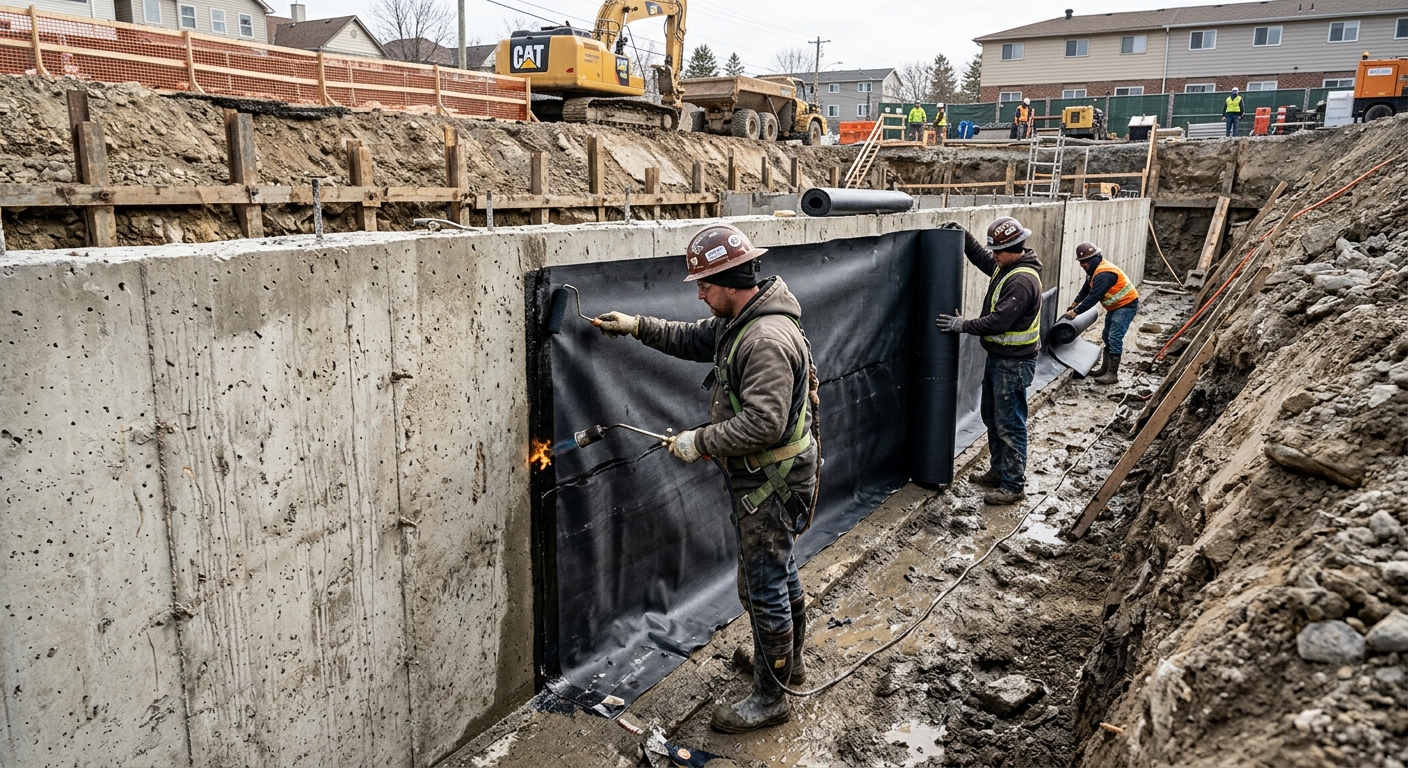
The key difference is source control versus symptom control. Exterior waterproofing—full excavation, new membrane, new perimeter drainage tile, and careful backfill—targets the water entry point and reduces hydrostatic pressure against the foundation wall. It costs more and is more disruptive, but it’s often the most complete fix when drainage systems are failing and clay-heavy soils are holding water against the basement perimeter.
Interior waterproofing manages water after it enters. A perimeter drain channel, sump pit, and sump pump system collect seepage at the wall-to-floor area and route it away before it pools. Interior solutions are typically less invasive and can be the best practical approach when exterior access is limited by decks, mature gardens, additions, or when excavating around tight urban lots would be extremely costly. However, interior systems do not stop lateral pressure on the wall itself; they reduce the damage and basement flooding risk.
In Mimico’s soil and weather conditions—mixed glacial till/clay with freeze–thaw—poured concrete walls often seal well with proper crack injection when cracks are stable and isolated. Block foundations more commonly need interior drainage as a complement, because water paths through mortar joints and irregular voids can be difficult to fully stop from the inside.
Consider sump pump backup too. Spring high water and power interruptions can turn a “working” pump into a flood event. The cost of a sump pump with backup commonly sits in the $1,200–$3,500 range, which is usually far less than emergency cleanup or replacing finishing materials.
Example: if your issue is a short, isolated leak crack, foundation crack repair at roughly $600–$3,000 may be justified without excavation. But if you’re seeing recurring dampness along multiple walls after heavy rains and melt, an interior perimeter drain with sump often becomes the sensible step, and full exterior excavation only makes sense when you have the access for it and you need long-term source control.
| Method |
Best For |
Addresses Source? |
Disruption |
Lifespan |
Price Band |
| Full exterior excavation + membrane |
Chronic seepage, failing exterior drainage, clay-heavy sites with hydrostatic pressure |
Yes (most complete) |
High |
20+ years with proper backfill and drainage |
$7,000–$25,000 |
| Interior French drain + sump system |
Interior dampness from failed weeping tile, limited exterior access, repeated basement seepage |
No (controls water after entry) |
Medium |
15–25 years with pump maintenance |
$3,500–$15,000 |
| Crack injection — epoxy (structural) |
Stable cracks where there’s no active water flow |
Partial (seals the path) |
Low |
10–20+ years when the crack is stable |
$600–$3,000 |
| Crack injection — polyurethane (active leak) |
Active seepage through cracks at tie holes or cold joints |
Partial (seals the active route) |
Low |
Often long-lasting for active leak paths |
$900–$3,000 |
| Interior drain channel only (no sump) |
Minor seepage where collected water can be managed effectively without a pump |
No (controls seepage, depends on site) |
Medium (floor/edge work) |
Variable—can be less reliable in high water table conditions |
$2,500–$7,500 |
| Re-grading + downspout extensions |
Surface water dumping toward foundation, basement dampness during rainfall only |
Yes (reduces water load on the perimeter) |
Low to medium |
Moderate; depends on drainage maintenance |
$900–$4,500 |
How to choose a waterproofing contractor in Mimico
Choosing the right contractor matters as much as the product. Start with Ontario-specific due diligence: (1) Licensing/credentials—ask for the contractor’s business details and confirm they’re operating legally for the scope they’re proposing; (2) Liability insurance—request a current certificate of insurance; if they’re doing exterior excavation, ask whether they carry coverage for jobsite risks and subcontractors; (3) WSIB/WCB—request proof of WSIB (or WCB coverage where applicable) and a clearance letter if you’re unsure. Then, before anyone starts, you should be able to match their stated scope to what’s written in the quote.
Get 2–3 itemised written quotes instead of a single lump sum. You want a labour + materials breakdown, and clear line items for inspection, surface preparation, disposal, and any permit pull or engineering support if structural repair is involved. Read exclusions: “hidden conditions” should not become a blanket excuse for not solving your actual leak pattern.
Warranty also needs specifics. Ask for the workmanship warranty length, whether it’s transferable to future homeowners, and whether the manufacturer’s warranty applies to the actual membrane/crack system installed. Payment schedules should be conservative—never pay more than about 10–15% upfront, and keep a holdback until the work is complete and cleaned up. Finally, insist on a written timeline with a start date, milestones, and completion estimate; waterproofing in Mimico often depends on weather windows for excavation and membrane cure time.
- Ask for a moisture/water-path assessment and proposed method tied to symptoms (cracks vs weepers vs surface water).
- Request 2–3 itemised quotes with labour and materials separated.
- Confirm what’s included: permit pulling, engineer letters (if needed), and disposal of excavated soil.
- Insist on written product specs (membrane type, drain system, crack injection system).
- Ask how they manage discharge for sump pumps (routing and distance from foundation).
- Verify liability insurance with a current certificate and jobsite coverage.
- Provide WSIB/WCB proof and clearance documentation on request.
- Confirm cleanup/restoration scope—especially if exterior excavation is proposed.
- Clarify warranty: workmanship term, manufacturer coverage, and transferability.
- Use a conservative payment schedule (≤10–15% upfront; holdback until completion).
- Get a written schedule and weather-dependent contingency plan.
- Ask for references from Toronto-area basements with similar foundation types and soil conditions.
Red flags in Mimico: vague scopes that don’t address discharge routing; promises like “we stop all water forever” without describing the drainage strategy; injection done without evaluating crack movement and foundation type; skipping surface prep and proper cure times; and refusing to show insurance, WSIB/WCB proof, or warranty terms in writing.
Frequently asked questions — waterproofing in Mimico
How much does foundation crack repair cost in Mimico?
In Mimico, foundation crack repair is usually priced by the crack type, length, and whether there’s active leakage. For isolated, stable cracks where epoxy injection is appropriate, you’ll often see pricing around $600–$3,000 depending on the number of holes, prep work, and how many injection points are needed. If the crack is actively seeping, polyurethane is typically used, and costs can lean toward the higher side within that band because the system and prep are more involved. Toronto-area freeze–thaw can widen small cracks over time, so companies sometimes need to address more than just one spot if the water pathway is longer than expected.
Do I need a sump pump in Mimico?
Many Mimico basements benefit from a sump pump when there’s ongoing seepage at the perimeter, especially after spring melt, heavy rainfall, or when older weeping tile systems are failing. If you’re getting water along the wall-to-floor line or pooling near corners, an interior perimeter drain channel paired with a sump pit is often the practical control method. The typical sump pump installation with backup can run about $800–$3,500, and the battery backup portion matters during outages during high-water events. If your leak is only occasional or mainly surface-water related (downspouts dumping toward the foundation), you may be able to solve it with re-grading and downspout extensions instead of a sump.
How does Mimico's soil affect my foundation?
Mimico sits over mixed glacial till and clay soils, and many yards have dense clay pockets that hold water against foundation walls. When the soil saturates, clay can expand and exert lateral pressure, which worsens cracks and can turn hairline leaks into active seepage over a few winter cycles. Freeze–thaw then helps widen defects as moisture cycles in and out of concrete or block mortar joints. This soil behaviour is one reason exterior excavation plus new drainage tile and membrane is often recommended when you have chronic seepage, while interior systems are used when exterior access is limited. If your basement shows efflorescence, damp corners, or recurring dampness after storms, it often points to water pressure and drainage failure rather than just a single “bad crack.”
Do I need a permit for foundation work in Ontario?
Often, yes—depending on what’s being done. In Ontario, foundation excavation, changes to lot drainage that affect water flow around the foundation, and structural crack repairs commonly require a permit. Sump pump installations may require municipal approval when discharge is routed to storm or sanitary systems. Structural repairs—especially major horizontal cracks in block walls—may require an engineer assessment to confirm whether underpinning or other structural work is needed. Before signing anything in Mimico, ask your contractor to confirm whether they will pull permits, what documentation is required, and where the sump discharge will go. Also verify they carry liability insurance and WSIB/WCB coverage so you’re protected if there are issues during the work.
How long does waterproofing last?
Longevity depends on the method and how well the installation matches the site conditions. Exterior waterproofing—when done with proper excavation, membrane detailing, and a working perimeter drainage system—often performs for many years and can be expected to last 20+ years in the right circumstances. Interior systems can also be long-lasting, but they’re management systems: with regular pump checks, many setups perform 15–25 years. Crack injection lifespans vary with crack stability: epoxy for stable cracks can last a long time, while polyurethane for active leaks is effective when the water pathway is properly sealed and the surrounding drainage isn’t overwhelmed. In Mimico, freeze–thaw and clay pressure mean maintenance matters—checking discharge, keeping downspouts clear, and ensuring grading doesn’t push surface water back toward the foundation.
Can I waterproof my basement from the inside only?
Yes, in many Mimico cases you can waterproof from the inside, especially when access for exterior excavation is limited or when the main problem is active seepage at the interior perimeter. Interior perimeter drainage (French drain channel), a sump pit, and a sump pump are often used to control water after it enters. Typical interior waterproofing / weeping tile solutions fall into about $3,500–$15,000 depending on how much wall length needs drainage and whether there’s a sump and backup system. However, interior-only work doesn’t remove the source of hydrostatic pressure against the wall; if exterior drainage has failed and clay-heavy soil is pushing laterally, a long-term “fix” may require exterior excavation and membrane replacement. A good contractor will assess whether you’re dealing with a localized crack versus a broader drainage failure.