Basement waterproofing options and costs in Mount Brydges
In Mount Brydges, homeowners usually face basement dampness long before they see dramatic wall failure—because the region’s mixed glacial till and clay pockets can hold water right at the foundation. With a population of 1,842 (Statistics Canada, 2021 Census), the local market is small, so experienced crews often book quickly when a neighbourhood hits a cluster of older-drain problems. Many Mount Brydges basements come from post-war and 1960–1980s homes, where original weeping tile or early drains can be partially clogged or collapsed; that shifts the “water entry” problem into ongoing hydrostatic pressure and slow seepage. The freeze–thaw cycles common across the Toronto economic region also widen small defects—hairline cracks and cold joints can become active leaks after a few winters, which is why your method choice matters as much as your budget.
Costs in Mount Brydges are shaped by access and the water-pressure profile around the foundation. Exterior excavation (when soil pressure and water table conditions are pushing laterally) generally sits in the higher band of $7,000 – $25,000, while interior perimeter drainage or weeping-tile replacement for chronic seepage often starts lower, commonly $3,500 – $15,000. In tight lots and near additions, excavation can require hand-digging and special staging, which increases labour hours even before materials are considered.
If you’re seeing recurring damp corners, efflorescence, or dampness after heavy rain, the comparison table below will help you match symptoms to the most appropriate system.
| Method |
What It Addresses |
Disruption Level |
Durability |
Price Range |
| Exterior excavation + new membrane + drainage tile |
Stops water at the foundation by managing lateral and hydrostatic pressure at the source |
High (yard excavation, regrading, backfill) |
Long-term (typically 15–30+ years with correct materials) |
$9,000 – $25,000 |
| Interior perimeter drain channel + sump pit |
Captures seepage inside the basement before it spreads; reduces water accumulation |
Medium (floor cutting in work zone) |
Long-term (often 10–20+ years depending on system details) |
$6,000 – $15,000 |
| Foundation crack injection (epoxy or polyurethane) |
Seals isolated cracks; epoxy for non-moving cracks, polyurethane for active leaks |
Low to Medium (drilling/patching) |
Moderate to long-term (repair lifespan depends on crack type) |
$600 – $3,500 |
| Sump pump installation (primary + battery backup) |
Prevents basement flooding during high water events and power interruptions |
Low to Medium (pit cut, discharge lines) |
Long-term when paired with quality pump and checks |
$1,400 – $4,000 |
| Window well drain installation |
Manages surface water around window wells and reduces water wicking into basement walls |
Low to Medium (site work around wells) |
Moderate to long-term (commonly 10–20+ years with cleanout access) |
$1,000 – $3,000 |
| Lot re-grading / downspout extension |
Diverts rainfall and reduces infiltration load against foundation perimeter |
Low (minor landscaping disruption) |
Varies (typically 5–15 years depending on maintenance) |
$1,500 – $7,000 |
Prices are estimates only and vary by project scope, site access and material selection.
What affects the price of waterproofing in Mount Brydges
In Mount Brydges and the wider Toronto area, two contractors can quote the “same” waterproofing job and end up 30–50% apart—mostly due to different assumptions about what’s actually causing the water. A short list of visible damp spots often isn’t enough; Toronto’s mixed clay-heavy soils (in pockets) can swell when saturated, increasing lateral pressure and turning static cracks into active leak paths. Freeze–thaw then widens those defects, which means a crack injection alone can cost less in the moment, but a full drainage plan may be the only way to stop repeat issues over multiple seasons.
Compared with the national average, regional price differences come from three local drivers. First, soil type: clay expands more than sand and can force water through tie holes, cold joints, and mortar lines. Second, water table and drainage: when local groundwater is high, sump run times rise, so discharge routing and pump sizing become more labour- and materials-intensive—especially if older weeping tile is clogged. Third, freeze–thaw: concrete and block movement during winter cycles can change what holds (sealants) and what fails (unmatched repairs).
Concrete examples from Mount Brydges: if your basement has efflorescence along a long block wall, crews often need more diagnostic time to decide whether interior drainage ($3,500 – $15,000) is sufficient or whether exterior excavation ($7,000 – $25,000) is justified. If the exterior has a deck or shared driveway that blocks access, excavation may require hand-digging around footings, which increases labour hours. If your weeping tile is original (commonly 60+ years old), the system is often completely failed, so a partial “top-up” rarely works and total scope increases.
| Price Factor |
Why It Matters |
Cost Impact |
| Interior vs. exterior approach — interior is less disruptive but addresses symptoms |
Interior systems manage water after it enters; exterior systems manage it at the source |
Can swing 30–40% depending on excavation and material selection |
| Foundation type — poured concrete vs. block vs. stone vs. ICF |
Different movement patterns and crack behaviors affect labour and product choice |
Typically varies by 10–25% in scope and prep work |
| Soil type — clay expands more than sand, adding pressure |
Clay saturation increases hydrostatic and lateral pressure on walls |
Often increases required drainage measures and testing time |
| Crack type and length — hairline vs. structural horizontal cracks |
Structural movement requires engineering-level assessment and different repair strategy |
May add $600–$3,000+ in repairs and can expand scope substantially |
| Sump pump backup system — battery or water-powered backup needed |
Ontario power interruptions during spring flooding require redundancy |
Commonly adds materials and labour, raising totals by hundreds to over a thousand |
| Access — landscaping, decks, or driveways must be removed for exterior |
Work below deck footings and in tight lots increases excavation time and restoration costs |
Can add 15–30% where exterior work is blocked |
| Weeping tile age — original tile (60+ years) may be completely failed |
Old drains often clog or collapse, turning “minor dampness” into persistent seepage |
Often forces full replacement rather than localized patching |
| Mould or efflorescence remediation required before sealing |
Sealers don’t adhere well to active salts, moisture, or contaminated surfaces |
May add a short remediation phase before waterproofing work begins |
Permits & regulations in Ontario
In Ontario, the specific scope determines whether you need a permit. As a rule of thumb for Mount Brydges homeowners, foundation excavation, structural crack repair (when it involves structural elements or significant wall movement), and changes to lot drainage typically require a building permit. If the project includes a sump pump installation that connects to storm or sanitary infrastructure, you usually need municipal approval and a contractor who understands local tie-in requirements. For structural repairs—especially horizontal cracks in block walls, major step cracking, or signs the foundation has shifted—an engineer’s assessment is often required to confirm whether underpinning or other structural work is necessary.
What typically does NOT require a permit: small cosmetic crack patching in non-structural areas, interior dehumidification-only installs, and most “non-structural” sealing of minor gaps that do not alter drainage patterns or structural integrity. However, if your scope includes excavating around the perimeter, modifying downspouts tied to the foundation, or addressing engineered structural concerns, assume you’ll need a permit and plan for that timeline.
To verify a contractor before you sign, ask for (1) your contractor’s business details and an Ontario licensing reference if applicable for the work they perform, then (2) a certificate of insurance showing liability coverage, and (3) WSIB/WCB clearance letters where applicable. In practice, homeowners in Mount Brydges should look at the contractor’s online registry information, review the COI wording (dates and insured parties), and confirm WSIB status with the current clearance letter—then keep copies with your contract.
Interior vs exterior waterproofing — what does Mount Brydges need?
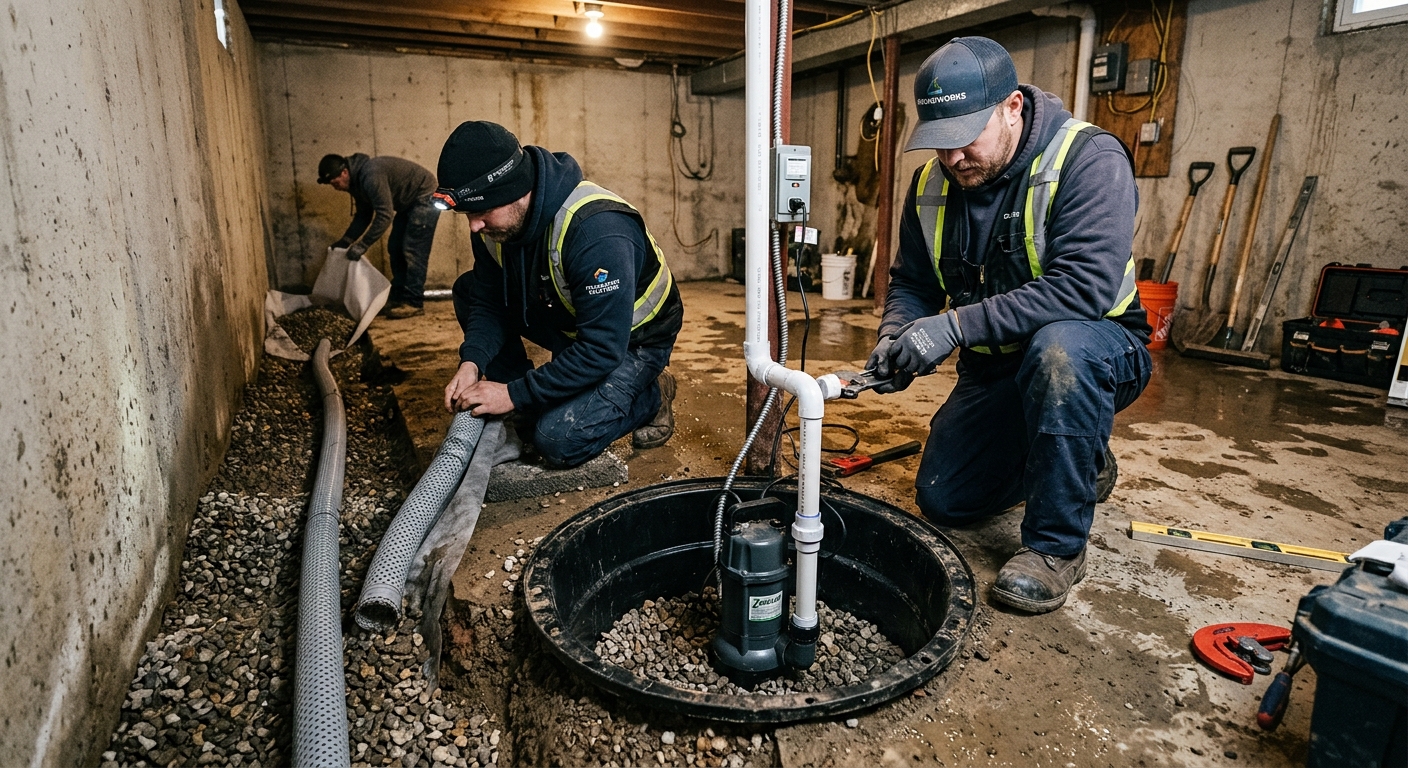
The fundamental difference is simple: exterior waterproofing prevents water from entering by addressing the source (excavation, membrane, and new drainage tile with correct backfill). Interior waterproofing manages water after it enters (perimeter drain channel, sump pit, sump pump). Exterior typically costs more and creates more yard disruption, but it’s the most direct way to relieve hydrostatic pressure when clay pockets and higher local water pressure are pushing laterally on foundation walls. Interior can be the smarter choice where access is limited or where the main issue is ongoing seepage that can be intercepted inside the basement.
For Mount Brydges conditions, poured concrete basements often respond well to crack injection when the cracks are isolated and not actively moving; epoxy can seal stable cracks, while polyurethane is used for active leaks that keep weeping. Block foundations, on the other hand, commonly benefit from interior drainage as a practical complement—especially when original weeping tile is partially collapsed or clogged. In both cases, the Toronto-area freeze–thaw cycles make “shortcuts” riskier: water that gets in will find cold joints and mortar seams, and small defects can grow over a few winters.
Sump pump backup systems matter in Ontario because power outages can happen during severe weather and spring runoff events. A battery backup (or equivalent redundancy approach) helps keep the basement dry when the primary pump loses power, which is particularly valuable during heavy rain when the ground is already saturated.
To illustrate pricing: if you have localized window well seepage and minor dampness, a window well drain might be in the lower range (often $1,000 – $3,000), and interior cleaning plus crack injection can avoid the far higher exterior total. But if you’re seeing recurring seepage along multiple walls after heavy storms—often tied to failed drainage—exterior excavation and drainage tile can be justified because the expected lifespan and source control align with the typical clay-and-freeze-thaw pressure profile.
| Method |
Best For |
Addresses Source? |
Disruption |
Lifespan |
Price Band |
| Full exterior excavation + membrane |
Homes with persistent seepage where exterior water management is needed |
Yes (at the foundation) |
High |
15–30+ years |
$9,000 – $25,000 |
| Interior French drain + sump system |
Chronic seepage with limited exterior access or after failed exterior drainage |
Partly (intercepts water inside) |
Medium |
10–20+ years |
$6,000 – $15,000 |
| Crack injection — epoxy (structural) |
Stable, non-moving cracks in poured concrete or block where movement is limited |
No (stops the crack path) |
Low to Medium |
Often 10–20 years when conditions remain stable |
$600 – $2,500 |
| Crack injection — polyurethane (active leak) |
Active leaks or water weeping through cracks (common after freeze–thaw) |
No (stops water at crack) |
Low to Medium |
Often 5–15 years depending on ongoing pressure dynamics |
$800 – $3,500 |
| Interior drain channel only (no sump) |
Light seepage where water can be managed without active pumping |
No (intercepts water inside) |
Medium |
5–12 years |
$3,500 – $8,500 |
| Re-grading + downspout extensions |
Surface-water driven dampness, minor seepage, and preventive maintenance |
Partly (reduces load against foundation) |
Low |
5–15 years (maintenance dependent) |
$1,500 – $7,000 |
How to choose a waterproofing contractor in Mount Brydges
Choosing the right contractor in Mount Brydges starts with verification. First, confirm they’re properly licensed for the work they perform and can provide proof of liability insurance. Next, ask for current WSIB/WCB clearance documentation (where applicable) and keep copies for your records. You should also expect them to describe how they handle permit coordination in Ontario if the scope includes excavation, drainage changes, or structural crack assessment. If they can’t provide documentation quickly, that’s often a sign the paperwork is an afterthought.
Get 2–3 itemised, written quotes that break down labour and materials instead of one lump sum. Ask whether permit pull is included, and whether disposal (spoils, old materials) is included or treated as a separate line item. Make sure the scope clarifies what’s excluded—common omissions include surface regrading, restoration of landscaping, crack mapping/diagnosis, sump pump discharge routing, and cleanout access for interior drains. Request a workmanship warranty length and verify product/manufacturer warranties too; ask whether warranties are transferable to future homeowners (important for resale).
Payment should be staged. Avoid paying more than 10–15% upfront; hold back a portion until the basement is tested and the finishing scope is complete. Finally, insist on a start date and completion estimate in writing, because excavation and waterproofing are schedule-sensitive under freeze–thaw conditions.
- Ask for insurance certificate and confirm the insured name matches your contractor’s legal entity.
- Request WSIB/WCB clearance letter (where applicable) before work begins.
- Confirm whether permits are required for your exact scope (excavation, drainage changes, structural work).
- Require an itemised quote: demolition/excavation, membrane/drain materials, pump and discharge components, labour hours.
- Check exclusions: landscaping restoration, grading, disposal, and any engineer assessment fees.
- Look for detailed scope: crack mapping, injection product type, and the number of crack locations.
- Ask about discharge location for sump systems and compliance with drainage routing requirements.
- Verify warranty terms: workmanship duration, what triggers coverage, and any exclusions for maintenance.
- Ask if the warranty is transferable to new owners.
- Set payment terms: keep upfront payment to 10–15% and hold back until punch list completion.
- Ensure there’s a written start and completion timeline with weather allowances.
- Confirm how they protect finishes (floor protection, dust control, and temporary containment).
In Mount Brydges, I consider these contractor red flags: refusing to put scope and exclusions in writing; quoting without diagnosing drainage (e.g., blaming only “cracks” without checking weeping tile/soil conditions); offering a “universal” solution regardless of foundation type; skipping sump backup discussion when the plan relies on active pumping; and asking for large upfront payments without a clear schedule and warranty documentation.
Frequently asked questions — waterproofing in Mount Brydges
Can I waterproof my basement in winter in Mount Brydges?
Yes, you can often complete parts of a waterproofing scope in winter in Mount Brydges, but the feasibility depends on what’s being done. Interior work like crack injection or interior perimeter drainage typically performs better than full exterior excavation when the ground is frozen and excavation is limited. Exterior excavation (membrane and new drainage tile) is usually constrained when soil is frozen and drainage is poor, which can extend timelines. If your quote is in the exterior band (commonly $7,000 – $25,000), crews may prioritize scheduling for safer excavation windows. In Ontario, we also plan around freeze–thaw so repairs don’t seal over active movement; for active leaks, polyurethane-type injection can be appropriate, but assessment still matters.
What is the difference between waterproofing and damp-proofing?
Waterproofing is designed to resist water entry under hydrostatic pressure—meaning it targets where water is forcing its way into the basement (cracks, tie holes, perimeter drainage). Damp-proofing generally addresses minor moisture and condensation conditions rather than true water pressure. In Mount Brydges, damp-proofing alone often doesn’t solve recurring seepage when clay pockets and high local water pressure push laterally against foundation walls, especially after freeze–thaw cycles. For example, installing interior drainage and a sump can be a waterproofing measure because it captures and removes water before it floods. If you’re seeing efflorescence and damp after heavy rain, contractors should be discussing drainage management and crack behavior—not just a surface treatment. That’s why interior waterproofing commonly falls into $3,500 – $15,000 depending on system details.
Will basement waterproofing affect my property value in Mount Brydges?
Usually, yes—because buyers value a dry, usable basement and documentation that the issue was properly addressed. In a smaller community like Mount Brydges (population 1,842, Statistics Canada, 2021 Census), proven repairs and a clear scope can reduce buyer uncertainty tied to older drainage systems and seasonal seepage. Waterproofing can also protect finishes (paint, drywall, flooring) that can degrade when water cycles through freeze–thaw. That said, value impact depends on quality and completeness: a short-term patch for a structural or active-leak crack may not impress buyers if the underlying water pressure source wasn’t managed. Well-documented work—whether interior systems or exterior excavation—supports resale, especially when warranty terms and maintenance notes are provided. If your solution requires active pumping and backup, demonstrating the system design can be a selling point compared with “unknown” dampness.
What drainage issues are most common in Mount Brydges homes?
The most common drainage issues in Mount Brydges typically relate to aging perimeter drainage and water management around the foundation. In many post-war and 1960–1980s homes, original weeping tile or early plastic drains can be partially collapsed or clogged, leading to interior dampness, efflorescence, and basement flooding during wetter periods. Another frequent issue is surface-water control: downspouts that discharge too close to the foundation or grading that slopes toward the house can overload the perimeter, especially after heavy rain. Finally, freeze–thaw cycles can turn hairline cracks, cold joints, tie holes, and mortar-line gaps into active leak paths, particularly in areas with dense clay that holds water against foundations. That’s why many projects combine crack repair with interior drainage, or—when pressure is the real driver—exterior excavation and new drainage tile.
How do I choose a waterproofing contractor in Mount Brydges?
Start by verifying documentation: request liability insurance and confirm WSIB/WCB clearance where applicable, then ensure the contractor can discuss permits for your scope under Ontario requirements. Ask for an itemised written quote with labour/material breakdown, not a lump sum. Make sure the scope clearly states what’s included (permit pull if required, disposal, restoration/grading) and what’s excluded. For waterproofing, insist on diagnosis details: crack mapping, foundation type considerations, and whether the plan relies on active pumping. Check warranty terms for both workmanship and product/manufacturer coverage, and ask whether the warranty is transferable. In Mount Brydges, be cautious with contractors who want large upfront payments; a common best practice is keeping upfront to 10–15% and holding back until completion. If a quote is far below typical ranges, ask what materials or steps are being reduced—especially if you’re targeting exterior waterproofing around $7,000 – $25,000.
What is a battery backup sump pump and do I need one in Mount Brydges?
A battery backup sump pump is a secondary system that runs on battery power during outages, helping protect your basement when the primary pump can’t operate. In Ontario, spring runoff and severe weather can occasionally coincide with power disruptions, and a flooded basement can happen faster than people expect because the water table rises after heavy rain. Whether you “need” one depends on your risk profile: if you’ve had previous flooding, if your basement collects water quickly after storms, or if your home is on lower grade or has persistent seepage, backup is usually a wise investment. Many homeowners pair interior drainage/sump systems with redundancy, and project totals often land in the interior band of $3,500 – $15,000 depending on how extensive the drainage is. A good contractor will size the primary pump, confirm discharge routing, and recommend backup based on your observed seepage rate—not a one-size-fits-all answer.