Basement waterproofing options and costs in Mount Hope Huron Park
In Mount Hope Huron Park, Ontario, basement waterproofing usually starts with one question: where is the water coming from—below the slab, through foundation cracks, or from hydrostatic pressure against the wall? With a local population of 5,030 (Statistics Canada, 2021 Census), you’ll notice fewer “crew-ready” contractors than in larger Toronto cores, and scheduling can matter when you’re trying to avoid heavy spring saturation. Pricing also reflects the area’s mix of glacial till and dense clay, which holds water, increases lateral pressure, and turns small defects into active leaks over a few freeze–thaw cycles.
In the Toronto region, many homes are post-war and 1960–1980s builds where older weeping tiles or early drains are often partially collapsed or clogged. When the original drainage is failing, interior systems may slow or reduce water ingress, but they don’t always relieve the pressure pushing against the foundation. That’s why some homeowners choose exterior excavation and membrane work to address the source, while others combine targeted crack repair with an interior perimeter drain. In neighbourhood pockets like older parts of the Huron Park area—where tight lots and mature landscaping are common—access constraints can be a bigger driver of cost than the actual membrane material.
Below is a practical comparison of common waterproofing methods and the cost ranges you’ll typically see for projects in this tier. Use it to sanity-check quotes before you compare scopes.
| Method |
What It Addresses |
Disruption Level |
Durability |
Price Range |
| Exterior excavation + new membrane + drainage tile |
Primary water entry by reducing hydrostatic pressure; repairs cold-joint risk at the exterior face |
High (excavation, landscaping removal, backfill/compaction, grading) |
Long-term when properly detailed for clay and freeze–thaw |
$7,500–$24,500 |
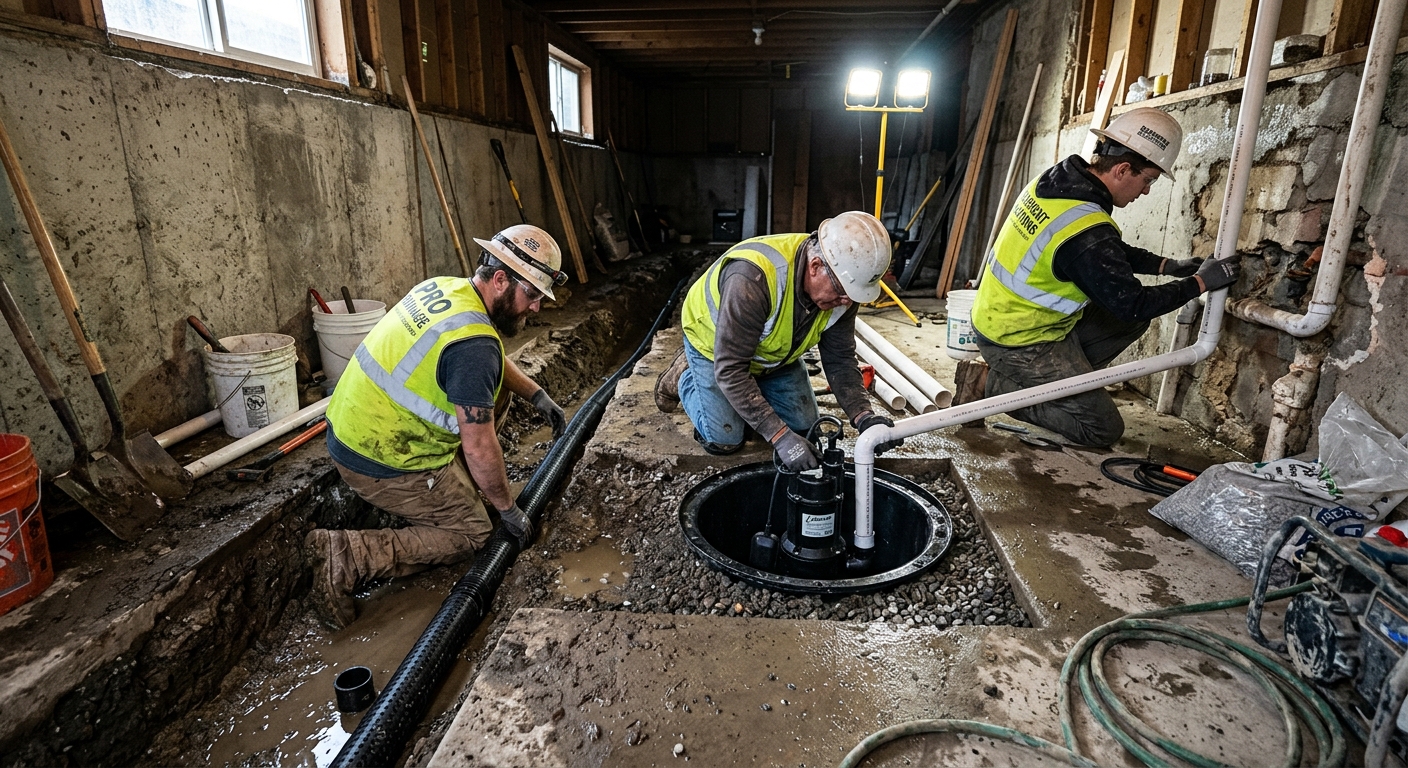
| Interior perimeter drain channel + sump pit |
Water that enters through wall footing/cold joints; redirects to sump |
Medium (interior access at perimeter; limited demolition) |
Very good for chronic seepage, especially with maintained sump discharge |
$4,500–$14,500 |
| Foundation crack injection (epoxy or polyurethane) |
Isolated cracks; epoxy for stable/structural cracks, polyurethane for active leaks |
Low (drilling and patching only) |
Good when crack type and pressure conditions are correctly matched |
$600–$3,000 |
| Sump pump installation (primary + battery backup) |
Reliably moves collected water; protects during power interruptions |
Low to Medium (excavation of sump pit; electrical work) |
High with backup system and sealed discharge path |
$1,200–$3,500 |
| Window well drain installation |
Localized inflow from around egress wells and saturated backfill areas |
Low to Medium (depends on footing depth and landscaping) |
Moderate to high when paired with proper weeping tile connections |
$1,000–$4,200 |
| Lot re-grading / downspout extension |
Improves surface water shedding; reduces runoff concentration near foundation |
Low (typically no foundation opening) |
Moderate (works best when the below-grade drainage is still functional) |
$700–$3,500 |
Prices are estimates only and vary by project scope, site access and material selection.
What affects the price of waterproofing in Mount Hope Huron Park
In Mount Hope Huron Park and across the Toronto economic region, quotes for the “same” basement issue can vary by 30–50% because the real scope is rarely identical: one contractor may be treating symptoms (installing a sump) while another may identify the water source (failing exterior drainage and pressure against the wall). Labour rates, time for hand-digging, disposal, and how much concrete cutting or excavation is required all move the total cost—especially when access is tight or work must be done beside mature landscaping.
Three drivers separate local costs from the national average: soil type, water table, and freeze–thaw. Toronto sits on mixed glacial till and pockets of dense clay that hold water and expand when saturated, increasing lateral pressure on foundation walls and widening defects over winter cycles. When water levels are high, sump pump systems may need more frequent cycling and more robust discharge detailing; when the ground is drier, labour time can be shorter and less backfill conditioning is required. In heavy clay areas, even “small” crack issues can become recurring if the hydrostatic pressure isn’t reduced, which is why exterior waterproofing often falls into the higher end of the local band, such as $7,000–$25,000, while interior solutions may land around $3,500–$15,000 depending on drainage layout and sump requirements.
Concrete examples from this part of Ontario: (1) a home with 1960s weeping tile that’s clogged typically requires a more extensive re-routing plan, adding cost to either an interior perimeter drain or an exterior excavation; (2) a poured-concrete wall with stable hairline cracking can sometimes be sealed with targeted injection (often closer to $600–$3,000 for limited footage); (3) a partially finished basement with cinder-block walls and interior efflorescence usually triggers pre-cleaning and more demolition, pushing interior projects toward the upper mid-range.
| Price Factor |
Why It Matters |
Cost Impact |
| Interior vs. exterior approach — interior is less disruptive but addresses symptoms |
Exterior reduces water pressure at the source; interior manages water after it enters |
Interior often $3,500–$15,000; exterior can be $7,000–$25,000 |
| Foundation type — poured concrete vs. block vs. stone vs. ICF |
Different cracking behaviour and connection details change prep, injection strategy, and drainage compatibility |
Block and stone often need more interior drainage coordination; ICF varies by seam/penetration details |
| Soil type — clay expands more than sand, adding pressure |
Clay saturation increases lateral wall pressure and recurrence if the pressure source remains |
Higher likelihood of needing exterior membrane + drainage, increasing costs |
| Crack type and length — hairline vs. structural horizontal cracks |
Hairline cracks may be sealed; structural horizontal cracks may require engineering and/or underpinning coordination |
Structural cases can add engineering/engineering-led work well beyond typical injection-only pricing |
| Sump pump backup system — battery or water-powered backup needed |
Backups protect against pump downtime during spring outages and power interruptions |
Commonly adds several hundred to over $1,000 depending on system type and pit work |
| Access — landscaping, decks, or driveways must be removed for exterior |
Hand excavation and restoration (stairs, patios, fencing, gardens) directly affects labour and disposal |
Can shift exterior waterproofing toward the upper end of the band |
| Weeping tile age — original tile (60+ years) may be completely failed |
Older tile can be collapsed or disconnected; “partial” systems often still leak |
May increase scope to new drainage routing and/or an interior perimeter strategy |
| Mould or efflorescence remediation required before sealing |
Sealing over active moisture/contamination reduces long-term adhesion and can worsen indoor air issues |
Adds prep time and cleaning products; can raise interior project cost |
Permits & regulations in Ontario
In Ontario, some waterproofing-related work typically triggers a permit, especially when you’re changing structural elements, altering drainage, or making connections that affect municipal services. Foundation excavation and work that involves structural crack repair (particularly horizontal cracks in block walls or other signs of possible movement) often requires a building permit. If an exterior drainage change involves re-routing water away from the foundation or changing discharge paths, you should expect at least a review by the municipality and/or permit process. Sump pump installations that connect to the storm or sanitary sewer generally require municipal approval before discharge is altered.
For structural crack repair, a structural engineer’s assessment is often required to determine whether underpinning or other structural work is necessary—not just sealing. If a contractor is proposing “crack injection only” for a large horizontal crack, you should ask for the engineering plan and how it will be documented.
To verify a contractor for a Mount Hope Huron Park project, homeowner steps should look like this:
- Confirm their Ontario business listing and contractor credentials for the specific scope they’re doing.
- Request a certificate of liability insurance showing active coverage and the correct insured name.
- Ask for proof of WSIB/WCB coverage (or the appropriate exemption documentation) matching the workers performing the job.
- For structural scopes, verify they can provide engineering support or work under an engineer of record.
- Ask for permit responsibility in writing: who pulls the permit, what is included, and who pays for re-inspections if needed.
Then, before signing, verify everything above appears in the written contract: scope, permit pull responsibility, discharge details, and documentation for engineering where required.
Interior vs exterior waterproofing — what does Mount Hope Huron Park need?
In Mount Hope Huron Park, the choice between interior and exterior waterproofing comes down to whether you can (and should) reduce the water pressure at the source. Exterior waterproofing—full excavation, new membrane, new drainage tile, and proper backfill—permanently addresses water entry by managing water before it reaches the foundation. It costs more and requires significant yard disruption, but it’s the most direct solution for homes sitting on dense clay that holds moisture and pushes laterally on foundation walls during freeze–thaw.
Interior waterproofing—perimeter drain channel, sump pit, and sump pump—handles water after it enters. It’s less invasive and often cheaper, especially when decks, fences, or finished basements limit excavation. That said, interior systems do not stop hydrostatic pressure from acting on the foundation; they intercept and remove it. This approach is commonly used as a practical complement in older Toronto-era homes with partial weeping tile failure and recurring seepage through cold joints, tie holes, and crack paths. Poured concrete walls can often seal well with crack injection when the cracks are stable; block foundations frequently need interior drainage to manage the pathways around mortar joints and wall footing interfaces.
Ontario power reliability during spring flooding is another key reason to discuss backup systems. If your sump pump is the only line of defence, battery backup (or another approved backup method) can prevent an “off-cycle” flood when the power drops.
Where price differences are justified: if you’re seeing dampness plus active seepage in multiple corners after heavy rain, exterior excavation may be warranted to the tune of roughly $7,000–$25,000. If your issue is localized and driven by a failed drain line near the perimeter, an interior French drain + sump plan might reduce the spend to $3,500–$15,000—and you can pair that with crack injection where isolated leaks exist.
| Method |
Best For |
Addresses Source? |
Disruption |
Lifespan |
Price Band |
| Full exterior excavation + membrane |
High water pressure, dense clay sites, chronic seepage where exterior drainage has failed |
Yes |
High |
Long-term with correct membrane detailing and drainage backfill |
$7,500–$24,500 |
| Interior French drain + sump system |
Chronic seepage, efflorescence, and water pooling that persists even after surface drainage fixes |
No (it manages water after entry) |
Medium |
Very good when discharge and pump maintenance are properly set up |
$4,500–$14,500 |
| Crack injection — epoxy (structural) |
Stable cracks with no active water pressure forcing flow through the crack |
Partially (stops moisture path at the crack) |
Low |
Good for stable conditions; recurrence risk if pressure persists |
$600–$2,400 |
| Crack injection — polyurethane (active leak) |
Active seepage through cracks during wet seasons or after thaw |
Partially (stops flow path at the crack) |
Low |
Good where material is matched to active conditions |
$900–$3,000 |
| Interior drain channel only (no sump) |
Light seepage where water can drain away reliably without pump cycling |
No |
Low to Medium |
Moderate; less reliable during high water table periods |
$3,500–$10,500 |
| Re-grading + downspout extensions |
Surface runoff and minor dampness near exterior walls after storms |
No |
Low |
Moderate; depends on whether below-grade drainage is functioning |
$700–$3,500 |
How to choose a waterproofing contractor in Mount Hope Huron Park
Choosing a contractor in Mount Hope Huron Park starts with credentials and proof you can verify, not just promises. For Ontario waterproofing work, ask for three items up front: (1) Ontario registration/licensing information for their trade category, (2) liability insurance, and (3) WSIB/WCB coverage for the workers on site. To check each, request the certificate of insurance (look for coverage limits and effective dates) and confirm the WSIB/WCB status matches the company performing the work. If they can’t provide current documents quickly, that’s a red flag.
Next, get 2–3 itemised written quotes. “Itemised” matters: labour + materials, disposal, site protection, excavation limits, and what’s included in testing and cleanup should be broken out instead of hidden inside a single lump sum. Confirm if permit pulling is included (and who pays). For exterior jobs, ask what disposal is included and whether restoration (topsoil, sod/seed, regrading) is part of the scope or an add-on.
Warranty and payment structure protect you. Look for a workmanship warranty length (often several years), and a separate product/manufacturer warranty for membranes, drainage components, and pumps where applicable. Confirm whether the warranty is transferable to a new homeowner. For payment schedule, never pay more than 10–15% upfront; hold back a portion until the job is complete and you’ve confirmed discharge and sealing details. Require a written timeline: start date, sequencing, and estimated completion, so you can plan around material deliveries and weather windows.
- Verify Ontario registration/licence for the specific scope they’re quoting.
- Ask for liability insurance certificate and confirm limits are appropriate for excavation and interior demolition.
- Confirm WSIB/WCB coverage for the workers who will be on site.
- Require 2–3 itemised quotes (labour, materials, disposal, restoration, and testing).
- Ask what’s excluded: patch/paint, slab cutting, basement finishing reinstatement, and landscaping restoration.
- Confirm whether permits are required and who pulls the permit.
- Check sump discharge route and whether it affects storm or sanitary connections.
- Request a written warranty: workmanship terms and what voids coverage.
- Confirm product warranties for membranes/pumps/drain components and whether they’re transferable.
- Ensure mock-up or inspection steps are included before sealing (mould/efflorescence prep, drying time).
- Confirm payment milestones: keep upfront at 10–15% and holdback until final walkthrough.
- Get start date and completion estimate in writing, tied to access and weather constraints.
Red flags seen on projects in the Mount Hope Huron Park area include: (1) contractors promising “guaranteed dry basements” without identifying water source and soil/water behaviour; (2) skipping crack type assessment (epoxy vs polyurethane) and injecting everything the same way; (3) no written permit responsibility for discharge/drainage changes where required; (4) offering only interior solutions with no discussion of failed weeping tile or clay-driven pressure; and (5) pushing for large upfront payments or vague scopes with no disposal/restoration details.
Frequently asked questions — waterproofing in Mount Hope Huron Park
Can I waterproof my basement in winter in Mount Hope Huron Park?
Yes, you can waterproof in winter in Mount Hope Huron Park, but the “how” changes. Interior work is usually the most feasible when freezing temperatures limit exterior excavation; installing a perimeter drain, sump pit, and sump pump can proceed as long as the slab and wall work can be safely accessed. Exterior excavation is typically harder in winter because frozen ground increases labour time and complicates backfill compaction for clay sites. If you’re dealing with active seepage, crack injection (polyurethane for active leaks) can often be done when the crack pathway is clearly wet, but mould and salts should still be addressed before sealing. For planning, ask contractors whether they’re scheduling based on your basement’s current moisture behaviour and whether they can coordinate pump testing and discharge details during the cold season.
What is the difference between waterproofing and damp-proofing?
In Ontario, homeowners often hear these terms used interchangeably, but the practical difference matters. Damp-proofing is usually a surface-level treatment designed to reduce minor moisture transfer and may not be intended for active water under pressure. Waterproofing is a system approach—addressing water entry paths and managing hydrostatic pressure through drainage, sealed crack pathways, membranes (exterior), and reliable discharge (often via a sump). In Mount Hope Huron Park, dense clay and freeze–thaw can turn “damp” issues into active seepage, so a damp-proof coating alone may not stop recurring flow through cold joints or tie holes. If your contractor is only offering a coating and no drainage strategy, ask how they’ll manage water collection and discharge, and what they’ll do when water levels rise.
Will basement waterproofing affect my property value in Mount Hope Huron Park?
Typically, well-documented waterproofing can help your property value and saleability because it reduces uncertainty around basement flooding and ongoing maintenance. Buyers in the Toronto region often ask practical questions: has seepage been corrected, do you have a sump with backup, and is there proof the work is properly detailed for clay-driven pressure and freeze–thaw cycles? While exact dollar-for-dollar impacts vary by market, a basement that no longer shows efflorescence, staining, or recurring wet corners is usually easier to sell. Keep your receipts, warranty documentation, and any permit/engineering notes. If your scope includes sump pump upgrades, that’s often easier for buyers to understand than membrane work behind a finished yard—though exterior waterproofing is the strongest source-control option when clay and water table risks are high.
What drainage issues are most common in Mount Hope Huron Park homes?
The most common drainage issues here are linked to aging or failed below-grade drainage and saturated clay conditions. Many older Toronto-area homes rely on original weeping tile or early drainage designs that may be partially clogged or disconnected, leading to interior dampness, efflorescence, and sometimes basement flooding rather than obvious exterior wall failure. Freeze–thaw cycles can widen small cracks, turning hairline defects into active leak paths. On top of that, downspouts that discharge too close to the foundation (or landscaping that no longer sheds surface water correctly) can increase the load against foundation walls. If you see water at multiple corners during spring rains or along mortar lines in block foundations, it’s often a sign you need an interior perimeter drain and sump plan, and potentially targeted crack work for isolated active leaks.
How do I choose a waterproofing contractor in Mount Hope Huron Park?
Choose a contractor you can verify. Start by asking for Ontario registration/licensing details, a current certificate of liability insurance, and WSIB/WCB coverage documents for the workers on site. Then request 2–3 itemised written quotes so you can compare labour, materials, disposal, and restoration separately—especially for exterior work, where excavation access and regrading can change the total substantially. Make sure the scope states whether permits are included and who pulls them, and whether sump discharge requires municipal approval. Confirm what warranty covers (workmanship and products) and whether it’s transferable. For pricing sanity-checks, exterior waterproofing excavation often lands around $7,000–$25,000, while interior solutions typically fall around $3,500–$15,000. If someone’s quote is dramatically outside those ranges without explanation, ask why.
What is a battery backup sump pump and do I need one in Mount Hope Huron Park?
A battery backup sump pump is an additional power system that keeps the sump running during power outages. In Mount Hope Huron Park and the wider Ontario region, spring storms and flooding periods are exactly when outages can happen, and backup matters because even a short pump downtime can allow water to rise quickly in a basement with elevated water pressure. You might not “always” need backup if your seepage is minimal and your sump rarely cycles, but if you experience frequent cycling during wet seasons, have a history of wet corners, or you’re installing an interior drainage system as your main line of defence, backup is a strong consideration. Battery backups typically add cost—commonly bringing sump installations into roughly $1,200–$3,500 depending on the pit work and system type. Ask your contractor to explain discharge and power testing steps before they finalize the design.