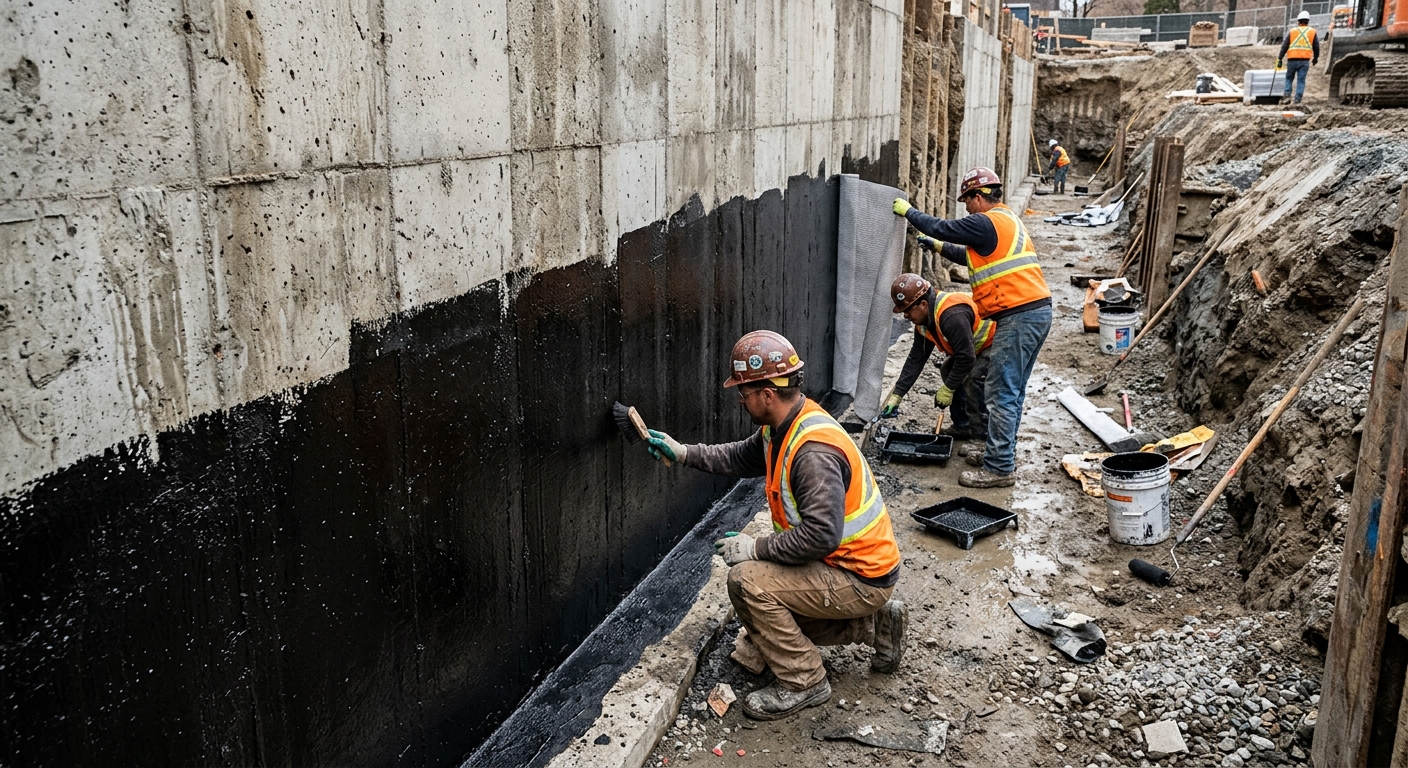
Basement waterproofing options and costs in Blind River
Blind River homeowners usually start waterproofing conversations after they notice damp corners, musty odours, or water staining along the basement perimeter. In this area, about 67.2% of homes were built before 1981, and that matters: many older basements rely on legacy tar-and-paper damp-proofing and aging weeping tile, both of which are prone to failure as soils cycle between saturation and freeze–thaw. With 3,422 residents and a homeowner-heavy mix of detached houses (77.8% of dwellings are single-detached), local crews often work on foundations where re-excavation access can be tight and landscaping is already established.
Northeast Ontario seasons add real cost pressure. Freeze–thaw can widen joints and hairline cracks over a few winters, turning “surface seepage” into active seepage. When downspouts discharge near the footing or grading slopes toward the house, soil stays wetter longer and waterproofing systems need more aggressive drainage. Contractors in Blind River also price for excavation depth, disposal, and cold-weather concrete work—especially when foundation crack repair and new drainage must be installed without rushing.
In demand areas include older residential pockets near downtown services and long-established lots where downspouts and grading were never corrected after landscaping was built up. If you’re seeing water only during spring melt, or you’re dealing with persistent hydrostatic pressure, the right option often becomes a combination. Below is a practical comparison of common methods and typical ranges used in Blind River before you request an itemised quote.
| Method |
What It Addresses |
Disruption Level |
Durability |
Price Range |
| Exterior excavation + new membrane + drainage tile |
Source control of water at foundation; replaces failed damp-proofing and weeping tile |
High (excavation, landscape restoration) |
Long-term when installed to proper depth and backfill details |
$9,000–$20,000 |
| Interior perimeter drain channel + sump pit |
Captures water after it enters; reduces hydrostatic pressure and interior wetness |
Medium (floor/footing access, limited demolition) |
Very good when discharge routing and pump selection are correct |
$4,000–$12,000 |
| Foundation crack injection (epoxy or polyurethane) |
Sealing cracks; stops seepage and restores tightness |
Low to medium (interior access) |
Good for the right crack type and surface prep |
$400–$1,200 |
| Sump pump installation (primary + battery backup) |
Moves collected groundwater away reliably, including during outages |
Low to medium (pit, discharge piping) |
High with proper backup and float controls |
$900–$3,000 |
| Window well drain installation |
Prevents bulk water pooling near basement windows |
Low (targeted exterior work) |
Good for localized leaks and grading issues |
$900–$2,500 |
| Lot re-grading / downspout extension |
Reduces surface water toward foundation; improves drainage patterns |
Low to medium (yard work, minor exterior adjustments) |
Moderate (depends on sustained grading and downspout routing) |
$600–$3,000 |
Prices are estimates only and vary by project scope, site access and material selection.
What affects the price of waterproofing in Blind River
Even when homeowners request the same scope, quotes in the Northeast of Ontario can differ by 30–50% because the real drivers aren’t the “brand of membrane”—they’re excavation conditions, water management, and how much problem-solving is required once we remove failed systems. Nationally, a typical waterproofing job might look similar on paper, but Blind River basements often face heavier site constraints than some larger centres: smaller lots, older landscaping built close to the foundation, and more frequent encounters with long-failed weeping tile.
Three conditions separate Northeast pricing from national averages: soil type, water table, and freeze–thaw. First, fine-grained or clay-heavy pockets can swell when saturated and press laterally on foundation walls, worsening existing cracks and stressing older membranes. Second, a high local water table and repeated wetting episodes increase sump run times and the amount of drainage piping required. Third, continental freeze–thaw widens joints and cracks over time, meaning a crack repair that looks “minor” in the first inspection can become a larger sealing and drainage correction by year two.
Concrete examples from Blind River: (1) When excavation requires removing a paved patio or deck step near the foundation, exterior waterproofing moves toward the higher band—closer to the $9,000–$20,000 range—because access dictates labour and disposal. (2) When only interior perimeter drainage is feasible due to mature shrubs and limited side-yard clearance, homeowners often land in the $4,000–$12,000 interior range, but they should expect we’re controlling water entry after it happens, not eliminating hydrostatic pressure at the exterior wall.
Because 67.2% of homes were built before 1981, many projects also start with the reality of corroded/failed drainage systems, so labour to locate, test, and clear routes can swing the price more than a homeowner expects.
| Price Factor |
Why It Matters |
Cost Impact |
| Interior vs. exterior approach — interior is less disruptive but addresses symptoms |
Exterior targets water before it enters; interior manages water after entry |
Interior typically costs less up front, but may require sump reliability for long-term control |
| Foundation type — poured concrete vs. block vs. stone vs. ICF |
Different wall materials respond differently to cracks, patching, and membrane detailing |
Block walls and older masonry often add steps (drainage complement, crack strategy) |
| Soil type — clay expands more than sand, adding pressure |
Swelling soils can intensify hydrostatic pressure and repeat leak cycles |
May push you toward exterior control or higher sump/dewatering requirements |
| Crack type and length — hairline vs. structural horizontal cracks |
Not all cracks can be sealed safely without assessing structural movement |
Structural/horizontal cracks can require engineer-led repairs, increasing costs |
| Sump pump backup system — battery or water-powered backup needed |
Spring melt and outage risk make uninterrupted pumping critical |
Backup adds cost but reduces “flood-on-day-of-outage” risk |
| Access — landscaping, decks, or driveways must be removed for exterior |
More removal/disposal means more labour and restoration |
Exterior jobs often jump when access is constrained |
| Weeping tile age — original tile (60+ years) may be completely failed |
Collapsed or clogged tile may require replacement or rerouting |
Increases excavation time and material quantities |
| Mould or efflorescence remediation required before sealing |
Sealing over contamination can trap moisture and worsen indoor air quality |
Additional prep extends labour and impacts sequencing |
Permits & regulations in Ontario
In Ontario, several waterproofing-related tasks typically require a building permit, particularly where you’re changing drainage or addressing structural concerns. In practice, foundation excavation around the perimeter, structural crack repair on foundations, and any changes that affect how water leaves or enters the property often trigger permit requirements through your municipality. If you’re installing or altering drainage that ties into storm or sanitary infrastructure, you should expect municipal approval before connections are made.
For structural crack repair—such as horizontal cracks in block walls, major step cracking, or signs of active movement—an engineer’s assessment is frequently recommended (and sometimes effectively required) to confirm whether underpinning or other structural work is needed before sealing. Ask the contractor whether they coordinate engineering support and whether they can document the basis for repair methods. Also verify they carry liability insurance and WSIB/WCB coverage, because waterproofing work involves excavation, concrete, and potentially hazardous basement conditions (moulded areas, confined spaces, and electrical components near sumps).
How homeowners can verify quickly in Blind River: (1) request the contractor’s Ontario licence details and confirm the business name matches the registry record; (2) ask for a current certificate of liability insurance and confirm it includes work on residential construction; (3) request proof of WSIB/WCB coverage (or a clearance letter where applicable); and (4) keep these documents with the written scope and permit information.
Interior vs exterior waterproofing — what does Blind River need?
The fundamental difference is source control versus symptom control. Exterior waterproofing—full excavation, new waterproofing membrane, new drainage tile, and proper backfill—addresses where water enters the foundation. It’s the most permanent option when the waterproofing system is properly detailed, because it reduces water pressure against the wall. The trade-off is cost and disruption: excavation is labour-intensive, and landscaping restoration (and sometimes patio/deck removals) is commonly required.
Interior waterproofing—perimeter drain channel, sump pit, and a sump pump—manages water that has already entered. It can dramatically reduce seepage stains, keep floors drier, and protect stored belongings, but it doesn’t stop hydrostatic pressure from acting on the exterior wall itself. In Blind River, this matters most when soils stay wet through freeze–thaw. If you’re dealing with older homes (many built pre-1981) and failed weeping tile, an interior approach is often the practical “best first step” when excavation isn’t feasible.
Which is appropriate? For poured concrete walls, crack injection often performs well as a companion strategy because sealed concrete tends to be tight once repaired and drainage is corrected. For block foundations, interior drainage is frequently a practical complement because block can show localized seepage through mortar and joints; interior drainage captures that water and reduces indoor moisture even when the exterior wall system is aged.
Backup pumping is important in Ontario because power can be interrupted during storms that also coincide with spring flooding. If you’re already investing in a sump, it’s usually worth budgeting for backup. For example, homeowners comparing exterior excavation in the $9,000–$20,000 band versus interior drainage in the $4,000–$12,000 band should choose based on access and whether you can realistically correct the water at the exterior. If excavation is available and the waterproofing system is failed throughout, the extra cost can be justified because you’re not relying on continuous interior pumping.
| Method |
Best For |
Addresses Source? |
Disruption |
Lifespan |
Price Band |
| Full exterior excavation + membrane |
Widespread seepage, failed damp-proofing, recurring hydrostatic pressure |
Yes |
High |
Long-term with proper drainage and backfill |
$9,000–$20,000 |
| Interior French drain + sump system |
Limited access for exterior work; wet floor corners; spring melt seepage |
No (controls water after entry) |
Medium |
Very good with reliable discharge and pump/backup |
$4,000–$12,000 |
| Crack injection — epoxy (structural) |
Cracks without active flow; structural integrity confirmed |
No (often paired with drainage) |
Low to medium |
Good for stable cracks when prepped correctly |
$400–$1,200 |
| Crack injection — polyurethane (active leak) |
Seeping cracks where water is actively moving |
No (needs water management strategy) |
Low to medium |
Good for active leakage when selected for the flow conditions |
$400–$1,200 |
| Interior drain channel only (no sump) |
Light moisture, intermittent seepage, short-term management |
No |
Medium |
Moderate; performance depends on gravity discharge |
$2,500–$7,500 |
| Re-grading + downspout extensions |
Surface-water-driven leaks; water near window wells and eaves |
Partially (reduces water load) |
Low to medium |
Moderate; must be maintained |
$600–$3,000 |
How to choose a waterproofing contractor in Blind River
Start by confirming the contractor is set up for Ontario residential work. Ask for their Ontario registration/licence details (confirm the business name), a current certificate of liability insurance, and proof of WSIB/WCB coverage (or a clearance letter). Because waterproofing often involves excavation, electrical connections for pumps, and indoor prep where mould can be present, you want coverage to match the actual scope.
Next, request 2–3 itemised written quotes. You’re looking for labour and materials breakdown (membrane/drainage components, pump type, discharge routing, disposal, and restoration), not a single lump sum. Scope gaps are where projects go over budget. Specifically ask: is permit pulling included (if required), is demolition and disposal included, and will the quote include restoring landscaping, steps, or flooring—at least to a defined baseline?
Warranty should be clear and measurable. Confirm the workmanship warranty length, product/manufacturer warranty details, and whether warranties are transferable to the homeowner if you sell. Payment schedule matters: never pay more than 10–15% upfront, and hold back a portion until you’ve confirmed performance (dryness, pump operation, and proper discharge) at project completion. Get the start date and estimated completion timeline in writing, including weather contingencies for exterior work.
- Ask how they determine whether leaks are surface-water, hydrostatic pressure, or failing weeping tile.
- Require a written scope with quantities (linear feet for drains, number of downspout extensions, pump model).
- Confirm whether they include disposal of excavation spoils and demolition debris.
- Check that crack repair method matches crack behaviour (epoxy for stable, polyurethane for active seepage).
- Request a drainage outlet plan (how discharge routes away from the footing).
- Verify sump pump specs: basin size, float controls, check valve, and backup approach.
- Make sure quotes state whether backup is battery-based or water-powered and what triggers it.
- Confirm membrane type and how seams and penetrations are treated (no “patch-only” solutions).
- Ask how they handle mould/efflorescence—prep requirements before sealing.
- Check warranty terms in writing and whether they reference measurable acceptance criteria.
- Clarify payment milestones tied to inspections, not just “work started.”
- Ensure the contractor provides proof of insurance and WSIB/WCB coverage before work begins.
In Blind River, red flags include contractors who: (1) guarantee “permanent dryness” without inspecting soils or drainage patterns; (2) recommend sump-only work when exterior failure and grading clearly point to source issues; (3) omit disposal/restoration details and later bill as “extras”; (4) offer crack injection without confirming whether the crack is active or structural; and (5) won’t provide insurance/WSIB/WCB documentation or a written scope that matches the quote.
Frequently asked questions — waterproofing in Blind River
What is a battery backup sump pump and do I need one in Blind River?
A battery backup sump pump is a secondary system that powers the sump pump during a power outage, usually using a battery pack connected to the sump controls. In Blind River and across Ontario, outages can coincide with storm events and rapid spring melt, which is exactly when groundwater inflow is highest. If you already have (or are installing) a sump, battery backup can be a practical safeguard because it helps prevent the “pump is off when it matters” scenario.
Whether you “need” it depends on your leak pattern and how your basement floods. If water appears during heavy rain or during thaw cycles—common in Northeast Ontario—backup is worth serious consideration. Budgeting-wise, sump pump installation often sits in the $900–$3,000 band, and adding backup is one of the most defensible upgrades if you experience seasonal outages.
How much does basement waterproofing cost in Blind River?
Basement waterproofing cost in Blind River usually depends on whether you can correct the problem from the exterior or if you have to manage water from the interior. Exterior waterproofing (excavation plus new membrane and drainage tile) is typically the most expensive pathway because it requires full excavation and backfill. Homeowners commonly budget around $9,000–$20,000 for exterior waterproofing, especially when access is tight or landscaping removal/disposal is required.
Interior waterproofing—perimeter drainage and sump management—often ranges from $4,000–$12,000. Smaller scopes like window well drains or downspout extensions may be lower, and foundation crack repair commonly falls around $400–$1,200 depending on crack type, length, and whether the leak is active. A proper site inspection determines which range applies to your leak pattern and foundation type.
Interior vs exterior waterproofing — which is better?
“Better” depends on what is driving your leakage. Exterior waterproofing is the best long-term option when it’s feasible, because it addresses the source by preventing water from contacting the foundation in the first place. That generally means exterior excavation, new membrane, and new drainage tile to manage groundwater and reduce hydrostatic pressure.
Interior waterproofing is often the better choice when exterior access is limited (mature landscaping, decks/patios close to the foundation, or cost constraints). Interior drainage and sump systems manage water after it enters, which can still be highly effective, but you are relying on pump reliability—especially during spring melt. For many homeowners in Blind River, a realistic decision comes down to feasibility and leak breadth: if you’re facing widespread wetness, exterior work closer to $9,000–$20,000 can be worth it; if you’re dealing with localized seepage or tight access, interior work around $4,000–$12,000 can be the practical solution.
Why is my basement leaking in Blind River?
In Blind River, basement leaks typically come from a combination of older waterproofing systems, water pathways, and Northeast Ontario freeze–thaw stress. Many homes were built before 1981, which means the original damp-proofing and weeping tile systems may now be failing or partially clogged. When that happens, groundwater and surface water find the easiest route into the basement—often through cracks, joints, or areas where downspouts discharge too close to the foundation.
Freeze–thaw then worsens the situation by expanding and contracting materials, turning minor seepage into more active leaks over multiple seasons. Practical triggers include poor grading, failed exterior drainage, and foundation crack behaviour (stable versus actively moving). The fastest way to identify your cause is a proper inspection that looks at staining patterns, crack location, and how water behaves during thaw and heavy rain.
How do I know if a foundation crack is serious?
A foundation crack is more concerning when it shows signs of movement or water involvement. Serious cracks often include horizontal cracks in block walls, step cracks that widen over time, cracks with seepage or active flow, or cracks that are accompanied by new interior moisture patterns (staining, efflorescence, or damp corners). Hairline cracks that remain stable and dry can sometimes be addressed with sealing methods, but you still want the contractor to verify conditions rather than assume.
In Blind River, freeze–thaw can widen or “activate” cracks, so what looks minor in early fall may leak later in spring. If you have a crack that appears during thaw cycles, or you can feel moisture around it, that’s a strong sign it needs targeted repair—and sometimes an engineer’s assessment if the geometry suggests structural involvement. When repairs are appropriate, crack injection is often priced around $400–$1,200, but the right method depends on whether the crack is active versus stable.
How much does foundation crack repair cost in Blind River?
Foundation crack repair cost in Blind River is usually driven by crack type, length, accessibility, and whether the crack is actively leaking. For many residential sealing scopes, crack repair commonly falls within the $400–$1,200 band. That pricing typically reflects crack injection work where prep and sealing are localized—often from the interior—provided the cracks are stable enough for the chosen injection material.
If a crack shows active seepage, contractors may use a polyurethane approach; if the crack is stable and needs structural-style sealing, epoxy may be used. Costs can also rise when additional prep is required (surface cleaning, removal of failing patch material), or when water remediation must be done before sealing (mould/efflorescence conditions). For any suspected structural movement, you should expect the process may include an engineer assessment before final repair decisions.