Basement waterproofing options and costs in Pembroke
Basement waterproofing in Pembroke usually starts with one blunt question: is the water coming from outside the foundation, or is it already finding its way inside through cracks, joints, and clogged drainage? With 73.3% of Pembroke homes built before 1981 (Statistics Canada, 2021 Census), many basements are housed in older poured-concrete and block foundations where early waterproofing approaches and original weeping tile systems are often worn out. In a Kingston–Pembroke setting, that matters for cost because contractors must account for clay-rich soils that hold water, seasonal freeze-thaw that can widen existing cracks, and older drainage infrastructure that’s frequently broken, collapsed, or missing.
Local pricing also reflects the practical reality of access and disposal. In neighbourhoods with older landscaping and mature trees—common in areas like Downtown Pembroke—exterior excavation can mean relocating steps, patios, or portions of fencing and then re-establishing grade. In contrast, interior systems can be installed with less yard disruption, but they manage water after it enters rather than stopping hydrostatic pressure at the wall.
Because homeowner households are 57.8% owner-occupied (Statistics Canada, 2021 Census), there’s strong repeat demand for reliable retrofits, and you’ll often see different contractor availability for exterior versus interior work. Use the cost ranges below to anchor your discussions before contractors measure your foundation, confirm your drainage condition, and propose the most appropriate combination.
| Method |
What It Addresses |
Disruption Level |
Durability |
Price Range |
| Exterior excavation + new membrane + drainage tile |
Source water entry by sealing the exterior wall and restoring drainage/tile |
High (excavation, backfill, landscaping restoration) |
Long-term (often 20+ years when properly detailed) |
$12,000–$25,000 |
| Interior perimeter drain channel + sump pit |
Hydrostatic water that gets in; redirects to sump for removal |
Medium (interior floor/room impact, limited exterior work) |
Good (typically 15+ years with proper pump maintenance) |
$4,000–$10,000 |
| Foundation crack injection (epoxy or polyurethane) |
Cracks and leak paths; epoxy for non-moving cracks, polyurethane for active seepage |
Low to medium (access to crack line, small prep) |
Variable (can be 10–20+ years depending on crack type and moisture conditions) |
$800–$1,800 |
| Sump pump installation (primary + battery backup) |
Run-time control and resilience during outages or prolonged spring wet periods |
Low to medium (pit + discharge routing, modest interior disruption) |
Good when paired with a reliable backup and check valves |
$900–$2,200 |
| Window well drain installation |
Water intrusion around egress/window wells and pooled surface water |
Low to medium (small exterior or yard excavation) |
Good (often 10+ years with clear outlets and maintenance) |
$1,000–$3,000 |
| Lot re-grading / downspout extension |
Reduces surface water around the foundation, lowering seepage load |
Low (yard work, minor restoration) |
Fair to good (depends on drainage maintenance and soil settlement) |
$1,200–$4,500 |
Prices are estimates only and vary by project scope, site access and material selection.
What affects the price of waterproofing in Pembroke
In the Kingston–Pembroke area, it’s common to see quotes for “the same” basement problem swing by 30–50% once you compare actual conditions and solution depth—not just the advertised methods. Two contractors can both propose “waterproofing,” but one might address the source with exterior drainage and membrane details, while another may only create an interior collection system. The difference is amplified in Eastern Ontario by three cost-separating drivers: clay-heavy soils, fluctuating water levels, and freeze-thaw.
Clay-rich soils expand when saturated and can push laterally on foundation walls, worsening seepage paths as cracks or mortar joints open and close through winter. Where water tables run high or fluctuate, sump systems must pump longer and sometimes require upgraded piping, check valves, and more robust discharge routes. In older housing stock—Pembroke has a large share of homes built before 1981 (Statistics Canada, 2021 Census)—original weeping tile systems (often older than 60 years) are frequently clogged, broken, or improperly connected, forcing either extensive exterior excavation or a layered interior retrofit.
Two practical examples in Pembroke: (1) if you have a block foundation with step cracking that’s still active, polyurethane injection may be needed as a targeted fix, but only if the surrounding drainage is corrected—otherwise the leak can return. (2) if your exterior is constrained by a paved driveway or mature beds in downtown blocks, the contractor may price higher for careful excavation and restoration, even for the same $12,000–$25,000 exterior band. Conversely, if you can improve grading and downspouts first, interior work might stay closer to the $4,000–$10,000 interior band.
| Price Factor |
Why It Matters |
Cost Impact |
| Interior vs. exterior approach — interior is less disruptive but addresses symptoms |
Exterior targets the source; interior collects water after entry |
Interior often 50–70% less than exterior for the same wall length; can rise quickly if extensive floor removal is needed |
| Foundation type — poured concrete vs. block vs. stone vs. ICF |
Different wall textures and crack behaviour affect prep and sealing |
Poured walls may respond better to crack injection; block/stone often requires interior drainage complements |
| Soil type — clay expands more than sand, adding pressure |
Saturated clay increases hydrostatic/lateral stress and seepage |
Can push scope toward exterior drainage/membrane or larger interior channels and more pumping capacity |
| Crack type and length — hairline vs. structural horizontal cracks |
Structural cracks may indicate movement and need engineering review |
Hairline: often lower injection costs; structural horizontal: can escalate due to analysis and possibly additional structural work |
| Sump pump backup system — battery or water-powered backup needed |
Spring wet periods plus outages increase risk of overflow |
Backup systems add cost but materially reduce failure risk during outages |
| Access — landscaping, decks, or driveways must be removed for exterior |
Hours of demolition, careful excavation, and restoration change labour cost |
Limited access can raise exterior pricing even if foundation footage is similar |
| Weeping tile age — original tile (60+ years) may be completely failed |
Failed tile can mean water has no pathway and seeks cracks/joints |
Often forces full drainage replacement rather than “repair-only,” increasing exterior scope |
| Mould or efflorescence remediation required before sealing |
Active contamination needs cleaning and drying before coatings/injection |
Delays and extra materials can add days and labour, especially if extensive removal is required |
Permits & regulations in Ontario
In Ontario, foundation-related work can trigger permit requirements depending on what you’re changing and how extensive it is. In most Pembroke homeowner scenarios, excavation near a foundation, structural crack repair that may be considered structural work, and changes to lot drainage commonly require a building permit. If a sump pump system connects into storm or sanitary services, municipal approval is typically required before any tie-in is completed. For foundation crack repairs, particularly major horizontal cracks in block walls, step cracking that suggests movement, or any suspected structural concern, an engineer’s assessment is often required to determine whether underpinning, monitoring, or other structural measures are needed.
What typically requires a permit (common examples): exterior foundation excavation that alters drainage paths, installing or modifying drainage outlets near utilities, and structural crack repairs where movement or structural integrity is in question. What typically may NOT require a permit (common examples): straightforward interior perimeter drainage retrofits with a sump pit/discharge to an approved location that does not modify municipal sewer connections, and localized crack sealing when it’s clearly non-structural and does not alter the building’s engineered state.
To verify contractor compliance in Pembroke, ask for three documents and check them actively:
1) Ontario licence/registration: confirm the contractor’s business status via Ontario’s public registry resources for the trade category they use. 2) Certificate of insurance: request a current liability insurance certificate showing the correct legal business name, and ask whether they’re adding you as an additional insured where applicable. 3) WSIB/WCB coverage: request a clearance letter or current coverage confirmation (not just “we’re covered” in an email). For structural crack work, confirm they have engineering support—either an engineer on staff or a licensed engineer engaged under the correct scope.
Interior vs exterior waterproofing — what does Pembroke need?
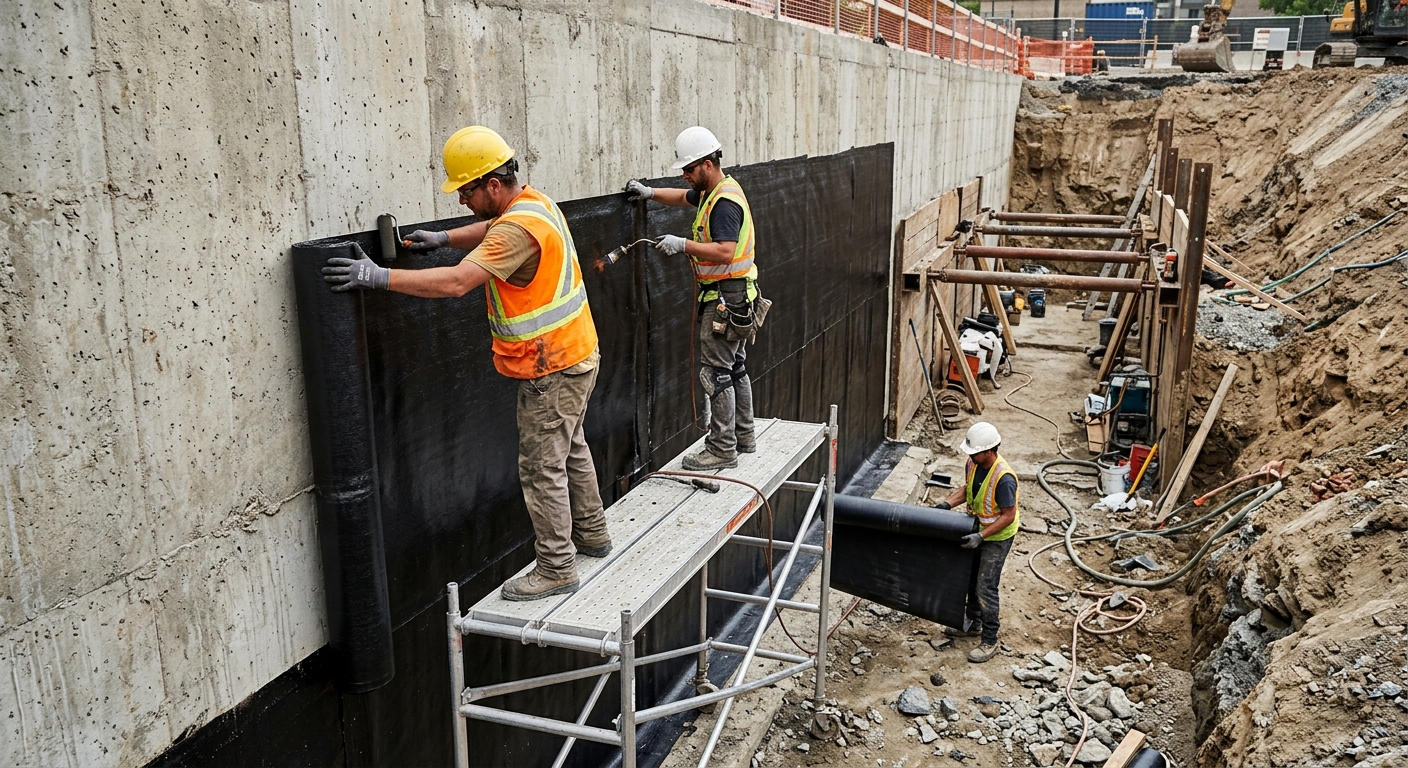
In simple terms, exterior waterproofing is source-control: full excavation, exterior membrane, new drainage tile, and careful backfill details. Interior waterproofing is symptom-control: it intercepts water after it enters using an interior drain channel and a sump pit (with a sump pump). In Pembroke’s climate, those differences matter because clay soils can keep foundations saturated and freeze-thaw can widen joints, which increases seepage opportunities. If the outside pathway remains, interior systems can still help, but they must handle the ongoing inflow.
When exterior excavation is feasible, it’s often the most complete solution for sustained seepage—especially when old weeping tile systems are clogged or missing. However, exterior is also the highest-disruption option in a market where older neighbourhood yards and mature landscaping can restrict access. Interior systems can be the practical choice when you’re trying to protect finished basements or avoid major yard restoration. Many poured-concrete walls seal more predictably with crack injection when cracks are non-moving, but you still need drainage correction so water isn’t continually forcing through new openings. For block foundations, interior drainage frequently becomes a complement because block walls and mortar joints can behave differently under freeze-thaw and saturation.
Ontario’s spring flooding pattern is another driver: sump pump reliability matters. A backup system (battery backup and/or water-powered backup, depending on site design) reduces the chance of basement flooding during power interruptions when pumps would otherwise stop.
A typical decision example: if your main issue is a localized crack leak and you can confirm drainage is generally functioning, crack injection at roughly the $800–$1,800 band may be justified. If inspection shows failed exterior drainage with sustained hydrostatic pressure, switching from interior-only work (often $4,000–$10,000) to exterior excavation can move you into the $12,000–$25,000 band—and the higher price is usually warranted because it removes the cause, not just the effect.
| Method |
Best For |
Addresses Source? |
Disruption |
Lifespan |
Price Band |
| Full exterior excavation + membrane |
Long-running leaks, failed weeping tile, clay-saturated soils, exterior wall seepage |
Yes (primary source control) |
High |
20+ years (when properly engineered and restored) |
$12,000–$25,000 |
| Interior French drain + sump system |
Active seepage after entry, intermittent dampness, practical retrofit with less yard disturbance |
No (water is managed after entry) |
Medium |
15+ years with maintenance |
$4,000–$10,000 |
| Crack injection — epoxy (structural) |
Non-moving hairline or stable structural cracks in poured concrete |
Partly (seals crack path, but doesn’t fix external water pressure) |
Low |
10–20 years (depends on crack movement and moisture conditions) |
$800–$1,800 |
| Crack injection — polyurethane (active leak) |
Cracks with active seepage; flexible sealing for ongoing moisture transmission |
Partly (seals leak path; still benefits from corrected drainage) |
Low to medium |
10–20 years (often shorter if water pressure remains high) |
$800–$1,800 |
| Interior drain channel only (no sump) |
Very minor dampness with adequate natural drying and low inflow |
No |
Medium |
5–10 years (can degrade if inflow increases) |
$2,500–$6,500 |
| Re-grading + downspout extensions |
Surface-water driven issues, seasonal staining, near-foundation runoff |
Helps reduce source load (not a full waterproofing system) |
Low |
5–10 years (depends on maintenance and settlement) |
$1,200–$4,500 |
How to choose a waterproofing contractor in Pembroke
Choosing a waterproofing contractor in Pembroke is about verifying compliance and protecting your budget from scope gaps. Start with Ontario licence/registration status for the trade category they claim to perform, and confirm liability insurance with a current certificate listing the correct legal business name. Then verify WSIB/WCB coverage by requesting a clearance letter or current coverage documentation—don’t rely on verbal assurances. If the contractor is doing structural crack repairs, ask how engineering support is arranged and whether they document the assessment if structural movement is suspected.
For pricing, get 2–3 itemised written quotes, not a single lump sum. The best quotes separate labour and materials (membrane, drainage tile, pumps, excavation and disposal, discharge piping, and restoration). Read exclusions carefully: is permit pulling included if required, is disposal/haul-away included, and are landscaping restorations included or allowance-based? Also confirm how they handle moisture-driven remediation (mould cleaning, efflorescence removal, and drying) before sealing.
Warranty matters in waterproofing. Ask for the workmanship warranty length, whether product/manufacturer warranties are provided in writing, and whether they’re transferable to the next homeowner. For payments, a safe approach is to keep upfront payments around 10–15% and hold back the remainder until the job is complete and cleaned up. Finally, ask for a start date and completion timeline in writing, including any weather-dependent pauses for excavation and curing.
- Request proof of Ontario registration/licensing for the specific work scope.
- Collect a current liability insurance certificate (date-valid, correct legal name).
- Verify WSIB/WCB clearance letter or current coverage confirmation.
- Insist quotes are itemised: labour, materials, disposal, permits, and restoration.
- Ask whether the quote includes excavation shoring and how they manage trench safety.
- Confirm what drainage outlet is used for sump discharge and whether it’s code-compliant.
- Ask if they inspect/record foundation type (poured, block) and crack classification.
- Verify sump pump specifications: check valves, alarms, and backup approach.
- Require a written warranty: workmanship term, product coverage, and conditions.
- Clarify the moisture prep steps (cleaning, drying, and timing before membrane/sealants).
- Use a payment schedule that keeps upfront to 10–15% and includes a completion holdback.
- Ask for an exact start/completion estimate and what happens if freeze-thaw interrupts work.
Red flags I regularly see with problematic waterproofing contractors in Pembroke include: overly vague scopes (“waterproofing” with no methods or measured wall sections), refusal to provide itemised line items and disposal details, warranty language that only covers “materials” but not workmanship, pushing large upfront payments, and promising a “permanent fix” without confirming drainage conditions or weeping tile condition—especially in older homes where fail points are often the drainage path, not just a visible crack.
Frequently asked questions — waterproofing in Pembroke
Can I waterproof my basement from the inside only?
Yes, you can often waterproof from the inside only in Pembroke, especially when you want less yard disruption or when access for exterior excavation is difficult (driveways, landscaping, mature trees). Interior systems like a perimeter drain channel, sump pit, and sump pump manage water after it enters. That can work well where leaks are primarily seepage through cracks/joints and where the exterior water load isn’t extreme. However, if your home has failed original weeping tile or persistent hydrostatic pressure from clay-heavy soils, interior-only approaches may require frequent pumping and can struggle during prolonged spring wet periods. In many cases, homeowners start with interior work in the $4,000–$10,000 band, then add crack injection around $800–$1,800 if the crack is stable or actively leaking. For the most source-control, exterior excavation and drainage tile/membrane is usually the better long-term solution.
What causes foundation cracks in Pembroke?
In Pembroke and the broader Kingston–Pembroke region, foundation cracks usually come from movement and stress cycling, not from one single event. Common causes include freeze-thaw expansion, moisture saturation in clay-rich soils, and differential settling over time—especially in homes built before 1981, when early drainage detailing and waterproofing materials were less durable. Freeze-thaw can widen existing joints and hairline cracks, which then become seepage paths. If water is not drained away properly, higher hydrostatic pressure increases the chance that cracks appear or worsen. You can also see cracking around areas like window openings, tie holes, and places where backfill was poorly compacted. The right fix depends on crack type: hairline and stable cracks may respond to crack injection (often $800–$1,800), while major horizontal or actively moving cracks need engineering assessment before you seal anything.
How do I compare waterproofing quotes?
Compare quotes in Pembroke by looking past the marketing and matching the scope line-by-line. First, confirm what each quote is actually doing: exterior excavation with membrane and drainage tile versus interior perimeter drains and a sump system. Interior-only solutions may be priced in the $4,000–$10,000 range, while exterior waterproofing commonly lands in the $12,000–$25,000 band. Next, make sure each quote includes the same assumptions: foundation type (poured concrete vs. block), whether weeping tile is repaired/replaced or confirmed failed, discharge route for the sump, and whether disposal and restoration are included. Ask whether crack injection is separate and how they choose epoxy versus polyurethane. Finally, check warranty terms and the payment schedule—responsible contractors keep upfront around 10–15% and hold back until completion. If two quotes differ wildly but list similar scope, ask for clarification on the missing work items.
How long does basement waterproofing take in Pembroke?
Timeframes in Pembroke depend on whether you’re doing interior work or exterior excavation and how weather-sensitive the schedule is. Interior perimeter drain + sump installations are typically faster because they avoid full exterior excavation, often taking roughly several days to a couple of weeks including prep, concrete cutting, installation, and drying/finishing. Exterior waterproofing can take longer because excavation, membrane installation, drainage tile placement, backfill, and then proper landscaping restoration all extend the schedule. Spring and freeze-thaw transitions also matter: contractors plan around temperature and curing needs, and excavation can slow if soils are excessively wet. If you’re only doing targeted crack injection, it’s usually quicker than full waterproofing—commonly scheduled in a shorter window, often aligned with the $800–$1,800 crack repair band. Ask for a written start date, completion estimate, and what happens if conditions prevent safe excavation or curing.
What is a weeping tile and does my Pembroke home have one?
A weeping tile is an older sub-surface drainage system installed around (or near) the foundation to collect water and channel it to a discharge point—often toward a sump or a gravity outlet. In many Pembroke homes built before 1981 (Statistics Canada, 2021 Census), original weeping tile systems were common, but they can be clogged, broken, disconnected, or missing entirely due to age and shifting. If you’re not sure, you can look for clues: a sump pit, older discharge piping, or historical references to replaced tile. During an inspection, contractors typically assess drainage by checking basement seepage patterns, probing for outlet locations, and reviewing whether old tile is present and functioning. Even when a system exists, it may not keep up during high water-table periods, and it can allow water to find cracks and joints. This is one reason exterior drainage replacement can be a large cost driver compared with interior-only approaches.
Can I waterproof my basement in winter in Pembroke?
You can sometimes do waterproofing in winter in Pembroke, but the best approach depends on the method. Interior crack injection and some interior work may proceed if conditions allow safe access and the product can be applied properly. However, full exterior excavation is often restricted because freeze conditions complicate trenching, drainage tile placement, and membrane detailing, and curing may be affected by temperature and moisture. Exterior work also carries higher risk when frozen soils limit drainage improvements and when the excavation environment is unsafe. If you must address an active leak during winter, contractors may focus on targeted crack repairs (often around the $800–$1,800 band) and ensure the sump system is operational—sump installations including backup can fall in the $900–$2,200 range. Regardless of season, ensure any permit-required changes (like certain drainage/sump discharge connections) are handled correctly in Ontario and that documentation and warranty terms are in writing.