Basement waterproofing options and costs in Tam O'Shanter-Sullivan
Tam O'Shanter-Sullivan, just east of Toronto, has a lot of basements where waterproofing problems don’t show up as obvious “wet spots” right away—they often begin as damp corners, musty odours, efflorescence, or intermittent seepage during heavy rain and spring melt. With a local population of 27,446 (Statistics Canada, 2021 Census), there’s steady demand for foundation services across the neighbourhood, especially in older pockets of the housing stock. In practice, many homes in the Toronto area were built in the post-war and 1960–1980s eras, which means original clay weeping tile or early drainage systems are often 40–60+ years old and frequently partially clogged or collapsed. When that happens, water has nowhere to go, and the freeze–thaw cycle in Ontario can widen small defects in block and poured concrete so minor cracks become active leaks over a few winters.
Because Toronto sits on mixed glacial till and clay soils—with pockets of dense clay—lateral pressure against foundation walls is a common trigger. That pressure, combined with high local water tables in many areas, increases the workload for excavation, drainage improvements, and sump systems. Contractor availability and access constraints also affect pricing: tight urban lots, decks, and additions can add labour for hand-digging and reinstatement, while failed exterior drainage often pushes homeowners toward interior drainage as the faster “stop the leak” option.
Below is a clear comparison of the most common solutions we see in Tam O'Shanter-Sullivan, with typical disruption and cost bands—so you can align the scope with what your basement is actually telling you.
| Method |
What It Addresses |
Disruption Level |
Durability |
Price Range |
| Exterior excavation + new membrane + drainage tile |
Hydrostatic pressure at the source; failed weeping tile; wall-to-soil water entry |
High (excavation, landscaping reinstatement, limited by access) |
Long-term—best “source control” when soil pressure is the driver |
$7,000–$25,000 |
| Interior perimeter drain channel + sump pit |
Water after it enters; chronic seepage; damp walls/efflorescence progression |
Medium (basement floor/footing work, sump location coordination) |
High when paired with proper discharge and sump backup |
$6,000–$15,000 |
| Foundation crack injection (epoxy or polyurethane) |
Isolated cracks—non-moving leaks (epoxy) or active seepage (polyurethane) |
Low to medium (cleaning and crack opening/ports) |
Moderate to high for suitable crack types; performance depends on cause |
$600–$3,500 |
| Sump pump installation (primary + battery backup) |
Frequent high-water events; reduces flooding risk during power interruptions |
Low to medium (pit/cabling, discharge piping, backup install) |
High for event control; longevity depends on discharge reliability |
$2,000–$6,000 |
| Window well drain installation |
Water intrusion at egress windows; surface runoff entering window wells |
Medium (excavation around window wells, rework of gravel/stone) |
Good for targeted fixes when downspouts and grading are corrected |
$1,200–$4,500 |
| Lot re-grading / downspout extension |
Surface water management; reduces inflow to foundation area |
Low to medium (soil/stone, grading corrections, downspout re-routing) |
Moderate—best as part of a bigger system if drainage tiles are failing |
$1,500–$6,500 |
Prices are estimates only and vary by project scope, site access and material selection.
What affects the price of waterproofing in Tam O'Shanter-Sullivan
In Tam O'Shanter-Sullivan and the broader Toronto market, two contractors can quote the “same” basement waterproofing job and still come in 30–50% apart. The gap usually isn’t about profit—it’s about how each company interprets the cause (water source and path) and the access realities of your lot.
The three biggest regional drivers that separate Toronto-area costs from the national average are soil type, water table, and freeze–thaw. Clay-heavy soils—common around the GTA—hold and expand when saturated, increasing lateral pressure on foundation walls and accelerating crack movement. In areas with higher water tables, sump systems run longer, and you often need upgraded drainage capacity and careful discharge planning. Freeze–thaw cycles then widen small defects in concrete and block, so small problems can turn into active leaks; that means more labour for prep, more ports for injection, or even a shift from crack sealing to drainage and membrane work.
Concrete examples we see locally: (1) If we find failed weeping tile and clay backfill packed tightly against the foundation, an exterior excavation and membrane scope tends to land closer to $7,000–$25,000 because of hand-digging, disposal, and reinstatement. (2) If the leak pattern is intermittent at corners but weeping tile is likely partially collapsed, an interior perimeter drain and sump can often be staged to control water for $3,500–$15,000, but only after the contractor confirms there isn’t a failing exterior system causing constant wall pressure. (3) If your basement has active seepage at a joint and the crack is moving, polyurethane injection may be targeted and cost-effective, while epoxy-only repairs can underperform—so the “cheaper” quote can become more expensive after another winter.
Finally, contractor availability and jobsite constraints—deck footings, shared driveways, tight landscaping beds, or working below porch steps—can add significant time even when the materials are similar.
| Price Factor |
Why It Matters |
Cost Impact |
| Interior vs. exterior approach — interior is less disruptive but addresses symptoms |
Exterior targets the water at the wall/soil interface; interior channels it after entry |
Interior often 40–60% less upfront than full exterior, but may need sump upkeep |
| Foundation type — poured concrete vs. block vs. stone vs. ICF |
Different crack behaviour and water paths; block can seep through mortar and joints |
Block/stone often higher due to more prep, ports, and drainage complement |
| Soil type — clay expands more than sand, adding pressure |
Clay saturation increases lateral loads and raises the risk of recurring leaks |
Clay areas can push exterior scopes toward the high end of the band |
| Crack type and length — hairline vs. structural horizontal cracks |
Moving or structural cracks may require engineering, not just sealing |
Structural conditions can increase costs by thousands due to added investigations |
| Sump pump backup system — battery or water-powered backup needed |
Reduces flooding risk during spring power interruptions |
Backup typically adds a few thousand, but can prevent total-loss damage |
| Access — landscaping, decks, or driveways must be removed for exterior |
More staging, hand-digging, and reinstatement labour |
Access constraints can swing an exterior job significantly |
| Weeping tile age — original tile (60+ years) may be completely failed |
Old drains often collapse or clog, forcing more comprehensive drainage replacement |
Complete replacement pushes interior-only options into higher interior/exterior scopes |
| Mould or efflorescence remediation required before sealing |
Moisture must be controlled first; surfaces may require cleaning and sometimes removal |
Remediation can add time and specialized materials |
Permits & regulations in Ontario
In Ontario, foundation excavation, structural crack repair, and changes to lot drainage commonly require a building permit. If a contractor is planning work that affects structural elements—particularly for major horizontal cracks, step cracks in block walls, or signs of movement—they should typically coordinate permit requirements and, in many cases, have a structural engineer assess the condition first. For sump pump installations, the connection method matters: if the discharge ties into storm or sanitary systems, municipal approval is often required before the tie-in is made.
What typically DOES require a permit in Ontario includes: excavation close to the foundation when it changes drainage pathways, structural repairs where there is potential movement or load transfer, and any work that modifies how water is directed away from the foundation at a property/municipal interface. What typically does NOT require a permit is: interior-only water management that doesn’t alter drainage routes beyond the foundation footprint (for example, installing a sump pit and perimeter drain under an existing basement floor), and targeted crack injection for a clearly non-moving crack—unless the scope expands to structural concerns.
For Tam O'Shanter-Sullivan homeowners, verify your contractor before signing:
- Check licensing/registration status using Ontario’s contractor/registration requirements (as applicable to their trades).
- Request a current Certificate of Insurance (liability) showing the policy is active.
- Ask for WSIB/WCB clearance or coverage documentation (or equivalent proof of coverage), and confirm it matches the legal name on the quote.
- For structural situations, confirm whether the contractor provides access to engineering support and who coordinates it.
- Get the permit responsibility in writing: who pulls the permit, and what’s included in the price.
These checks protect you when hidden water pressure or crack movement turns a “simple” repair into structural-grade work.
Interior vs exterior waterproofing — what does Tam O'Shanter-Sullivan need?
Exterior waterproofing is the “source control” approach: full excavation exposes the foundation wall, then a membrane and new drainage tile are installed, and backfill is placed back in a controlled way to reduce water build-up. This is the most effective method when Toronto-area clay soils are holding moisture against the foundation and when older weeping tile is failing. The trade-off is cost and disruption—excavation, temporary barriers, and landscaping reinstatement are unavoidable, especially in tight lots.
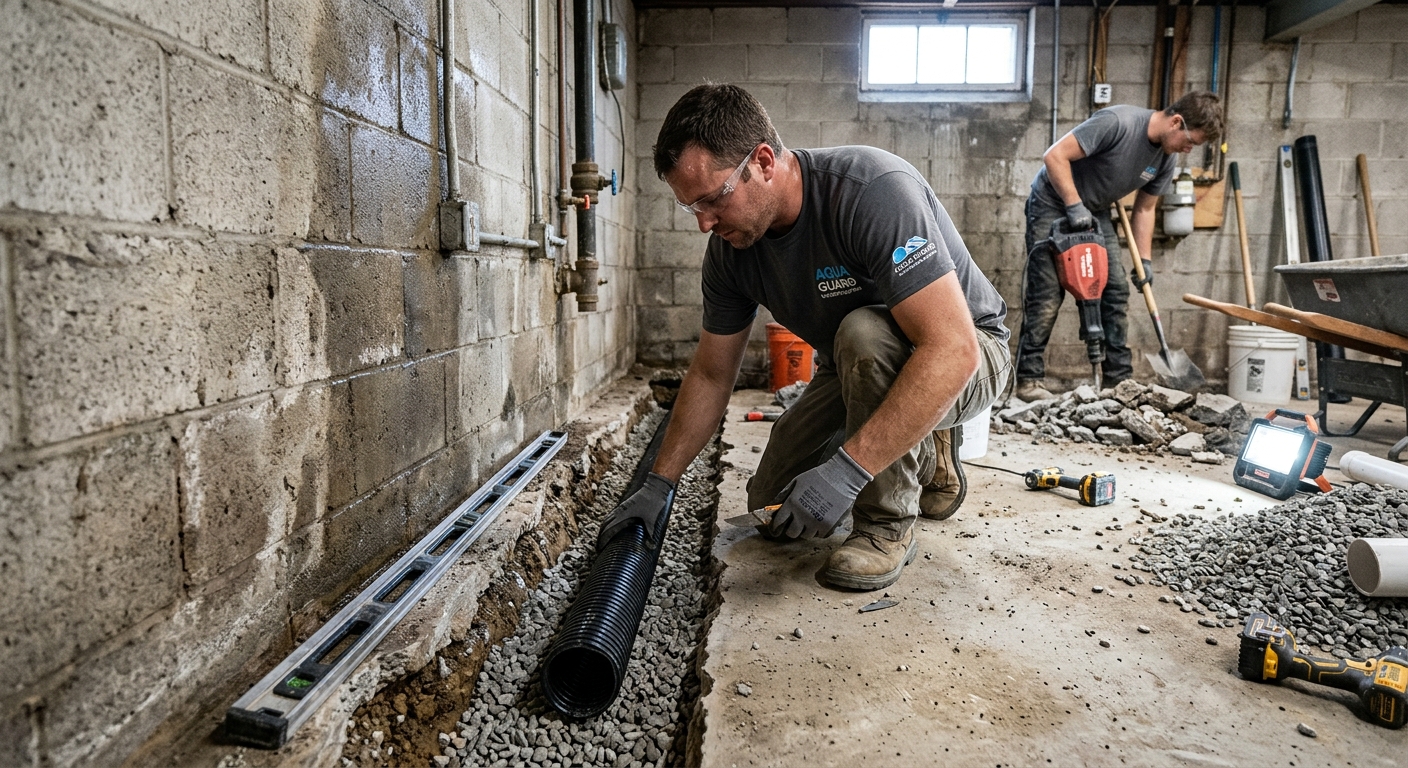
Interior waterproofing manages water after it enters. Common components are a perimeter drain channel, a sump pit, and a sump pump that directs water away from the basement. Interior work is typically less invasive, and it can be a practical choice where exterior access is constrained or where the leak pattern is consistent seepage through joints that can be intercepted. But interior solutions do not stop hydrostatic pressure from acting on the wall; they reduce the water volume and risk of flooding inside.
In Tam O'Shanter-Sullivan, poured concrete walls often respond well to crack injection when cracks are isolated and not moving, particularly when paired with proper interior drainage to handle seasonal peaks. Block foundations, on the other hand, frequently need interior drainage as a complement because water can travel through mortar joints and around tie holes even when the visible crack is repaired. Given Ontario’s freeze–thaw cycles and spring melt, sump pump reliability matters—backup systems are worth serious consideration if your basement has a history of high-water events.
To put it in dollars: if a contractor recommends full exterior waterproofing but your main issue is a single leaking corner and limited seepage, you may not need to excavate all walls. A well-designed interior perimeter drain and sump system may fall in the $3,500–$15,000 band, while exterior excavation and membrane replacement often lands in the $7,000–$25,000 range—so the price difference is justified when soil pressure and failing exterior drainage are confirmed, not just suspected.
| Method |
Best For |
Addresses Source? |
Disruption |
Lifespan |
Price Band |
| Full exterior excavation + membrane |
High lateral soil pressure, failing weeping tile, chronic seepage tied to exterior wall/soil interface |
Yes |
High |
15+ years with correct drainage design and backfill |
$7,000–$25,000 |
| Interior French drain + sump system |
Chronic seepage, efflorescence that keeps returning, high-water events where exterior access is limited |
No (intercepts water after entry) |
Medium |
10–15+ years depending on pump/backup and discharge |
$3,500–$15,000 |
| Crack injection — epoxy (structural) |
Non-moving cracks where the water pathway is stable |
Partially (stops flow through the crack, not wall-soil pressure) |
Low |
Moderate to high when the crack is truly non-moving |
$600–$2,500 |
| Crack injection — polyurethane (active leak) |
Active seepage at joints or cracks where water is still finding a path |
Partially (targets active leak path) |
Low to medium |
Moderate to high when paired with drainage control |
$800–$3,000 |
| Interior drain channel only (no sump) |
Light seepage, mild dampness, or when water volume is low and discharge is reliable |
No |
Medium |
Limited if water table rises; performance depends on year-round conditions |
$1,500–$6,000 |
| Re-grading + downspout extensions |
Surface water run-off issues, gutter overflows, and near-surface water management |
Helps reduce inflow |
Low to medium |
Moderate (best with drainage system support) |
$1,500–$6,500 |
How to choose a waterproofing contractor in Tam O'Shanter-Sullivan
Choosing the right waterproofing contractor in Tam O'Shanter-Sullivan comes down to documentation, scope clarity, and whether the crew understands Toronto’s soil-and-freeze challenges. Start by verifying Ontario licensing/registration status relevant to the work they’ll perform, then confirm liability insurance coverage with a current Certificate of Insurance showing active limits and coverage details. Next, ask for WSIB/WCB clearance or proof of coverage for the company and current workers—don’t accept a “we’re covered” statement without paperwork.
Then get 2–3 itemised written quotes (not lump sums). Look for a breakdown that separates labour and materials and clearly states what’s included: membrane type, drainage pipe/tile specifications, disposal, surface restoration, and what happens if additional excavation reveals more failed tile or additional crack length. Scope exclusions should be explicit—otherwise you end up paying change orders after the crew opens the wall.
Warranty matters too. Confirm the workmanship warranty length and what it covers (crack injection performance, drain function, seal integrity), plus any product/manufacturer warranty terms. Ask whether the warranty is transferable to future owners—buyers do ask.
Payment schedule: never pay more than 10–15% upfront. Use a holdback until the job is complete and cleaned up. Finally, get a start date and a realistic completion timeline in writing, especially for winter prep work and any curing times for injections or membranes.
- Ask what diagnostic steps they use (water test, inspection method, crack mapping).
- Confirm whether they assess discharge routes for sump pumps (where water goes).
- Require an itemised scope with quantities (linear feet, number of ports, pump model).
- Ensure permit responsibility is stated (who pulls it and what’s included).
- Ask how they handle failed weeping tile discovery during excavation.
- Request photos/documentation before sealing and after cleanup.
- Verify warranty terms are specific to the method used (epoxy vs polyurethane).
- Check if they include mould/efflorescence remediation when needed before sealing.
- Get backup pump details if your basement is prone to spring flooding.
- Confirm disposal and reinstatement scope (topsoil, sod/stone repairs, grading).
- Clarify who is responsible for utility locates and any municipal requirements.
- Review payment milestones—holdback until functional testing is complete.
Red flags we see in Tam O'Shanter-Sullivan include: quotes that refuse to discuss permits or warranty specifics, vague “we’ll waterproof it” scopes without crack mapping or drainage design, offering epoxy-only injection for active leaks, minimizing sump backup recommendations in basements with a history of spring high water, and requesting large deposits (more than 15%) before any work begins.
Frequently asked questions — waterproofing in Tam O'Shanter-Sullivan
Why is my basement leaking in Tam O'Shanter-Sullivan?
Most leaks in Tam O'Shanter-Sullivan come from water that accumulates against the foundation and then finds a path through cracks, tie holes, or failing drainage. Toronto-area clay soils can hold moisture and expand during freeze–thaw, which increases pressure against foundation walls and widens small defects over multiple winters. Another common driver is older weeping tile or early drainage systems that are partially clogged or collapsed; that causes interior dampness and, in heavy spring melt, basement flooding even if the exterior walls don’t look “dramatically” failed. If you’re seeing efflorescence or a recurring damp strip along one wall, contractors often recommend confirming drainage capacity before sealing anything permanently.
How do I know if a foundation crack is serious?
In Ontario homes around Tam O'Shanter-Sullivan, not every crack means structural failure, but you should treat horizontal cracks in block walls and step cracks as more concerning than hairline shrinkage cracks. A crack is more likely serious if it’s growing year to year, widens when the ground is saturated, shows water seepage (dark staining or wetness), or appears as repeated patterns near corners and window openings. You can also watch for associated signs like ongoing efflorescence, damp floors near the crack line, or doors/windows that start sticking. If you have signs of movement or an unusual crack geometry, a structural engineer assessment is often necessary before deciding between injection-only repairs and drainage or underpinning.
How much does foundation crack repair cost in Tam O'Shanter-Sullivan?
Foundation crack repairs vary mainly with crack type, length, whether the crack is active (ongoing moisture) and how much prep is required. For isolated, accessible cracks, typical epoxy or polyurethane injection pricing often falls in the $600–$3,000 range depending on the number of injection ports, crack length, and whether drying conditions are needed. If your crack is part of a broader water problem—such as failed weeping tile causing constant pressure—injecting alone may not be enough, and interior drainage or a sump may be required, shifting the budget upward into the interior waterproofing band ($3,500–$15,000). A proper inspection is the fastest way to avoid paying for an “injection-only” fix when the cause is hydrostatic pressure.
Do I need a sump pump in Tam O'Shanter-Sullivan?
You may need a sump pump if your basement has chronic seepage during spring rain/melt, if water collects in a low area, or if clay soils and higher water table conditions make interior interception necessary. Many Toronto-area basements don’t flood every month, but they do during high-water events—so a sump is often the safety layer once a perimeter drain is installed. If you’ve had power outages during wet periods or your basement history includes water levels rising quickly, ask about a backup system. Battery backup (and sometimes water-powered backup depending on design) can be the difference between cleanup and major damage.
How does Tam O'Shanter-Sullivan's soil affect my foundation?
Tam O'Shanter-Sullivan sits in a Toronto-area environment of mixed glacial till and clay soils with dense clay pockets. Clay is the key issue: when saturated, it expands and exerts lateral pressure on foundation walls. During freeze–thaw, that pressure is paired with ground movement and moisture cycling, which can widen hairline cracks and push water through joints and defects. That’s why we often see seepage worsen over a few winters even if the original crack seemed minor. If your home is on clay and the weeping tile is older or partially failed, exterior excavation and new drainage tile can be the most reliable source-control approach, while interior systems are more about interception and flood risk reduction.
Do I need a permit for foundation work in Ontario?
In Ontario, many foundation-related changes do require permits, especially when work involves foundation excavation, structural repair, or modifications to how lot drainage directs water. For example, altering drainage pathways around the foundation, coordinating tie-ins, or addressing major crack conditions typically triggers permit involvement. Interior waterproofing can be simpler, but if a sump ties into storm or sanitary systems, municipal approval is often required. The best approach for Tam O'Shanter-Sullivan homeowners is to ask the contractor to clearly state in writing who pulls the permit and what is included. You should also verify the contractor carries appropriate liability insurance and WSIB/WCB coverage before any excavation or structural crack work begins.