Basement waterproofing options and costs in Petrolia
Basement waterproofing in Petrolia usually starts with one question: where is the water coming from? In a town where 79.1% of households are owner-occupied and single-detached homes make up 82.3% of dwellings, homeowners tend to want a solution that protects the entire foundation system—not just what shows up on the basement floor. That matters here because 55.1% of homes were built before 1981, and older tar-and-paper style damp proofing, aging weeping tile, and cracked mortar joints often can’t keep up once freeze–thaw stresses and seasonal groundwater bring moisture back toward the foundation.
In the Windsor–Sarnia corridor, pricing is heavily shaped by soil and groundwater behaviour. In many areas of Lambton and Essex County, fine-textured, poorly drained soils and higher seasonal water conditions can keep moisture pressed against basements, increasing seepage and hydrostatic pressure. That typically raises the scope for exterior excavation and drainage work, especially where contractors must deal with compacted backfill, limited access, or the need for cold-weather detailing (insulation continuity, proper frost-resistant backfill, and protecting drainage lines). If your home is near the downtown core and you have tight setbacks, or you’re dealing with an older weeping-tile system that’s clogged, you’ll often see interior drainage options priced closer together—while comprehensive exterior systems swing wider due to excavation and restoration requirements.
Neighbourhoods such as near the downtown and older residential blocks around Broadway Avenue tend to see steady demand because a lot of housing stock is older and access can be tight. Below is a practical comparison of common options and what they typically address, so you can line up quotes before any contractor starts digging.
| Method |
What It Addresses |
Disruption Level |
Durability |
Price Range |
| Exterior excavation + new membrane + drainage tile |
Source water control by draining groundwater away and reducing hydrostatic pressure |
High (excavation, landscaping restoration) |
Long-term when installed with correct backfill, frost detailing, and discharge routing |
$12,000–$25,000 |
| Interior perimeter drain channel + sump pit |
Water management after it enters by collecting seepage and pumping it away |
Medium (interior floor/wall edge access) |
Strong protection when paired with properly sized sump discharge and backwater planning |
$8,000–$18,000 |
| Foundation crack injection (epoxy or polyurethane) |
Crack pathways that leak—stops seepage through joints and fractures |
Low to medium (surface prep, drilling ports) |
High for the right crack type; best results when paired with drainage strategy |
$600–$2,500 |
| Sump pump installation (primary + battery backup) |
Automated removal of collected water and resilience during outages/overload |
Low to medium (pit/sump work, discharge routing) |
Very good for system reliability; depends on pit design and backup type |
$1,800–$4,500 |
| Window well drain installation |
Directing surface and groundwater from window wells away from basement openings |
Low to medium (excavate around wells, routing/drain connection) |
Good when downspouts and discharge are coordinated correctly |
$1,000–$3,200 |
| Lot re-grading / downspout extension |
Reducing surface water infiltration by improving site drainage and directing roof runoff |
Low (minor excavation, landscaping touch-ups) |
Moderate—best as a first-line fix or complement to drainage |
$900–$2,800 |
Prices are estimates only and vary by project scope, site access and material selection.
What affects the price of waterproofing in Petrolia
In Petrolia and across the Windsor–Sarnia region, you can see quotes for the “same” waterproofing job land 30–50% apart. The difference isn’t just contractor pricing—it’s the water path, foundation material, and how much of the system is truly being rebuilt versus patched. Nationally, averages assume more uniform soil and simpler access. In this region, however, soil type and water-table behaviour plus freeze–thaw cycles are the trio that separates Windsor–Sarnia costs from the national average.
First, clay-heavy soils expand during freeze–thaw and exert lateral pressure on foundation walls, which can worsen cracks over time. Second, elevated seasonal groundwater increases sump pump run times and raises the engineering/selection requirements for footing drains and discharge routing. Third, repeated freeze–thaw opens existing joints, especially in older concrete and block foundations, meaning leakage pathways must be treated with the right method—like polyurethane for active seepage or interior drainage to manage pressure loads.
Two local examples often show up in Petrolia. If your home has a pre-1981 foundation and the original weeping tile is likely over 40+ years old, contractors may need to replace or bypass it, which can push scope toward exterior excavation or a more comprehensive interior drainage build-up. Conversely, if your downspouts and lot grading are clearly directing runoff away, re-grading and downspout extensions can reduce the volume of water entering and lower the overall need for aggressive drainage work; it’s common to see this as part of an exterior scope, not a standalone “cure.”
Where an interior perimeter drain + sump system can fall into the $8,000–$18,000 band, a full exterior excavation + membrane and drainage tile can jump toward $12,000–$25,000 when soil and water conditions require deeper footing drains, robust backfill, and careful cold-weather detailing for continuity through the frost line. In practice, older housing stock combined with damp basements and clogged drainage makes comprehensive approaches more frequent—especially where interior finishes would be costly to remove more than once.
| Price Factor |
Why It Matters |
Cost Impact |
| Interior vs. exterior approach — interior is less disruptive but addresses symptoms |
Interior systems handle water after entry; exterior systems reduce source seepage and pressure at the wall |
Interior often 30–60% less disruptive; exterior can cost more due to excavation and restoration |
| Foundation type — poured concrete vs. block vs. stone vs. ICF |
Different materials crack and leak differently; crack repair and drainage pairing changes |
Block and older stone/brick mixes often increase labour and crack-injection quantities |
| Soil type — clay expands more than sand, adding pressure |
Freeze–thaw expansion increases lateral pressure and widens leakage pathways |
Clay sites can increase scope for drainage capacity and reinforcement/backfill |
| Crack type and length — hairline vs. structural horizontal cracks |
Structural horizontal cracks may indicate movement, requiring assessment beyond sealing |
Structural cases increase investigation and can add engineer/support costs |
| Sump pump backup system — battery or water-powered backup needed |
Backup reduces failure risk during outages and high-rain or spring events |
Adding backup typically adds material and electrical work |
| Access — landscaping, decks, or driveways must be removed for exterior |
Exterior work requires excavation and later restoration; tight access increases labour time |
Removal/restoration can materially add to excavation-based quotes |
| Weeping tile age — original tile (60+ years) may be completely failed |
Failed tile changes the water pathway; may require replacement or comprehensive diversion |
More likely to move from partial fixes to full drainage retrofits |
| Mould or efflorescence remediation required before sealing |
Moisture contamination must be treated before membranes/injections to ensure adhesion and safety |
Remediation adds time, containment, and disposal; can’t be skipped |
Permits & regulations in Ontario
In Ontario, homeowners in Petrolia should expect that certain foundation and drainage changes require a permit before work starts. As a rule of thumb, foundation excavation, structural crack repair when it involves potential structural implications, and modifications that change lot drainage typically fall under permit requirements because they can affect drainage flow, structural integrity, or site services. For sump pump installations that connect into municipal storm or sanitary systems, municipal approval is often required—contractors should confirm the discharge plan and any connection approvals before they cut into anything.
For structural crack repair—particularly horizontal cracks in block walls or any crack pattern suggesting movement—an assessment by a structural engineer is frequently required to determine whether underpinning or other structural remediation is needed. A reputable contractor should be able to show engineering support where warranted, along with appropriate liability insurance and WSIB/WCB coverage. Even when a permit isn’t needed for minor sealing work, liability coverage and correct product installation still matter for performance and safety.
How to verify compliance step-by-step: (1) Ask for the contractor’s Ontario licensing details and record number (if applicable to their trade scope), and confirm it matches their business name. (2) Request a current certificate of insurance (liability) and check the expiry date and jobsite address/name. (3) Ask for WSIB/WCB clearance documentation or proof of coverage. (4) Confirm in writing whether the contractor is pulling any required permits and who is responsible for inspections. (5) Ensure the discharge plan is documented—especially if it’s anything more than a discharge to a suitable existing location.
Interior vs exterior waterproofing — what does Petrolia need?
Interior and exterior waterproofing differ in how they treat water. Exterior waterproofing—full excavation, new membrane, new drainage tile, and properly engineered backfill—targets the source by reducing how much groundwater reaches and presses against the foundation wall. It usually costs more and creates landscape disruption, but when done correctly it can provide a more permanent reduction in seepage risk because hydrostatic pressure is managed at the outside face.
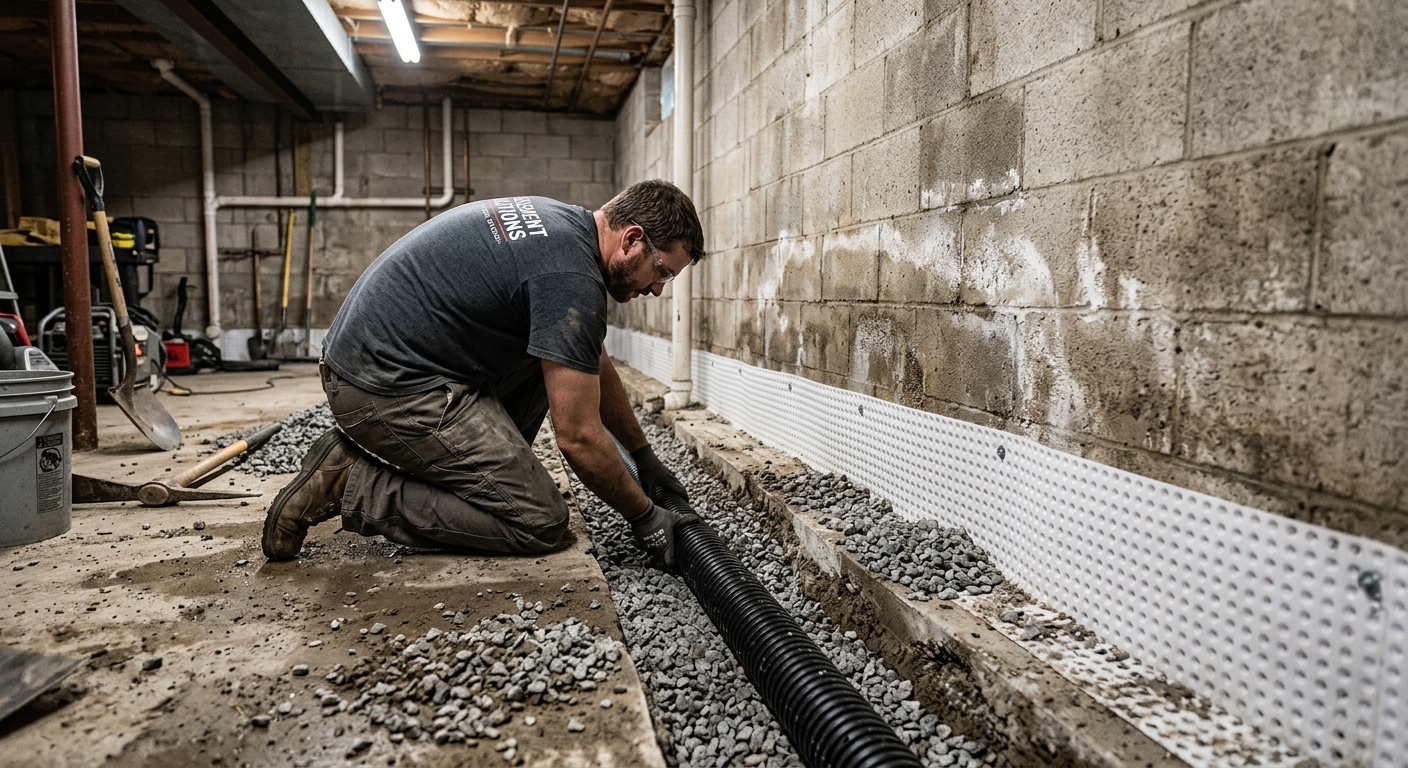
Interior waterproofing—perimeter drain channels, a sump pit, and sump pump discharge—manages water after it enters the basement. It’s less invasive and often more practical where access is constrained (tight lots, mature landscaping, or difficult excavation). However, it does not stop hydrostatic pressure from acting on the foundation wall itself, which means it works best when paired with proper crack treatment and a reliable pump system.
Petrolia’s climate and local foundation mix commonly push solutions toward combining strategies. With older homes (many built before 1981) and the freeze–thaw cycles that widen cracks over time, poured concrete foundations often respond well to crack injection combined with interior drainage to manage incidental seepage. Block foundations frequently benefit from interior drainage as a complement because block joints can be more variable in how they leak under pressure. If mouldy areas, recurring floor seepage, or high seasonal water marks appear, an interior drain channel + sump system in the $8,000–$18,000 band can be justified by performance and reduced disruption, while exterior excavation + drainage tile in the $12,000–$25,000 band becomes more compelling when you want to reduce source water and stop the problem at the wall.
Power resilience matters in Ontario. For many Petrolia basements, adding a backup system to the sump (battery or water-powered backup) protects against spring overloads and occasional outages when groundwater drives higher inflow. If you’re deciding between options, a realistic example is: an interior perimeter drain + sump may stabilize daily seepage, but if inspection shows failed weeping tile and frequent outward seepage during high water seasons, the incremental cost of exterior excavation can be justified because it reduces the load your sump must handle year after year.
| Method |
Best For |
Addresses Source? |
Disruption |
Lifespan |
Price Band |
| Full exterior excavation + membrane |
Frequent seepage, failing weeping tile, and sites where exterior access is workable |
Yes |
High (excavation + restoration) |
Long-term when drainage is engineered and protected against frost |
$12,000–$25,000 |
| Interior French drain + sump system |
Active seepage, higher seasonal groundwater, and cases where exterior excavation is limited |
No (manages after entry) |
Medium (floor edge access) |
Very good with proper pit sizing, discharge, and backup |
$8,000–$18,000 |
| Crack injection — epoxy (structural) |
Stable, non-moving cracks in poured concrete or well-defined leakage planes |
Partially (seals a pathway, but doesn’t remove pressure source) |
Low (drilling/patching) |
High for suitable crack types |
$600–$2,500 |
| Crack injection — polyurethane (active leak) |
Ongoing seepage where water pressure feeds the crack pathway |
Partially (stops active leakage) |
Low (targeted crack work) |
Good for active leaks when installation conditions are right |
$700–$2,700 |
| Interior drain channel only (no sump) |
Light dampness or controlled seepage where pumping isn’t required |
No |
Low to medium |
Moderate—depends on gravity discharge feasibility |
$4,000–$10,000 |
| Re-grading + downspout extensions |
Water driven by roof runoff or surface pooling near foundation |
No (reduces surface water contribution) |
Low |
Moderate—best as a complement to drainage |
$900–$2,800 |
How to choose a waterproofing contractor in Petrolia
Choosing the right waterproofing contractor in Petrolia is mainly about verifying proof and comparing scopes, not just asking for the lowest number. Start with Ontario coverage checks: (1) Liability insurance—request a certificate and confirm it’s current and covers the type of work being quoted. (2) WSIB/WCB coverage—ask for clearance documentation or proof of coverage so you’re not left holding risk if labour is injured on your property. (3) If structural engineering is likely, ask whether they have an engineering partner or how they handle referrals when crack patterns suggest movement. A strong contractor won’t hesitate to provide documentation before you sign anything.
Next, request 2–3 itemised written quotes. You want a labour + materials breakdown (membrane, drainage tile, filter fabric, sump basin, pump, backflow components, disposal/restoration), not a lump sum that hides assumptions. Read the scope carefully: what’s excluded (repairs to landscaping, floor finishes, asbestos testing, engineering assessments, permit pulls, disposal of excavated soil)? Confirm disposal is included if they’re excavating. Ask whether permits are pulled by the contractor or by you, and whether inspections are covered.
Warranty matters. A workmanship warranty should be clearly stated (length and what it covers). Also note product/manufacturer warranties and whether they’re transferable if you sell the home. For payment schedule, avoid paying more than 10–15% upfront; hold back a portion until completion and walkthrough.
Finally, insist on a written timeline with start date and completion estimate. Waterproofing projects often overlap weather windows, but your contractor should still identify critical-path items like excavation access, curing times for crack injection, pump install lead times, and backfill sequencing.
- Provide current liability insurance certificate (expiry date visible).
- Provide WSIB/WCB clearance or proof of coverage for all required parties.
- Use itemised quotes: labour, materials, disposal, and restoration listed separately.
- State what permits (if any) are pulled and who handles inspections.
- Include exact drainage components: tile size, discharge routing, filter fabric, and sump specifications.
- Clarify exclusions: mould removal, asbestos risk assessment, and basement finishing repairs.
- Confirm crack injection method selection based on active vs. stable cracking.
- Require a basement photo/mark-up walkthrough of leak locations before pricing adjustments.
- Specify warranty length for workmanship and warranty terms for materials.
- Confirm product warranty transferability to future owners.
- Schedule payment: only 10–15% upfront; holdback until final clean-up and test run.
- Get a written timeline, including curing/backfill sequencing and weather contingencies.
Red flags in Petrolia include contractors who offer a one-price “membrane and done” approach without inspecting or mapping water entry routes; quoting without explaining why they chose interior versus exterior; refusing to provide insurance/WSIB/WCB documents; promising no excavation when there’s evidence of failed weeping tile; or issuing vague warranty wording that doesn’t specify workmanship coverage and rework responsibilities.
Frequently asked questions — waterproofing in Petrolia
What causes foundation cracks in Petrolia?
In Petrolia, foundation cracks most often develop from the combined stress of soil movement and freeze–thaw cycling. When groundwater sits against a foundation in winter and then freezes, expansion can widen joints and hairline cracks. As temperatures swing, repeated freeze–thaw keeps working those pathways, especially on older concrete and block foundations that may have limited movement accommodation. In many older Petrolia homes (a large share built before 1981), weeping tile and exterior damp-proofing are often aging or clogged, which increases moisture around the wall and raises seepage pressure—further stressing cracked areas. Also, seasonal soil swelling in finer, poorly drained soils can exert lateral pressure, turning small cracks into longer leak routes over time (Statistics Canada, 2021 Census).
How do I compare waterproofing quotes?
Start by comparing scope, not just total price. Ask each contractor to describe the water pathway and the specific system they’re installing: exterior excavation + new drainage tile and membrane, or interior perimeter drainage with a sump. In Petrolia, a properly scoped interior perimeter drain + sump system typically falls in the $8,000–$18,000 band, while a full exterior excavation can land around $12,000–$25,000. If one quote is much lower, check whether it excludes discharge work, disposal, backfill/frost detailing, permit handling, crack injection, or restoration. Require itemised labour and materials, plus warranty wording and who is responsible for repairs if leaks recur. A good contractor will be able to explain why their chosen method fits your foundation type and local drainage conditions.
How long does basement waterproofing take in Petrolia?
Timelines in Petrolia depend on whether you’re doing exterior or interior work and how complex the site access is. Interior perimeter drainage and sump retrofits often take less time than full exterior excavation because you’re not reopening the entire perimeter. Typical sequencing includes confirming leak points, installing drain channel components, setting the sump pit and discharge routing, then testing pumping performance. Exterior projects can take longer due to excavation, installing membrane and drainage tile around the foundation, managing cold-weather detailing, and completing backfill in a frost-safe way. Crack injection is comparatively quick (days, depending on number and depth of cracks) but still requires surface prep and correct cure time. Ask for a written start date and completion estimate and confirm how weather impacts scheduling during spring melt and freeze–thaw periods.
What is a weeping tile and does my Petrolia home have one?
A weeping tile is the underground drainage system installed around (or at the footing level of) many older basements to collect groundwater and direct it away from foundation walls. In practical terms, it helps prevent water from building up against the outside of the basement. Many homes built in the decades before modern exterior drainage standards still have original weeping tile, but it may be failing or clogged—especially when it’s over 40+ years old and exposure plus silt buildup reduces flow. In Petrolia’s older housing stock, it’s common to see weeping tile that no longer carries water effectively, which can lead to seepage and higher sump cycling. You can often determine whether it exists by checking for old inspection/access points, lift of sump-related piping, or by having a contractor perform an investigation during excavation.
Can I waterproof my basement in winter in Petrolia?
Yes, you can often do portions of basement waterproofing in winter in Petrolia, but it depends on what work is required. Interior solutions like perimeter drain installation, sump pit work, and crack injection are commonly scheduled when basement access is workable and temperatures allow product installation and proper curing. Exterior excavation is where winter becomes challenging: frozen ground can slow digging, limit drainage-tile placement, and complicate frost-safe backfill and membrane detailing. When temperatures are low, contractors need the right materials and sequencing to ensure membranes and sealants perform properly. The best approach is to schedule diagnostic work early, then decide whether the project is interior-first (to control leakage immediately) while planning exterior drainage for a safer excavation window. Your contractor should explain the winter-specific constraints before quoting.
What is the difference between waterproofing and damp-proofing?
Waterproofing and damp-proofing are related, but they address different levels of moisture and different water pressure conditions. Damp-proofing typically refers to coatings or membranes meant to resist dampness and minor moisture—often appropriate for low moisture conditions and not designed to withstand significant hydrostatic pressure. Waterproofing is a broader system: it’s designed to manage or control water entry, including seepage under pressure, by combining drainage (like footing drains and membrane systems), sealing of cracks, and often a sump system to remove collected water. In Petrolia’s Windsor–Sarnia corridor, freeze–thaw and seasonal groundwater can increase pressure against foundations, so homeowners with recurring seepage usually need true waterproofing strategies. For example, if you’re moving from a dampness issue to active seepage, a sump installation in the $1,800–$4,500 band or a perimeter drain approach may be the difference between “dry-ish” and reliably dry.