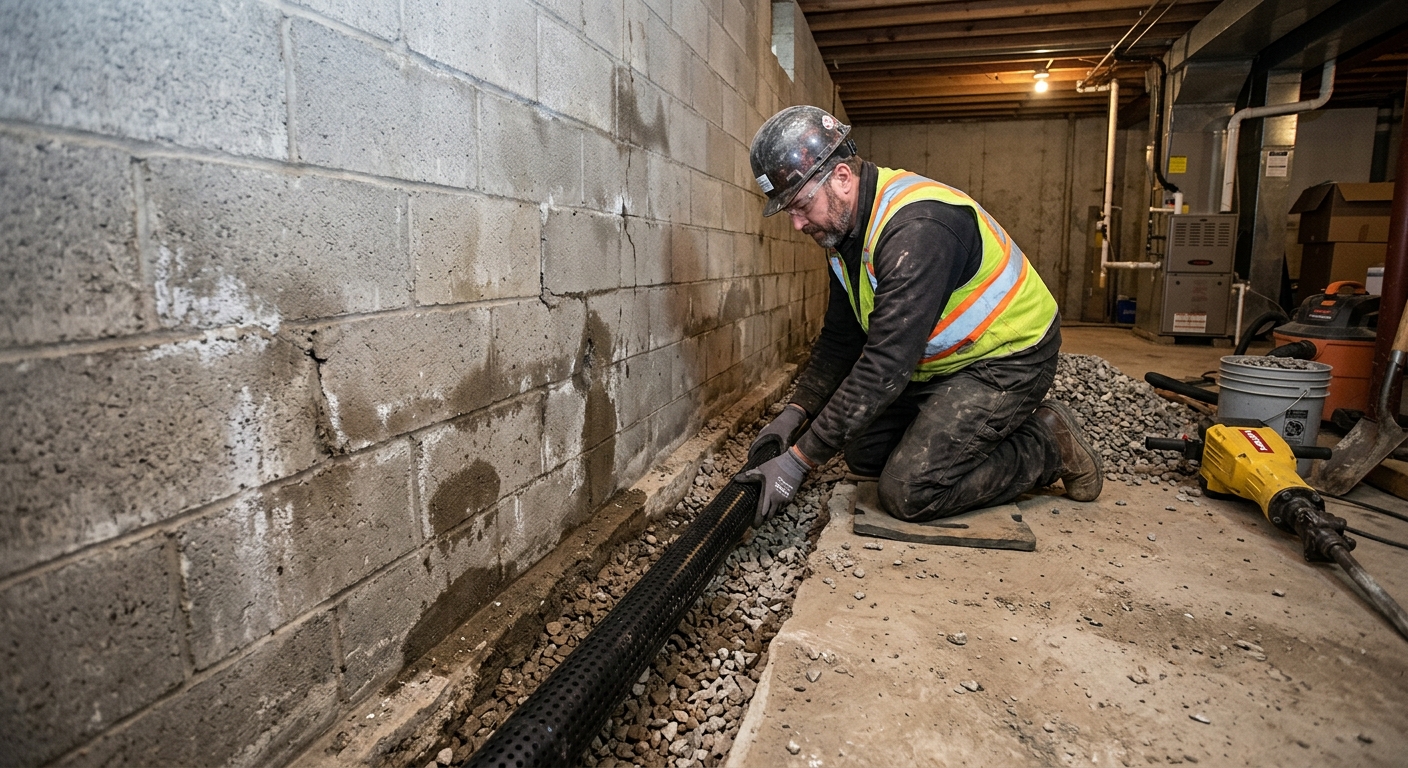
Basement waterproofing options and costs in Hamilton
In Hamilton, homeowners typically start by comparing waterproofing options that match how water is getting into the basement—through hydrostatic pressure on the foundation wall, along joints and cold seams, or through failing weeping tile. Because many Hamilton homes are older (54.6% were built before 1981), a higher share of basements have original or legacy waterproofing systems that may no longer perform, including corroded weeping tile and tar-and-paper style barriers that have aged for decades. On top of that, Muskoka–Kawarthas market conditions affect pricing and scheduling: contractors often price for clay-heavy soils and long excavation access needs, and competition varies by neighbourhood as demand rises where older housing stock concentrates (for example, parts of Stoney Creek and the older central Hamilton belts near mountain escarpments).
In this region, freeze–thaw cycles can turn minor cracking into active leakage paths, so you’ll see quotes shift based on whether the contractor is treating the source (exterior) or managing water after it enters (interior). If the soil is holding moisture and the water table is seasonally high, you may need a sump pump system sized for run time, and sometimes a battery backup for power interruptions during spring wet weather. If you’re dealing with a long, repeating crack pattern, injection (epoxy or polyurethane) can be a lower-disruption option—especially for poured concrete walls that respond well when cracks are stable.
Use the table below to compare the most common Hamilton approaches, typical disruption, and what each method tends to last in real, Ontario basements—then we’ll break down what drives quote differences.
| Method |
What It Addresses |
Disruption Level |
Durability |
Price Range |
| Exterior excavation + new membrane + drainage tile |
Primary water entry: hydrostatic pressure, seepage at walls, joint leakage with new drainage system |
High (excavation, removal and landscaping restoration) |
Long-term (often 20+ years with proper backfill and drainage) |
$8,000 – $25,000 |
| Interior perimeter drain channel + sump pit |
Water after entry: intercepts seepage and relieves basement floor/wall area dampness |
Medium (floor cutting in affected areas) |
High (typically 15+ years if pump and lines are maintained) |
$5,000 – $18,000 |
| Foundation crack injection (epoxy or polyurethane) |
Crack-driven leakage paths: seals hairline to active leaks depending on product |
Low to Medium (surface prep; limited interior access) |
Medium to High (often 10–20 years; depends on crack movement) |
$600 – $2,500 |
| Sump pump installation (primary + battery backup) |
Manages recurring seepage and reduces hydrostatic impact on floors |
Low to Medium (pit cut-in; discharge line routing) |
High (long as long as backup is tested and maintained) |
$1,800 – $4,500 |
| Window well drain installation |
Localized water ingress at window wells and grade transitions |
Low (targeted excavation and grading) |
Medium to High (typically 10+ years when weep/drain is kept clear) |
$1,200 – $3,200 |
| Lot re-grading / downspout extension |
Surface water control to reduce seepage load on foundation |
Low (minor excavation and landscaping adjustments) |
Medium (can last 5–10+ years with ongoing maintenance) |
$600 – $3,000 |
Prices are estimates only and vary by project scope, site access and material selection.
What affects the price of waterproofing in Hamilton
In Hamilton and the broader Muskoka–Kawarthas economic region, waterproofing quotes can vary by roughly 30–50% for what looks like the same “leaking basement” because the water source and foundation response are rarely identical. Two homes can share the same visible damp wall, but one may have high water table seepage that requires a sump system and drainage tile, while the other may have surface runoff near the grade that’s fixed with re-grading and downspout extensions. Contractors also price access risk differently: excavating a narrow lot under decks or driveways increases labour and disposal costs, and material logistics can shift with seasonal demand.
The three biggest regional drivers that separate local costs from a national average are soil type, water table, and freeze–thaw. Clay-heavy, fine-textured soils can hold moisture and expand during winter freeze–thaw, exerting more lateral pressure on foundation walls and worsening crack leakage over time. When water tables seasonally rise, sump systems may need larger pumps and more robust discharge routing, which affects both labour and hardware. In older housing stock (common in Hamilton, where 54.6% of homes were built before 1981), original weeping tile may be silted, partially collapsed, or completely failed, so crews often have to retrofit drainage or add interior interception to stop recurring dampness.
Concrete examples: (1) If you find extensive interior efflorescence and recurring puddling after spring rains, you’re usually closer to the interior perimeter drain range of $5,000 – $18,000 because the solution needs intercepting drainage and pump management. (2) If the leak path is on a long exterior wall and the exterior drainage system is missing or failed, the project often lands in the exterior excavation band of $8,000 – $25,000, especially when excavation depth and backfill are extensive.
Understanding your basement’s condition up front is what protects you from paying for the wrong “symptom fix” and coming back the next spring.
| Price Factor |
Why It Matters |
Cost Impact |
| Interior vs. exterior approach — interior is less disruptive but addresses symptoms |
Interior usually manages water after entry; exterior targets the water source with membrane and drainage tile |
Interior can cost 30–60% less, but may not stop wall hydrostatic pressure |
| Foundation type — poured concrete vs. block vs. stone vs. ICF |
Crack response and how water travels differ by material; block can have more joint leakage pathways |
Poured concrete may suit crack injection better; block often requires interior drainage for practicality |
| Soil type — clay expands more than sand, adding pressure |
Clay holds moisture and increases lateral pressure during freeze–thaw cycles |
Clay can push you toward sump capacity upgrades and stronger drainage details |
| Crack type and length — hairline vs. structural horizontal cracks |
Horizontal/structural movement may require engineer assessment before sealing |
Hairline cracks can be lower-cost; structural work can add significant time and diagnostics |
| Sump pump backup system — battery or water-powered backup needed |
Backup reduces risk during power interruptions common in wet seasons and storms |
Backup typically adds mid-range equipment and testing time |
| Access — landscaping, decks, or driveways must be removed for exterior |
Exterior waterproofing requires more excavation and restoration scope |
Deck/drive removal and repairs can materially increase the total |
| Weeping tile age — original tile (60+ years) may be completely failed |
Original tile systems often silt up or fail, leaving water no safe path |
May require replacement drainage and increases excavation labour |
| Mould or efflorescence remediation required before sealing |
Sealing over active contamination increases failure risk and indoor air concerns |
Extra prep and remediation steps add cost before waterproofing can be completed |
Permits & regulations in Ontario
In Ontario, foundation excavation, structural crack repair, and changes to lot drainage typically require a building permit. If you’re planning to modify how water leaves the property—such as re-routing downspouts, changing drainage grading near the foundation, or tying sump discharge into a sewer system—you should expect to involve municipal approval and/or permit requirements. Sump pump installations can also trigger requirements when the discharge is connected to storm or sanitary services, so it’s important to confirm the exact discharge route in your written scope.
For structural crack repair (especially horizontal cracks in block walls or major step cracks that suggest movement), a structural engineer’s assessment is often required before contractors start sealing or proposing underpinning. In practice, that means your contractor should either (a) work with an engineering assessment they can reference in writing or (b) clearly state that an engineer visit is included or recommended. At the same time, verify the contractor carries liability insurance and WSIB/WCB coverage, and that they understand how waterproofing work interacts with structural stability.
Step-by-step for Hamilton homeowners: first, ask for the contractor’s Ontario licence/registry information (and the direct link or company number), then request a current certificate of insurance showing liability coverage. Next, ask for WSIB/WCB clearance or a coverage letter and confirm the dates match today. Before signing, confirm in writing whether the contractor will pull permits (or list the permits as homeowner responsibility) and whether disposal, excavation backfill, and restoration are included.
Interior vs exterior waterproofing — what does Hamilton need?
Hamilton homeowners usually face a fundamental decision: go after water at its source with exterior waterproofing, or intercept and manage water after it enters with interior waterproofing. Exterior excavation involves digging down along the foundation, applying a proper membrane system, installing drainage tile, and rebuilding/backfilling with controlled drainage layers. This approach can permanently reduce water entry and hydrostatic pressure on basement walls, but it’s significantly more disruptive because landscaping, paths, and sometimes driveways or patios must be removed and restored.
Interior waterproofing—typically a perimeter drain channel with a sump pit and sump pump—focuses on capturing seepage water once it shows up on the inside. It’s less invasive and often faster to schedule, but it does not relieve the wall from outside water pressure; instead, it reduces how much water collects at the floor and along wall/floor intersections. In Hamilton’s Muskoka–Kawarthas market, the decision often comes down to soil behaviour and foundation type. Poured concrete walls often respond very well when cracks are stable, so crack injection can complement an interior system. Block foundations, on the other hand, can leak through block cores and mortar joints more persistently, so many projects use interior drainage as a practical complement even when exterior work is limited by access or landscaping.
Because Ontario basements see freeze–thaw movement and spring wet seasons, sump pump reliability matters. A battery backup (and routine testing) can be the difference between a dry basement during a short outage and a cleanup you didn’t budget for.
As a practical example, if you only need to correct active leakage at a crack and limit dampness, crack injection plus interior drainage may land in the lower band of $600 – $2,500 for the repair component and $5,000 – $18,000 for a full interior setup. But if your exterior drainage is failed and water is pressing the wall for months, the justification for exterior excavation becomes clearer—often in the $8,000 – $25,000 range—because the source is addressed rather than continually managed inside.
| Method |
Best For |
Addresses Source? |
Disruption |
Lifespan |
Price Band |
| Full exterior excavation + membrane |
Repeated seepage, high water table impact, failed exterior drainage, or long wall issues |
Yes (targets exterior water entry and hydrostatic pressure) |
High |
20+ years with proper drainage/backfill |
$8,000 – $25,000 |
| Interior French drain + sump system |
Intermittent basement dampness, interior seepage where exterior access is limited, or retrofit projects |
Partly (intercepts after entry, not exterior pressure) |
Medium |
15+ years with maintenance |
$5,000 – $18,000 |
| Crack injection — epoxy (structural) |
Stable cracks in poured concrete where the main issue is water seepage through a defined crack line |
No (seals the crack; doesn’t replace missing drainage) |
Low to Medium |
10–20 years if cracks remain stable |
$600 – $2,500 |
| Crack injection — polyurethane (active leak) |
Active seepage or cracks with ongoing moisture movement |
No (seals the pathway; managing external pressure may still be needed) |
Low to Medium |
10–20 years depending on water pressure severity |
$800 – $3,100 |
| Interior drain channel only (no sump) |
Light seepage control, dry-to-damp transitions, or when pump discharge routing is not feasible |
Partly (captures water but without active lift) |
Low to Medium |
Lower than full sump systems in heavy seasons |
$4,000 – $10,500 |
| Re-grading + downspout extensions |
Surface water runoff issues, poor grading near grade line, and first-step mitigation |
Sometimes (reduces load on foundation; not a full fix if weeping tile has failed) |
Low |
5–10+ years with upkeep |
$600 – $3,000 |
How to choose a waterproofing contractor in Hamilton
Choosing the right waterproofing contractor in Hamilton comes down to verification and clarity. First, confirm Ontario licensing/registration details for the contractor or the applicable trade, then check liability insurance: ask for a certificate of insurance and verify it lists your job site or is valid for the correct entity. Next, verify WSIB/WCB coverage. In Ontario, you want a current coverage letter or clearance (the contractor should be able to provide documentation on request) so you’re not taking on risk if someone is injured during excavation or inside concrete work.
Second, get 2–3 itemised, written quotes. Look for labour and material breakdowns: what membrane system is being used, what drainage tile spec is installed, whether disposal is included, and how discharge lines will be routed. Avoid “lump sum only” proposals—waterproofing failures often trace back to vague scope details like “we’ll fix cracks” without product type, injection plan, or verification of crack movement.
Third, review warranty terms. Ensure the workmanship warranty length is clear, separate from the product/manufacturer warranty, and ask whether the warranty is transferable to future owners. Payment scheduling matters: never pay more than 10–15% upfront, and request a holdback until the job is fully complete, tested, and cleaned up.
Finally, request a written timeline with the intended start date, expected duration, and contingency planning for excavation conditions and material lead times.
- Ask for the contractor’s direct Ontario registry/licence information and confirm the legal business name matches the quote.
- Request a current certificate of liability insurance before work starts.
- Get WSIB/WCB clearance/coverage documentation and check the dates.
- Insist on an itemised scope: membrane, drainage tile, filter fabric, sump components, and discharge routing details.
- Confirm whether the contractor pulls permits (or specify the exact permits required and who is responsible).
- Clarify exclusions: pre-existing mould/efflorescence remediation, landscaping restoration limits, and concrete patching extent.
- Ask how they handle existing weeping tile (abandon, connect, replace) and how they verify its condition.
- Confirm crack injection product type (epoxy vs polyurethane) and the plan for crack preparation and sealing.
- Get warranty details in writing: workmanship term, product term, and whether it’s transferable.
- Require a payment schedule with a holdback (for example, hold 10–15% until completion verification).
- Ask about post-install testing/commissioning: pump check, discharge flow verification, and battery backup test if included.
- Require a start date and completion estimate in writing, including how delays are managed.
Red flags I see in Hamilton include: quotes with no site inspection or moisture reading/water path discussion, vague language like “we’ll seal it” without crack type and product specified, no documented WSIB/WCB or insurance, pushing for large upfront payments, and warranties that only cover materials (not workmanship) or are missing transferability terms.
Frequently asked questions — waterproofing in Hamilton
What is a battery backup sump pump and do I need one in Hamilton?
A battery backup sump pump is a sump system add-on that keeps the pump running during a power outage so water can still be removed from your basement. In Hamilton, the main reason to consider it is reliability during spring wet weather and storm-related outages—when seepage increases and you least want a basement to flood. If you already know you have recurring dampness or puddling after heavy rains, backup becomes even more valuable.
Cost-wise, Hamilton projects often price sump pump installs (primary + backup) in the band of $1,800 – $4,500, depending on pump capacity, alarm features, and how complex discharge routing is. If the home has a history of outages or you’re finishing a basement into more living space, backup is usually a smart risk-reduction step. A contractor should also explain whether the backup is battery-powered (and tested) or uses an alternate mechanism.
How much does basement waterproofing cost in Hamilton?
Basement waterproofing in Hamilton varies mainly by whether you treat the source from the exterior or manage water after it enters from the interior. For interior waterproofing / weeping tile approaches, homeowners commonly see ranges like $5,000 – $18,000 for perimeter drainage, sump pit work, and related labour. For exterior waterproofing (excavation), the typical band is $8,000 – $25,000, because full excavation, new membrane, new drainage tile, and backfill are disruptive.
Smaller repairs can sometimes fall outside those larger bands. Foundation crack repair by injection is often in the $600 – $2,500 range for straightforward crack paths, assuming the crack is stable enough for a seal-and-monitor approach. Re-grading and downspout extensions may cost less, but they’re usually best when surface runoff is the primary driver. A proper site inspection in Hamilton matters: clay-heavy ground, older weeping tile conditions, and freeze–thaw can push the right solution toward larger scopes.
Interior vs exterior waterproofing — which is better?
In Hamilton, “better” depends on the water source. Exterior waterproofing (full excavation, membrane, drainage tile) usually performs best when you have hydrostatic pressure from outside, failed weeping tile, or long-term seepage along the foundation wall. It targets the problem at the exterior and is often the most complete solution in Ontario’s freeze–thaw conditions.
Interior waterproofing is often the better fit when exterior access is limited (deck/driveways, landscaping constraints, or budget) or when you need a less disruptive retrofit. It can be highly effective at keeping basements dry by intercepting seepage using a perimeter drain and sump system, but it does not stop hydrostatic pressure from acting on the wall itself.
Many Hamilton basements—especially in older homes where waterproofing may have aged (54.6% built before 1981)—benefit from a hybrid plan: crack injection (if cracks are stable) plus interior drainage for interception. If you’re deciding between $8,000 – $25,000 exterior and an interior range like $5,000 – $18,000, the deciding factor should be whether the exterior drainage system is actually functioning.
Why is my basement leaking in Hamilton?
Most basement leaks in Hamilton come from three mechanisms: (1) water entry from hydrostatic pressure when clay soils hold moisture and the water table rises seasonally, (2) failure of existing drainage such as weeping tile (common in older homes), or (3) freeze–thaw movement that widens small cracks and turns seepage into active leakage paths.
Older housing stock increases the odds of failing original weeping tile and aging waterproofing barriers. With Ontario winters, minor cracking in concrete or masonry can evolve over time, so a “hairline” crack today may become a moisture pathway after freeze–thaw cycles. Also, surface runoff near the foundation matters—if downspouts dump too close to the house or grading has settled, water can saturate backfill and increase seepage.
A proper diagnosis involves tracing the water path during wet weather if possible, checking around joints and cold seams, and verifying discharge routes. Without that, homeowners may pay for crack injection when the real issue is drainage loading—or pay for interior drainage when the exterior system has failed completely.
How do I know if a foundation crack is serious?
Not every crack in a basement foundation is serious, but some indicators in Hamilton signal a higher risk of ongoing leakage or structural concern. As a general guide, hairline cracks that are stable and do not show moisture staining, efflorescence, or widening are often less urgent. Cracks that run horizontally or show step-like patterns in block walls can be more concerning because they may indicate movement and water seepage at joints.
Look for these practical signs: active dampness along the crack after heavy rains, mineral staining or white deposits (efflorescence), crack growth over time, and signs of interior bowing or door/window misalignment. In older homes (many built before 1981), cracks may also be the result of long-term pressure cycles, so a crack that’s repeatedly wet should be treated as an active water pathway, not just cosmetic.
For serious-looking cracks, insist on an assessment—often including an engineer for structural evaluation when horizontal or major step cracks are involved. Then waterproofing can be matched correctly, whether that’s injection (epoxy for stable cracks or polyurethane for active leaks) or adding drainage support.
How much does foundation crack repair cost in Hamilton?
Foundation crack repair cost in Hamilton commonly depends on whether you’re injecting a few small crack segments or working along a longer run with active seepage. For many typical crack injection jobs, homeowners see a range like $600 – $2,500, especially when the crack length is limited and prep is straightforward.
If the crack is actively leaking, the choice of material can shift the estimate. Epoxy injection is commonly used for stable, non-moving cracks, while polyurethane injection is used where water is actively moving through the crack path. The “seriousness” factor matters too: if there are signs of structural movement (for example, significant horizontal cracking), the contractor may require an engineer assessment first, which can increase total cost beyond a simple injection.
In Hamilton’s climate, freeze–thaw can keep cracks active seasonally, so you’ll want a contractor who verifies crack condition and moisture behaviour rather than rushing to seal everything. A good quote will itemise prep, injection locations, and cleanup—and explain how interior drainage or a sump system complements crack sealing when needed.