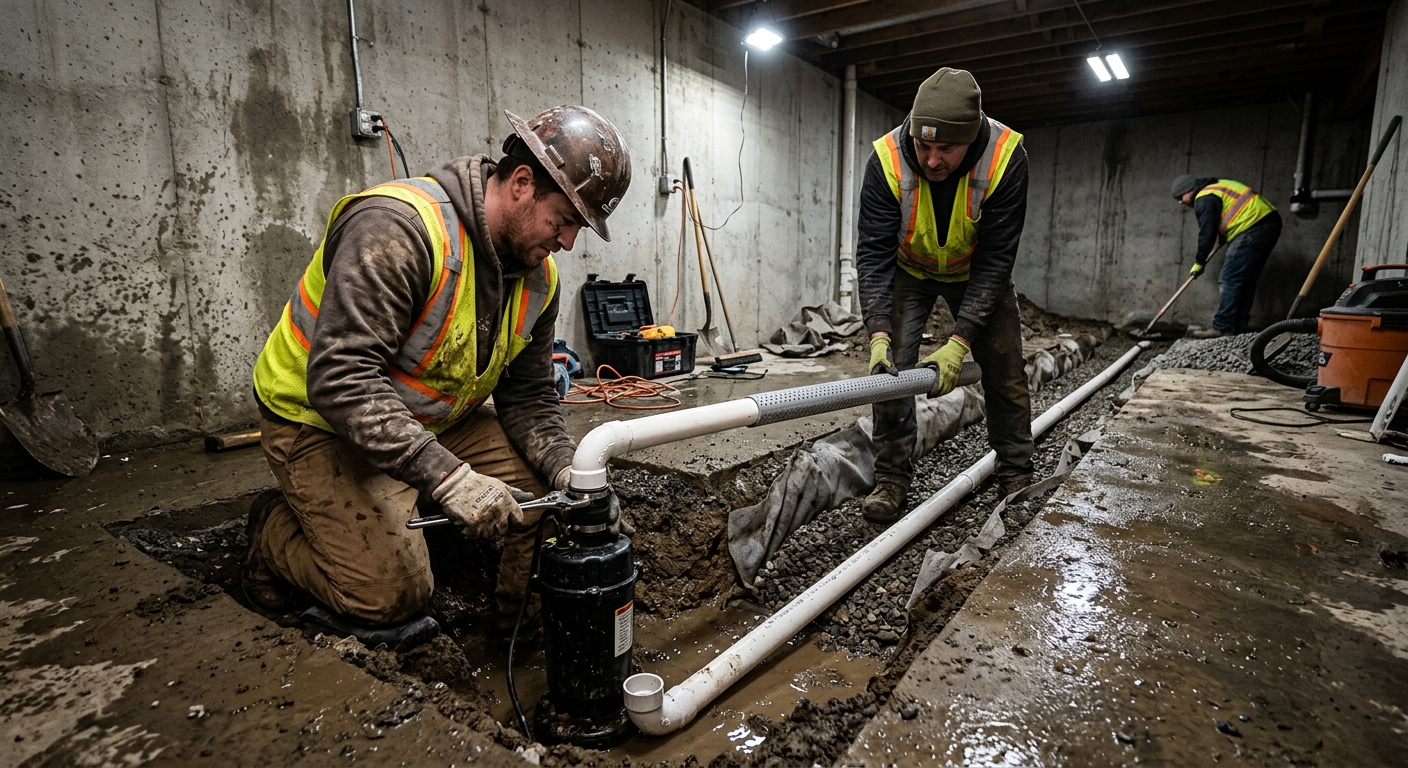
Basement waterproofing options and costs in South River
In South River, basement waterproofing is usually less about “one magic membrane” and more about fixing how water gets around (or through) the foundation. With 1,101 residents and a housing stock where 77.1% of homes were built before 1981, many basements still rely on the original damp-proofing approach of their era—often paired with weeping tile systems that have been quietly failing for years. That matters because older poured concrete and block foundations tend to develop hairline cracks and mortar gaps, and once freeze–thaw widens them, minor seepage can become active leakage.
In Ontario, especially in Northeast-style conditions, pricing is shaped by three practical realities: excavation depth and backfill space, handling water during work, and cold-weather concrete scheduling when foundation repairs are required. Contractors in this area also see more call-backs from clogged or collapsed drainage because fine-grained soils can hold water against foundation walls. If you have older weeping tile that’s backed up, exterior work typically needs more excavation and more time, while interior drainage often becomes a stop-gap or complement.
Work is particularly in demand around older residential pockets near the downtown/South River core where yards are tighter and landscaping is established—meaning exterior excavation can require deck or walkway removal and careful reinstatement. Below is a straightforward comparison of common methods and what they address, so you can line up quotes with scope instead of just price.
| Method |
What It Addresses |
Disruption Level |
Durability |
Price Range |
| Exterior excavation + new membrane + drainage tile |
Primary source of water entry by sealing the exterior wall and carrying it away before it presses inward |
High (re-excavation, backfill, landscape restoration) |
Long-term; designed to work as a full system with drainage |
$9,000–$20,000 |
| Interior perimeter drain channel + sump pit |
Manages water that enters the basement by collecting it below the slab level and pumping it out |
Medium (floor/finishes disruption near perimeter) |
High when combined with proper sealing and sump maintenance |
$4,000–$12,000 |
| Foundation crack injection (epoxy or polyurethane) |
Stabilizes cracks and stops seepage paths (epoxy for stable cracks; polyurethane for active leaks) |
Low (targeted repair with surface preparation) |
Good for correct crack type selection; depends on drainage and crack movement |
$400–$1,200 |
| Sump pump installation (primary + battery backup) |
Controls hydrostatic water levels during spring melt and heavy rain |
Low to medium (pit cut-in, discharge line work) |
Very good protection when backup is included and discharge is correctly routed |
$900–$3,000 |
| Window well drain installation |
Stops water accumulation at egress areas that can oversaturate basement walls and window surrounds |
Low to medium (local excavation around window well) |
Good; lifespan depends on correct grading and outlet protection |
$1,000–$4,000 |
| Lot re-grading / downspout extension |
Redirects surface water away from the foundation to reduce load on drainage systems |
Low (yard work; minimal basement disruption) |
Moderate; must be maintained and paired with failed drainage corrections |
$2,000–$6,000 |
Prices are estimates only and vary by project scope, site access and material selection.
What affects the price of waterproofing in South River
In South River and across the broader Northeast/Ontario market, you can see quotes for the “same” basement issue vary by 30–50% because contractors price the underlying water pathway differently. Two basements that both have damp corners can require very different work if one has active seepage from cracked walls while the other is mostly surface-water overload. The scope also changes when drainage routing, discharge locations, and excavation constraints are accounted for—items that are often missing from rough, phone-style estimates.
The three strongest cost drivers that separate Northeast-style pricing from a national average are soil type, water table behaviour, and freeze–thaw cycling. Clay-heavy or fine-grained soils can hold water and press laterally against foundation walls as saturation increases; during winter freeze–thaw, that pressure can widen cracks and force seepage into mortar joints. High seasonal water loads increase sump run times and can mean upgraded drainage and backup pump components. In homes with older housing stock (and many in South River were built before 1981), failing weeping tile and aging damp-proofing are common, so the job may shift from “seal a spot” to a perimeter drainage retrofit.
Concrete examples from what we see locally: if downspouts discharge near the footing or grading has settled, exterior excavation often needs more rework—pushing labour toward the upper end of exterior ranges such as $9,000–$20,000. If your leakage is mostly at the perimeter and the floor is already unfinished, an interior approach can be more efficient—often landing in the $4,000–$12,000 band—without full excavation. Conversely, if there’s a structural horizontal crack in block, crack repair may be only part of the scope, and you’ll also need a drainage plan to avoid repeat movement.
| Price Factor |
Why It Matters |
Cost Impact |
| Interior vs. exterior approach — interior is less disruptive but addresses symptoms |
Exterior addresses water before it presses the wall; interior controls water after entry |
Interior often reduces disruption and cost versus full excavation; exterior can cost far more but is the source-level fix |
| Foundation type — poured concrete vs. block vs. stone vs. ICF |
Materials respond differently to cracking, injection, and membrane adhesion |
Block and stone often require more detailed drainage + crack strategy; ICF may need different sealing products |
| Soil type — clay expands more than sand, adding pressure |
Saturated fine-grained soils can swell and increase lateral pressure on walls |
More pressure typically means stronger drainage design and higher likelihood of repeat failures if not addressed |
| Crack type and length — hairline vs. structural horizontal cracks |
Not all cracks are the same; structural movement can keep reopening seals |
Structural cracks may require engineer involvement and additional stabilization, increasing cost |
| Sump pump backup system — battery or water-powered backup needed |
Spring flooding and power interruptions can leave basements vulnerable |
Backup adds cost but prevents loss of stored water during outages |
| Access — landscaping, decks, or driveways must be removed for exterior |
Excavation and reinstatement drive labour time and material replacement |
Tighter sites push pricing toward the upper exterior band due to extra removal/restoration |
| Weeping tile age — original tile (60+ years) may be completely failed |
Collapsed/clogged drainage can force larger excavation and re-routing |
If tile is beyond salvage, scope expands to new tile and drainage outlet work |
| Mould or efflorescence remediation required before sealing |
Moisture and salts must be addressed for coatings and sealants to bond properly |
Remediation adds steps and time; sealing over active salts can shorten system life |
Permits & regulations in Ontario
In Ontario, basement waterproofing projects can fall under permit requirements depending on what you’re changing. Foundation excavation, structural crack repair (especially when it involves horizontal/major cracks that could indicate movement), and changes to lot drainage or discharge often require a building permit. If your sump pump discharge connects to storm or sanitary systems, municipal approval is typically required before the tie-in—don’t assume it’s “standard” plumbing work.
For structural crack repair, an engineer’s assessment is often needed for horizontal cracks in block walls or step-like cracking that suggests structural movement. A good contractor will be able to coordinate engineering support and confirm whether underpinning, localized reinforcement, or additional stabilization is required.
To verify an Ontario contractor in South River, follow a simple checklist: (1) confirm their trades/contractor registration where applicable through relevant provincial/authorized registries used in Ontario (and confirm they list the correct business name); (2) request a Certificate of Insurance showing general liability—make sure the coverage limits are current and match the scope (excavation, pumping, and concrete work); (3) request WSIB/WCB clearance (or valid exemption documentation if applicable), then verify the clearance is not expired; and (4) for structural work, ask how engineering support is handled and whether it’s included in the quoted scope or provided separately.
Interior vs exterior waterproofing — what does South River need?
The key difference is source-level protection versus after-the-fact water management. Exterior waterproofing involves full excavation to expose the foundation wall, then installing a membrane system and new drainage tile so water is collected and carried away before it builds hydrostatic pressure. That’s the more permanent approach, but it costs more and disrupts the yard because you must reopen backfill and reinstate landscaping.
Interior waterproofing typically uses a perimeter drain channel around the basement floor edge and a sump pit to collect water that enters through cracks and joints. This approach is less invasive and can be completed without full exterior excavation, but it doesn’t stop water pressure from acting on the wall itself. In South River’s older housing stock (with 77.1% built before 1981), we often see this as a practical complement: crack injection can address specific seepage paths, while interior drainage controls the remainder so moisture doesn’t accumulate.
How this plays out by foundation type: poured concrete walls usually respond well when paired with correct crack injection (especially for stable, non-moving cracks). Block foundations often benefit from interior drainage because mortar voids and joint seepage are harder to fully “lock down” from one side. For sump pumps, backup matters in Ontario—spring snowmelt and heavy rain can coincide with power outages, and backup reduces the risk of sump failure when a basement is already stressed.
Price justification example: if exterior excavation is $9,000–$20,000 but you only have damp staining from seasonal surface-water splash, a targeted interior plan at $4,000–$12,000 (plus grading/downspout corrections) may be the better value. However, if water is consistently entering from active exterior wall pressure, exterior work is usually the cost-effective long-term solution even though it’s disruptive.
| Method |
Best For |
Addresses Source? |
Disruption |
Lifespan |
Price Band |
| Full exterior excavation + membrane |
Ongoing seepage driven by hydrostatic pressure; exterior drainage failure; consistent wetting along multiple wall areas |
Yes |
High |
Long (system is designed to control water before it enters) |
$9,000–$20,000 |
| Interior French drain + sump system |
When access limits exterior excavation; perimeter leaks are the main issue; unfinished basement floors allow cleaner installs |
No (manages water after entry) |
Medium |
High with good discharge routing and pump maintenance |
$4,000–$12,000 |
| Crack injection — epoxy (structural) |
Stable cracks in poured concrete where movement is minimal |
Yes (stops seepage path through that crack) |
Low |
Good where crack movement is not ongoing |
$400–$1,200 |
| Crack injection — polyurethane (active leak) |
Active seepage through cracks, especially where water is still moving |
Yes (stops active leak path) |
Low |
Good for active leaks; still benefits from drainage improvements |
$500–$1,500 |
| Interior drain channel only (no sump) |
Light dampness or localized water where a sump isn’t practical; typically complemented with grading |
No |
Medium to low (depends on floor work) |
Moderate (relies on gravity discharge/low loads) |
$3,000–$8,000 |
| Re-grading + downspout extensions |
Surface-water issues that overwhelm gutters/soft spots near the foundation |
Indirectly (reduces water load) |
Low |
Moderate; best when drainage systems are functioning |
$2,000–$6,000 |
How to choose a waterproofing contractor in South River
Start by verifying your contractor properly—Ontario basement waterproofing isn’t just about “getting it dry,” it’s about doing it in a way that won’t fail during the next spring melt. Ask for proof of general liability insurance and confirm the certificate matches the legal name on the estimate and covers excavation, concrete work, and drainage installation. Then request WSIB/WCB clearance (or valid documentation if exempt). If the contractor claims they handle permit/engineering steps, ask for evidence of that capacity before work begins.
Get 2–3 itemised written quotes (not lump sums). The best quotes separate labour and materials and list what’s included: excavation depth, membrane type, drainage tile size, filter fabric, discharge routing, disposal, and reinstatement. Confirm whether a permit is included in the price (or explicitly excluded) and whether the contractor is responsible for restoring landscaping/decks/driveways back to pre-work condition. For warranty, look for a clear workmanship warranty length and who provides it; confirm the product/manufacturer warranty terms and whether it transfers if you sell the home.
On payment, never pay more than about 10–15% upfront. Hold back the remainder until the job is complete and you’ve received documentation (pump specifications, discharge details, and warranty paperwork). Finally, get a written start date and completion timeline so you can plan around excavation and curing—especially important in Ontario when cold nights can affect concrete and coatings.
- Ask for WSIB/WCB clearance and check the expiry date
- Require a current Certificate of Insurance with liability coverage limits
- Get proof of experience with basements like yours (poured vs. block; older pre-1981 homes)
- Request a written scope that lists excavation limits, drainage routing, and discharge outlet
- Confirm whether permit applications are included or your responsibility
- Require itemised labour/materials breakdown (membrane, tile, gravel, fabric, pump model)
- Verify disposal and backfill material selection are included
- Ask about cold-weather procedures for concrete/surface prep
- Check warranty: workmanship duration + manufacturer terms + transferability
- Clarify sump pump backup availability and what’s included (battery type, integration)
- Set a payment schedule with a holdback until final walk-through
- Get start/completion dates in writing and what happens if weather delays work
Red flags in South River include: (1) quotes that don’t explain where water is coming from (no inspection/water pattern documentation); (2) “we’ll waterproof it” promises without specifying membrane, drainage tile, and discharge routing; (3) no clear warranty terms in writing; (4) vague exclusions like “floor patching not included” without a defined allowance; and (5) asking for large upfront payments beyond 10–15% without a contract schedule.
Frequently asked questions — waterproofing in South River
How do I compare waterproofing quotes?
To compare waterproofing quotes in South River, match the scope line-by-line instead of comparing one total number. Ask each contractor to list the method (exterior excavation + membrane versus interior perimeter drain + sump), the drainage components (tile size, gravel wrap/filter fabric), and the discharge route. Confirm whether a permit is included for excavation and drainage changes, and whether disposal/restoration (backfill, landscaping reinstatement, patching) is covered. If one quote includes a sump pump backup system and another doesn’t, the “cheaper” option can cost more later during outages. As a pricing anchor, exterior solutions are commonly quoted around $9,000–$20,000, while interior perimeter drainage often sits around $4,000–$12,000, depending on access and whether the foundation needs crack strategy work.
How long does basement waterproofing take in South River?
Timelines in Ontario can vary, but a typical basement waterproofing project in South River often follows a few predictable steps: inspection/testing and scope confirmation first, then demolition/excavation, installation (membrane, drainage tile, or interior drains), followed by backfill and curing/finishing. Interior perimeter drain installs are often quicker than full excavation because they avoid reopening the yard—many are completed in stages within about 3–7 working days, depending on how much floor finishes need removal and whether a sump pit and discharge piping are required. Full exterior excavation projects commonly take longer because excavation, membrane work, drainage tie-ins, and backfill stabilization take time; weather can extend schedules when temperatures drop at night. Contractors should provide a written completion estimate and outline weather delay procedures.
What is a weeping tile and does my South River home have one?
A weeping tile is a drainage system installed around (or sometimes at the base of) the foundation to collect groundwater and direct it to an outlet—often leading to a sump or gravity discharge. In older South River homes, especially those built before 1981, weeping tile may be present but commonly fails due to collapse, clogging, or disconnected sections after decades of freeze–thaw. You can’t reliably identify it just by looking at the basement corners; it usually requires inspection through weep holes (if accessible), examination of existing sumps/pipe runs, or camera/locating work when feasible. If you see ongoing efflorescence, musty odours, or frequent corner seepage during spring melt, the original weeping tile may be ineffective even if it was originally installed.
Can I waterproof my basement in winter in South River?
It depends on the method and the conditions. In Ontario winter, exterior excavation is often delayed because soil is frozen and excavation depth becomes more difficult and expensive—plus backfill and membrane performance require controlled conditions. Interior work can sometimes proceed earlier because it’s less dependent on outdoor ground thawing, but cold temperatures still matter for surface prep, sealant cure times, and any concrete patching. A good contractor will use cold-weather procedures and confirm the temperature range needed for the products being installed. If you have active leaks in winter, interior drainage and crack sealing may be the faster “stabilize first” approach, while full exterior work may wait for spring. Expect scheduling choices based on labour availability and curing constraints.
What is the difference between waterproofing and damp-proofing?
In Ontario practice, damp-proofing is meant to resist minor moisture and humidity—think of it as a barrier against light, non-pressurized seepage. Waterproofing is designed to stop or manage water entry under higher loads, including hydrostatic pressure when soils saturate in spring and during heavy rain. In South River homes built before 1981, older damp-proofing systems and weaker drainage performance can fail when freeze–thaw widens cracks and joints. That’s why “just sealing a spot” can miss the real problem if water is pressing the wall. The most reliable waterproofing approach typically includes a drainage pathway (new membrane + drainage tile or an interior perimeter drain and sump) plus targeted crack treatment. The right solution depends on whether you’re dealing with dampness only or active water movement.
Will basement waterproofing affect my property value in South River?
Yes—usually positively—because buyers in South River (and across Ontario) strongly value dry, stable basements, especially when there’s a history of seepage, odours, or mold risk. Waterproofing doesn’t just improve comfort; it reduces recurring repair uncertainty and protects finishes and mechanical systems. If your project uses a clear scope (drainage routing, sump pump strategy, crack repair where needed) and you can document warranties and workmanship, that paperwork can support resale conversations. The impact is strongest when the work addresses the source-level issue (often exterior drainage and membrane) or provides reliable hydrostatic control (interior perimeter drains plus sump and proper discharge). Cost matters too: homeowners weighing $9,000–$20,000 versus $4,000–$12,000 should choose based on water pathway, not just budget, because the best ROI comes from fixing why water is entering in the first place.