Basement waterproofing options and costs in Aylmer
Aylmer, Ontario has a lot of basements where water problems are tied to the way local ground holds moisture. In the London economic region, many neighbourhoods sit over clay-rich, poorly draining soils; that combination, plus freeze-thaw, pushes foundation walls through repeated wet-and-dry cycles. It’s one reason homes built before 1981 are so often the ones we see first for remedial waterproofing, because earlier systems—original tar-and-paper approaches and weeping tile installations—are more likely to be corroded, partially blocked, or outright failed. With 7,699 people in the community and 2,105 homeowner households (Statistics Canada, 2021 Census), demand is steady: many owners want basement comfort before finishing lower levels, and landlords are also protecting rental basements.
Cost in Aylmer tends to be shaped by two job realities: excavation complexity and water management needs. When seepage paths are driven by hydrostatic pressure, exterior work (membrane plus new drainage tile) costs more because it requires deeper excavation, staging, and proper backfill. When access is tight or you’re trying to limit yard disruption—common in older, established pockets such as central Aylmer near residential streets—interior perimeter drainage is often the practical first step. London-area contractors also price differently based on labour availability in peak spring and after major rain events, when crews get booked quickly.
Below is a clear comparison of common methods and realistic price bands, so you can align quotes before you schedule site assessment.
| Method |
What It Addresses |
Disruption Level |
Durability |
Price Range |
| Exterior excavation + new membrane + drainage tile |
Source water entry; reduces hydrostatic pressure at the foundation wall |
High (excavation along wall, landscaping/restoration) |
Long-term when drainage is installed correctly |
$12,000–$25,000 |
| Interior perimeter drain channel + sump pit |
Controls seepage that has entered; keeps floor perimeter dry |
Medium (cutting at foundation line; typically no full yard excavation) |
High with proper sump/backup and discharge setup |
$8,000–$18,000 |
| Foundation crack injection (epoxy or polyurethane) |
Stops water through specific cracks and stabilizes suitable structural cracks |
Low to medium (surface prep; limited concrete demolition) |
Variable by crack type and whether pressure is ongoing |
$600–$2,500 |
| Sump pump installation (primary + battery backup) |
Manages collected water during high water table periods and outages |
Low to medium (excavate sump pit; electrical connections) |
High with backup + routine maintenance |
$1,500–$3,500 |
| Window well drain installation |
Water entry at basement windows; prevents pooling and localized seepage |
Low to medium (dig around window wells; reconfigure materials) |
Good for targeted leaks when grading/discharge are correct |
$2,000–$4,800 |
| Lot re-grading / downspout extension |
Moves roof runoff away from the foundation to reduce saturation |
Low (surface work; restoring grass/turf) |
Moderate (best as a supporting measure) |
$3,000–$7,200 |
Prices are estimates only and vary by project scope, site access and material selection.
What affects the price of waterproofing in Aylmer
In Aylmer and the wider London region, it’s common to see quotes for the same “basement leaking” complaint land 30–50% apart. The gap usually comes down to whether the contractor is addressing the real source of water entry and pressure, or only treating symptoms you can see—plus how much excavation and wall preparation is required. Even with similar methods, details like the length of wall treated, discharge routing, and whether drains are already blocked can change labour and material demand fast.
Three local drivers separate regional costs from the national average: soil type, water table, and freeze-thaw. Clay-heavy soils common across much of Ontario expand during freeze-thaw and can exert lateral pressure on foundations, worsening cracking over time; by the time you see wet walls, cracks may have changed. When the water table is high near rivers/low-lying areas, sump systems may run more often and need higher-capacity components, alarms, or discharge upgrades. Freeze-thaw also widens small foundation cracks as moisture trapped in concrete expands when it freezes, which can turn a “hairline leak” into a recurrent one unless cracks are treated correctly. In older housing stock—58.2% of homes built before 1981 (Statistics Canada, 2021 Census)—failed weeping tile is a recurring root cause.
Concrete examples: in Aylmer, a block foundation with active seepage at multiple joints often costs more than a single crack injection because it usually needs interior perimeter drainage plus sealing. A basement with a higher perimeter wall length (e.g., extended walls) typically pushes exterior membrane and drainage into the upper end of the $12,000–$25,000 band. Meanwhile, targeted crack injection plus localized drainage repairs can stay closer to the $600–$2,500 crack-repair range, but only when hydrostatic pressure is controlled.
| Price Factor |
Why It Matters |
Cost Impact |
| Interior vs. exterior approach — interior is less disruptive but addresses symptoms |
Exterior manages water at the source; interior manages water after it enters |
Interior often saves on excavation, but may require ongoing sump capacity |
| Foundation type — poured concrete vs. block vs. stone vs. ICF |
Different walls respond differently to sealing and crack repair |
Poured concrete cracks may respond well to injection; block joints often need drainage complement |
| Soil type — clay expands more than sand, adding pressure |
Clay’s moisture cycles increase wall stress and seepage likelihood |
Higher risk means more robust waterproofing scope |
| Crack type and length — hairline vs. structural horizontal cracks |
Active leaks and movement require different products and more investigation |
Structural repairs can add engineer-led steps and costs |
| Sump pump backup system — battery or water-powered backup needed |
Backup protects against outage during spring wet periods |
Often adds a few thousand dollars but reduces failure risk materially |
| Access — landscaping, decks, or driveways must be removed for exterior |
Excavation time and restoration are labour-heavy in established lots |
Can move exterior projects toward the top of the regional range |
| Weeping tile age — original tile (60+ years) may be completely failed |
Failed drains can force water to find new paths |
Often requires full drainage replacement rather than a partial fix |
| Mould or efflorescence remediation required before sealing |
Moisture-damaged materials must be stabilized to ensure coatings and sealants bond |
Adds prep steps; improves long-term success of sealing |
Permits & regulations in Ontario
In Ontario, waterproofing can trigger permits depending on what you change. In many Aylmer basement projects, foundation excavation, structural crack repair, and changes to lot drainage commonly require a building permit because they involve either structural components or alterations that affect how water is managed off the foundation. If your sump pump discharges into municipal storm or sanitary systems, approvals are typically required—your contractor should clarify the discharge route and whether any municipal review is needed before they connect anything. For structural cracks (especially horizontal cracks in block walls or signs of movement), a structural engineer’s assessment is often required to confirm whether underpinning or additional structural work is necessary.
What often does not require a permit is limited interior work that doesn’t alter structure—such as installing an interior drain channel with a sump pit where it’s treated as remedial waterproofing, crack injection where no structural changes are proposed, or window well drain adjustments that don’t modify foundation drainage patterns beyond normal site practices. That said, scope details matter; a responsible contractor should tell you what needs a permit before starting.
How to verify a contractor in Aylmer: (1) Ask for their Ontario licence number and confirm they’re properly registered for the work they’re selling; (2) Request a current certificate of insurance (liability) naming you as certificate holder if applicable; (3) Confirm they carry WSIB coverage (or explain their exemption status in writing). For structural repair, (4) ask for proof of engineering support (engineer letter/report) and confirm they carry liability insurance that covers their work; (5) get everything documented before the first day—scope, permit responsibility, and disposal of excavated materials.
Interior vs exterior waterproofing — what does Aylmer need?
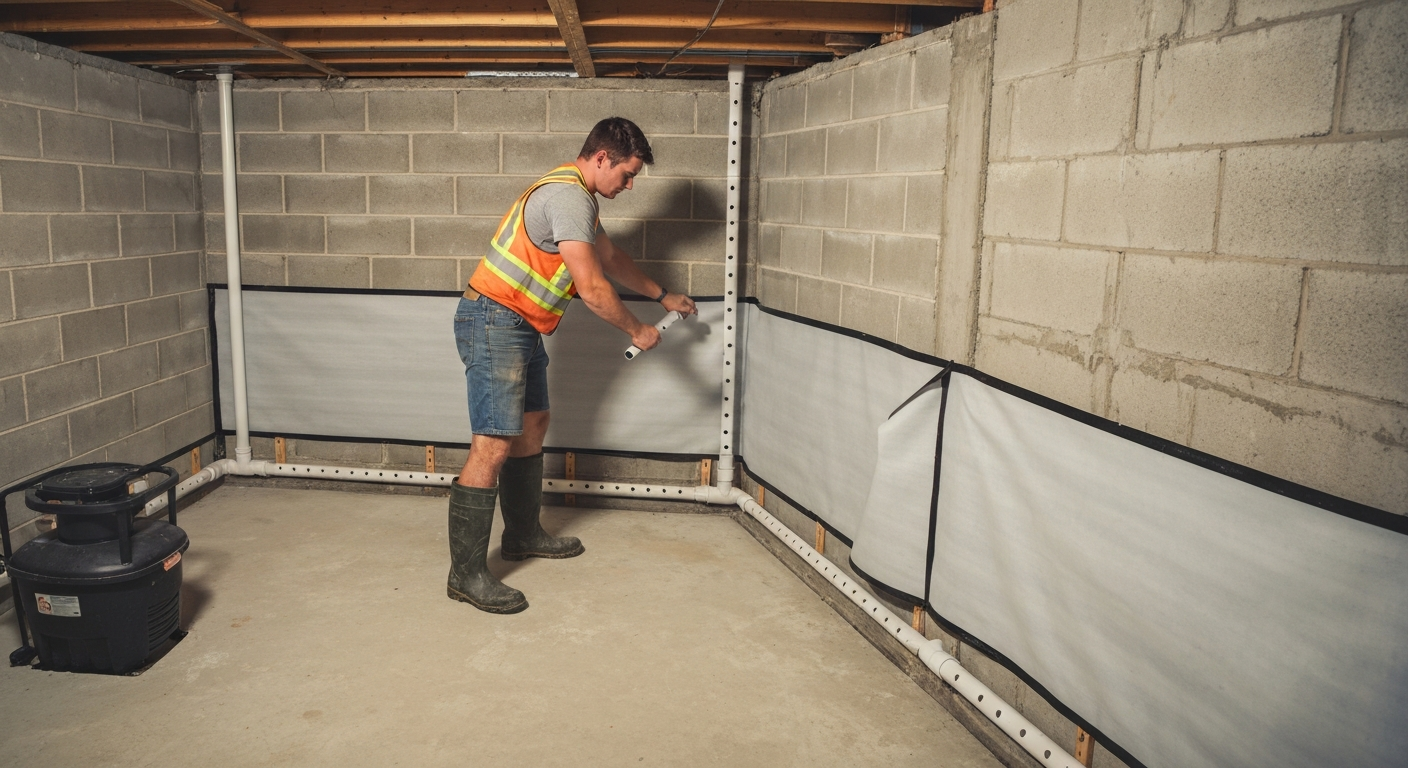
The fundamental difference is how each approach treats water. Exterior waterproofing—full excavation along the foundation, new membrane, new drainage tile, and properly engineered backfill—targets the source of water entry and helps manage hydrostatic pressure before it reaches the wall. It usually costs more in Aylmer because excavation depth, equipment access, and restoration are substantial, and established landscaping may need to be removed and rebuilt. Interior waterproofing—perimeter drain channel, sump pit, and sump pump—controls water that already entered the basement. It’s less invasive and often cheaper, but it doesn’t stop pressure from building against the foundation wall itself.
In Aylmer’s climate and soil conditions, the “right” choice depends on where and how water is coming in. For poured concrete walls with discrete leakage points, crack injection can be effective—especially when paired with interior perimeter drainage—because the concrete can respond well to properly selected injection materials. For block foundations, leaks often occur along mortar joints and through multiple joints; in those cases, interior drainage (often with a sump) is frequently the practical complement, even if exterior drainage upgrades are also considered. Because spring melt and rain can raise water tables quickly, sump pump backup systems matter in Ontario: a primary pump alone can still leave you exposed during a power outage or jam event.
A dollar example: if a contractor is recommending interior perimeter drainage at the $8,000–$18,000 range but your walls show widespread seepage tied to a failed weeping tile system and high lateral pressure, exterior waterproofing can justify the $12,000–$25,000 investment because it reduces the driving force instead of only collecting runoff inside. If your issue is localized window well pooling, the cheaper combination of targeted window well drainage plus downspout extensions can be a better value than full exterior work.
| Method |
Best For |
Addresses Source? |
Disruption |
Lifespan |
Price Band |
| Full exterior excavation + membrane |
Frequent seepage, high water table indicators, failed drainage around perimeter |
Yes |
High (excavation and yard restoration) |
Long-term when drainage and backfill are correct |
$12,000–$25,000 |
| Interior French drain + sump system |
Basements with signs of seepage after heavy rain/snowmelt; limited yard access |
No (manages after entry) |
Medium (cutting at perimeter) |
High with proper sump, discharge, and backup |
$8,000–$18,000 |
| Crack injection — epoxy (structural) |
Non-active or stable cracks where structural bonding is needed |
Partially (through-crack path sealing) |
Low to medium |
Good for suitable crack conditions |
$600–$2,500 |
| Crack injection — polyurethane (active leak) |
Active water flow through cracks/joints |
Partially (targets active leak paths) |
Low to medium |
Good when crack activity matches product choice |
$800–$2,900 |
| Interior drain channel only (no sump) |
Light dampness, minor localized seepage where pump collection isn’t needed |
No |
Medium |
Limited if water table rises high enough to overwhelm collection |
$6,000–$12,000 |
| Re-grading + downspout extensions |
Surface water management and roof runoff control |
No (supportive) |
Low |
Moderate; best as a companion measure |
$3,000–$7,200 |
How to choose a waterproofing contractor in Aylmer
Start by verifying Ontario coverage and legitimacy in a practical way. Ask each contractor for (1) proof of applicable Ontario registration/licensing for the scope they’re proposing; (2) a current liability insurance certificate (and confirm the policy is active for the job dates); and (3) proof of WSIB coverage. If they claim exemption, ask for the exemption documentation in writing. You can also request a clearance letter and verify coverage details match your address and the scope. For projects involving structural crack repair, ensure they can provide engineering support (report/letter) rather than “estimating” structural stability.
Next, get 2–3 itemised written quotes, not a single lump sum. A good quote breaks labour and materials (excavation/disposal, membrane/drain tile, interior drain channel, sump pit/piping, electrical and backup, and restoration). Read the exclusions line-by-line: does the price include permit support (if needed), disposal of soils, saw-cutting, concrete patching, and restoration of sod/interlock? Confirm warranty terms: you want clear workmanship warranty length (often multi-year), product/manufacturer warranty coverage, and whether warranties transfer if you sell your home.
On payment, never approve large deposits beyond about 10–15% upfront. Hold back a portion until the job is complete, tested, and cleaned up. Finally, insist on a written timeline with a realistic start date and completion estimate—waterproofing often depends on dry-weather scheduling in Aylmer’s spring conditions.
- Ask for a written site plan showing what will be excavated/installed and where discharge will go.
- Confirm the quote includes disposal of excavated soil (not “by customer”).
- Ensure sump discharge routing is explained (where it exits and how it prevents backflow).
- Request the specific membrane/drain tile system names and product data sheets.
- Verify interior drain details: pipe size, slope, and filter fabric/gravel specification.
- Make sure backup plan is explicit: battery backup vs water-powered backup.
- Ask how they test flow (e.g., hose test after perimeter drainage is installed).
- Confirm restoration scope: grading, topsoil, sod, and any deck/steps removal/rebuild rules.
- Check whether they include concrete reinstatement and crack repair materials.
- Ensure warranty terms are written and include workmanship + product coverage details.
- Use an itemised quote template and compare like-for-like methods.
- Do not sign until permit responsibility (if any) is clearly assigned in writing.
In Aylmer, watch for red flags like: vague scope (“seal basement” with no method details), no named discharge plan for sump water, quotes that recommend interior drainage only despite widespread exterior evidence (e.g., roof runoff and failing perimeter drainage), payment schedules requesting large upfront deposits beyond 10–15%, and warranties that are only verbal or exclude key workmanship items.
Frequently asked questions — waterproofing in Aylmer
Can I waterproof my basement from the inside only?
Yes, many homeowners in Aylmer do interior-only waterproofing, especially when yard access is tight or excavation would be too disruptive. Interior solutions typically include a perimeter drain channel, a sump pit, and a sump pump (often with backup). This manages water after it enters, which is important when your foundation is already absorbing moisture through cracks or joints. That said, if your issue is largely hydrostatic pressure from a failed exterior drainage system, interior-only work may not fully stop wall movement and can become a “collection” solution rather than a source-control fix. For example, a sump-related interior program often falls in the $8,000–$18,000 band, while adding battery backup increases protection during spring wet periods. If your home was built before 1981, it’s especially worth investigating whether weeping tile has failed (Statistics Canada, 2021 Census).
What causes foundation cracks in Aylmer?
In Aylmer, foundation cracks usually come from a combination of soil movement and moisture cycling. Clay-rich, poorly draining soils can hold water, then shrink as the soil dries and swell again when it’s wet—pushing and releasing pressure against foundation walls. Ontario’s freeze-thaw cycles then worsen this: trapped moisture expands when it freezes, which can widen small cracks over time. If older weeping tile systems are clogged or collapsed, water can concentrate alongside the foundation, raising seepage pressure during heavy rain or rapid snowmelt. Homes built before 1981 are commonly affected because earlier drainage and waterproofing details were less robust. A smaller, hairline crack may respond well to targeted crack repair, often in the $600–$2,500 range, but horizontal/structural crack patterns may require an engineer assessment before sealing or injection.
How do I compare waterproofing quotes?
Compare quotes like you’d compare appliance specs: method, scope, components, and responsibilities. Ask each contractor to itemize labour and materials rather than using a one-line lump sum. Look for specifics such as whether they’re proposing exterior excavation with membrane and drainage tile (often $12,000–$25,000) or interior perimeter drainage with sump (often $8,000–$18,000). Confirm what’s included for disposal, restoration, and discharge routing. Also check whether a permit is required for the proposed work and whether the contractor will support the permit process where needed. Pay attention to warranty language (workmanship and product), and whether the quote includes backup sump protection. A good comparison will show you what problem each scope intends to solve—source of water entry versus after-entry management—so you don’t end up paying twice for mismatched repairs.
How long does basement waterproofing take in Aylmer?
Timing in Aylmer depends on method and weather. Interior perimeter drain work can often be staged in a matter of days to a week or more, since it involves cutting and installing at the foundation line, forming a sump pit, running discharge piping, and then patching. Exterior excavation tends to take longer because it requires excavation along the foundation, installation of membrane and drainage tile, backfilling, and then restoring landscaping—often extending timelines due to inspection and drying/settling time. Spring schedules can be busier because wet conditions and rapid snowmelt trigger urgent leak calls. Ask for a written start date, completion estimate, and whether the contractor includes curing/restoration time in that estimate. If your project involves structural crack evaluation or engineering documentation, add time for the assessment and any required decisions before work begins.
What is a weeping tile and does my Aylmer home have one?
Weeping tile is a perimeter drain system installed around or near the foundation, designed to collect groundwater and direct it to a discharge point (often historically to a sump, or sometimes to a gravity outlet). In older Ontario homes—many built before 1981—it’s common to have a form of weeping tile, but it may be clay tile that can crack, become clogged with sediment, or fail where connections were never properly maintained. Whether your Aylmer home has it depends on the original construction era and what renovations were done since. A professional waterproofing inspection can often identify clues in the basement (existing sumps, older drain lines), around the perimeter (signs of drain access), or during excavation when exterior drainage replacement is performed. If the weeping tile has failed, interior-only measures may still help, but you’re more likely to need sump pump capacity and, in some cases, updated drainage improvements for longer-term results.
Can I waterproof my basement in winter in Aylmer?
Sometimes, but it’s not ideal in most Aylmer basements. Winter conditions can limit excavation depth, and frozen soils make it harder to install exterior drainage tile and proper backfill. Interior work is more feasible because it’s less dependent on ground conditions, and crack injection can be done when the interior is dry enough for proper prep and curing. That said, you should be cautious about sealing over damp or active moisture—freeze-thaw can reactivate leaks. The best approach is usually to address source conditions when conditions allow (often late fall to early spring depends on access, but many crews prefer dry stretches). If you’re dealing with active seepage now, a contractor may recommend interior perimeter drainage and a sump setup first. As a reference point, sump pump installations (including backup) often sit in the $1,500–$3,500 range, but a full interior perimeter system typically falls in the $8,000–$18,000 band depending on extent. For exterior strategies, ask what their winter plan includes and how they control moisture during installation.