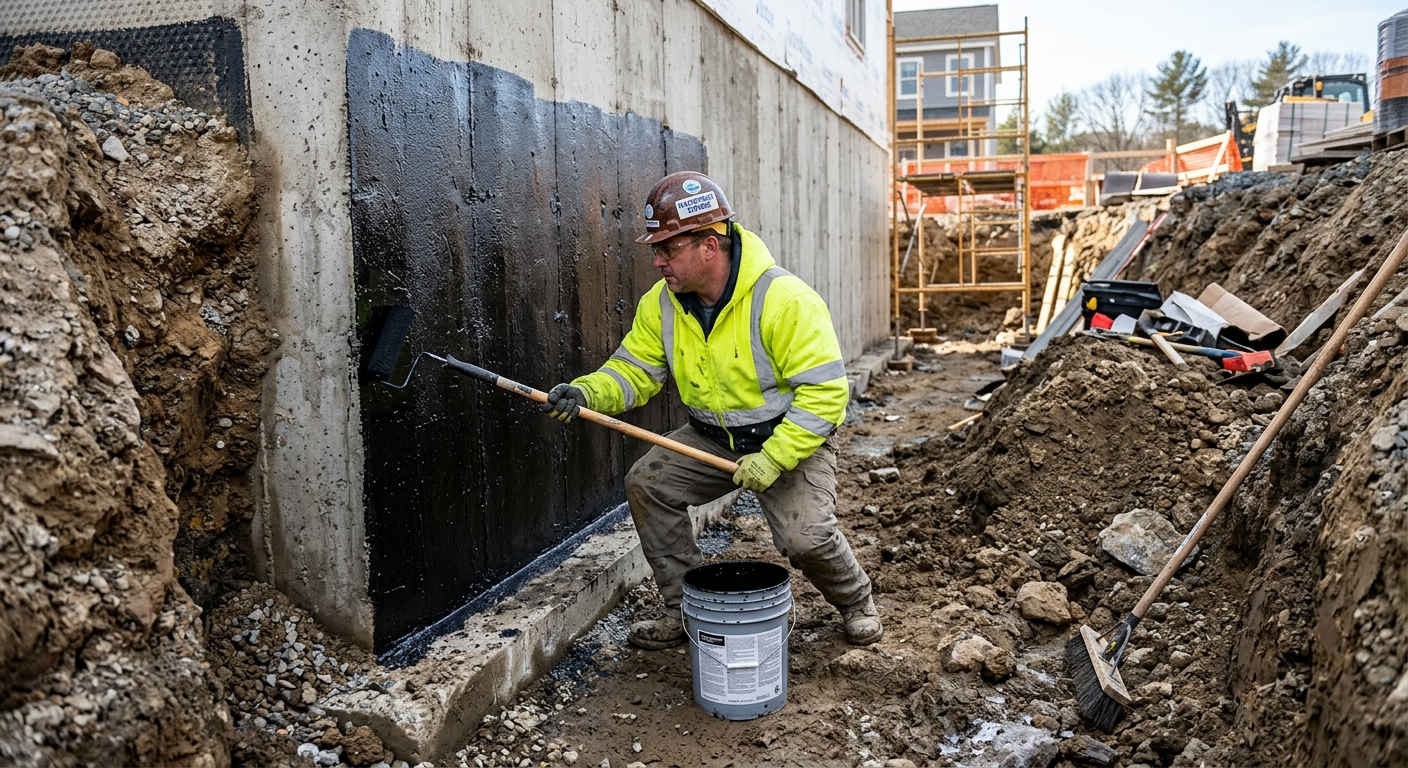
Basement waterproofing options and costs in Forest Hills
In Forest Hills, basement waterproofing decisions start with acknowledging how the local ground behaves and how that changes what contractors must do. With a population of 6,238 in the area (Statistics Canada, 2021 Census), there’s a smaller contractor pool than in the core Toronto neighbourhoods, so availability can affect scheduling and, at times, pricing. Just as important: a lot of nearby housing was built in the post-war through 1970s period, when many homes relied on earlier tar-and-paper systems and older drainage methods. When clay backfill stays saturated, those systems often fail slowly—showing dampness and efflorescence first, and then active seepage.
Toronto’s freeze–thaw cycles add another cost driver. Small defects at cold joints, tie holes, and hairline cracks can widen during repeated winter expansion, turning “seasonal damp” into “regular water.” That’s why Forest Hills waterproofing quotes often differ even for similar-looking basement walls: some projects stop water before it reaches the foundation (exterior), while others manage water after entry (interior).
In Forest Hills, exterior work is especially in demand around the busier residential edges where lots are tight and excavation must be carefully planned near decks, driveways, or additions. That’s where the “same leak” can become a higher-excavation challenge, and why homeowners see larger exterior price ranges.
Below is a practical comparison of the main waterproofing methods contractors use in the Toronto region—then we’ll break down what pushes quotes higher or lower.
| Method |
What It Addresses |
Disruption Level |
Durability |
Price Range |
| Exterior excavation + new membrane + drainage tile |
Hydrostatic pressure at the wall and water migration through soil behind the foundation |
High (excavation, landscaping repair) |
Long-term when properly detailed and backfilled |
$10,000–$25,000 |
| Interior perimeter drain channel + sump pit |
Water that enters through cracks/cold joints by collecting it before it spreads |
Medium (floor and wall cut lines) |
High with correct pump sizing and discharge routing |
$4,500–$13,000 |
| Foundation crack injection (epoxy or polyurethane) |
Isolated crack pathways (epoxy for non-moving/structural, polyurethane for active seepage) |
Low to medium (surface prep) |
Best for the right crack type and proper surface curing |
$600–$3,000 |
| Sump pump installation (primary + battery backup) |
Prevents basement flooding during sustained inflow or power interruptions |
Low to medium (pit excavation and plumbing) |
Improves reliability significantly with backup |
$1,200–$3,500 |
| Window well drain installation |
Redirects surface water away from below-grade window areas |
Low (targeted excavation and drain/gravel bed) |
Good for localized entry points |
$900–$3,000 |
| Lot re-grading / downspout extension |
Reduces direct runoff and puddling near foundation walls |
Low to medium (groundwork and downspout modifications) |
Moderate (depends on ongoing maintenance) |
$7,00–$8,000 |
Prices are estimates only and vary by project scope, site access and material selection.
What affects the price of waterproofing in Forest Hills
In Forest Hills and the broader Toronto economic region, two homeowners can get quotes that differ by 30–50% for what looks like the same basement leak. That gap usually comes down to how the contractor chooses to address water movement in clay-heavy soils, how much excavation is required, and whether the job includes upgrades that protect against power outages and recurring freeze–thaw movement.
Three drivers separate local costs from the national average: soil type, water table, and freeze–thaw. Clay-heavy soils common around Toronto and many Ontario neighbourhoods expand as they saturate and then re-freeze, increasing lateral pressure on foundation walls and worsening crack activity over time. High local water tables in many areas raise sump run times and can require better drainage routing and larger pump capacity. Meanwhile, freeze–thaw cycles widen small defects in concrete and masonry; a crack that was “hairline” in year one can become a pathway that needs more than surface patching by year three.
Cost also rises when older housing stock is involved. If original weeping tile is 60+ years old, it may be partially collapsed or completely failed, leading to interior dampness, efflorescence, and eventual flooding—shifting the scope toward interior drainage and sump systems rather than simple “cosmetic” repairs. If your basement has active seepage through cold joints or tie holes, crack injection (often polyurethane for active leaks) may be needed in addition to drainage.
For example, a localized stair-step crack might fall in the $600–$3,000 repair band, but the moment it connects to chronic seepage you’re often discussing an interior perimeter drain plus sump at roughly $4,500–$13,000. Access is another real-world lever: removing a deck, working around a tight addition, or hand-digging near shared driveways can add labour and disposal costs even when the membrane system itself is straightforward.
| Price Factor |
Why It Matters |
Cost Impact |
| Interior vs. exterior approach — interior is less disruptive but addresses symptoms |
Exterior targets the source; interior manages water after entry |
Interior often runs lower initially, but chronic conditions may require upgrades (typically +10–30% later if source isn’t addressed) |
| Foundation type — poured concrete vs. block vs. stone vs. ICF |
Different materials crack, move, and accept repairs differently |
Block and older stone often push toward interior drainage; poured concrete may respond better to correctly selected crack injection |
| Soil type — clay expands more than sand, adding pressure |
Saturated clay increases hydrostatic and lateral pressure |
More robust drainage and membrane detailing; exterior scopes typically rise |
| Crack type and length — hairline vs. structural horizontal cracks |
Active/structural movement can require engineering-level assessment |
Structural complexity can add engineer fees and potentially structural stabilization work |
| Sump pump backup system — battery or water-powered backup needed |
Power interruptions during spring melt can turn a “small leak” into flooding |
Backup adds cost, usually a noticeable uplift versus a primary pump alone |
| Access — landscaping, decks, or driveways must be removed for exterior |
Tight sites increase excavation labour and restoration |
Exterior projects can spike quickly when demolition and restoration are extensive |
| Weeping tile age — original tile (60+ years) may be completely failed |
Failed weepers drive interior moisture and require re-routing or replacement |
Interior drainage scope usually expands; exterior replacement becomes more likely |
| Mould or efflorescence remediation required before sealing |
Sealers and membranes won’t perform on contaminated surfaces |
Prepping and remediation add time and materials before waterproofing |
Permits & regulations in Ontario
In Ontario, waterproofing-related work can range from relatively straightforward repairs to projects that require municipal oversight—especially when you’re changing how water is collected, discharged, or routed. In general, foundation excavation, structural crack repair, and changes to lot drainage typically require a building permit. If you’re installing or modifying a sump system that connects to the storm or sanitary sewer, you’ll usually need municipal approval before tying into those services.
For structural crack repair—particularly horizontal cracks in block walls or major step cracks—a structural engineer’s assessment is often required to confirm whether underpinning or additional structural remediation is needed. As a homeowner, ask whether the contractor provides engineering support for structural repairs and whether they carry liability insurance and WSIB/WCB coverage (so you’re not assuming risk if someone is injured on site).
Step-by-step verification for a Forest Hills homeowner:
- Ask the contractor for their Ontario business/licence information and confirm it matches their legal entity.
- Request a current certificate of liability insurance showing limits appropriate for construction work.
- Request WSIB/WCB clearance letters or proof of coverage.
- Confirm which permits are included in the quote (and what’s excluded).
- If there’s any structural crack work, ask for the engineer involvement plan in writing.
- Get the contractor’s disposal plan for excavated material and any concrete demolition, so you’re not surprised by add-ons.
Work that typically DOES require a permit often includes exterior foundation excavation that changes drainage, tying sump discharge into municipal sewers, and structural crack repair requiring engineering guidance. Work that typically does NOT require a permit usually includes internal sump basin installation when it does not involve sewer tie-ins, targeted crack injection for non-structural leaks, and downspout extensions that do not alter grading in a way that triggers permit requirements—but always confirm with your contractor and the municipality before work begins.
Interior vs exterior waterproofing — what does Forest Hills need?
The fundamental difference is source control versus water management. Exterior waterproofing—full excavation, new membrane, re-established drainage tile, and properly compacted backfill—addresses the source of water entry by blocking and redirecting moisture before it reaches the foundation wall. It’s more expensive and disruptive, but it’s designed for long-term performance when soil moisture and lateral pressure are the drivers.
Interior waterproofing—such as a perimeter drain channel, sump pit, and sump pump—works after water enters the basement by collecting it at the foundation perimeter and discharging it away. This is typically less invasive and can be the better practical choice when excavation is difficult near decks, additions, or shared driveways. However, interior methods don’t stop hydrostatic pressure on the wall itself, which is why crack injection and interior drainage are often paired in Toronto-area basements.
In Forest Hills, foundation material matters. Poured concrete walls generally respond better to correctly chosen crack injection—epoxy for non-moving cracks and polyurethane when there’s active seepage. Block foundations often need interior drainage as a practical complement because block joints and surface mortar can allow localized moisture movement over time. For either option, sump pump backup is a smart add-on in Ontario: spring flooding and heavy melt can coincide with power interruptions, and backup systems help prevent a small inflow from becoming a basement loss.
Where is the price difference justified? If you’re seeing dampness and recurring seepage driven by failed drainage around the entire perimeter, an exterior approach can be warranted at roughly $10,000–$25,000. If your issue is localized—like one window well or a single active crack—interior-focused repairs may stay in the $600–$3,000 injection band plus targeted drainage, avoiding the high cost of excavation.
| Method |
Best For |
Addresses Source? |
Disruption |
Lifespan |
Price Band |
thead>
| Full exterior excavation + membrane |
Perimeter-wide seepage, high water pressure, older drainage tile that’s failed |
Yes |
High (excavation and restoration) |
Long-term with correct membrane detailing and backfill compaction |
$10,000–$25,000 |
| Interior French drain + sump system |
Chronic seepage when excavation is limited or when the homeowner needs a lower-disruption path first |
No (collects water after entry) |
Medium (floor and wall channel work) |
High when pump sizing, discharge routing, and bedding are correct |
$4,500–$13,000 |
| Crack injection — epoxy (structural) |
Non-moving or stabilized cracks in poured concrete where hydrostatic pressure is limited |
Partially (seals the crack pathway) |
Low (prep and injection points) |
Good for the right crack type and surface prep |
$600–$2,500 |
| Crack injection — polyurethane (active leak) |
Active seepage through cracks where water is still finding a pathway |
Partially (stops the leak pathway) |
Low to medium |
High for active leaks when the product and curing conditions are correct |
$900–$3,000 |
| Interior drain channel only (no sump) |
Minor moisture control where inflow is low and a sump is not required |
No |
Medium |
Moderate (depends on whether inflow stays low) |
$3,500–$8,500 |
| Re-grading + downspout extensions |
Surface runoff problems near the foundation, puddling, and water getting pulled toward the wall |
Yes (for surface water management) |
Low to medium |
Moderate (needs maintenance and stable grading) |
$700–$8,000 |
How to choose a waterproofing contractor in Forest Hills
Choosing the right waterproofing contractor in Forest Hills comes down to proof, process, and alignment between what’s written in the quote and how the job is actually built. Start by verifying Ontario licensing and coverage. Ask for their Ontario business licence details (or the correct provincial registration they operate under), and request a certificate of liability insurance. For workers on your property, confirm WSIB/WCB coverage by asking for clearance documentation—don’t accept verbal assurances.
Then get 2–3 itemised written quotes. You want a breakdown that separates labour from materials (membranes, drainage board, tile, sump basin, pumps, discharge piping), plus line items for excavation, disposal, and any restoration. A lump sum with vague wording is where homeowners get surprised by change orders.
Read the scope carefully and look for what’s excluded: permit pull included or not, disposal and dump fees, patching and finishing, and whether the contractor replaces landscaping/sod/stone to an agreed standard. Warranty matters too: confirm workmanship warranty length, what’s covered for product failures, whether manufacturer warranties apply to your exact system, and whether warranties are transferable if you sell your home.
Payment schedule should protect you. Never agree to paying more than 10–15% upfront; hold back a portion until key milestones are complete and the site is left clean and functional. Finally, insist on a clear timeline: start date and completion estimate in writing, with scheduling tied to weather constraints common in Ontario basements.
- Ask for Ontario licence/registration details and confirm the company name matches the quote.
- Request certificate of liability insurance (and verify it’s current).
- Provide WSIB/WCB proof/clearance documentation for workers.
- Get 2–3 itemised quotes with labour/material line items (not lump sums).
- Confirm whether permits are included and who submits them.
- Confirm sump discharge routing (and whether any sewer tie-ins need approval).
- Verify excavation scope limits (how far, how deep, and what areas are restored).
- Ask what disposal is included (excavated soil/concrete) and where it goes.
- Require a written waterproofing plan: membrane system, drainage tile, and backfill compaction approach.
- Check warranty: workmanship duration, product/manufacturer warranty, and transferability.
- Confirm pump specs (CFM/head rating) and whether battery backup is included for outages.
- Set a payment schedule with minimal upfront payment and final holdback until completion.
In Forest Hills, I consider these red flags: (1) contractors who refuse to itemise scope or won’t show you the materials list, (2) promises like “we’ll stop all water” without addressing soil pressure or drainage, (3) skipping sump discharge details (especially where tie-in approvals may be needed), (4) no stated permit responsibility for excavation or drainage changes, and (5) warranty language that’s mostly sales-focused and doesn’t specify workmanship coverage clearly.
Frequently asked questions — waterproofing in Forest Hills
What is a battery backup sump pump and do I need one in Forest Hills?
A battery backup sump pump adds power coverage when the main electrical circuit is interrupted. In Forest Hills and across Ontario, that matters because spring melt and heavy rain can create sustained inflow, and the same weather systems that raise basement water can also lead to short outages. A primary pump moves water during normal operation; the battery backup takes over long enough to prevent overflow while power is restored.
You don’t always “need” it for every minor dampness issue, but if you’ve ever had water pooling after a power interruption—or you’re installing a new sump anyway—it’s one of the most cost-effective upgrades for risk reduction. In our local pricing, a sump pump upgrade with backup commonly sits around $1,200–$3,500 depending on basin size and discharge requirements. For chronic seepage, I usually recommend backup as part of a complete interior drainage plan.
How much does basement waterproofing cost in Forest Hills?
Basement waterproofing costs in Forest Hills depend on whether your contractor addresses the water source (often exterior excavation) or manages water after entry (interior drainage). For a full exterior excavation with membrane and drainage tile, homeowners commonly see ranges roughly around $10,000–$25,000, especially when hand-digging is required near decks, driveways, or additions.
For interior waterproofing—perimeter drain channel plus sump pit and pump—typical ranges are often about $4,500–$13,000. Smaller, targeted fixes like foundation crack injection can be much lower when the issue is isolated; injection pricing commonly falls in the $600–$3,000 band. The fastest way to get accurate pricing is to ask for a scope-based estimate: what failed (weeping tile, cracks, runoff), which parts of the perimeter are active, and what the contractor is doing to manage freeze–thaw movement.
Interior vs exterior waterproofing — which is better?
“Better” in Forest Hills usually means “better for your water pathway.” Exterior waterproofing is best when you’re dealing with perimeter-wide source water—failed drainage tile, saturated clay pushing laterally against the wall, and recurring seepage that worsens with freeze–thaw. It’s more disruptive because it requires excavation and landscaping restoration, but it targets the source. Interior waterproofing is better when access is constrained or when you need a less invasive solution first; it collects water after it reaches the basement through cracks or joints.
In poured concrete basements, crack injection plus interior drainage can be a very effective combination because concrete may seal more reliably when cracks are properly assessed. With block foundations, interior drainage is often a practical complement due to how moisture moves through masonry joints over time. If you’re comparing costs, exterior approaches can be justified when you’re spending in the $10,000–$25,000 range to prevent repeated seasonal issues. If your leak is localized, interior solutions may stay closer to $600–$3,000 plus drainage.
Why is my basement leaking in Forest Hills?
Basement leaks in Forest Hills typically come from a combination of site conditions and the way water behaves in clay soils during saturation and freeze–thaw. Common causes include failing weeping tile or an older drainage system that’s partially collapsed or clogged, tie holes or cold joints that open slightly over winter cycles, and cracks that start hairline but become active as moisture and expansion repeat.
Another frequent driver is surface water: if downspouts discharge near the foundation, or if grading allows water to pool, runoff is pulled toward the wall and then finds its way into foundation seams. That’s why two homes can both “have cracks” but need different solutions—one needs exterior source control while another may mainly need drainage correction and localized crack injection. If you also see efflorescence, it often indicates mineral-laden moisture moving through concrete or masonry, not just a one-time plumbing spill.
How do I know if a foundation crack is serious?
You should treat a crack as potentially serious if it shows movement, is horizontal (especially in block walls), widens over time, or is associated with active moisture such as dampness, seepage, or efflorescence. In Ontario, freeze–thaw can enlarge small defects, but the “tell” is whether the crack is becoming a pathway rather than staying a stable hairline. Stair-step cracks that keep reappearing after dry seasons are also more concerning than a single old settlement crack that never changes.
In Forest Hills, I recommend documenting the crack and asking for an inspection before injecting or sealing it. A proper assessment should determine the foundation material, crack pattern, and whether the wall is under lateral pressure from clay saturation. If the contractor suspects structural movement (for example, major horizontal cracking), engineering review is commonly required before you proceed with structural stabilization. For many isolated non-moving cracks, injection solutions can be within the $600–$3,000 band, but misdiagnosis can lead to re-leaking.
How much does foundation crack repair cost in Forest Hills?
Foundation crack repair costs in Forest Hills depend on whether the crack is actively leaking, the number of injection points, and whether it’s a simple isolated repair or part of a perimeter drainage problem. For typical crack injection work—when the leak pathway is localized—homeowners often see pricing in the $600–$3,000 range.
Epoxy injection is commonly used when cracks are stable and non-moving, while polyurethane injection is used more often when there’s active seepage and water is still finding a route through the crack. The difference in product and prep is why “the same crack size” can still cost differently. If the contractor finds that the crack is only one symptom of failed drainage tile or chronic hydrostatic pressure, the likely full-scope price moves out of the crack-only range toward interior drainage and sump systems (often $4,500–$13,000) or, in some cases, exterior source control.