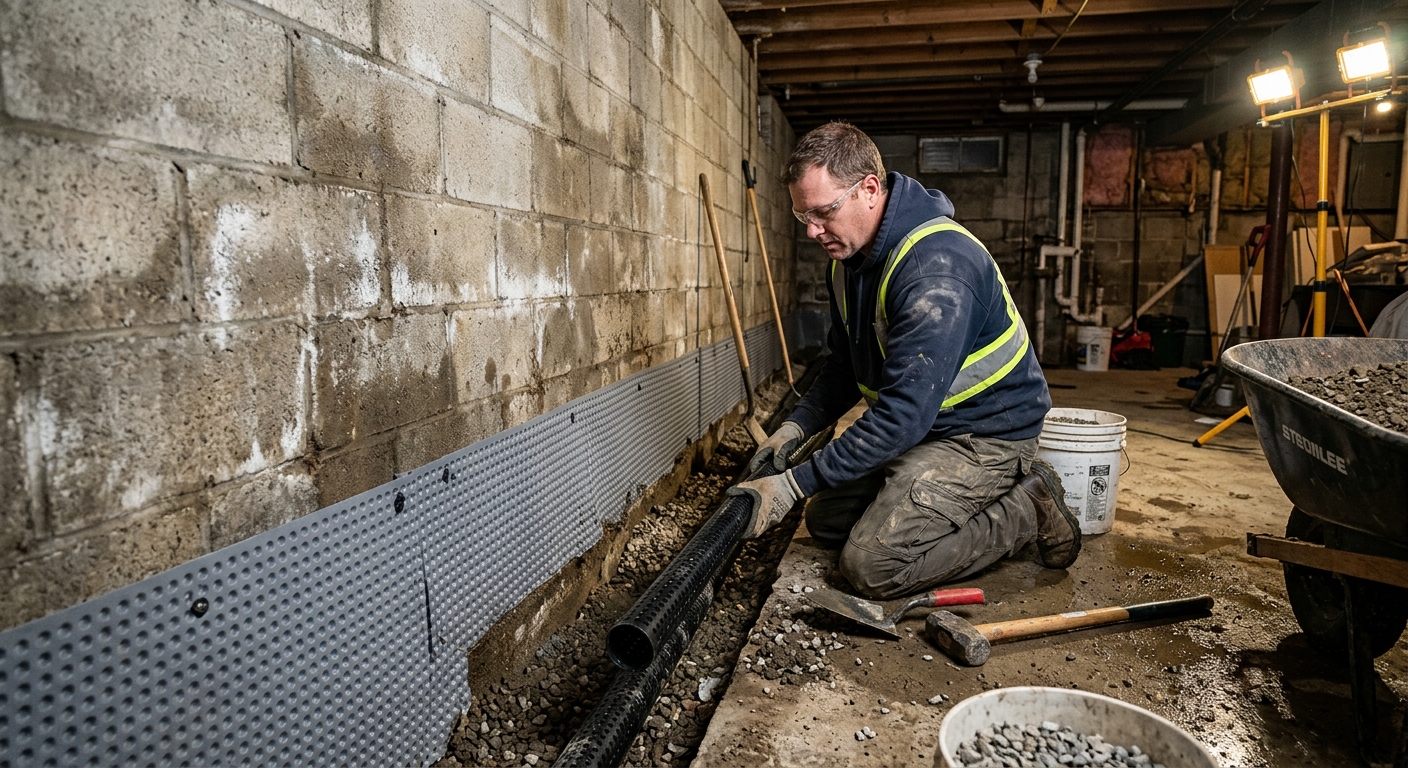
Basement waterproofing options and costs in Cookstown
Cookstown homeowners usually deal with basement dampness or seepage because the surrounding Toronto economic region sits on mixed glacial till and clay pockets that hold water against foundations. With a population of 1,214 (Statistics Canada, 2021 Census), Cookstown is small enough that many trades serve nearby lots, so you’ll often see similar crews handling both interior fixes and exterior excavations for surrounding townships. Two waterproofing realities show up quickly in local basements: first, many homes are older, and original drainage systems can be partially collapsed or clogged; second, freeze–thaw cycles turn minor defects—cold joints, tie holes, and small cracks—into active leaks after a few winters.
In practice, costs move more with scope and access than with brand names. Exterior work in the Toronto area often requires excavation around decks, additions, or tight driveways, which drives labour time and disposal costs. Interior waterproofing can be quicker because it avoids full excavation, but it’s typically most effective when paired with interior drainage, especially where clay soil and higher water pressure are pushing laterally on foundation walls. Neighbourhoods and pockets with older housing stock and frequent damp-basement complaints (commonly around Cookstown’s more established residential streets and near long-standing lots with mature landscaping) tend to be where demand for targeted crack repair and sump systems is highest.
Below is a practical comparison of the main options and typical price bands before you request itemised quotes—then you can match the method to your likely water-entry path.
| Method |
What It Addresses |
Disruption Level |
Durability |
Price Range |
| Exterior excavation + new membrane + drainage tile |
Source of water entry (hydrostatic pressure) with new waterproofing layer and catchment drainage |
High (excavation, backfill, landscape restoration) |
Long-term when installed to correct slope, bedding, and membrane laps |
$12,000–$25,000 |
| Interior perimeter drain channel + sump pit |
Water after it enters (intercepts seepage, reduces pooling, protects interior finishes) |
Medium (floor/edge work, limited excavation) |
Very good when piping, pump, and discharge routing are done correctly |
$6,000–$13,500 |
| Foundation crack injection (epoxy or polyurethane) |
Isolated cracks and leak paths at tie holes, small separation, and hairline openings |
Low to medium (drilling, surface patching) |
Good for correct crack type; active leaks often need polyurethane |
$900–$3,000 |
| Sump pump installation (primary + battery backup) |
Prevents basement flooding during higher water seasons and power interruptions |
Low to medium (pit/coring, electrical work, discharge routing) |
High when paired with reliable backup and proper venting/discharge details |
$1,400–$4,000 |
| Window well drain installation |
Controls rain infiltration and snowmelt around window wells |
Low (targeted excavation/stone removal) |
Good for localized entry points when grating and slope are maintained |
$1,200–$3,000 |
| Lot re-grading / downspout extension |
Redirects roof runoff away from foundation to reduce water load |
Low (surface work) |
Moderate to good when surfaces stay properly sloped and maintained |
$700–$3,500 |
Prices are estimates only and vary by project scope, site access and material selection.
What affects the price of waterproofing in Cookstown
In Cookstown and across the Toronto region, it’s common to see 30%–50% swings between quotes for what sounds like the “same” basement fix. The biggest reason is that a basement problem is rarely caused by one single failure; contractors price for how they’ll find and control the water path—and that depends heavily on soil, water pressure, and how the home was built. These three drivers—soil type, water table conditions, and freeze–thaw—are what separate Toronto-area pricing from the national average.
Clay-heavy soils common around parts of Ontario tend to expand when saturated during freeze–thaw, increasing lateral pressure against foundation walls and worsening cracks over time. When water is held in the backfill, sump run times rise and the drainage scope usually expands, which can push interior systems toward the upper end of the $3,500–$15,000 band for interior waterproofing. In older neighbourhoods with pre-existing clay weeping tile or early plastic drains, partial failure can also mean more demolition and more time locating abandoned lines.
Concrete examples from Cookstown-style properties: (1) A poured-concrete wall with a few small, stable cracks often costs closer to the lower end of crack repair (around $600–$3,000) because injection is targeted; (2) a block foundation with multiple damp seams and efflorescence typically needs interior drainage plus a sump, moving toward the higher end of interior pricing; (3) a tight lot where exterior excavation requires removing landscaping, deck stairs, or portions of a driveway is more often priced like a full excavation project (commonly $7,000–$25,000).
Finally, mould remediation or active efflorescence removal before sealing can add labour days and disposal costs, but it’s essential—sealing over contaminated surfaces won’t perform the way homeowners expect over Ontario winters.
| Price Factor |
Why It Matters |
Cost Impact |
| Interior vs. exterior approach — interior is less disruptive but addresses symptoms |
Interior controls water after entry; exterior attempts to stop the source by managing hydrostatic pressure |
Interior often reduces excavation/disposal, but may require sump + ongoing monitoring; exterior can add $5,000–$12,000+ |
| Foundation type — poured concrete vs. block vs. stone vs. ICF |
Different wall materials fail differently; permeability and crack patterns change the repair method |
Block and older stone frequently increase scope (more drainage) compared with crack-focused repairs |
| Soil type — clay expands more than sand, adding pressure |
Clay saturation increases lateral pressure and can force water through older joints |
More frequent or higher-capacity drainage requirements can add $1,000–$6,000+ |
| Crack type and length — hairline vs. structural horizontal cracks |
Structural movement needs assessment; stable hairlines may be addressable with injection |
Structural repairs can escalate into engineering/underpinning discussions, adding major cost |
| Sump pump backup system — battery or water-powered backup needed |
Power interruptions during wet spring periods can turn seepage into flooding |
Backup can add roughly $600–$2,000 depending on system type and install complexity |
| Access — landscaping, decks, or driveways must be removed for exterior |
Tight access increases labour hours and disposal/restore work |
Exterior access constraints can swing costs by thousands on otherwise similar homes |
| Weeping tile age — original tile (60+ years) may be completely failed |
Older drainage often collapses/clogs, leaving water with no path |
When tile replacement is required, excavation scope usually increases |
| Mould or efflorescence remediation required before sealing |
Moisture-contaminated surfaces limit adhesion and can spread spores if not cleaned |
Often adds time for cleaning, drying, and disposal; can add $500–$3,000+ |
Permits & regulations in Ontario
In Ontario, waterproofing projects can range from straightforward sealing to work that touches drainage patterns and structural risk. As a rule of thumb, foundation excavation, structural crack repair where the wall is treated as a structural element, and changes to how water is directed around the lot typically require a building permit. If your contractor proposes anything that alters grading, involves re-routing drainage away from the foundation, or includes work that affects how loads are handled, expect a permit discussion early—not after labour mobilization.
Sump pump installations that connect discharge to municipal storm or sanitary systems generally require municipal approval. If discharge is going to a legal surface route (where permitted), contractors should still confirm the location and method comply with local servicing requirements. For structural crack repair—especially horizontal cracks in block walls or major step cracks—an assessment by a structural engineer is often required to determine whether underpinning or other structural work is needed.
Step-by-step, here’s how a Cookstown homeowner can verify contractor credentials in Ontario:
- Ask for the contractor’s Ontario licence details and the exact legal entity name they’re working under.
- Request a clearance letter or proof of current status (as applicable) and confirm it matches the entity on the contract.
- Ask for a current certificate of liability insurance naming you as “additional insured” where appropriate; verify limits and effective dates.
- Confirm WSIB coverage (and clearance, if available) for workers doing the installation.
- For structural scope, request confirmation that they coordinate engineering support and that it’s included (or clearly excluded) in your quote.
- Get the permit plan in writing: who pulls the permit, what work it covers, and whether the homeowner pays permit fees.
Where it matters, paperwork protects you—especially when the job goes beyond waterproofing and starts touching drainage compliance or structural evaluation.
Interior vs exterior waterproofing — what does Cookstown need?
For Cookstown basements, the key difference is whether you stop water at the foundation or manage it after it enters. Exterior waterproofing involves full excavation, applying membrane systems to the exterior foundation face, installing new drainage tile, and then restoring backfill with correct drainage paths. It’s the most “source control” approach, but it costs more and it disrupts landscaping, decks, and sometimes driveways—especially in tighter lots common around older streets.
Interior waterproofing typically includes perimeter drain channels, a sump pit, and a properly sized sump pump (often with backup). This approach doesn’t stop hydrostatic pressure on the wall itself; instead, it intercepts seepage and directs it away from the foundation interior. In Toronto-area clay conditions, this can still work very well—particularly where exterior access is difficult or where drainage systems already failed in past decades. Poured-concrete walls often respond well to targeted crack injection (especially when cracks are stable and properly identified). Block foundations frequently need interior drainage as a practical complement because block seams and joints can remain challenging to fully seal from the interior alone.
Ontario’s freeze–thaw cycle matters year-round: exterior repairs must handle winter movement and correct membrane laps, while interior systems must run reliably through spring melt and early summer rains. That’s why a battery backup system for the sump can be worth considering—power interruptions during wet seasons can turn slow seepage into a fast flood, even in small amounts of standing water.
Price-wise, if a home has one localized leak path, crack injection may be justified on its own (often around $600–$3,000). But if you’re dealing with repeating dampness along a perimeter with clay-saturated backfill, interior perimeter drains plus a sump commonly land in the $3,500–$15,000 range; adding backup can push toward the upper portion. For chronic seepage and confirmed failed weeping tile, exterior excavation is sometimes the only way to reduce recurring hydrostatic pressure, which is why exterior projects often fall in the $7,000–$25,000 band.
| Method |
Best For |
Addresses Source? |
Disruption |
Lifespan |
Price Band |
| Full exterior excavation + membrane |
Active hydrostatic pressure, failing weeping tile, chronic perimeter seepage, or where exterior access is feasible |
Yes (source control) |
High (excavation and landscape restoration) |
Long-term when drainage tile, laps, and backfill are done correctly |
$12,000–$25,000 |
| Interior French drain + sump system |
Basements that are damp or intermittently flooding, especially when exterior work is limited |
No (controls water after entry) |
Medium (floor/edge work) |
Very good with correct pump sizing and discharge routing |
$6,000–$13,500 |
| Crack injection — epoxy (structural) |
Stable, non-moving cracks in poured concrete where leakage is minimal or stopped |
Partial (seals pathway) |
Low to medium (surface preparation and injection points) |
Good for correctly assessed, stable cracks |
$900–$2,400 |
| Crack injection — polyurethane (active leak) |
Active seepage and crack flow where water is moving through the defect |
Partial (seals pathway) |
Low to medium (surface prep; injection) |
High when applied to the right crack type and surface condition |
$1,000–$3,000 |
| Interior drain channel only (no sump) |
Milder seepage where water volume is low and gravity discharge is practical |
No (manages water after entry) |
Medium to low (depends on routing) |
Moderate; performance depends on discharge and seasonal water levels |
$3,500–$7,500 |
| Re-grading + downspout extensions |
Roof runoff management where exterior drainage is the main issue and foundation entry is limited |
No (reduces water load) |
Low (surface work and minor excavation) |
Moderate; requires maintenance |
$700–$3,500 |
How to choose a waterproofing contractor in Cookstown
Choosing the right waterproofing contractor in Cookstown is mostly about verification and clarity. First, confirm Ontario credentials. Ask whether they are properly licensed/registered for the work they’re doing under the correct legal entity name, and request proof of liability insurance (certificate of insurance with effective dates and adequate limits). Also confirm WSIB/WCB coverage and ask for a clearance letter when available—this matters for on-site worker safety and protects you from subcontractor gaps. For any structural component (for example, major cracks that may require engineering input), make sure they explicitly coordinate with engineering support rather than assuming “standard waterproofing” will solve structural movement.
Next, get 2–3 itemised written quotes. You want labour and materials breakdowns (membrane, drainage tile, pumps, injection products, disposal, and restoration), not a single lump sum number. Read the scope closely: what’s included or excluded for permit pulling, debris removal, and landscaping reinstatement. Ask how they verify the water path before they seal anything—good contractors typically do visual inspection and check common entry points like tie holes, crack locations, window wells, and discharge locations.
Warranty matters. Request both (1) workmanship warranty length and what it covers (labour and rework) and (2) product/manufacturer warranty for membranes, injections, and pumps. Ask if the warranty is transferable to future owners (helpful for resale). In payment terms, avoid large deposits—never more than about 10–15% upfront—and use a holdback until the job is complete and defects are corrected. Finally, insist on a written start date and completion estimate.
- Verify Ontario licence/registration details for the correct legal entity.
- Confirm liability insurance and request a certificate of insurance.
- Confirm WSIB coverage and ask for proof/clearance.
- Get engineering included in writing if crack assessment is structural.
- Request a written scope with included materials and quantities.
- Confirm whether excavation support, disposal, and backfill compaction are included.
- Ask how they protect existing finishes and manage dust/cleanup.
- Check whether permit fees are included and who pulls the permit.
- Ask for sump discharge routing details and compliance notes.
- Confirm pump sizing and whether a battery backup option is offered.
- Review warranty: workmanship + manufacturer terms and transferability.
- Use a payment schedule with a holdback until completion/inspection.
Red flags to watch for in Cookstown: vague scopes (“we’ll waterproof it”), refusal to provide insurance/WSIB documentation, quotes without disposal or restoration line items, no written warranty terms, and pressure to accept a large upfront payment or start without a signed contract and permit clarity.
Frequently asked questions — waterproofing in Cookstown
How do I compare waterproofing quotes?
Start by comparing quotes line-by-line, not by the total price. In Cookstown and the wider Toronto region, two contractors can both propose “waterproofing” but mean different things—one may be installing a sump to manage water after entry, while the other is doing exterior source control. Ask each company to list labour and materials separately (membrane, drainage tile, sump components, injection products), and confirm what’s included for disposal and landscape restoration. Make sure the scope states whether permits are required and who pulls them. If you’re seeing a wide swing—say one quote near the lower end of interior work and another near the upper interior band (for example around the $3,500–$15,000 range)—verify the difference is real (access, excavation, backup pump, remediation), not just marketing language.
How long does basement waterproofing take in Cookstown?
Typical timelines depend on whether you’re doing interior or exterior work. Interior perimeter drainage and a sump installation often take about several days to a couple of weeks once floor cutting, channel forming, pump installation, and backfilling/drying are considered—especially if drying time is needed after cleaning. Exterior excavation usually takes longer because access, excavation, membrane and drainage tile installation, backfill compaction, and then landscape restoration all add time; it can stretch into several weeks in a normal Ontario work sequence. In Cookstown, winter conditions can affect curing and scheduling, so contractors plan around temperature and weather. If your basement also needs crack injection, that can be added quickly, but any mould or efflorescence remediation can extend timelines. Always ask for a written start date and completion estimate so you can plan around trades scheduling.
What is a weeping tile and does my Cookstown home have one?
Weeping tile is an older style of perimeter drainage system designed to collect groundwater around a foundation and direct it to a discharge point (often to daylight, a sump, or a buried drain line). Many older Cookstown-area homes built decades ago used clay weeping tile; over time it can collapse, clog, or disconnect—especially in clay backfill where water is held during freeze–thaw cycles. Whether your home has one depends on the original drainage approach and the era of construction. A contractor can usually identify it by locating the drain line connection point, checking basement discharge routes, and sometimes inspecting accessible sections during interior drain installation. If your home shows chronic dampness, efflorescence, or basement flooding without obvious wall failures, the existing weeping tile is often the suspect.
Can I waterproof my basement in winter in Cookstown?
In Ontario winters, many contractors can still do interior waterproofing work, but conditions matter. If the basement is frozen solid, you may see longer drying times and challenges with clean cutting or surface prep. Exterior excavation is more limited in winter because digging and membrane work require workable conditions and controlled application temperatures; freeze conditions can increase the risk of poor adhesion or uneven backfill placement. That said, crack injection and interior drainage/sump installations can sometimes proceed if surfaces can be prepared properly and if water management is addressed during installation. The safest way to schedule is to ask the contractor what they can reliably complete in your basement conditions and what they would defer until spring. A quality contractor should explain temperature limits for products and how they’ll protect your home while they work.
What is the difference between waterproofing and damp-proofing?
In homeowner language, damp-proofing usually means reducing moisture penetration, while waterproofing aims to stop or manage water entry more aggressively. In Ontario basements, the practical difference shows up when you compare systems: damp-proofing may be limited to surface coatings or basic sealants intended for occasional seepage, but it doesn’t necessarily address hydrostatic pressure when the water table rises or when clay backfill expands with freeze–thaw. Waterproofing solutions like exterior membranes and new drainage tile are designed for hydrostatic pressure control (source control), while interior perimeter drains and sump pumps manage water after it enters (symptom control). If you’re seeing active wet spots, recurring efflorescence, or flooding during spring melt, you generally need a waterproofing approach appropriate to the water path—not just a cosmetic coating.
Will basement waterproofing affect my property value in Cookstown?
Often, yes—especially when you can demonstrate the problem is solved and provide documentation (scope, warranty, and workmanship details). In Cookstown, damp basements and occasional flooding can be a major buyer concern because they signal ongoing moisture risk and potential finish/structural impacts. A well-designed solution—such as interior drainage with a properly sized sump (and, if needed, battery backup) or targeted crack injection—can improve livability and reduce recurring maintenance. For example, homeowners sometimes choose interior waterproofing within the $3,500–$15,000 band when source control isn’t feasible; that can still be a meaningful value improvement when paired with clear warranty terms and correct discharge routing. Exterior waterproofing typically costs more (commonly in the $7,000–$25,000 range), but it can provide stronger reassurance when failing drainage and clay-lateral pressure are confirmed. In all cases, keep permits, photos before/after, and warranty paperwork.