Basement waterproofing options and costs in London
In London, Ontario, basement waterproofing typically comes down to two realities: many homes were built before modern waterproofing standards, and the local ground and drainage conditions can keep re-triggering moisture problems. With 52.3% of homes in the area built before 1981, it’s common to see original or outdated tar-and-paper systems and weeping tile that have failed or are partially collapsed. That matters because many “one-time” leaks become repeated seepage once clay-rich soils hold water, then shift with wet/dry cycles.
London’s mixed soils and, in some neighbourhoods, relatively shallow water tables near rivers and low-lying areas increase the odds of hydrostatic pressure. In practical terms, that’s why exterior excavation is often priced higher (more digging, more disposal, more reinstatement), while interior approaches can be a cost-effective first step when you’re trying to manage existing water entry without removing landscaping. Freeze-thaw cycles also widen small foundation cracks over time, so homeowners may pay for both crack repair and drainage upgrades.
Trade demand is especially high around older residential pockets such as Wortley Village, where lots and mature landscaping can complicate access and schedule, and where many basements face moisture season after season. The next step is comparing the most common remedial systems—costs, disruption, and what each method is actually designed to address.
| Method |
What It Addresses |
Disruption Level |
Durability |
Price Range |
| Exterior excavation + new membrane + drainage tile |
Stops water at the foundation source; adds full perimeter drainage and relieves hydrostatic pressure |
High (excavation, grading, landscaping reinstatement) |
Long-term when combined with proper drainage and backfill |
$12,000–$25,000 |
| Interior perimeter drain channel + sump pit |
Collects seepage after water enters; reduces hydrostatic impact on the basement floor/walls |
Medium (interior floor sections, minimal exterior disruption) |
High when paired with proper discharge and pump protection |
$8,000–$18,000 |
| Foundation crack injection (epoxy or polyurethane) |
Seals cracks; epoxy for stable cracks, polyurethane for active leaks and seepage paths |
Low (surface prep and injection ports) |
Good to long-term, depending on whether the crack is still moving |
$600–$2,500 |
| Sump pump installation (primary + battery backup) |
Moves collected water away reliably during heavy rain/snowmelt and power interruptions |
Low to Medium (pit excavation + electrical work) |
High when backup is included and discharge is correctly directed |
$1,500–$3,500 |
| Window well drain installation |
Prevents water pooling near egress windows; reduces seepage into window wells and sill areas |
Low to Medium (well excavation/stone work) |
Good when paired with grading and a protected discharge path |
$1,200–$3,000 |
| Lot re-grading / downspout extension |
Directs roof and surface water away from the foundation to reduce water loading |
Low to Medium (minor excavation and landscaping touch-ups) |
Moderate; often best as a supporting measure |
$800–$2,500 |
Prices are estimates only and vary by project scope, site access and material selection.
What affects the price of waterproofing in London
In London, you can see waterproofing quotes for the same “type” of basement work vary by roughly 30–50% depending on site conditions, the chosen system, and how much preparation is required. That gap is real across Ontario because the job is rarely just about sealing one crack—it’s about managing how water moves through clay-rich soils, what your water level does after rain/snowmelt, and whether older drainage components are already failing.
Three drivers separate London’s costs from the national average: (1) soil type, (2) water table/groundwater conditions, and (3) freeze-thaw. Clay-heavy ground in many parts of Ontario holds water, then expands and contracts as it freezes and dries. That movement increases lateral pressure on basement walls and can worsen cracking over time, even after a temporary patch. Where the local water table is high, sump pumps run longer and require more robust discharge and backup. After heavy rain or rapid snowmelt, older weeping tile may be overwhelmed or collapsed, which pushes crews toward interior drainage plus a sump system—or toward full exterior waterproofing if access allows.
For example, a home with failed original weeping tile and damp block walls often needs interior perimeter drainage plus a sump pump; you might land in the interior range of about $8,000–$18,000. In contrast, a smaller job limited to hairline crack sealing might look more like the $600–$2,500 band, especially if the crack is stable and there’s no active seepage. Costs also rise if you’re dealing with 1980s-or-older construction (52.3% of homes are pre-1981) where materials and drainage details are unknown or deteriorated, requiring more diagnostic time and prep.
Next, here are the biggest price factors contractors use when building an itemised proposal for a London basement.
| Price Factor |
Why It Matters |
Cost Impact |
| Interior vs. exterior approach — interior is less disruptive but addresses symptoms |
Exterior tackles water at the source; interior manages water after it enters |
Interior often saves on excavation but may not prevent ongoing wall pressure |
| Foundation type — poured concrete vs. block vs. stone vs. ICF |
Different materials crack differently and accept sealing systems differently |
Poured concrete may respond well to injection; block often needs drainage complements |
| Soil type — clay expands more than sand, adding pressure |
Clay increases swelling/shrink cycles and increases seepage risk |
More robust drainage and sealing prep is required in clay areas |
| Crack type and length — hairline vs. structural horizontal cracks |
Active or structural movement needs more than “seal it and forget it” |
Structural scenarios can increase scope to engineering and/or more extensive repairs |
| Sump pump backup system — battery or water-powered backup needed |
Spring storms and power outages can make a primary pump insufficient |
Adds equipment and wiring but reduces failure risk |
| Access — landscaping, decks, or driveways must be removed for exterior |
Excavation depth and limited access increase labour time and protection measures |
Can shift a project from mid-range to upper-range pricing |
| Weeping tile age — original tile (60+ years) may be completely failed |
Old drainage may be collapsed, clogged, disconnected or saturated |
May require full replacement, new drainage layout, and clean-out work |
| Mould or efflorescence remediation required before sealing |
Sealers won’t perform correctly over active salts or contaminated surfaces |
Extra labour, containment, and drying time can add cost |
Permits & regulations in Ontario
In Ontario, some waterproofing-adjacent work requires permits, especially when you’re changing foundation elements, correcting drainage that affects grading, or repairing structural conditions. As a rule of thumb for London homeowners: foundation excavation, structural crack repair, and changes to how the lot handles water often trigger a permit requirement. If a sump pump discharge connects into a municipal sewer system, municipal approval is commonly needed before that tie-in is made.
Here’s what typically does require a permit: (1) foundation excavation for exterior waterproofing (especially where drains and backfill are being reworked), (2) structural crack repairs—particularly horizontal cracks in block walls or any crack that suggests movement—where a structural engineer’s assessment is often needed, and (3) any lot drainage alterations that materially change how water is managed near the foundation.
What often does not require a permit: small interior crack injection for stable, non-structural cracks (done strictly as sealing), localized window well drain adjustments, and downspout extensions when they don’t involve excavation that alters foundation or major drainage systems. Your contractor should confirm in writing for your specific scope.
Step-by-step, verify your contractor in London by: (1) checking their Ontario licensing on the appropriate online registry, (2) requesting a current certificate of liability insurance, (3) confirming WSIB/WCB coverage clearance or status letter, and (4) for structural repairs, asking whether they work with engineering support and will provide documentation for the scope.
Interior vs exterior waterproofing — what does London need?
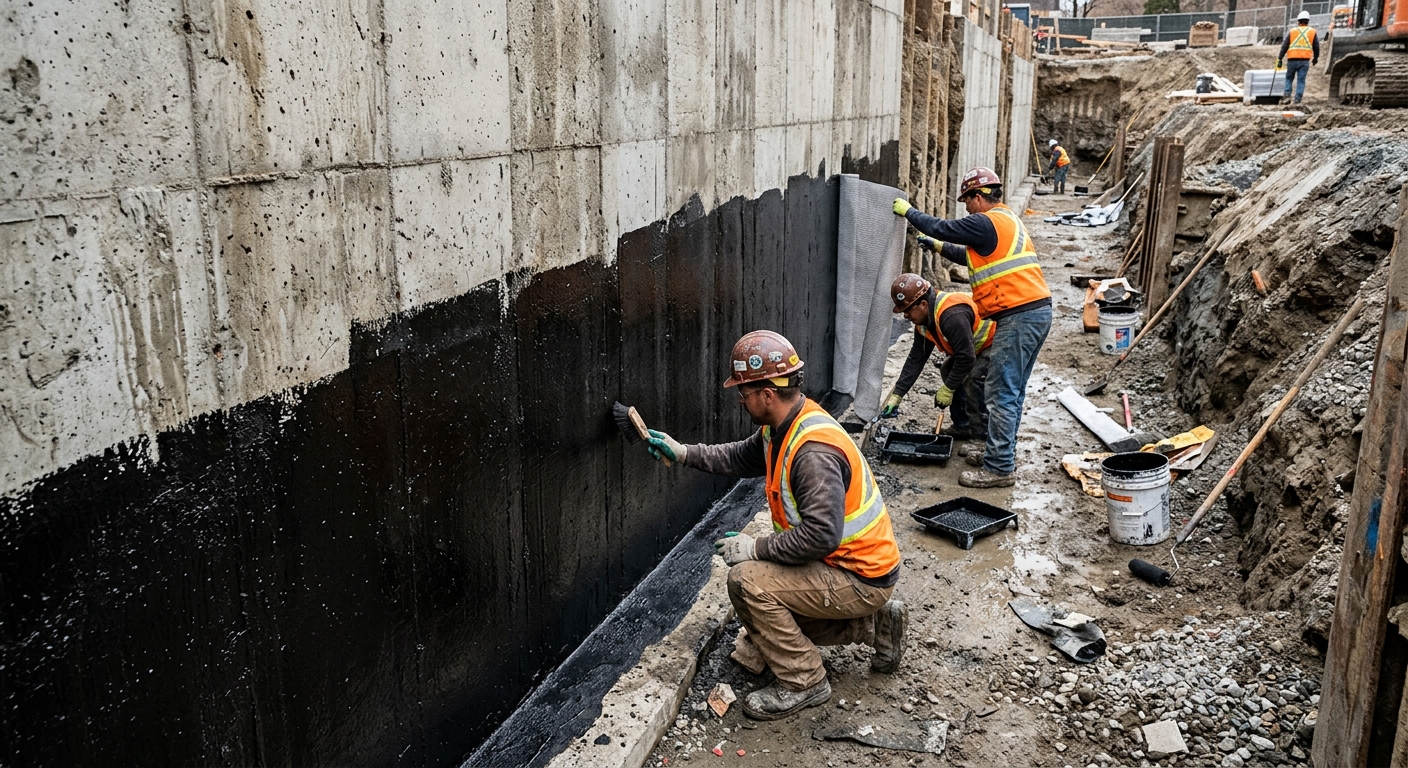
The key difference is where the solution stops the water. Exterior waterproofing involves full excavation, a new membrane, new perimeter drainage tile, and backfill. That approach permanently addresses the source by keeping water from contacting foundation walls in the first place, but it’s more expensive and disruptive because it requires yard access, excavation depth, and landscaping restoration. Interior waterproofing—typically a perimeter drain channel, sump pit, and sump pump—collects water after it enters the basement. It reduces damage and keeps floors drier, but it doesn’t remove hydrostatic pressure from the wall itself.
In London’s clay-influenced soils and freeze-thaw climate, exterior systems often perform best when water table conditions are high or when older weeping tile is failing. That said, interior solutions can be the right fit when you have limited excavation access, finished landscaping, or when the basement needs immediate protection while you address long-term source control. For poured concrete walls, crack injection (especially when cracks are stable) can pair well with interior drainage to create a more complete dry system. For block foundations, injection alone often isn’t enough because water paths and joint behaviour can continue—so interior perimeter drainage is frequently a practical complement.
Battery backup matters in Ontario because spring flooding and storm-related outages do happen. If you’re paying for a sump system anyway, adding backup is usually justified for basements that are finished or used frequently.
To see the trade-off: exterior waterproofing in London commonly sits around $12,000–$25,000, while a typical interior perimeter drain plus sump approach often falls in the $8,000–$18,000 band. The difference is justified when exterior access is workable and you’re truly dealing with source-entry hydrostatic pressure; it’s less justified when the issue is localized drainage misdirection and the crack is stable.
| Method |
Best For |
Addresses Source? |
Disruption |
Lifespan |
Price Band |
| Full exterior excavation + membrane |
High water pressure, repeated seepage, failed weeping tile, exterior wall deterioration |
Yes (best at stopping water before it reaches walls) |
High |
Long-term when drainage and backfill are done correctly |
$12,000–$25,000 |
| Interior French drain + sump system |
Water ingress already occurring; limited exterior access; managing hydrostatic pressure indoors |
Partially (manages water after entry) |
Medium |
High with proper pump discharge and backup |
$8,000–$18,000 |
| Crack injection — epoxy (structural) |
Stable cracks where water seepage is minimal and crack movement has stopped |
No (it seals a path but doesn’t change water load) |
Low |
Good when cracks are truly stable |
$600–$2,500 |
| Crack injection — polyurethane (active leak) |
Active seepage or damp cracks that keep feeding moisture |
No (seals active pathways, but source water can still drive future seepage) |
Low |
Good to long-term when paired with drainage |
$900–$3,000 |
| Interior drain channel only (no sump) |
Minor seepage control where gravity drainage/discharge is feasible |
Partially (doesn’t remove groundwater pressure when water levels rise) |
Medium |
Moderate to good depending on water conditions |
$4,500–$10,000 |
| Re-grading + downspout extensions |
Surface water management issues; gutters overflowing; minor moisture around perimeter |
No (reduces load, doesn’t stop groundwater seepage) |
Low to Medium |
Moderate; needs periodic maintenance |
$800–$2,500 |
How to choose a waterproofing contractor in London
Choosing the right contractor in London starts with verification, not promises. First, confirm Ontario licensing status where applicable for the work they’re performing. Next, request a certificate of liability insurance and ensure it’s current and matches the job address. Third, verify WSIB/WCB coverage by asking for a clearance letter or equivalent status document; don’t accept “we’re covered” without paperwork. For jobs involving foundation or structural crack repairs, ask whether they use engineering support and whether they can provide documentation for structural scope and liability coverage.
Then get 2–3 itemised written quotes. You want line items for labour and materials (membranes, drainage tile, sump components, pumps, pumps’ backup system, excavation disposal, reinstatement), not just one lump sum. Read the exclusions: does the quote include disposal? Is permit pulling included or excluded? Are repairs limited to crack sealing, or is there a plan for drainage upgrades if the source is groundwater? A good contractor will explain why their approach fits your foundation and clay/water conditions.
Warranty matters. Ask for the workmanship warranty length, the manufacturer warranty terms for membranes/pumps (and whether it transfers to you), and what happens if water conditions persist. On payment, don’t pay more than 10–15% upfront; hold back a portion until the system is completed, tested, and cleaned up. Finally, require a written start date and completion estimate—waterproofing timelines can swing if excavation access is tight or if conditions require extra prep.
- Request proof of Ontario licensing (for applicable scope) before work begins.
- Verify liability insurance by matching the certificate to your project address.
- Confirm WSIB/WCB clearance or status letter.
- Get 2–3 itemised quotes with labour + materials breakdown (not lump sum).
- Ask whether permits are included and who pulls them.
- Confirm disposal and backfill material specifications are included.
- Ensure the scope defines sump discharge route and includes proper discharge protection.
- Ask if they include a backup pump plan (battery or water-powered) when sump is installed.
- Clarify how they handle existing mould/efflorescence before sealing.
- Make them define the warranty: workmanship + product, and transferability.
- Set payment terms in writing with a 10–15% maximum upfront and holdback until completion.
- Require a written timeline, including when inspections/engineering sign-offs occur (if needed).
Red flags we see in London include: contractors who refuse to provide insurance/WSIB clearance paperwork, quotes that omit drainage scope but promise “dry forever,” vague warranty terms, a deposit request higher than 15% without a signed schedule, and no clear plan for sump discharge or backup power when interior drainage is proposed.
Frequently asked questions — waterproofing in London
Do I need a sump pump in London?
Not every basement needs a sump pump, but many London basements do—especially where seepage increases after heavy rain or rapid snowmelt. If your soil is clay-rich and holds water, or if older weeping tile is partially failed, water often collects around the perimeter and rises enough to require pumping. A sump is also more likely if you’ve had hydrostatic symptoms like recurring dampness along the wall-footing line, puddling, or water intrusion during spring thaws. In quotes, sump systems commonly sit around $1,500–$3,500 for installation, and that cost can be higher when battery backup is included. If you’re already doing interior drainage, it’s often more cost-effective to include backup than to retrofit later.
How does London's soil affect my foundation?
London’s mixed soils often include clay-rich areas, and clay is the big driver of repeated moisture cycles. Clay holds water longer, so the soil stays saturated and then dries; during that process it can shrink and swell, increasing movement pressures against foundation walls. That movement can worsen cracks over time—especially after Ontario freeze-thaw cycles, when trapped moisture expands as it freezes. With 52.3% of housing built before 1981, it’s also common to find original drainage systems that are no longer performing, so groundwater loading becomes more intense. Practically, you may see different results from crack injection alone versus combining drainage and sealing. In many cases, managing the source water load (often exterior) or collecting it properly (often interior + sump) gives homeowners the best long-term outcome.
Do I need a permit for foundation work in Ontario?
Many foundation-related waterproofing scopes require permits in Ontario, but it depends on what you’re changing. In London, foundation excavation, structural crack repairs (particularly if there’s any sign of movement or horizontal cracks), and meaningful lot drainage changes commonly require permits. If your sump discharge is being connected to municipal sewer systems, municipal approval is typically required before that tie-in. Smaller sealing-only work—like crack injection for a stable, non-structural crack—often may not require a permit, but you should confirm with your contractor and, if needed, the local authority before work starts. The safest approach is to ask for the permit plan in writing as part of your itemised quote and to ensure the contractor provides documentation of compliance.
How long does waterproofing last?
Durability depends on whether the system addresses the real water pathway and whether ongoing conditions (clay movement, water table, drainage failures) are corrected. Exterior waterproofing systems typically provide the longest protection because they stop water at the source with a membrane and new drainage tile. Interior systems can last a long time too, especially when you install a properly sized drain and sump with a reliable discharge route. However, if the underlying issue is hydrostatic pressure driven by groundwater and original weeping tile failure, an interior-only approach may need more maintenance and could have more frequent pump cycles. As a reference for budget planning, many homeowners compare interior projects in the $8,000–$18,000 range versus exterior projects in the $12,000–$25,000 range—exterior usually costs more because it’s built for long-term source control, which affects lifespan.
Can I waterproof my basement from the inside only?
Yes, you can often improve a basement from the inside only, and it’s a common choice in London when excavation would be too disruptive or access is limited by landscaping, decks, or driveways. Interior waterproofing usually includes a perimeter drain channel and a sump pit/pump, sometimes paired with crack injection. That approach manages water after it enters, which helps stop floor seepage and reduces damp conditions. But it doesn’t eliminate hydrostatic pressure against the foundation wall, so it’s best matched to your specific conditions—especially if clay and freeze-thaw cycles keep driving water toward the perimeter. If the issue is active seepage through cracks or joints, injection may help but is usually stronger when paired with drainage. If there’s clear evidence that source-entry water loading is the main driver, exterior excavation typically gives the most durable results.
What causes foundation cracks in London?
In London, foundation cracks are commonly caused by soil movement, water pressure, and freeze-thaw. Clay-rich soils expand when wet and shrink when dry, which increases stress against basement walls. When water levels rise after heavy rain or rapid snowmelt, hydrostatic pressure can push through small weaknesses, making cracks appear or worsen. Ontario’s freeze-thaw cycles then enlarge those small openings—trapped moisture freezes and expands, widening hairline cracks over time. Age is another factor: with many homes built before 1981, original drainage details and waterproofing materials were often not designed for today’s expectations, and failing weeping tile can increase moisture loads. The right fix depends on crack type (hairline vs structural/horizontal) and whether the crack is active—this is why a proper assessment matters before choosing epoxy or polyurethane injection.