Basement waterproofing options and costs in Welland
Basement waterproofing in Welland is a practical necessity for many homeowners, especially because much of the housing stock here is aging and many basements were originally protected with simpler systems that don’t hold up forever. In Welland, about 65.6% of homes were built before 1981 (Statistics Canada, 2021 Census), and that matters: older tar-and-paper or early weeping tile setups often fail as weeping tile clogs, foundation coatings degrade, and cracks widen through Ontario’s repeated freeze–thaw cycles. The region also sits on clay and silty clay subsoils with areas of higher groundwater that can creep close to basements, which raises seepage risk and increases labour for excavation and drainage stone placement.
In the Hamilton–Niagara Peninsula market, costs typically run higher than the “national average” because dealing with wet, cohesive soils means more excavation time, more robust membrane detailing, and careful backfill and drainage restoration. Contractor availability is usually strongest around high-demand areas, and we see particularly frequent waterproofing calls in neighbourhoods near downtown Welland and along older, established residential corridors where lot grading and drainage patterns tend to be less forgiving.
Before you compare bids, it helps to match the method to the water-entry pathway (bulk water, hydrostatic pressure, or localized cracks). The table below summarizes the most common options used in Welland, what they address, typical disruption, and realistic price ranges for this tier.
| Method |
What It Addresses |
Disruption Level |
Durability |
Price Range |
| Exterior excavation + new membrane + drainage tile |
Primary water entry through foundation walls and hydrostatic pressure; replaces failed weeping tile |
High (full excavation; landscaping restoration) |
Long-term (often 15–25 years with proper backfill and drainage) |
$12,000–$25,000 |
| Interior perimeter drain channel + sump pit |
Water that enters from cracks/weep points; manages it before it damages finishes |
Medium (removes portions of slab/finished areas) |
Good (often 10–20 years depending on maintenance and pump performance) |
$8,000–$18,000 |
| Foundation crack injection (epoxy or polyurethane) |
Crack sealing to stop leakage pathways; epoxy for structural stabilization, polyurethane for active leaks |
Low (typically limited drilling and patching) |
Moderate to long-term (best when active water has been properly controlled) |
$600–$1,800 |
| Sump pump installation (primary + battery backup) |
Relieves hydrostatic pressure inside the basement and handles power interruptions |
Low to medium (pit excavation; minor interior restoration) |
High (properly sized system with backup is durable and reliable) |
$1,800–$4,200 |
| Window well drain installation |
Prevents water pooling and seepage at basement window wells during spring runoff |
Low (targeted excavation/repairs) |
Good (typically 8–15 years if drainage media stays clean) |
$1,200–$3,000 |
| Lot re-grading / downspout extension |
Redirects surface water away from foundation to reduce water load on waterproofing |
Low to medium (minor excavation; landscaping work) |
Moderate (depends on ongoing maintenance) |
$1,500–$5,500 |
Prices are estimates only and vary by project scope, site access and material selection.
What affects the price of waterproofing in Welland
In Welland and across the Hamilton–Niagara Peninsula, it’s common to see quotes for the “same” basement leak range far beyond a small difference—often in the 30–50% spread—because the underlying water pathway is rarely identical from house to house. Two factors that explain much of the variation are excavation conditions (how wet and cohesive the soil is) and how thoroughly the contractor addresses water at the source versus only managing symptoms inside.
Three local drivers consistently separate regional pricing from what homeowners see in broader national estimates: soil type, water table, and freeze–thaw. Clay-heavy pockets around parts of the Hamilton–Niagara Peninsula can hold moisture and expand as temperatures swing, increasing lateral pressure on foundation walls and worsening cracks over time. Where groundwater is closer to grade (often roughly 2–4 m below grade with perched water possible in shallow fill layers), sump systems may run more frequently and require better drainage stone, larger discharge lines, and sometimes backup. Ontario’s freeze–thaw also widens existing cracks—so a small, hairline crack treated as if it were structural can become a recurring issue, adding cost later.
Real examples from Welland: (1) A homeowner with a block foundation and failed original weeping tile often needs interior perimeter drainage plus a new sump pit—pricing frequently lands in the $8,000–$18,000 band for interior approaches rather than just a $600–$1,800 crack injection. (2) If excavation reveals saturated clay and poor access near a driveway or deck, exterior work can move toward the upper $12,000–$25,000 band because excavation time and disposal increase.
Finally, older housing stock matters: with 65.6% of homes built before 1981 (Statistics Canada, 2021 Census), many basements have aging drainage components that may be 60+ years old, meaning replacement is more likely than “spot fixes.”
| Price Factor |
Why It Matters |
Cost Impact |
| Interior vs. exterior approach — interior is less disruptive but addresses symptoms |
Exterior aims at water source; interior mainly manages water after entry |
Exterior often higher; interior can be 30–60% less disruptive |
| Foundation type — poured concrete vs. block vs. stone vs. ICF |
Different wall systems crack and seal differently; surface prep and detailing changes |
Block and older poured concrete can require more prep and drainage coordination |
| Soil type — clay expands more than sand, adding pressure |
Clay holds water and expands during freeze–thaw, increasing hydrostatic stress |
More robust drainage stone, membrane detailing, and labour for wet excavation |
| Crack type and length — hairline vs. structural horizontal cracks |
Structural horizontal cracks may indicate movement and require engineering input |
Structural repairs and longer injection runs increase cost |
| Sump pump backup system — battery or water-powered backup needed |
Power outages during spring storms/flooding can turn a “managed leak” into a flood |
Backup adds cost but reduces risk; often worth it in Welland spring conditions |
| Access — landscaping, decks, or driveways must be removed for exterior |
Time and restoration materials increase when exterior work is blocked by finished areas |
Exterior bids can swing significantly based on restoration scope |
| Weeping tile age — original tile (60+ years) may be completely failed |
Old tile frequently clogs, collapses, or disconnects from downspout/grade systems |
Replacement rather than tie-ins becomes necessary |
| Mould or efflorescence remediation required before sealing |
Sealers and membranes won’t perform well over active contamination or salts |
Additional labour/materials for remediation and controlled drying |
Permits & regulations in Ontario
In Ontario, foundation excavation, structural crack repair, and changes to lot drainage typically require a building permit. If your plan includes significant work that alters how water is directed or how the foundation is reinforced, assume a permit may be required even when the basement itself looks “cosmetic.” In particular, sump pump installations that tie into storm or sanitary sewer systems usually require municipal approval. Rules vary by municipality and by how the discharge is routed, but you should not rely on verbal assurances—ask the contractor to confirm the permit/approval pathway in writing before work starts.
For structural crack repair—especially horizontal cracks in block walls, major step cracking, or signs of wall movement—a structural engineer’s assessment is often necessary to confirm whether underpinning or other structural work is needed. A well-run contractor will coordinate that engineering step and will not oversell crack injection as a universal cure.
How to verify a contractor’s Ontario compliance (simple steps for Welland homeowners): (1) Check the contractor’s Ontario business registration and any relevant trades licensing information through Ontario’s online sources; if they are asking to do regulated work, make sure they can demonstrate authorization. (2) Request a certificate of insurance: general liability naming you as an interested party (where applicable). (3) Verify WSIB/WCB coverage status and clearance: ask for a clearance letter or proof of coverage and expiry dates. (4) For structural scope, confirm they carry engineering support—either in-house or via a partner engineer—and that the engineer provides sealed documentation where required.
Interior vs exterior waterproofing — what does Welland need?
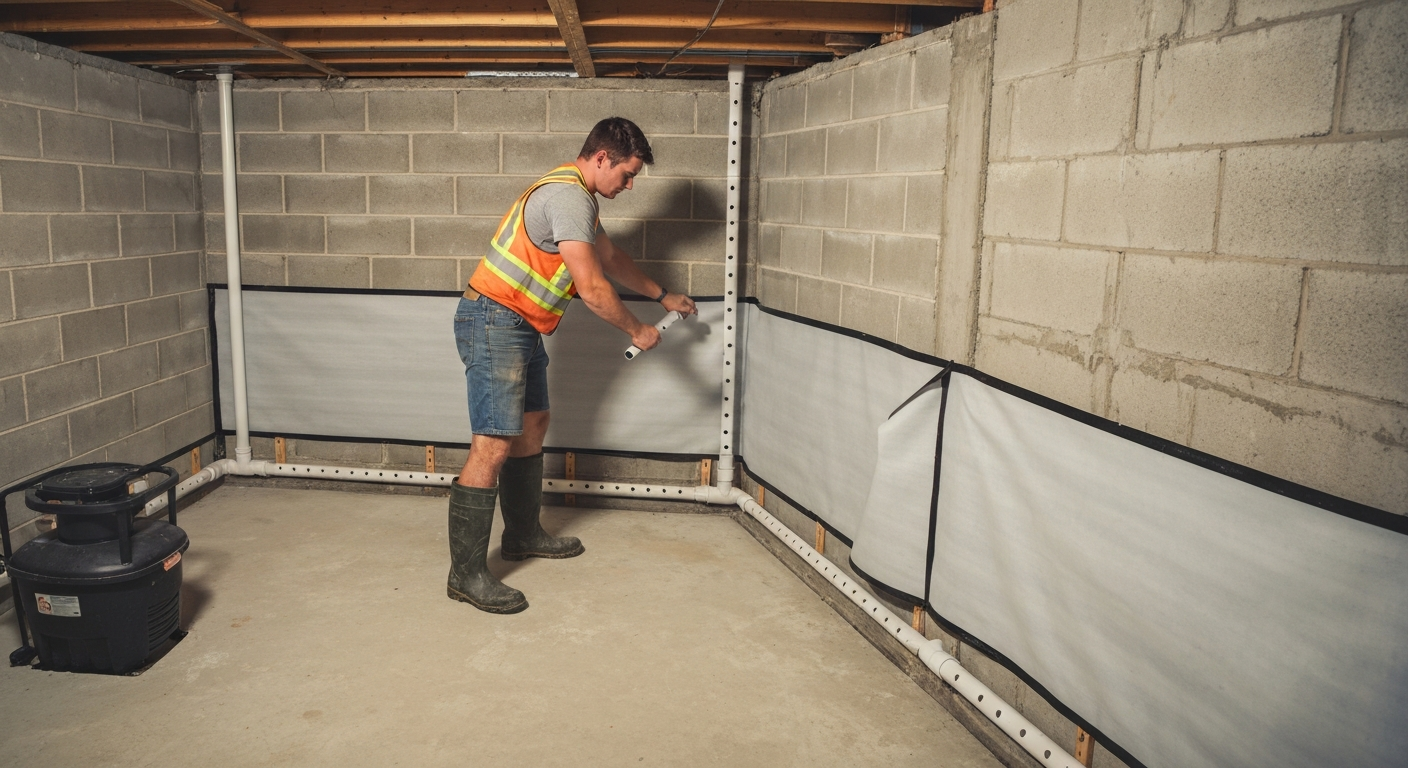
The fundamental difference is that exterior waterproofing tackles the source of water entry by fully excavating around the foundation, installing or replacing membrane systems and drainage tile, and then rebuilding grade and backfill. Interior waterproofing, by contrast, is a “control after entry” approach: it collects seepage using an interior perimeter drain channel and sump pit/pump system. Because it doesn’t stop hydrostatic pressure from building against the wall, interior methods can be a strong solution when you need less disruption, but they generally perform best as part of a broader plan that includes crack sealing and good surface water control.
In Welland’s Hamilton–Niagara Peninsula conditions—clay-heavy subsoils, seasonal freeze–thaw, and groundwater that can be relatively close—exterior systems usually provide the most permanent risk reduction. However, block foundations often require interior drainage as a practical complement, because cracks and mortar joints can channel water in ways that are hard to perfect from the outside alone. Poured concrete walls often respond well to crack injection when the crack pattern is compatible with a sealing strategy (especially when the crack is stable), but if the crack is actively transferring water under load, injection alone without drainage control can fail over time.
Sump pumps matter in Ontario spring seasons, particularly when power can be interrupted. Backup systems help prevent short, high-volume seepage events from turning into finish damage. For example, if you’re deciding between interior perimeter drainage and a full exterior excavation: interior projects can sit in the $8,000–$18,000 band, while exterior excavation and membrane work often fall into the $12,000–$25,000 band. The extra exterior cost is justified when you’re seeing widespread seepage, frequent wetting after rain/snowmelt, or evidence of failed weeping tile where replacing the source drainage would realistically reduce ongoing pump runtime and future cracking risk.
| Method |
Best For |
Addresses Source? |
Disruption |
Lifespan |
Price Band |
| Full exterior excavation + membrane |
Widespread seepage, failed exterior drainage, stable access for excavation |
Yes |
High |
15–25 years (typical) |
$12,000–$25,000 |
| Interior French drain + sump system |
When excavation is limited or as a practical complement in block/poured basements |
No (manages after entry) |
Medium |
10–20 years |
$8,000–$18,000 |
| Crack injection — epoxy (structural) |
Non-active cracks where stabilization is the goal; compatible crack conditions |
Partial (seals pathways if crack is stable) |
Low |
Moderate to long-term |
$600–$1,800 |
| Crack injection — polyurethane (active leak) |
Active weeping where flexible sealing is needed |
Partial (seals pathways while controlling leakage) |
Low |
Moderate (best with drainage control) |
$600–$1,800 |
| Interior drain channel only (no sump) |
Light seepage that can drain by gravity and doesn’t rely on pump discharge |
No |
Medium to low |
5–12 years (more variable) |
$4,000–$10,000 |
| Re-grading + downspout extensions |
Surface water pooling, frequent dampness after storms/snowmelt, preventive upgrades |
Yes for surface water (not groundwater pressure) |
Low to medium |
3–8 years (depends on maintenance and grading stability) |
$1,500–$5,500 |
How to choose a waterproofing contractor in Welland
Choosing the right waterproofing contractor in Welland comes down to verification, clear scope, and realistic system design for Ontario conditions. Start with licensing/registration checks where applicable, then confirm liability insurance and WSIB/WCB coverage. Ask for a certificate of insurance (and ensure it’s current; ideally show proof of general liability with coverage dates). For WSIB/WCB, request a clearance letter or proof of coverage status—don’t accept screenshots without dates. If structural repair is part of the plan, ensure the contractor provides (or coordinates) engineering support rather than making assumptions.
Next, get 2–3 itemised written quotes. You want a labour-and-materials breakdown that clearly separates excavation, membrane/drainage components, sump pit and pump model, concrete cutting/patching, disposal, backfill and restoration, and any permit/inspection line items. Review exclusions carefully: for example, some quotes exclude landscaping restoration, disposal fees, or remediation of mould/efflorescence before sealing. If a contractor can’t explain how they’ll handle wet clay excavation, how they’ll slope discharge lines, and whether they’ll include backup power, that’s a sign the quote may be under-scoped.
Warranty matters. Look for a workmanship warranty stated clearly (length, what’s covered, and response time) and separate product/manufacturer warranties for key components like pumps and membranes. Also confirm whether the warranty is transferable if you sell the home. Payment schedule should be conservative—never pay more than 10–15% upfront, and hold back part of the total until the work is complete and water testing/documentation is provided. Finally, insist on a start date and completion estimate in writing so spring scheduling and drying time are planned, not guessed.
- Verify insurance coverage dates and ask for a certificate naming you as an interested party (where applicable).
- Confirm WSIB/WCB clearance or proof of coverage before work begins.
- Request 2–3 itemised quotes (labour + materials) instead of a single lump sum.
- Ensure scope includes excavation/disposal/restoration if exterior work is proposed.
- Ask whether permits/municipal approvals are included or handled by you (and who pulls them).
- Confirm sump pump details: basin dimensions, pump model, discharge line type, and required check valves.
- Ask specifically if battery backup or alternative backup is included when power interruptions are a risk.
- Get a written plan for crack injection (epoxy vs polyurethane) tied to whether cracks are active.
- Require mould/efflorescence remediation steps if salts or contamination are present.
- Check warranty length for workmanship and product components, and whether it’s transferable.
- Review payment schedule: keep upfront payments to 10–15% and hold back until completion.
- Confirm drainage grading: downspout extensions and final surface slope away from foundation.
Red flags we see around waterproofing projects in Welland: (1) contractors who promise a “one-size-fits-all” cure like crack injection without addressing drainage; (2) quotes that don’t list membrane/drainage/pump components by name or specifications; (3) no written warranty details or warranty that’s only “verbal”; (4) refusal to provide proof of insurance or WSIB/WCB; and (5) demanding large upfront payments before excavation starts.
Frequently asked questions — waterproofing in Welland
What drainage issues are most common in Welland homes?
In Welland, the most common issues we see are surface water pooling around the foundation after spring melt, downspouts that discharge too close to the basement wall, and failed or clogged weeping tile that can’t keep up with heavier runoff. Because Welland sits on clay-and-silty-clay subsoils, the ground can hold water and create pressure against basement walls, and Ontario’s freeze–thaw cycles can widen existing cracks over time. Many homes built before 1981 (Statistics Canada, 2021 Census) also have older drainage details that simply aren’t designed for today’s expectations of performance and ongoing maintenance. When exterior drainage fails, interior symptoms often show up as damp corners, efflorescence, and recurring seepage after heavy rain or snowmelt.
How do I choose a waterproofing contractor in Welland?
Choose a contractor who can explain the water-entry pathway and match the method to your foundation and drainage reality in Welland. Start by verifying Ontario compliance: request proof of liability insurance (current certificate) and confirm WSIB/WCB coverage via a clearance letter or proof with dates. Then get 2–3 itemised written quotes that list materials and system components (membrane type, drainage tile specs, pump model, and backup if included). Be cautious of vague scopes or “guarantees” that don’t mention backup, disposal, or restoration. A reputable contractor will also clarify permits when needed for drainage changes and sump discharge, and will provide a workmanship warranty with a clear coverage period. If a quote is dramatically low, ask what’s excluded—like mould remediation or proper backfill.
What is a battery backup sump pump and do I need one in Welland?
A battery backup sump pump is an auxiliary pump/power system designed to run during power outages so your sump basin doesn’t fill up when the grid goes down. In Welland, this can matter because spring flooding and heavy rain can increase seepage volumes and, during storms, power interruptions can occur. A typical “main” sump pump may be enough for gradual dampness, but for basements that wet quickly during snowmelt or for homeowners with previous pump failures, backup reduces the chance of a short-duration overflow. Pricing commonly places sump pump installation (including backup) in the $1,800–$4,200 range, depending on system size and discharge details. Whether you need backup depends on your leak speed, sump sizing, and how critical uninterrupted pumping is for your basement finishes.
How much does basement waterproofing cost in Welland?
Basement waterproofing in Welland typically falls into different bands based on whether you treat the source (exterior) or manage water after it enters (interior). For exterior waterproofing that includes excavation, membrane, and new drainage tile, many projects land in the $12,000–$25,000 range. Interior waterproofing such as perimeter drain channels and sump pits is commonly in the $8,000–$18,000 band. Smaller targeted work—like foundation crack repair by injection—is often in the $600–$1,800 range, but it’s only appropriate when the crack conditions are compatible with sealing (and ideally when water pressure is otherwise controlled). The final price depends on access (decks/driveways/landscaping), excavation difficulty in clay-heavy soils, and how much drainage and restoration is included.
Interior vs exterior waterproofing — which is better?
“Better” depends on what’s driving the leak. Exterior waterproofing is usually the most complete solution in Welland because it addresses the source: it replaces failed drainage tile, installs membrane protection, and rebuilds backfill and grade to reduce water pressure. Interior waterproofing is often more practical when excavation is limited or disruption needs to be kept smaller; it manages water after entry using perimeter drainage and a sump system. With Welland’s clay and freeze–thaw conditions, exterior work often makes the biggest difference when weeping tile has failed and seepage is recurring after storms. That said, interior drainage can be a smart complement for block foundations and for situations where exterior access is constrained. If exterior costs are in the $12,000–$25,000 band but your leak is localized, a careful contractor may recommend a less disruptive plan combined with re-grading—while still respecting the limitations of interior-only approaches.
Why is my basement leaking in Welland?
Basement leaks in Welland usually come from one (or a combination) of these: (1) surface water infiltration from grading/downspouts that direct runoff toward the foundation, (2) groundwater and hydrostatic pressure pushing through cracks or foundation joints—made more likely by clay-heavy subsoils that hold moisture, and (3) aging drainage components like failed weeping tile. Ontario freeze–thaw can worsen cracks by expanding existing defects, so what starts as dampness can become recurring seepage. In older homes built before 1981 (Statistics Canada, 2021 Census), it’s common to find drainage details that were never designed for modern maintenance realities, like clogged tile or undersized sumps. If you only seal a crack without addressing water load and drainage, the basement can leak again when seasonal conditions shift.