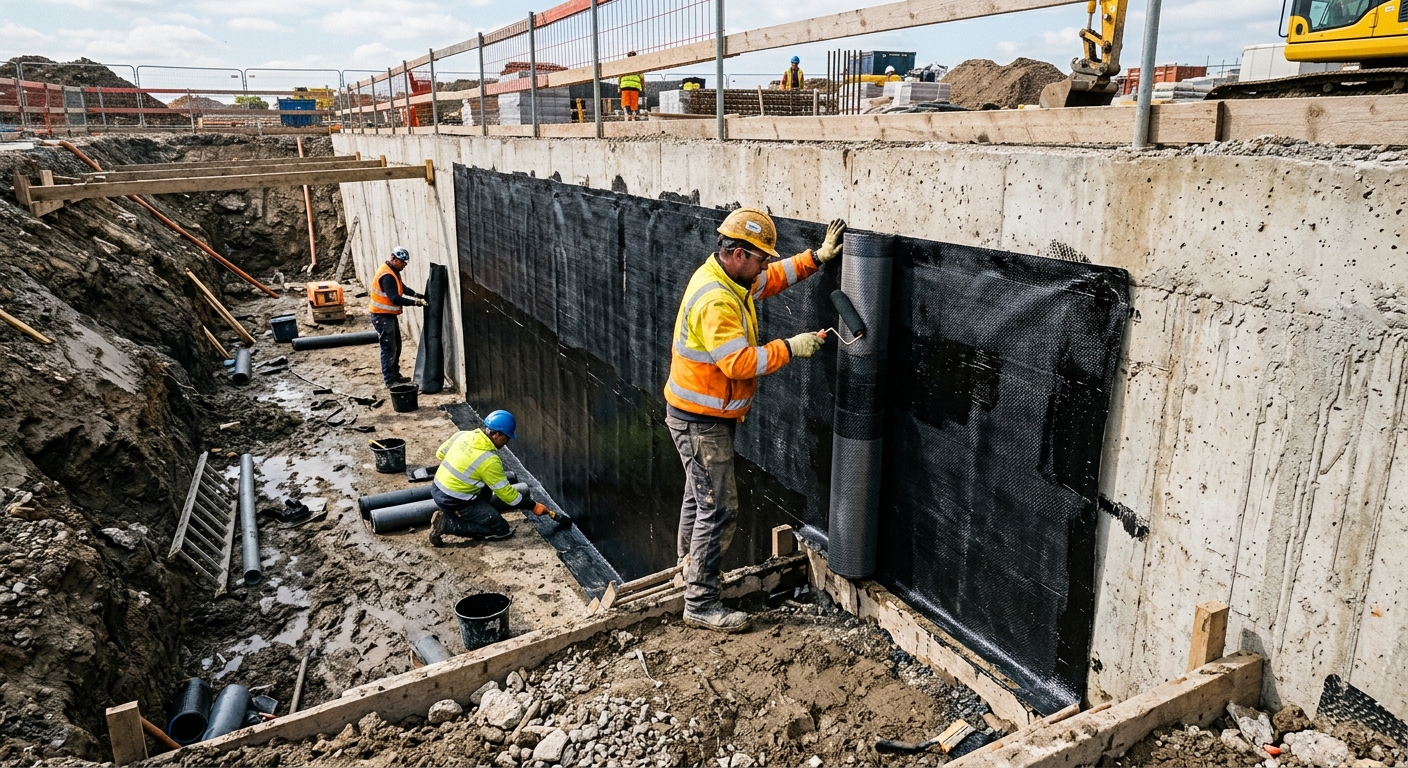
Basement waterproofing options and costs in North Riverdale
North Riverdale, Ontario sees a lot of basements with ongoing dampness, and the right fix depends on where the water is entering and how the soil around your foundation holds moisture. With a population of 11,916 (Statistics Canada, 2021 Census), the area’s housing stock is a mix of post-war builds and later renovations, and many of those earlier basements relied on original tar-and-paper membranes and clay weeping tile that are now well past their serviceable lifespan. In practice, that means homeowners often find efflorescence, musty odours, and wet floors even when there’s no dramatic “failed wall” moment.
Toronto-area pricing is also shaped by access constraints—tight urban lots, decks, and landscaping close to foundations—and by the way freeze–thaw in Ontario turns small defects into active leaks. On mixed glacial till and clay soils, saturated backfill can exert lateral pressure, widening cracks at cold joints, tie holes, and mortar lines. Contractors are often busiest in older pockets where drainage infrastructure has clogged or partially collapsed, including parts of the North Riverdale corridor where basements are regularly impacted by perched water and older drain systems.
Below is a practical comparison of the most common approaches you’ll see in North Riverdale, along with typical cost ranges, so you can compare proposals before you book a site visit.
| Method |
What It Addresses |
Disruption Level |
Durability |
Price Range |
| Exterior excavation + new membrane + drainage tile |
Stops water at the foundation source; replaces failed weeping tile and membrane where lateral soil/water pressure is high |
High (excavation, landscaping restoration) |
Long-term when properly detailed to drainage outlet and backfill |
$7,000–$25,000 |
| Interior perimeter drain channel + sump pit |
Intercepts seepage and manages hydrostatic pressure after water enters |
Medium (cutting perimeter trench, interior finishing impact) |
High with proper pump sizing and discharge routing |
$3,500–$15,000 |
| Foundation crack injection (epoxy or polyurethane) |
Targets isolated cracks; epoxy suits non-active/static cracks, polyurethane suits active leaks |
Low to Medium (surface prep, drilling) |
Good for the right crack type and preparation |
$600–$3,000 |
| Sump pump installation (primary + battery backup) |
Controls chronic seepage; battery backup reduces risk during outages and high spring flows |
Low to Medium (pit installation, minor wall/floor openings) |
Very good with reliable backup and discharge design |
$800–$3,500 |
| Window well drain installation |
Prevents surface water and pooling from entering below-grade window wells |
Medium (excavation around wells) |
Good when tied into proper drainage |
$1,200–$4,800 |
| Lot re-grading / downspout extension |
Redirects roof runoff away from foundation and reduces saturating backfill |
Low to Medium (soil reshaping, minor surface work) |
Moderate (depends on ongoing surface maintenance) |
$900–$3,200 |
Prices are estimates only and vary by project scope, site access and material selection.
What affects the price of waterproofing in North Riverdale
In Toronto’s local market, quotes for the same basic waterproofing problem can swing by 30–50% once contractors consider site conditions. That’s why you’ll see different numbers even when homeowners describe the same symptoms—“damp wall” or “wet corner”—but the water’s path, the foundation type, and the state of existing drainage are not identical. For North Riverdale, the biggest separations from a national average are soil type, water table behaviour, and freeze–thaw cycling.
Toronto-area mixed glacial till and clay pockets hold water against foundations and expand when saturated, which can add lateral pressure to concrete and block walls and worsen cracks over a few winters. When the water table is seasonally high, interior sump systems can run more often and need better capacity and backup. In older homes, original weeping tile systems can fail completely—sometimes from age, sometimes from partial collapse—so contractors may price interior-only solutions when an exterior repair isn’t feasible, or price full excavation when it is the more permanent fix.
Concrete examples from North Riverdale pricing: if your foundation is poured concrete with a few non-structural cracks, crack injection might sit closer to the $600–$3,000 range. If your contractor must excavate under a deck or remove hardscape along a shared driveway, exterior excavation can quickly move toward the upper end of the $7,000–$25,000 band due to access time and restoration. Likewise, a clogged 1960–1980s weeping tile may turn what looks like “minor seepage” into a full interior perimeter drain and sump project, aligning with the $3,500–$15,000 range.
These differences are also why a thorough site visit matters: matching the method to the soil, water dynamics, and foundation age is what keeps the fix from failing in the next freeze–thaw season.
| Price Factor |
Why It Matters |
Cost Impact |
| Interior vs. exterior approach — interior is less disruptive but addresses symptoms |
Exterior targets hydrostatic pressure at the source; interior manages water after it enters |
Interior often 40–70% less labour/disruption; exterior costs more but can be more permanent |
| Foundation type — poured concrete vs. block vs. stone vs. ICF |
Different wall textures and crack patterns affect prep, sealing method, and drainage strategy |
Block often needs more interior drainage detail; poured concrete may suit targeted injection better |
| Soil type — clay expands more than sand, adding pressure |
Clay saturation increases lateral pressure and keeps seepage active longer |
Higher risk of repeated failures if exterior drainage isn’t addressed; costs drift upward |
| Crack type and length — hairline vs. structural horizontal cracks |
Active/structural cracks require different products and sometimes engineering review |
Horizontal or active leaks can push work from injection-only to drainage plus structural assessment |
| Sump pump backup system — battery or water-powered backup needed |
Backup reduces risk during outages during spring flooding and heavy rain events |
Typically adds a noticeable line-item cost but lowers failure risk |
| Access — landscaping, decks, or driveways must be removed for exterior |
Tight lots increase hand-dig time and restoration |
Can add thousands depending on hardscape removal and reinstatement complexity |
| Weeping tile age — original tile (60+ years) may be completely failed |
When older drains are clogged or broken, replacement or full interior interception becomes necessary |
Drives scope from “manage seepage” to “replace drainage pathway” |
| Mould or efflorescence remediation required before sealing |
Sealers and membranes don’t bond reliably over active salts or contaminated surfaces |
Extra prep time and materials can increase total cost, especially for heavy salt migration |
Permits & regulations in Ontario
In Ontario, you should expect that foundation excavation, structural crack repair, and changes to lot drainage typically require a building permit. If a project involves installing or altering a sump pump discharge pathway that connects to storm or sanitary services, municipal approval is commonly required. For structural crack repair—especially horizontal cracks in block walls or major step cracking—an engineer’s assessment is often required to confirm whether the wall is stable and whether underpinning or other structural work is necessary. A reputable contractor should be comfortable coordinating the engineering component when required.
What usually does NOT require a permit (depending on scope) includes smaller, non-structural crack injection of limited area, interior-only water management where you’re not altering drainage connections to municipal services, and targeted window well drains when they are routed to an approved area on your property rather than into a municipal system. That said, rules can vary based on how discharge is handled, the extent of excavation, and whether you’re changing grading near the foundation—so your contractor’s permit plan should be explicit in writing.
To verify a contractor in North Riverdale, start with their Ontario licence status via the appropriate public registry and confirm the certificate of insurance (liability coverage) lists your property address or at least your project scope type. Then request proof of WSIB/WCB coverage (clearance letter or current account status, depending on the contractor’s program). For anything structural, ask whether they include engineering support (or subcontract it) and ensure the permit pulls—when needed—are handled by someone authorized to do so.
Interior vs exterior waterproofing — what does North Riverdale need?
In North Riverdale, the fundamental difference is that exterior waterproofing is a source-control approach, while interior waterproofing is a management approach. Exterior work—full excavation, new membrane, new drainage tile, and careful backfill—addresses where water pressure builds behind the foundation. It costs more and requires landscape disruption, but it can dramatically reduce seepage drivers caused by Toronto’s clay-heavy pockets and seasonal water saturation.
Interior waterproofing—perimeter drain channel, sump pit, and sump pump—captures water after it enters and reduces floor-level seepage and basement flooding risk. The trade-off is that it doesn’t relieve hydrostatic pressure against the wall itself. That matters in Ontario’s freeze–thaw cycles, where repeated saturation and thaw can widen existing defects at cold joints and cracks. In many homes, especially block foundations, interior systems are a practical complement even when crack sealing is also done. Poured concrete walls, on the other hand, often respond well to properly prepared crack injection as part of an overall plan, but they still benefit from drainage control when the weeping tile is failing.
Toronto power reliability is another planning point. During heavy spring rain and storm events, outages can happen. That’s why homeowners increasingly ask for sump pump backup systems. A battery backup may add cost, but it reduces the chance of basement water rising during an outage—particularly when clay soils keep water around the foundation longer.
A concrete example: if an exterior excavation job is constrained by decks and hardscape, an interior perimeter drain and sump may land closer to the $3,500–$15,000 range. If the weeping tile is completely failed and access is workable, spending toward the $7,000–$25,000 exterior range is often justified because it removes the root cause rather than chasing water after it enters.
| Method |
Best For |
Addresses Source? |
Disruption |
Lifespan |
Price Band |
| Full exterior excavation + membrane |
Active seepage driven by lateral soil/water pressure; failed original drainage; homes where access is manageable |
Yes |
High |
Long-term with correct drainage outlet and backfill detailing |
$7,000–$25,000 |
| Interior French drain + sump system |
Chronic seepage or failing weepers where exterior excavation is difficult or too disruptive |
No (manages water after entry) |
Medium |
High with good pump sizing and discharge routing |
$3,500–$15,000 |
| Crack injection — epoxy (structural) |
Non-active or stabilized cracks; where leakage is not actively flowing |
Partial (seals defect) |
Low |
Good when crack movement is controlled |
$600–$3,000 |
| Crack injection — polyurethane (active leak) |
Active water seepage through cracks; cracks showing ongoing dampness during wet periods |
Partial (seals defect and manages entry point) |
Low |
Good for active leaks when properly prepped |
$800–$3,200 |
| Interior drain channel only (no sump) |
Mild seepage and manageable water loads; situations where sump is not necessary after assessment |
No |
Medium (floor/edge cutting) |
Moderate to high if water volumes remain low |
$2,000–$7,500 |
| Re-grading + downspout extensions |
Surface runoff issues; problems that worsen after heavy rain but lack persistent seepage through the wall |
Helps reduce source pressure indirectly |
Low to Medium |
Moderate (relies on continued maintenance) |
$900–$3,200 |
How to choose a waterproofing contractor in North Riverdale
Start by verifying the contractor’s Ontario licensing status for the work they’re proposing, then confirm liability insurance and WSIB/WCB coverage. In North Riverdale, waterproofing is often a mix of excavation, concrete work, and drainage installation, so you want a contractor who can support the full scope. To check insurance, request a current certificate of insurance—make sure it’s not expired and that the policy limits are appropriate for excavation and interior demolition. For WSIB/WCB, ask for a clearance letter or proof of active coverage rather than verbal confirmation.
Next, get 2–3 itemised written quotes—not just a lump sum. A good quote breaks out labour and materials (membrane, drainage board, tile, pump system components, disposal, and any concrete restoration), and it clearly states what’s included versus excluded. Pay attention to the permit pull: ask whether the contractor will obtain permits when required and whether disposal of excavated material is included. Warranty should also be clear: separate workmanship warranty length from product/manufacturer warranties, and confirm whether the warranty is transferable if you sell your home.
For payment scheduling, don’t agree to large upfront amounts—aim for no more than 10–15% at the start and use a holdback until the job is complete and deficiencies are addressed. Finally, insist on a written timeline with a start date, expected duration, and conditions that could extend the schedule (weather, curing times, or access restoration constraints common in Toronto lots).
- Confirm Ontario licensing for the specific type of work in the proposal.
- Request a current certificate of liability insurance and verify dates.
- Provide proof of WSIB/WCB clearance or active coverage.
- Ensure quotes are itemised (labour + materials + disposal + restoration).
- Ask exactly what’s excluded (e.g., sod replacement, deck rebuild, re-pointing).
- Verify whether permits are included when drainage connections or structural work is involved.
- Confirm your discharge route for sump/water is compliant and described in writing.
- Ask what product system is proposed (membrane type, drainage board, sealant/injection resin).
- Request a workmanship warranty term and what triggers/voids it.
- Ask if the manufacturer warranty requires registration and whether they handle it.
- Use a payment schedule with 10–15% max upfront and a holdback for final completion.
- Get a written start/completion estimate and planned curing/restoration steps.
Red flags in North Riverdale include: quoting exterior waterproofing without inspecting the existing weeping tile condition; offering “crack injection only” while ignoring active seepage patterns and freeze–thaw risks; vague discharge details for sump pumps; warranty language that only covers labour for a short period without product terms; and requiring large deposits (over 25%) before any work starts.
Frequently asked questions — waterproofing in North Riverdale
What causes foundation cracks in North Riverdale?
In North Riverdale and across the Toronto area, foundation cracks are commonly linked to freeze–thaw cycles and moisture-driven movement. When clay-heavy soils around your foundation stay saturated, they can expand during winter conditions and apply lateral pressure, which worsens small defects over multiple seasons. Cracks also form at common weak points like cold joints, tie holes, and areas where older drain systems failed and allowed prolonged seepage. In post-war and 1960–1980s homes, original waterproofing details may have aged, so you’ll often see cracks plus dampness rather than only one symptom. If you’re budgeting, targeted repairs like foundation crack repair are often in the $600–$3,000 range depending on crack type and length (Statistics Canada, 2021 Census).
How do I compare waterproofing quotes?
Comparing quotes in Ontario works best when you compare scope, not just totals. Ask each contractor to specify: whether they’re proposing exterior excavation, interior perimeter drainage, crack injection, sump pump components, and how discharge is routed. Make sure labour and materials are itemised (membrane/drainage tile components, pump model, backup system if included, disposal, and restoration). Also confirm whether permits are required for your scope and whether they’re included. If one quote offers interior only while another includes exterior membrane replacement, the difference is usually because the first solution manages symptoms, while the second controls water at the source. As a rule of thumb, exterior excavation typically aligns with the $7,000–$25,000 band, while interior waterproofing and weeping tile approaches often fall into the $3,500–$15,000 band.
How long does basement waterproofing take in North Riverdale?
Timeline depends on whether you’re doing exterior or interior work, the amount of excavation, and how much restoration is required. Interior perimeter drains and sump systems often take several days to a couple of weeks including concrete cutting, waterproofing board/lines, pump install, and re-finishing. Full exterior excavation can take longer because excavation, membrane detailing, drainage tile installation, and careful backfill/compaction require time—plus weather and curing considerations. Freeze–thaw can also affect scheduling in Ontario: contractors may adjust plans around ground conditions to avoid disturbed backfill that won’t compact properly. Your best practice is to request a written start date and completion estimate, with “weather contingency” noted, and confirm when restoration work (sod, landscaping, driveway/steps) will occur after the drainage and membranes are fully set.
What is a weeping tile and does my North Riverdale home have one?
A weeping tile is an underground drainage system installed at or near foundation footing level to collect groundwater and redirect it away from the basement. In many older Toronto-area homes, the weeping tile was clay and sometimes tarred in early systems; over time it can clog or collapse, leading to chronic dampness, efflorescence, or basement flooding. North Riverdale homes built in the mid-century era often had them, but you may not have visible evidence—especially if renovations covered older drains. The most reliable way to confirm is a camera inspection or careful assessment during excavation (exterior) or by locating tie-in points during interior drainage installation. If your original weeping tile is failing, solutions can range from interior perimeter drainage and sump systems to full exterior replacement, with interior typically often falling in the $3,500–$15,000 range.
Can I waterproof my basement in winter in North Riverdale?
Yes, you can often waterproof basements in winter in Ontario, but what’s feasible depends on temperature and whether the work is interior or exterior. Interior options—like crack injection, perimeter drain channel work, and sump pump installations—are usually more controllable because they don’t rely on excavating frozen soil. Exterior excavation in winter is more challenging: frozen ground complicates excavation, and proper membrane/backfill detailing is harder when temperatures prevent the right compaction and curing. Also, Ontario freeze–thaw can mask or exaggerate leak behaviour, so contractors should inspect during conditions that reflect the water season or confirm active seepage carefully. If you’re dealing with active leaks, polyurethane crack injection is sometimes used for running water, while stabilized cracks may suit epoxy. Ask your contractor to describe what conditions they require to proceed safely and effectively.
What is the difference between waterproofing and damp-proofing?
Waterproofing and damp-proofing are often used loosely, but the difference matters. Damp-proofing generally aims to reduce moisture penetration under normal conditions; waterproofing is designed to manage hydrostatic pressure and active water entry—especially during heavy rain and spring runoff. In North Riverdale, where mixed clay soils can hold water and expand during Ontario freeze–thaw, “damp-proofing” is frequently not enough for chronic seepage and sump-level flooding. That’s why the right solution depends on water pressure and entry points: exterior waterproofing with membrane and drainage tile targets source water; interior systems like perimeter drains and sump pumps manage the water after it enters. If you’re comparing quotes, look for clear statements about hydrostatic conditions, drainage discharge routing, and whether the proposed system is intended to handle active leaks—particularly when you’re budgeting within the $7,000–$25,000 exterior or $3,500–$15,000 interior ranges.