Basement waterproofing options and costs in Kingston
Basement waterproofing in Kingston, Ontario usually starts with figuring out where the water is coming from: through the foundation wall, at the floor-to-wall joint, or through clogged or failed weeping tile. Kingston also has a sizable older housing base—about 52.7% of homes were built before 1981 (Statistics Canada, 2021 Census)—and those foundations are more likely to have aging tar-and-paper style membranes, corroded tile, and cracks that widened during years of freeze-thaw. With 132,485 residents and 32,295 homeowner households, there’s steady demand for interior drainage retrofits and targeted foundation repairs across neighbourhoods like Westdale and the older pockets near downtown.
In the Kingston–Pembroke economic region, the biggest cost drivers are local soils and groundwater conditions. Clay-rich soils tend to hold and expand when saturated, increasing lateral pressure on foundation walls and amplifying seepage once tie holes, joints, or cracks begin to fail. Contractors also price for seasonal freeze-thaw cycles that can worsen existing leaks over time, especially on poured concrete and block foundations.
That’s why two homeowners can receive quotes that differ even when they describe the “same leak.” If your priority is stopping the water at the source, exterior excavation (typically $12,000 – $25,000) is the most permanent option, but it’s also the most invasive. If you’re managing water after it enters, interior systems (often $4,000 – $10,000) can be a cost-effective path—particularly when exterior access is limited by decks, mature landscaping, or narrow side yards.
Below is a practical comparison of common Kingston waterproofing methods and what they usually address, setting you up for a tighter, apples-to-apples quote.
| Method |
What It Addresses |
Disruption Level |
Durability |
Price Range |
| Exterior excavation + new membrane + drainage tile |
Water at the foundation exterior; restores drainage path around footing |
High (landscape removal, excavation, regrading/backfill) |
High (source control) |
$12,000 – $25,000 |
| Interior perimeter drain channel + sump pit |
Seepage and floor/wall joint leaks by collecting and pumping water away |
Medium (finishing impacts along perimeter) |
Medium to high (depends on sump capacity and foundation condition) |
$7,500 – $15,000 |
| Foundation crack injection (epoxy or polyurethane) |
Stops cracks and reduces water passage through targeted leaks |
Low to medium (openings may be needed along crack line) |
Medium to high (best when combined with drainage) |
$800 – $1,800 |
| Sump pump installation (primary + battery backup) |
Reduces basement flooding during rain/spring melt; backup protects during outages |
Low to medium (minor core drilling/pipe routing) |
Medium to high (outage-resilient) |
$1,250 – $3,400 |
| Window well drain installation |
Surface water entry near basement windows and window wells |
Low to medium (excavation around specific openings) |
Medium (site- and grading-dependent) |
$900 – $2,200 |
| Lot re-grading / downspout extension |
Redirects roof runoff away from foundation to reduce hydrostatic pressure triggers |
Low to medium (topsoil/grade adjustments) |
Medium (best as part of a full drainage plan) |
$1,200 – $4,500 |
Prices are estimates only and vary by project scope, site access and material selection.
What affects the price of waterproofing in Kingston
In Kingston–Pembroke, two contractors can price the “same” waterproofing issue differently because the work isn’t identical—site conditions and foundation details drive labour time and material usage. It’s common to see a 30–50% spread across Kingston and the broader Ontario market when one company designs for soil/water movement and the other focuses only on sealing visible cracks. Nationally, waterproofing costs are influenced by climate, but the regional split in eastern Ontario versus other parts of the province is often rooted in soil type, water table behaviour, and freeze-thaw impacts.
First, soil type matters. Clay-rich soils—common across much of Ontario—hold water and can expand during freeze-thaw, increasing lateral pressure on foundation walls and widening cracks over time. When water finds a weak point (a tie hole, joint, or micro-crack), seepage becomes persistent. Second, water table and drainage conditions affect how hard interior systems must work. In Kingston–Pembroke, higher or fluctuating groundwater can increase sump pump run times and make the drainage design more demanding. Third, freeze-thaw cycles compound existing weaknesses in poured concrete and block foundations, so a “quick seal” without drainage often fails sooner.
Here are a few Kingston examples that typically move the price up or down:
- A home with original weeping tile that’s clogged or missing often needs a full drainage reset; interior-only approaches may still work, but you’ll usually see higher scope due to floor channel runs and pump selection.
- Cracks that are structural (long, stepped, or horizontal) usually require more testing and labour than hairline seepage; crack injection may still be $800 – $1,800, but additional repairs can push beyond that.
- Homes with tight side yards near Westdale or downtown often force interior drainage retrofits rather than exterior excavation, keeping jobs closer to the $4,000 – $10,000 interior band—unless excavation is truly required for source control.
These factors are why exterior excavation can land closer to $12,000 – $25,000 when access is workable and when the goal is to stop the water at the foundation boundary rather than manage it after entry.
| Price Factor |
Why It Matters |
Cost Impact |
| Interior vs. exterior approach — interior is less disruptive but addresses symptoms |
Exterior controls the source; interior manages water once it enters the basement |
Exterior often adds excavation/materials; interior can be materially lower but may need stronger pumping |
| Foundation type — poured concrete vs. block vs. stone vs. ICF |
Different wall assemblies react differently to freeze-thaw and crack propagation |
Poured concrete may respond well to targeted injection; block often needs perimeter drainage integration |
| Soil type — clay expands more than sand, adding pressure |
Water retention increases hydrostatic pressure and crack cycling |
Clay-heavy sites tend to increase labour/design time and may justify exterior source control |
| Crack type and length — hairline vs. structural horizontal cracks |
Structural movement may require engineering and/or additional stabilization beyond sealing |
More probing/testing and remedial work can raise the scope beyond simple injection |
| Sump pump backup system — battery or water-powered backup needed |
Outages during heavy spring melt can turn “managed” leaks into flooding |
Backup adds components and install time; often increases total cost noticeably but reduces risk |
| Access — landscaping, decks, or driveways must be removed for exterior |
Excavation footprints and restoration requirements affect labour and disposal costs |
Tighter access can push you toward interior solutions or increase restoration costs |
| Weeping tile age — original tile (60+ years) may be completely failed |
Failed tile can cause chronic groundwater loading around the footing |
Replacement or re-routing increases exterior costs; interior systems may require longer perimeter drains |
| Mould or efflorescence remediation required before sealing |
Moisture contamination must be addressed before sealing to protect finishes and performance |
Additional remediation steps add labour/materials and can extend timelines |
Permits & regulations in Ontario
In Ontario, foundation-related work can trigger permit requirements, especially when you’re altering drainage conditions, doing structural crack repairs, or changing the way water moves around the foundation. In Kingston, contractors typically handle the paperwork, but homeowners should know what usually requires approval versus what doesn’t.
Work that typically requires a building permit: exterior foundation excavation and membrane installation that changes drainage around the foundation; interior perimeter drainage work that includes modifying the foundation floor/walls and installing drainage channels; structural crack repairs on major horizontal or step cracks that may require an engineered solution; and changes to lot drainage that alter how stormwater is handled near/at the foundation. Sump pump installations that connect discharge to municipal services (storm or sanitary), or that alter discharge paths into those systems, usually require municipal approval.
Work that typically does NOT require a building permit: routine downspout extensions that discharge to an approved location on the property without connecting to municipal services; targeted window well drain additions limited to minor excavation; and crack injection where it’s not tied to structural stabilization (still, it should be assessed).
How to verify licensing and coverage (step-by-step) in Kingston: (1) confirm the contractor is registered for the appropriate category of work where applicable, and ask for their Ontario licence details in writing; (2) request a current certificate of insurance—verify the policy covers general liability for foundation/waterproofing work; (3) ask for proof of WSIB/WCB clearance or coverage (and make sure it’s current); (4) for structural crack repairs, ask whether they provide engineering support or work with an engineer—good waterproofing firms will document an engineer’s assessment when cracks suggest structural movement.
Before signing, keep copies of the certificate of insurance, WSIB/WCB clearance, and any engineering letter or assessment report for your records.
Interior vs exterior waterproofing — what does Kingston need?
Exterior waterproofing and interior waterproofing differ in one critical way: exterior systems aim to stop water before it enters the basement, while interior systems manage water after it gets in. Exterior excavation typically includes full dig-back to the foundation, new membrane, new drainage tile around the footing, and careful backfill and regrading. That addresses the source of seepage and chronic hydrostatic pressure, but it’s more expensive and disruptive.
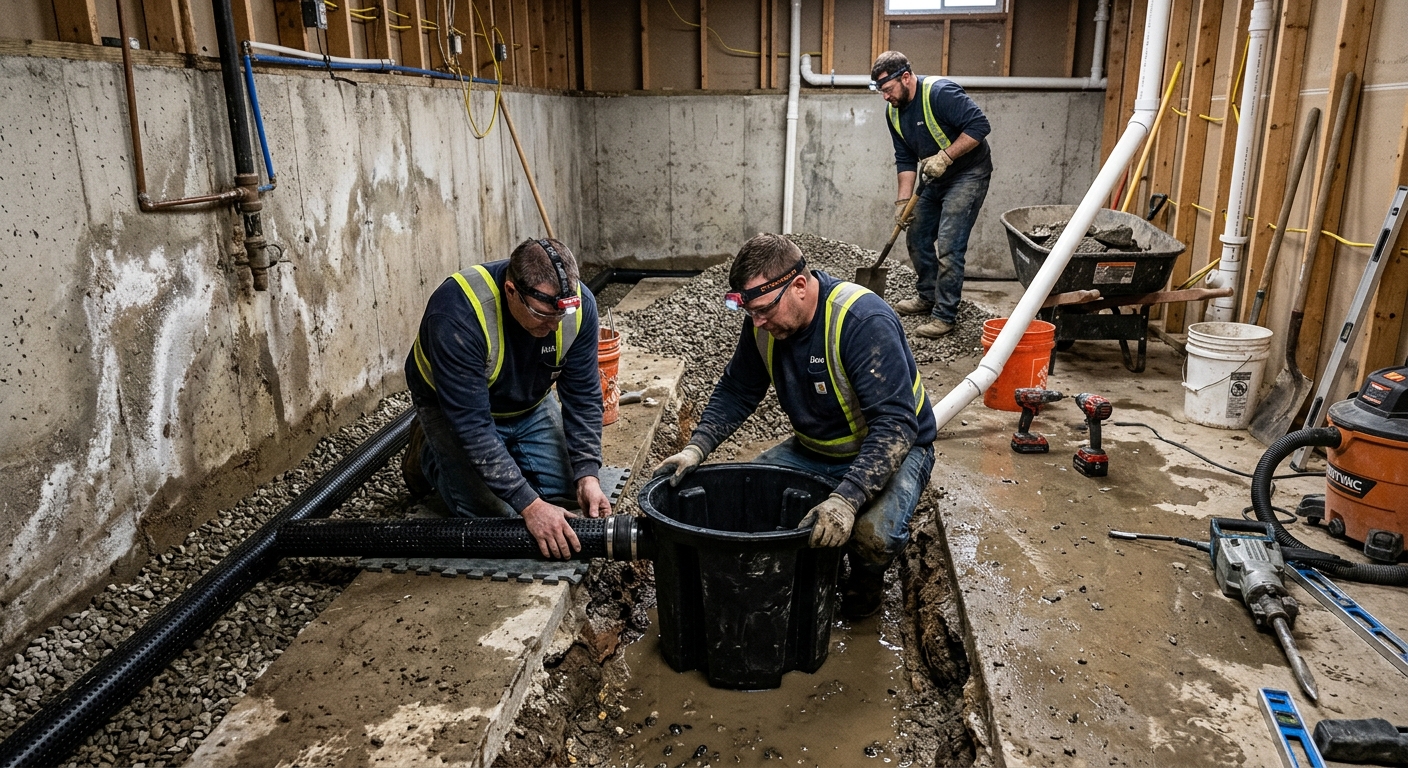
Interior waterproofing usually adds a perimeter drain channel, a sump pit, and a sump pump. In Kingston’s soil-and-water conditions—especially with clay-rich soils that can expand during freeze-thaw—interior approaches can be very effective at preventing flooding, but they don’t eliminate the pressure against the wall itself. For that reason, interior systems are often chosen when exterior access is limited or when you need a faster, less invasive retrofit to protect finishes right away.
Kingston’s foundation mix also matters. Poured concrete walls often respond well to crack injection when the crack is primarily a seepage path, and you still keep water moving using drainage. Block foundations, common in older homes, frequently benefit from interior perimeter drainage because water can travel through joints and multiple leakage paths—even if crack injection improves one area.
Battery backup on the sump pump is worth discussing for Kingston basements. During spring melt and heavy rain, power interruptions can coincide with peak runoff, and the backup helps prevent overnight flooding. If you’re comparing options, a common justification is timing and risk: exterior waterproofing in the $12,000 – $25,000 band may be overkill if your issue is localized window-well seepage or a small perimeter leak—where interior drainage solutions can fall into the $4,000 – $10,000 range. But when groundwater loading is widespread, exterior source control can be the best long-term value.
| Method |
Best For |
Addresses Source? |
Disruption |
Lifespan |
Price Band |
| Full exterior excavation + membrane |
Chronic seepage, higher groundwater loading, and clay-heavy soils pressing on walls |
Yes |
High |
Long (often the most complete solution) |
$12,000 – $25,000 |
| Interior French drain + sump system |
Interior leaks, floor joint water, and practical retrofit when exterior access is limited |
No (manages after entry) |
Medium |
Medium to long with properly sized pump/discharge |
$7,500 – $15,000 |
| Crack injection — epoxy (structural) |
Non-moving cracks where the priority is restoring a sealed barrier |
Partial (targets entry path) |
Low to medium |
Medium to high (depends on crack movement and drainage) |
$800 – $1,800 |
| Crack injection — polyurethane (active leak) |
Cracks with active seepage that need flexible sealing |
Partial (targets entry path) |
Low to medium |
Medium (often combined with drainage) |
$900 – $2,200 |
| Interior drain channel only (no sump) |
Light seepage where gravity drainage is reliable and power dependence is avoided |
No |
Lower to medium |
Shorter to medium (site-dependent) |
$4,000 – $8,500 |
| Re-grading + downspout extensions |
Surface-water driven problems and “first-line” corrections for minor dampness |
Partial (reduces triggers) |
Low to medium |
Medium (usually needs ongoing maintenance) |
$1,200 – $4,500 |
How to choose a waterproofing contractor in Kingston
Choosing a waterproofing contractor in Kingston starts with verifying coverage and scope clarity. First, confirm Ontario licensing/registration for the type of work they’re doing (ask for the exact licence number and the work category). Next, request a current certificate of insurance showing general liability—then read the policy details to ensure foundation/waterproofing work is covered. Finally, ask for WSIB/WCB clearance or proof of coverage and make sure it’s valid for the period of the project. If the contractor won’t share documents up front, that’s a red flag.
For pricing, get 2–3 itemised written quotes with a labour and materials breakdown—not a single lump sum. Make sure each quote includes the same scope: excavation depth (if exterior), membrane system type, drainage tile specifications, pipe routing, disposal, and restoration. Ask whether a building permit is included when required, and whether site protection and reinstallation of landscaping/steps are part of the contract.
Warranty matters. Look for two things: a workmanship warranty (how long they stand behind the installation) and a product/manufacturer warranty tied to the specific membrane/tile materials. Ask if warranties are transferable to future owners—important for home resale.
On payment, avoid heavy upfront deposits. A good rule is no more than 10–15% at the start, with a holdback until the job is completed and verified. Get a start date and completion estimate in writing, including contingencies for weather and curing times.
- Verify the contractor’s Ontario licence/registration and confirm the exact scope they’re permitted to perform.
- Request a certificate of insurance and confirm it’s current (not expired) and appropriate coverage amounts.
- Get WSIB/WCB clearance/proof in writing before work starts.
- Require itemised quotes with labour, materials, disposal, and restoration lines—not lump sums.
- Check exclusions: cracked concrete repairs, engineering, mould treatment, or landscaping restoration should be explicitly listed.
- Ask whether permits are included (when required) and who pulls them.
- Confirm how discharge is routed for sump pumps and whether municipal approvals are handled.
- Ask what happens if water management doesn’t solve the issue—warranty should cover workmanship, not just “attempts.”
- Get sump pump specs in writing: flow rate, discharge size, alarms (if any), and backup type.
- Ensure drainage design includes proper grading around discharge and downspout management.
- Look for engineering involvement when cracks suggest structural movement.
- Use a contract that states payment milestones, inspections, and warranty start dates.
Common red flags in Kingston include: (1) quotes that skip site assessment and moisture mapping but still promise “guaranteed dry basements”; (2) refusing to provide insurance/WSIB/WCB documentation; (3) describing crack injection without talking about drainage (a frequent cause of repeat leaks); (4) vague scopes like “install drainage” without pipe routes, tile specs, or sump sizing; and (5) large deposits (more than 15%) before any work begins.
Frequently asked questions — waterproofing in Kingston
How long does waterproofing last?
In Kingston, the lifespan of waterproofing depends on whether the job controls water at the source or only manages it after entry. A properly installed exterior system—membrane plus drainage tile and correct backfill/regrading—often performs the longest, because it reduces hydrostatic pressure against foundation walls during Kingston’s freeze-thaw seasons and wet spring cycles. Interior systems can last many years too, but performance hinges on sump design, discharge routing, and whether the original weeping tile is failed or contributing groundwater loads. If you’re comparing costs, interior drainage retrofits are frequently in the $4,000 – $10,000 band, while exterior excavations are often $12,000 – $25,000 for full source control. With correct design and maintenance (especially keeping downspouts directed away), many homeowners see strong long-term results.
Can I waterproof my basement from the inside only?
Yes, you can often waterproof from the inside in Kingston—especially when the leak is localized (like a floor joint issue) or you can’t access the exterior due to decks, hardscaping, or mature landscaping. Interior options like a perimeter drain channel with a sump pit can stop flooding by collecting water as it enters and pumping it away. However, interior-only work does not eliminate hydrostatic pressure pushing on the foundation wall; it manages water after entry. That’s why contractors may recommend interior systems when immediate protection is needed, while still planning for long-term source control if the groundwater loading is high or the weeping tile is completely failed. If your home is from the pre-1981 era (Statistics Canada, 2021 Census), older drainage assemblies are more likely to be clogged or missing, and that can affect whether interior-only approaches are enough.
What causes foundation cracks in Kingston?
Foundation cracks in Kingston are usually a combination of movement and water. In clay-rich soils common in Eastern Ontario, saturation and freeze-thaw cycles can expand the surrounding ground, increasing lateral pressure on foundation walls. Over time, that pressure widens existing weak points, including tie holes, joints, and microscopic cracks. Older housing stock also plays a role; with 52.7% of homes built before 1981 (Statistics Canada, 2021 Census), many foundations have drainage systems that are aging or failing, which lets groundwater load build up around the footing. Typical causes include poor drainage, clogged weeping tile, downspouts directing water toward the foundation, and seasonal freeze-thaw cycling that stresses poured concrete and block. The key question is whether cracks are “seepage-only” or suggest structural movement—engineer assessment is important for major horizontal or step cracks.
How do I compare waterproofing quotes?
To compare waterproofing quotes in Kingston, start by lining up the scope details—don’t compare only the total price. Ask for an itemised breakdown of labour and materials for the same components: membrane type (if exterior), drainage tile size and routing, pipe discharge plan, excavation extent, disposal, and restoration. Confirm whether the quote includes permit pulling when required, and whether mould or efflorescence remediation is included before sealing. Compare also the systems’ specs: for interior jobs, ask about sump pump capacity, discharge line size, and whether battery backup is included. Many quote spreads come from differences like “crack injection only” versus “crack injection plus drainage,” and from access/restoration complexity. If one proposal falls within the $4,000 – $10,000 interior range and another lands at $12,000 – $25,000, the question should be what water source is being controlled.
How long does basement waterproofing take in Kingston?
Timelines vary with access, foundation type, and whether you’re doing exterior excavation or an interior drainage retrofit. In Kingston, exterior jobs often take longer because excavation requires more preparation and more restoration, and because membrane and backfill work must be done carefully through weather windows. Interior perimeter drainage typically moves faster—less excavation, fewer landscaping impacts—though finishing repairs and cure times still apply. Crack injection is usually quicker than full drainage systems, but it depends on crack length and whether there’s active leakage that must be treated before sealing. A typical approach is: site inspection and design first, then scheduling excavation/interior openings, then installing drainage/membrane, followed by curing and final restoration. Ask your contractor for a written start date and completion estimate, including weather contingencies.
What is a weeping tile and does my Kingston home have one?
Weeping tile is a foundation drainage system installed around or near the footing to collect groundwater and redirect it to an outlet (historically to a sump or discharge point). Many Kingston homes—particularly older ones—may have original weeping tile, but it can be clogged, cracked, disconnected, or simply missing depending on renovations over the years. In a home built before 1981 (Statistics Canada, 2021 Census), the likelihood of aging or failed drainage components is higher, and that’s a common reason interior seepage becomes chronic after years of freeze-thaw. You can’t reliably “guess” from the basement alone—your contractor may use inspection, moisture mapping, and sometimes camera scope or test probing to confirm condition. Even if you do have tile, it may not be functioning, so the waterproofing plan still needs to address what the water is doing today.