Basement waterproofing options and costs in Waterfront Communities-The Island
In Waterfront Communities-The Island, basement waterproofing usually comes down to whether your problem is being driven from the outside soil and water pressure or from ongoing seepage once water finds a path. The City’s housing mix—many homes built in the post-war era and in the 1960–1980s—often means older drainage systems (including original clay weeping tile) are partially clogged or collapsed, so water shows up as dampness, efflorescence, and recurring wet spots rather than a single obvious wall failure.
For context, Waterfront Communities-The Island has a population of 65,913 (Statistics Canada, 2021 Census). That dense, urban fabric matters: contractors frequently work around narrow side yards, shared driveways, and built-up landscaping, which increases the time needed for excavation and safe staging. Toronto’s freeze–thaw cycles also amplify small defects; hairline cracks and cold joints can turn into active leaks after a few winters, especially where clay-rich pockets hold water against the foundation and expand when saturated.
Demand is especially high in and around older, lower-rise blocks where drainage retrofits are common—homeowners in areas like Alexandra Park and the wider Queen West corridor often see chronic basement dampness because drainage was designed for older soil conditions and the original weeping tiles can be at end-of-life.
Below are the main waterproofing approaches and typical cost ranges you’ll see in Waterfront Communities-The Island, so you can compare contractor proposals before you sign a contract.
| Method |
What It Addresses |
Disruption Level |
Durability |
Price Range |
| Exterior excavation + new membrane + drainage tile |
Hydrostatic water pressure at the foundation; replaces failing weeping tile and seals behind the wall |
High (excavation, backfill, landscaping reinstatement) |
Long-term when drainage runs to a proper discharge |
$7,000–$25,000 |
| Interior perimeter drain channel + sump pit |
Manages water after entry; reduces seepage, eliminates puddling and recurring dampness |
Medium (some floor wall cutting and cleanup) |
Very good for ongoing seepage, especially with sump maintenance |
$3,500–$15,000 |
| Foundation crack injection (epoxy or polyurethane) |
Seals cracks to stop targeted leak paths; choice depends on crack type and movement |
Low (drill/patch; minimal demolition) |
Good for stable cracks; excellent for active-leak sealing with polyurethane |
$600–$3,000 |
| Sump pump installation (primary + battery backup) |
Keeps the sump pit pumped down during spring storms and high water conditions |
Low to Medium (pit, discharge routing, power/battery setup) |
Improved reliability with backup power; performance depends on drainage design |
$1,200–$5,000 |
| Window well drain installation |
Prevents groundwater and surface runoff from pooling around below-grade windows |
Low to Medium (excavation at the window well) |
Good where window wells are the source of recurring wetness |
$900–$4,500 |
| Lot re-grading / downspout extension |
Redirects roof and surface water away from the foundation to reduce inflow and hydrostatic load |
Low to Medium (minor excavation, patching, landscaping) |
Moderate (relies on continued maintenance and good grading) |
$600–$5,000 |
Prices are estimates only and vary by project scope, site access and material selection.
What affects the price of waterproofing in Waterfront Communities-The Island
In Waterfront Communities-The Island and across the broader Toronto area, two quotes for what looks like the “same” basement job can land 30–50% apart. The difference isn’t just contractor brand—it’s what your basement is actually telling you about water movement, how old the drainage system is, and how constrained the site is when crews need to excavate or work beneath existing structures.
Three drivers most strongly separate local costs from the national average: soil type, water table, and freeze–thaw cycles. Toronto sits on mixed glacial till and clay soils with pockets of dense clay that hold water against foundations. When saturated, clay expands and can increase lateral pressure on foundation walls, worsening cracks over time. During winter, freeze–thaw cycles expand small defects in concrete and block walls—so what starts as hairline cracking can become an active seep within a few seasons.
High water conditions also change drainage requirements. When there’s chronic water around the perimeter, interior solutions frequently need more pump capacity and a more reliable discharge path; when exterior drainage is necessary, full excavation and membrane systems become the most cost-effective long-term fix, especially for failing weeping tile. In areas with 1960–1980s homes, original weeping tile may be 60+ years old in typical service life terms, and partially failed systems often mean more time spent locating the remaining runs.
Two practical examples from Waterfront Communities-The Island: (1) A clay-heavy lot with ponding near the foundation usually pushes the project toward exterior excavation and membrane—commonly in the $7,000–$25,000 band—because interior drainage alone may be overwhelmed. (2) A house with localized cracking but otherwise functioning perimeter drainage can often be managed with targeted crack injection, frequently in the $600–$3,000 range, rather than full excavation.
| Price Factor |
Why It Matters |
Cost Impact |
| Interior vs. exterior approach — interior is less disruptive but addresses symptoms |
Exterior tackles the source of hydrostatic pressure; interior manages water after entry |
Interior can be ~lower upfront; exterior often adds excavation, membrane, and reinstatement costs |
| Foundation type — poured concrete vs. block vs. stone vs. ICF |
Crack behaviour and sealing strategy differ by foundation material |
Block walls commonly require interior drainage complements; poured concrete may respond better to injection where stable |
| Soil type — clay expands more than sand, adding pressure |
Clay holds water and increases lateral load during saturation and freeze cycles |
Can push you from “patching” solutions into full drainage and membrane work |
| Crack type and length — hairline vs. structural horizontal cracks |
Active or structural movement needs a different repair plan and sometimes engineering review |
Structural repairs increase labour, materials, and possible engineering/engineering contingencies |
| Sump pump backup system — battery or water-powered backup needed |
Protects your basement during spring storms and outage scenarios |
Backup adds cost but can prevent costly re-flooding during pump downtime |
| Access — landscaping, decks, or driveways must be removed for exterior |
Urban access constraints raise excavation and reinstatement time |
May significantly increase exterior excavation budgets |
| Weeping tile age — original tile (60+ years) may be completely failed |
Older systems are often clogged or broken, limiting the effectiveness of “repair-only” approaches |
If replacement is needed, costs rise toward exterior excavation and drainage replacement |
| Mould or efflorescence remediation required before sealing |
Sealers won’t bond well over contaminated or actively crystallizing salts |
Extra labour and materials for remediation and surface prep |
Permits & regulations in Ontario
In Ontario, certain basement and drainage work around foundations typically requires a building permit, especially when you’re altering the structure or changing how water flows away from the home. In practice, foundation excavation, structural crack repair, and changes to lot drainage often fall into permit territory because they can affect structural performance and how water is managed at the property line. If your plan includes connecting sump discharge to storm or sanitary infrastructure, you may also need municipal approval and must follow the local discharge requirements.
For structural crack repair—particularly horizontal cracks in block walls, significant step cracking, or signs consistent with movement—an assessment by a structural engineer is often required to determine whether underpinning or other structural mitigation is needed. Good contractors in Ontario will either have engineering on their network or can coordinate it for you, and they should carry proper liability insurance and WSIB/WCB coverage for their workers.
To verify compliance for homeowners in Waterfront Communities-The Island, start with these steps: (1) ask for the contractor’s Ontario business licence/registration details and confirm their credentials; (2) request a certificate of insurance naming you appropriately if required; (3) obtain confirmation of WSIB/WCB clearance (or equivalent proof of coverage) before work starts; and (4) ask exactly who pulls the permit—then confirm the permit number once issued.
Work that typically does NOT need a permit: interior surface drying, spot crack sealing that’s purely non-structural and does not involve changing drainage routes, and installing/repairing window well covers. However, once you’re cutting into floors for new drainage channels, building a sump system, excavating, or altering discharge paths, you should confirm permit requirements before starting.
Interior vs exterior waterproofing — what does Waterfront Communities-The Island need?
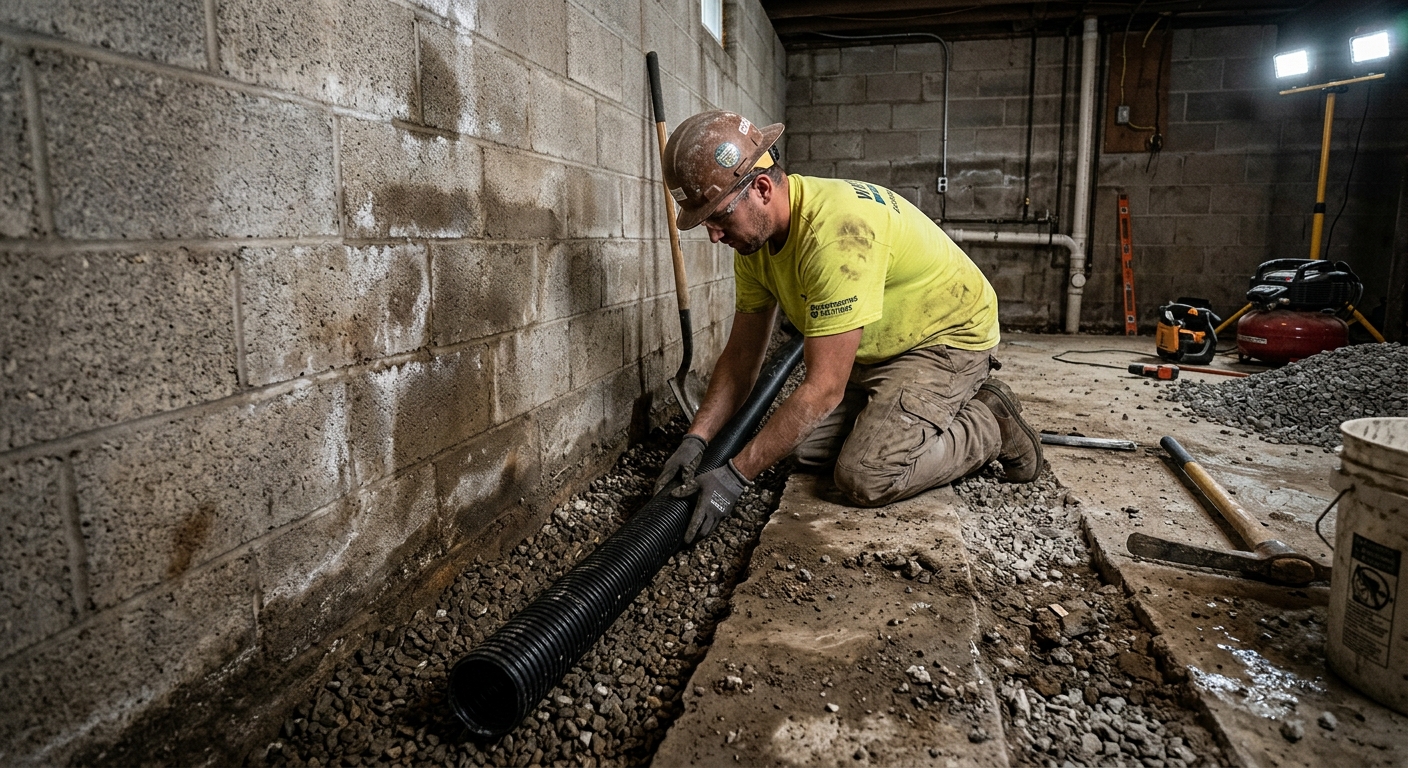
Waterproofing strategy in Waterfront Communities-The Island is about matching the approach to the water pressure and entry path. Exterior waterproofing involves full excavation to expose the foundation, install a membrane, add or replace drainage tile, and then backfill with properly compacted drainage material. Done correctly, it addresses the source of water entry by reducing hydrostatic pressure. The tradeoff is disruption: excavation in a dense Toronto lot often means removing landscaping, working around walkways and hardscaping, and coordinating reinstatement.
Interior waterproofing manages water after it enters. Typical systems include a perimeter drain channel along the footing, a sump pit, and a sump pump to keep the pit dry. Interior work is usually less invasive and can be the right choice when you’re dealing with chronic seepage, partially failed weeping tile, or when exterior access is too limited. However, interior systems don’t stop hydrostatic pressure against the wall; they reduce the consequences by collecting and pumping water away.
In Toronto’s freeze–thaw climate, you also need to plan for reliability during spring high-water and potential power disturbances. That’s why backup systems—like battery backup—are often recommended for homeowners whose basements see recurring seepage after heavy rain or snowmelt.
How this usually plays out locally: poured concrete walls can respond well to crack injection when cracks are stable, particularly if water entry is limited to a few lines. Block foundations often do better with interior drainage as a practical complement, especially when older drainage systems are struggling. A common justification example: if a basement is flooding from a perimeter zone with clay-saturated backfill and failed weeping tile, spending in the $7,000–$25,000 exterior range can cost less than repeated interior-only interventions over multiple seasons. If instead you have a small number of active crack leaks with manageable drainage, targeted injection and drainage upgrades can land closer to the $600–$3,000 crack repair band plus a sump tie-in.
| Method |
Best For |
Addresses Source? |
Disruption |
Lifespan |
Price Band |
| Full exterior excavation + membrane |
Active seepage from perimeter water pressure; failing weeping tile; persistent dampness after storms |
Yes |
High |
Long-term when drainage discharges correctly |
$7,000–$25,000 |
| Interior French drain + sump system |
Chronic seepage, clogged/failed exterior drains, or restricted exterior access |
No (manages after entry) |
Medium |
Long-term with correct pump sizing and maintenance |
$3,500–$15,000 |
| Crack injection — epoxy (structural) |
Stable, non-moving cracks where sealing the concrete crack is appropriate |
Mostly (stops a leak path; doesn’t replace drainage) |
Low |
Good when the crack is truly stable |
$600–$2,500 |
| Crack injection — polyurethane (active leak) |
Active seepage through cracks, including small water jets and active joints |
Mostly (stops a leak path; complements drainage) |
Low |
Excellent for active-leak situations when properly selected |
$800–$3,000 |
| Interior drain channel only (no sump) |
Light dampness or slow seepage where gravity drainage can work reliably |
No |
Medium |
Shorter to moderate depending on ability to discharge and seasonality |
$2,000–$7,500 |
| Re-grading + downspout extensions |
Surface runoff issues and early dampness related to roof water around the foundation |
Indirect (reduces inflow) |
Low to Medium |
Moderate; requires maintenance of grading and eavestroughs |
$600–$5,000 |
How to choose a waterproofing contractor in Waterfront Communities-The Island
Choosing a waterproofing contractor in Waterfront Communities-The Island starts with verifying the basics—then confirming the details match your foundation and your water source. First, ask for proof of Ontario licensing/registration details, then request a certificate of liability insurance and WSIB/WCB coverage (or clearance proof, as applicable). For WSIB/WCB, don’t accept verbal assurances—ask for the clearance letter or documented proof and check that it aligns with the company name doing the work.
Next, get 2–3 itemised written quotes instead of one lump-sum number. You want a breakdown showing labour and materials (excavation, membrane/drain tile, pump and backup, concrete cutting, disposal, and reinstatement). Reading the scope carefully prevents surprises: confirm what’s included for permit pull (if required), debris removal/disposal, and restoration of landscaping or driveway areas. If the contractor can’t clearly explain exclusions, like failing drain abandonment or engineering contingencies, that’s a risk.
Warranty matters too. Ask for the workmanship warranty length and what it covers, plus the manufacturer/product warranty for membranes, coatings, drainage components and pumps. Clarify whether warranties are transferable if you sell the home.
For payment schedule, never pay the majority up front. A common safe approach is limiting upfront payment to about 10–15%, then holding back a portion until the work is complete and cleaned up. Finally, insist on a start date and completion timeline in writing so you’re not stuck with an open excavation during Toronto weather swings.
- Request proof of Ontario licensing/registration details before signing.
- Ask for a current certificate of liability insurance and verify policy dates.
- Confirm WSIB/WCB coverage (clearance letter or documented proof).
- Get 2–3 itemised quotes with labour + materials breakdown.
- Ensure the scope states what will be removed/disposed and what will be reinstated.
- Clarify whether a permit is required and who pulls it (and whether costs are included).
- Confirm how drainage discharge is handled (and whether it ties into municipal acceptance rules).
- Ask how they identify active leaks (visual mapping, moisture checks, crack type selection).
- Require crack injection product selection based on crack behaviour (epoxy vs polyurethane).
- Ask about pump sizing and discharge routing; include backup plan where needed.
- Verify warranty details: workmanship term, product warranty terms, transferability.
- Agree to a payment schedule with a holdback; avoid large deposits.
In Waterfront Communities-The Island, common red flags include: contractors who blame “house settling” without mapping crack locations; quotes that mention exterior work but don’t address access limitations (decks/driveways/raised additions); vague scopes with no line items for membrane, drainage tile, or disposal; and crews who won’t discuss backup power for sump systems when your basement is prone to spring seepage. Another red flag is a warranty that covers materials but not workmanship, or refusing to provide written start/completion dates.
Frequently asked questions — waterproofing in Waterfront Communities-The Island
Do I need a sump pump in Waterfront Communities-The Island?
You may need a sump pump in Waterfront Communities-The Island if you get active seepage after heavy rain or snowmelt, especially where the perimeter drain can’t reliably rely on gravity drainage. With Toronto’s freeze–thaw cycles and clay-heavy pockets that hold water against foundations, sump systems often provide the reliability that interior drainage alone can’t guarantee during peak seasons. If your assessment shows chronic groundwater or recurring basement puddling, a sump install is commonly paired with an interior perimeter drain channel and may include battery backup for resilience during power outages.
In practical terms, homeowners often see sump-related work starting around $1,200–$5,000, depending on whether you’re adding a pump only or also installing the pit, discharge routing, and backup.
How does Waterfront Communities-The Island's soil affect my foundation?
In Waterfront Communities-The Island, the dominant issue is how mixed glacial till and clay soils behave when they’re saturated. Dense clay can hold water tight against the foundation, increasing lateral pressure on basement walls. During freeze–thaw, small defects—like hairline cracks, cold joints, and tie holes—can widen and become active leak paths over a few winters. This is why two basements with the same-looking crack can require very different solutions: one might be a localized crack injection job, while another needs exterior drainage replacement because the soil is continuously supplying water.
Where clay saturation is persistent, interior systems may still help, but exterior membrane and drainage upgrades are often the more complete solution.
Do I need a permit for foundation work in Ontario?
Often, yes—especially when you’re doing excavation near a foundation, making structural crack repairs, or changing lot drainage away from the home. In Ontario, foundation excavation and structural crack work typically require a building permit, and sump connections that affect discharge routes can require municipal approval. For major repairs involving potential structural movement, a structural engineer’s assessment is commonly required before you proceed with underpinning or related work.
For a homeowner in Waterfront Communities-The Island, the best way to verify is to ask your contractor to state exactly what they’re pulling permits for, then confirm the permit number once issued. Also verify the contractor is properly insured and has documented WSIB/WCB coverage before work begins.
How long does waterproofing last?
“How long it lasts” depends on which failure mode you’re correcting: sealing the leak path, managing water pressure, or both. Targeted crack injection can last many years when the crack is stable; active-leak polyurethane repairs are designed for seepage that persists through cold joints and small movements. Interior perimeter drains and sump systems can perform long-term if the pump, discharge, and backup power are appropriate for Toronto’s seasonal high-water. Exterior waterproofing with membrane and drainage tile typically offers the most durable outcome because it reduces hydrostatic pressure at the source.
That said, longevity is also about maintenance—keeping downspouts functional and ensuring grading remains sloped away from the foundation.
Can I waterproof my basement from the inside only?
Yes, you can often waterproof from the inside only, especially if the source is limited seepage through cracks or if exterior access is constrained in Waterfront Communities-The Island lots. Interior perimeter drain channels and sump systems can greatly reduce dampness, efflorescence, and puddling by collecting water and pumping it away. For isolated active leaks, crack injection (epoxy or polyurethane) can be an effective targeted option without the disruption of exterior excavation.
However, interior-only approaches generally manage water after it enters; they don’t fully stop hydrostatic pressure against the wall. If your issue is continuous lateral pressure from clay-saturated backfill and failing weeping tile, a full exterior solution may be more cost-effective long-term than repeated interior fixes. Interior work commonly aligns with the $3,500–$15,000 range depending on scope.
What causes foundation cracks in Waterfront Communities-The Island?
Foundation cracks in Waterfront Communities-The Island are typically driven by a mix of soil moisture changes, freeze–thaw movement, and the age of the structure and original drainage. Clay-rich soils can expand when saturated and increase lateral pressure on basement walls, which can worsen cracks over time. Toronto’s freeze–thaw cycles then contribute by expanding small defects in concrete and block foundations, turning minor issues into active seep points. In many post-war and 1960–1980s homes, older drainage systems (including partially failed weeping tile) can contribute by letting water build up near the foundation.
If you see horizontal cracks in block walls or step cracking that appears to change over seasons, treat it as a potential structural concern and get a professional assessment before choosing a repair method.