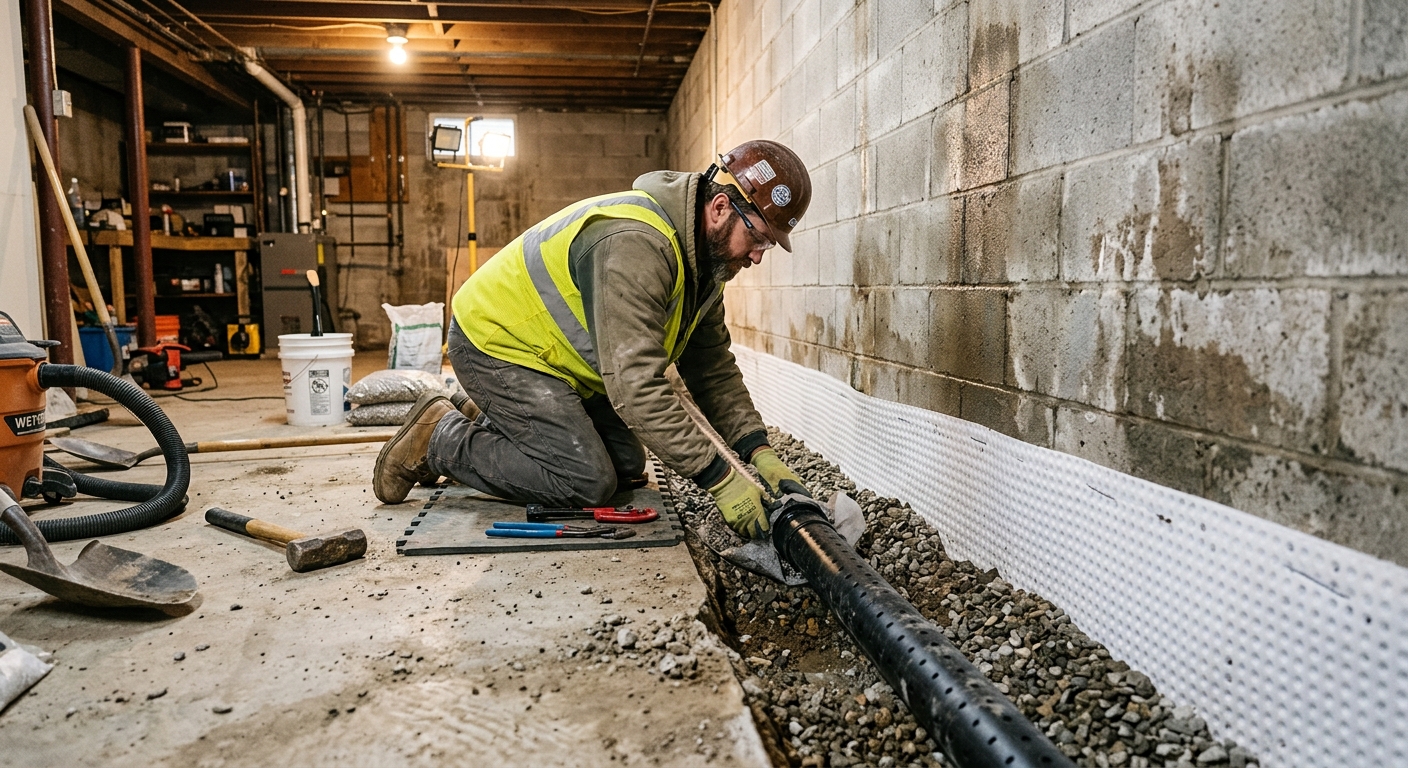
Basement waterproofing options and costs in Pioneer Park
Pioneer Park is a growing, family-focused community in the Toronto economic region, and that means lots of basements in mixed glacial till and dense clay soils. With a population of 9,108 (Statistics Canada, 2021 Census), you’ll also see steady turnover in older homes—many built before consistent modern drainage detailing—where original tar-and-paper systems and early weeping tile are often partially failed. That matters because in Toronto-area basements, water rarely “chooses” only one path; it typically finds weak spots at cold joints, tie holes, cracks, and around older drains that have shifted or clogged over time.
Local waterproofing costs are shaped by excavation access constraints, freeze–thaw cycles, and the fact that many post-war and 1960–1980s homes have drainage that’s now 40–60+ years old. Contractors price differently depending on whether they can excavate along the foundation wall or whether they must work from inside due to decks, driveways, or shared lot edges. In demand areas around older bungalow pockets and established streets with mature landscaping—where hand-digging is common—you’ll typically see higher labour and disposal costs for exterior work. When exterior access is difficult, many homeowners choose a staged approach: targeted interior drainage and sump first, followed by exterior excavation later if needed.
Below is a practical comparison of the most common solutions we see for Pioneer Park basements, with realistic Pioneer Park/Toronto price bands to help you line up like-for-like scopes.
| Method |
What It Addresses |
Disruption Level |
Durability |
Price Range |
| Exterior excavation + new membrane + drainage tile |
Lateral water pressure, failed perimeter drainage, water at foundation contact points; creates a full “drainage plane” |
High (excavation, removal and landscaping restoration) |
High (best source control when access allows) |
$7,000 – $25,000 |
| Interior perimeter drain channel + sump pit |
Water that enters through cracks and weeping tile failure; manages hydrostatic seepage |
Medium (floor/sidewall opening along perimeter) |
Medium-to-high (depends on crack condition and discharge management) |
$3,500 – $15,000 |
| Foundation crack injection (epoxy or polyurethane) |
Isolated cracks; epoxy for structural-type sealing, polyurethane for active leaks |
Low (localized drilling and injection) |
Medium-to-high (best for defined crack patterns) |
$600 – $3,000 |
| Sump pump installation (primary + battery backup) |
Chronic seepage and high run times; reduces flood risk during power disruptions |
Low-to-medium (pit excavation and plumbing) |
Medium-to-high (system performance depends on discharge and backup) |
$800 – $3,500 |
| Window well drain installation |
Surface water infiltration around window wells and egress areas |
Low-to-medium (partial landscaping/grading around wells) |
Medium (good for targeted wetting sources) |
$1,200 – $4,000 |
| Lot re-grading / downspout extension |
Redirects roof runoff and reduces water load against foundation |
Low (minor demolition and yard work) |
Low-to-medium (works best with drainage already functioning) |
$900 – $3,500 |
Prices are estimates only and vary by project scope, site access and material selection.
What affects the price of waterproofing in Pioneer Park
In Pioneer Park, it’s common to see quotes for the same “basement waterproofing” work land 30–50% apart across the Toronto area, even when the visible problem looks similar. The difference usually comes down to how each contractor diagnoses the water source (source control at the exterior vs symptom management inside), what they include in the scope, and what conditions they uncover once excavation or interior demolition starts. Labour rates and disposal costs are also influenced by access constraints—tight urban lots, mature landscaping, decks, and working below deck footings.
Three local drivers separate Toronto-area pricing from a national average: soil, water table, and freeze–thaw. In Pioneer Park, mixed glacial till and clay pockets can expand when saturated, exerting lateral pressure on foundation walls and worsening cracks. That expansion turns small defects into active leaks over a few winters, which is why foundation crack repairs and interior drainage scopes often expand after the first freeze. High local water tables in many neighbourhoods also increase sump pump run times and the need for a properly sized discharge path. And on older housing stock—especially post-war and 1960–1980s homes—original weeping tile may be partially collapsed or clogged, so “same-day” repairs can become multi-trade drainage work.
Concrete examples we see in Pioneer Park: (1) a basement with damp corners plus efflorescence often needs interior perimeter drainage and a sump, whereas a basement with one defined active crack may be handled with crack injection alone; (2) houses with exterior access blocked by a sunroom or shared walkway often shift the job toward interior approaches, which can be cheaper upfront but may not fully relieve hydrostatic pressure. At the same time, if you’re spending in the $7,000 – $25,000 exterior range, you’re typically paying for true source control—excavation, membrane, and new drainage tile—rather than patching symptoms.
| Price Factor |
Why It Matters |
Cost Impact |
| Interior vs. exterior approach — interior is less disruptive but addresses symptoms |
Exterior targets the water entry path; interior captures water after it enters |
Interior often costs less initially (often within $3,500 – $15,000), but exterior can reduce recurrence |
| Foundation type — poured concrete vs. block vs. stone vs. ICF |
Crack behaviour and sealing strategy vary by wall material |
Block foundations commonly need interior drainage complements; poured concrete often responds better to sealing + injection |
| Soil type — clay expands more than sand, adding pressure |
Clay holds water and increases lateral pressure during freeze–thaw |
Higher risk of active seepage can push scopes toward drainage + sump systems |
| Crack type and length — hairline vs. structural horizontal cracks |
Not all cracks are equal; horizontal/structural patterns may require engineering |
Structural-type repairs can add engineering and labour beyond the $600 – $3,000 crack injection band |
| Sump pump backup system — battery or water-powered backup needed |
Reduces flood risk during power interruptions common in spring weather |
Can increase pump system pricing within the $800 – $3,500 range |
| Access — landscaping, decks, or driveways must be removed for exterior |
More removal and restoration equals more labour and disposal |
Can push exterior excavation toward the upper end of $7,000 – $25,000 |
| Weeping tile age — original tile (60+ years) may be completely failed |
Older drains are often collapsed, clogged, or misaligned |
May change a repair plan into replacement or add interior capture measures |
| Mould or efflorescence remediation required before sealing |
Moisture damage must be addressed before coatings/sealants will perform |
Adds time for drying and proper remediation, increasing total cost |
Permits & regulations in Ontario
In Ontario, certain waterproofing-related work can trigger permit requirements, especially when you’re changing structural elements, drainage pathways, or connecting to municipal services. Generally, excavation for exterior waterproofing near a foundation, structural crack repair that affects load-bearing walls, and changes to lot drainage or weeping tile discharge typically require a building permit. If you’re installing or modifying a sump pump system that connects to the storm or sanitary sewer, municipal approval is usually required before any tie-in.
For structural crack repair—particularly horizontal cracks in block walls or any major step-crack pattern—plan for an assessment by a structural engineer. That engineering step determines whether underpinning or other structural measures are needed, not just sealant or patching. A reputable waterproofing contractor in Pioneer Park will coordinate this and can explain how they handle liability when structural conditions are involved.
How to verify a contractor in Pioneer Park (Ontario) step-by-step:
- Check the contractor’s Ontario licence/registration status through the appropriate provincial registry for their trade category.
- Ask for a current certificate of insurance (liability) and confirm the effective dates and coverage limits.
- Request proof of WSIB/WCB clearance (or an equivalent compliance letter) before work starts.
- For structural scopes, confirm they have engineering support in writing (who provides the assessment, and how recommendations are implemented).
- Confirm whether permits are pulled by the contractor or the homeowner—get this in the written scope.
If you want a simple rule: exterior excavation that changes foundation systems, structural crack remediation, and any tie-in to municipal sewer systems are where permits/approvals commonly come into play; cosmetic sealing of isolated damp spots without drainage changes often does not.
Interior vs exterior waterproofing — what does Pioneer Park need?
The fundamental difference is that exterior waterproofing aims to stop water at its source—full excavation, membrane application, new drainage tile, and then properly compacted backfill. Interior waterproofing, by contrast, manages water after it enters—typically a perimeter drain channel, sump pit, and sump pump discharge. In Pioneer Park’s Toronto-area freeze–thaw climate, source control is the more permanent choice when there’s active hydrostatic pressure, especially in mixed clay soils that expand when saturated. However, exterior work costs more and often requires landscape removal, which is a major decision driver in established neighbourhoods with decks, mature plantings, and tight lot lines.
Approach selection should also reflect foundation type. Poured concrete walls often respond well to crack injection when cracks are well-defined, particularly when paired with interior drainage as a backup. Block foundations, however, more commonly need interior drainage as a practical complement because mortar joints and block behaviour can allow seepage even when “small leaks” appear localized. That’s why we often see interior French drains and sump systems used when excavation isn’t feasible, while exterior excavation is recommended for long runs of leaking, recurring efflorescence, or failing weepers.
Sump pump backup deserves special attention in Ontario. Even if power interruptions are not constant, spring flooding seasons and severe weather can extend downtime when a primary pump fails. A battery backup or water-powered backup helps bridge that gap—often worth the cost when the basin already shows frequent high run times.
A concrete dollar example: if you’re choosing between an interior perimeter drain + sump plan in the $3,500 – $15,000 band and full exterior excavation in the $7,000 – $25,000 range, the higher cost is justified when you have clear evidence of recurring water pressure (multiple wet walls, persistent floor seepage, or failing weeping tile). If the issue is a single active crack or localized window well wetting, you may not need to excavate the entire perimeter.
| Method |
Best For |
Addresses Source? |
Disruption |
Lifespan |
Price Band |
| Full exterior excavation + membrane |
High water pressure, widespread seepage, failing exterior drainage, chronic dampness on multiple walls |
Yes (stops entry at the exterior) |
High (excavation and landscaping restoration) |
Long (typically decades with correct drainage and backfill) |
$7,000 – $25,000 |
| Interior French drain + sump system |
Homes with limited exterior access; chronic seepage after weeping tile failure; basements with recurring damp floor conditions |
No (captures water after it enters) |
Medium (perimeter floor/sidewall openings) |
Medium-to-long if discharge path and pump capacity are correct |
$3,500 – $15,000 |
| Crack injection — epoxy (structural) |
Static, non-moving cracks where water entry is limited or can be stabilized |
Mostly (seals crack pathway) |
Low (localized drilling/injection) |
Medium-to-long for stable cracks |
$600 – $3,000 |
| Crack injection — polyurethane (active leak) |
Active seepage through cracks that show movement of water |
Seals the pathway at the crack |
Low (targeted injections) |
Medium (good for active leaks when correct prep is done) |
$700 – $3,500 |
| Interior drain channel only (no sump) |
Minor seepage or intermittent dampness where water can be managed without pump reliance |
No (still symptom management) |
Medium (perimeter work, but less equipment) |
Short-to-medium (depends on water volumes) |
$2,000 – $8,000 |
| Re-grading + downspout extensions |
Surface water issues from roof runoff; early-stage dampness near grade |
Indirect (reduces load, doesn’t seal cracks) |
Low (yard work) |
Low-to-medium (requires ongoing maintenance) |
$900 – $3,500 |
How to choose a waterproofing contractor in Pioneer Park
Choosing a waterproofing contractor in Pioneer Park comes down to verification, scope clarity, and realistic sequencing for Toronto-area conditions. Start by confirming Ontario compliance. For licensing, use the provincial registry for the contractor’s applicable trade category and ensure it’s active for the company you’re hiring. Next, request a certificate of insurance (liability) and verify it’s current, includes work at your address, and lists the right insured parties. Finally, ask for WSIB/WCB coverage evidence or a clearance letter before any demolition begins—this protects you if labour is injured on site.
Get 2–3 itemised written quotes that break out labour and materials (membranes, drainage tile, pumps, liner systems, excavation, disposal, restoration). A lump sum quote often hides exclusions like proper disposal of excavated soil, patching and waterproofing around penetrations, or whether permits are included. Read the scope for what’s not included: does the quote include de-moulding if there’s visible efflorescence, the full perimeter drain layout, proper discharge routing, and restoration to pre-existing grade? Also confirm warranty terms—workmanship warranty length, manufacturer product warranty duration, and whether warranty coverage is transferable to a new owner.
On payment, avoid large deposits. A practical rule is never more than 10–15% upfront; keep a holdback until the job is complete and inspected. Ask for a start date and completion estimate in writing, plus what weather delays are expected during freeze–thaw shoulder seasons.
- Ask how they diagnose water entry: exterior source control vs interior capture, not just “dry it out”.
- Confirm whether they address failed weeping tile (60+ years) or only install interior drains.
- Ensure the pump system includes discharge requirements and backflow prevention where needed.
- Get a site access plan for decks, driveways, and hand-digging constraints.
- Require a written scope of work with photos/measurements of crack locations.
- Ask which membrane and drainage products they use and why they’re suitable for clay soils.
- Confirm disposal and restoration are either included or listed as exclusions.
- Verify they coordinate permits/approvals if connecting sump discharge to municipal services.
- Request engineering involvement in writing for structural crack patterns.
- Make sure crack injection includes correct prep (cleaning, surface preparation, and correct injection ports).
- Use the quote to confirm expected price alignment with the right band (exterior $7,000 – $25,000 vs interior $3,500 – $15,000).
- Get warranty documentation before signing and keep it in your home file.
Red flags we hear about in Pioneer Park: contractors who promise “one-size-fits-all” waterproofing without mapping cracks or drainage; quotes that skip a discussion of soil and water pressure (common with clay); using injection products without confirming whether cracks are active; offering no pump backup discussion in chronic seepage basements; and delaying paperwork like insurance/WSIB/WCB until after you’ve paid deposits.
Frequently asked questions — waterproofing in Pioneer Park
What is a weeping tile and does my Pioneer Park home have one?
Weeping tile is the perimeter drainage pipe system installed around foundations to collect groundwater and direct it away from the basement—often to a sump, a dry well, or an outlet line. In many Toronto-area basements, especially homes built in the post-war to 1960–1980s era, the original weeping tile used clay sections or early plastic, and that older piping is frequently partially collapsed or clogged by the time homeowners notice interior dampness. If you see efflorescence (white mineral salts) along block or poured concrete, or recurring damp corners after heavy rain or thaw periods, that can point to failing perimeter drains.
To confirm without guesswork, ask for a drainage check: a camera inspection (if accessible) or evidence review of existing tile lines, cleanouts, and discharge plumbing. It’s also worth noting that if the weeper is 60+ years old, replacement or a combined interior sump approach is commonly priced within the $3,500 – $15,000 range depending on how much opening and excavation is needed.
Can I waterproof my basement in winter in Pioneer Park?
Yes, but it depends on what kind of waterproofing you’re planning and what freeze–thaw is doing to your foundation walls right now in Ontario. Interior work—like crack injection, interior drain channels, sump pits, and pump installation—can often be completed in winter because it’s localized and doesn’t always require full exterior excavation. Exterior excavation is more challenging when soil is frozen or saturated; excavation may increase labour and cause schedule delays if you can’t safely excavate and backfill to correct compaction standards.
In Pioneer Park, the priority is that water conditions and temperatures don’t prevent proper prep. For crack injection, contractors usually need dry, clean crack prep and correct product curing conditions. For interior drains, they still need to ensure discharge is properly routed and that pump components are protected. If your goal is source control via exterior membrane, many homeowners plan it for milder seasons to keep costs predictable—especially when working within the $7,000 – $25,000 exterior excavation band.
What is the difference between waterproofing and damp-proofing?
Damp-proofing is generally about slowing down moisture penetration, while waterproofing is designed to actively manage water entry and seepage so your basement stays dry under wet conditions. In Ontario’s Toronto region, “damp” can quickly become “wet” due to clay soils holding water, plus freeze–thaw cycles widening defects in concrete and block walls. That’s why products and methods that work for minor moisture won’t always handle recurring hydrostatic pressure.
For example, exterior excavation with a proper membrane and new drainage tile is true source control waterproofing: it reduces the amount of water at the foundation so seepage doesn’t keep coming back. Interior perimeter drainage and sump systems are waterproofing in a practical sense—because they capture and remove water—but they manage what enters rather than fully eliminating pressure. Crack injection can be waterproofing for isolated active leaks when the right material is chosen (polyurethane for active leaks vs epoxy for stable cracks).
If you’re deciding between interior drainage and crack injection, your contractor should explain where water is coming from and which approach is most realistic for Pioneer Park’s freeze–thaw-driven crack behaviour.
Will basement waterproofing affect my property value in Pioneer Park?
Often, yes—when it’s done for the right cause and documented properly. In Ontario, buyers consistently value basements that are dry, usable, and free of recurring efflorescence, musty odours, and “mystery water.” A well-scoped waterproofing job also reduces the risk of expensive interior damage over multiple winters, especially in clay-heavy Toronto-area soils where small defects can become active leaks.
That said, value impact depends on approach and how well the work matches the problem. Exterior source control can be more compelling for buyers because it addresses water entry, but it requires excavation and restoration. Interior drainage with a sump and backup can still be very effective and budget-aligned—especially if exterior access is limited. Many homeowners find the decision easier when the scope is priced transparently: for example, an interior perimeter drain and sump plan typically falls within the $3,500 – $15,000 band, while full exterior waterproofing is often in the $7,000 – $25,000 band.
To protect your resale value, keep warranties, product information, and inspection photos so future buyers can understand what was corrected.
What drainage issues are most common in Pioneer Park homes?
The most common issues usually come from older perimeter drainage systems and yard drainage patterns that put water against foundation walls. In the Pioneer Park/Toronto area, dense clay pockets and high saturation can increase lateral pressure, while freeze–thaw cycles worsen existing cracks. Many homeowners report damp corners, floor seepage during spring thaws, and white efflorescence along block or poured walls—symptoms that often point to failing weeping tile or poor discharge routing.
Two frequent scenarios: (1) original clay or early plastic weeping tile systems (often decades old) are clogged or collapsed, so water no longer drains properly; and (2) downspouts and grading issues direct roof runoff toward the foundation, increasing the wet season load. Window wells are also a hotspot, especially where surface water collects around egress areas.
When you see active seepage through a defined crack line, crack injection may be targeted. When you see multiple wet areas or chronic dampness, interior perimeter drainage and sump installation—within the $3,500 – $15,000 or pump $800 – $3,500 ranges depending on system scope—tends to be more reliable.
How do I choose a waterproofing contractor in Pioneer Park?
Start by verifying compliance and capacity, then demand a scope you can compare. In Ontario, ask the contractor to show: current liability insurance, WSIB/WCB proof or clearance letter, and active registration/licensing for the work they’ll perform. You should also ask whether permits are needed for your specific scope—especially for exterior excavation that changes lot drainage and for any sump discharge connections that may require municipal approvals.
Next, get 2–3 itemised written quotes (labour + materials, not just a lump sum). Confirm what’s included: disposal, restoration, crack prep, pump discharge routing, and whether remediation is required if mould or efflorescence is present. A strong contractor explains whether you need exterior source control or an interior capture strategy based on soil, water pressure, and foundation type.
Finally, review warranty terms and payment schedule. Keep upfront payments to about 10–15% and hold back until completion. If someone quotes exterior work far below the typical $7,000 – $25,000 band without explaining access/disposal or product quality, treat it as a red flag.