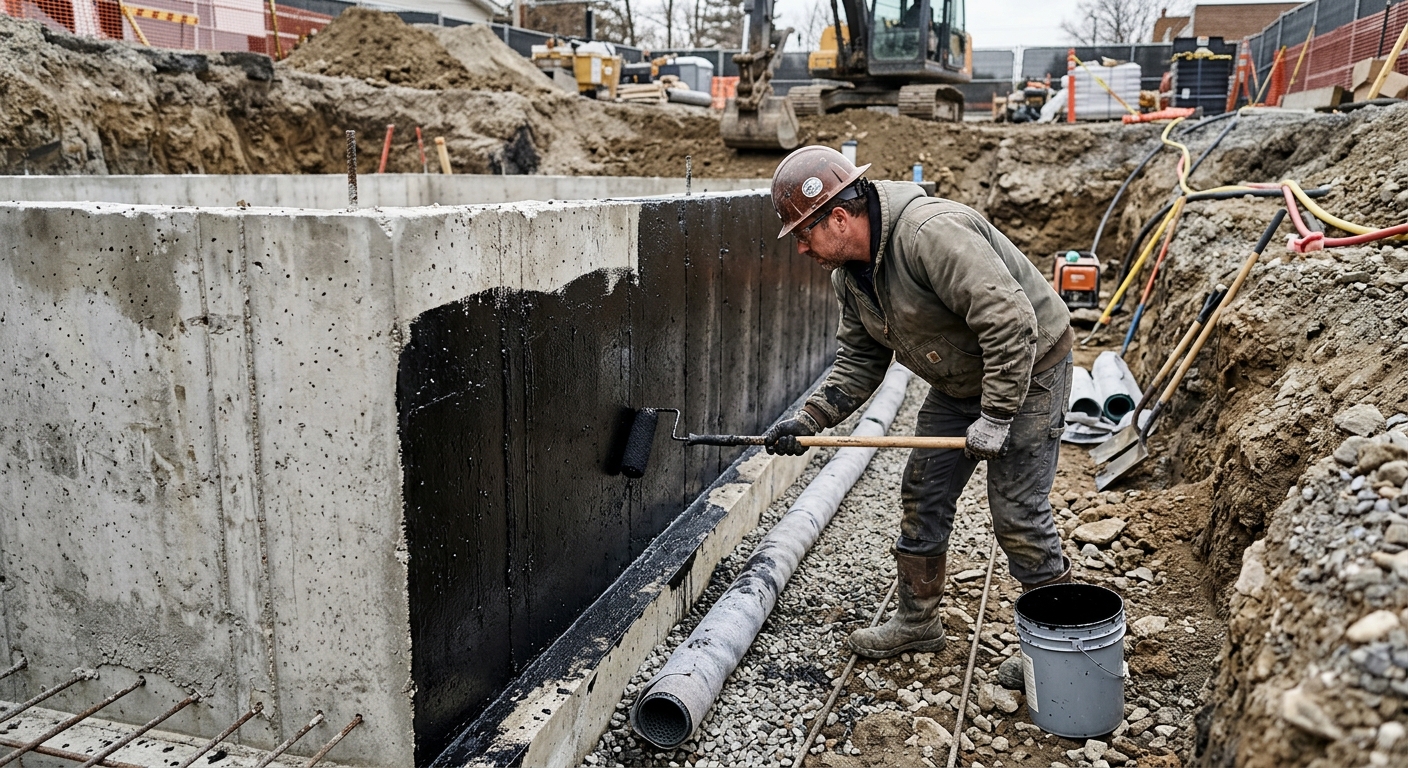
Basement waterproofing options and costs in Cherry Hill
In Cherry Hill, homeowners typically face one of two realities: water is finding a path through old cold joints and cracks, or failing drainage behind and around the foundation is no longer managing hydrostatic pressure. With Cherry Hill’s smaller population (3,027 residents, Statistics Canada, 2021 Census), trades tend to get booked solidly when a cluster of nearby homes start seeing the same spring and early-summer dampness patterns.
Because much of the surrounding Toronto-area housing stock includes post-war and 1960–1980s basements, many properties still rely on original clay weeping tile or early drains that have since clogged, collapsed, or disconnected. When that happens, you may see efflorescence, damp block joints, and slow seepage that worsens after freeze–thaw cycles turn hairline defects into active leak paths. At the same time, local glacial till and dense clay soils can hold water against foundations and expand when saturated, adding lateral pressure to walls—so the “right” fix depends on whether the source is outside the foundation or water that has already entered.
Toronto’s market also affects availability and pricing: exterior work requires excavation access, careful scheduling around driveways and landscaping, and more labour hours for hand-digging around additions or deck footings. In parts of Cherry Hill where basements frequently get damp—particularly older, infill-adjacent blocks near the regional street grid—contractors see the highest demand for exterior excavation plus drainage replacement.
Below is a side-by-side comparison of common waterproofing approaches and realistic price ranges for Cherry Hill.
| Method |
What It Addresses |
Disruption Level |
Durability |
Price Range |
| Exterior excavation + new membrane + drainage tile |
Primary water control by replacing the drainage path and stopping water at the wall/footing line |
High (excavation along foundation, landscaping/driveway impacts) |
Long-term (typically 20+ years with proper detailing) |
$7,500–$24,500 |
| Interior perimeter drain channel + sump pit |
Water after entry (reduces hydrostatic pressure at the inside face of the wall) |
Medium (floor work in perimeter zone) |
Long-term with correct sump sizing and discharge management (15+ years) |
$4,000–$14,500 |
| Foundation crack injection (epoxy or polyurethane) |
Targeted leak routes through cracks/voids (epoxy for structural-type cracks; polyurethane for active seepage) |
Low (minor drilling/patching) |
High when crack movement is understood; localized repairs may need follow-up |
$800–$2,800 |
| Sump pump installation (primary + battery backup) |
Ongoing water removal to protect the basement and limit seepage recurrence |
Low-to-medium (pit and discharge piping) |
Reliable if power backup and discharge are correctly designed (10–15+ years) |
$1,100–$3,300 |
| Window well drain installation |
Surface-water entry near egress window wells and downspout splash zones |
Low-to-medium (excavation around the window well) |
Good (often 10–15 years depending on grading and maintenance) |
$900–$2,500 |
| Lot re-grading / downspout extension |
Reduces oversaturation and directs roof runoff away from foundation |
Low (minor excavation/landscaping) |
Moderate (can last 5–10 years if grading remains stable) |
$750–$2,200 |
Prices are estimates only and vary by project scope, site access and material selection.
What affects the price of waterproofing in Cherry Hill
In Cherry Hill and across the Toronto economic region, waterproofing quotes for the “same” basement problem can vary by 30–50% because contractors price for site conditions, not just the symptom. Two basements can both show damp walls, but one may have a localized crack with functioning drainage, while the other may have dense clay soils holding groundwater against the foundation for months—turning a small leak into an ongoing water-pressure issue.
Three local drivers typically separate regional costs from the national average: soil type, water table behaviour, and freeze–thaw cycles. Mixed glacial till and pockets of dense clay can expand when saturated, pushing laterally on foundation walls and worsening cracks over time. When that clay is present, labour and materials often rise because contractors must manage both drainage and water migration routes, especially around cold joints and tie holes. High water-table conditions in many Toronto-area neighbourhoods also increase sump run times and require correctly sized pumps and discharge routing, which adds cost.
Freeze–thaw then accelerates the problem by widening small defects in concrete and block foundations. For example, a homeowner with a 1960s poured-concrete wall may pay closer to the lower end of interior solutions (often in the $3,500–$15,000 band overall for interior waterproofing projects), while the homeowner with failed exterior drainage and severe lateral pressure may be pushed into exterior excavation pricing (commonly within $7,000–$25,000). In the GTA, older housing stock also means the original weeping tile—sometimes installed decades ago—may be completely failed.
Concrete Cherry Hill examples: (1) if backfill is clay-heavy and remains wet, exterior excavation may be costlier because drainage must be rebuilt through the full foundation run; (2) if the basement has efflorescence and ongoing seepage, contractors often must address moisture-damaged finishes before sealing, which adds time; and (3) if access is tight near additions or deck footings, hand-digging can add labour hours even when the waterproofing material package is similar.
| Price Factor |
Why It Matters |
Cost Impact |
| Interior vs. exterior approach — interior is less disruptive but addresses symptoms |
Exterior targets the water entry path; interior manages water after it enters |
Interior often saves on excavation and restoration; exterior can cost 2x+ where full perimeter access is needed |
| Foundation type — poured concrete vs. block vs. stone vs. ICF |
Different wall materials crack and leak differently, changing prep and sealing methods |
Poured and ICF may accept targeted injections more effectively; block often benefits from interior drainage to manage joint seepage |
| Soil type — clay expands more than sand, adding pressure |
Saturated clay increases lateral pressure and keeps the foundation environment wetter |
Clay-heavy sites usually require more robust drainage detailing; exterior scopes are more likely |
| Crack type and length — hairline vs. structural horizontal cracks |
Structural movement changes whether injections can be durable |
Horizontal/step cracking may trigger engineering, underpinning considerations, and higher labour costs |
| Sump pump backup system — battery or water-powered backup needed |
Power stability matters during spring storms and outages |
Backup can add meaningful material/labour, but it reduces the risk of failure during outages |
| Access — landscaping, decks, or driveways must be removed for exterior |
Every foot of exposed foundation increases labour and restoration scope |
Tight urban lots and deck/shoe locations can push costs toward the higher end of the exterior band |
| Weeping tile age — original tile (60+ years) may be completely failed |
Old drainage often clogs or disconnects, forcing a full replacement rather than a patch |
If tile is failing along the entire perimeter, exterior excavation is more likely and cost rises |
| Mould or efflorescence remediation required before sealing |
Sealers typically perform poorly over active contamination or on wet, salt-laden surfaces |
Additional prep can add hours and consumables; sometimes it changes the approach to include drying time |
Permits & regulations in Ontario
In Ontario, certain basement-related waterproofing tasks may require permits, particularly when you’re altering drainage patterns, connecting new systems to municipal services, or making changes that affect structural stability. As a homeowner in Cherry Hill, it’s smart to confirm requirements before work begins so you’re not stuck with delays or scope disputes.
Work that typically requires a permit includes: foundation excavation along the exterior, structural crack repairs where the foundation may be considered structurally impacted (for example, major horizontal or step-type cracks in block walls), and changes to lot drainage that alter how water is conveyed. If your sump pump discharge ties into a storm or sanitary connection, municipal approval is commonly needed for the tie-in and method of discharge.
Work that often does not require a permit usually includes interior-only leak management that doesn’t change discharge to municipal systems—such as installing an interior perimeter drain channel and a sump where discharge routing is handled within permitted standards, or conducting localized crack injection where there’s no indication of structural movement. Still, permit triggers vary by how the contractor documents the work, so don’t assume.
Step-by-step, verify your contractor’s Ontario readiness: (1) check the contractor licence details using Ontario’s public business/regulatory listings; (2) request a certificate of insurance naming you as additional insured if applicable, plus coverage limits; (3) confirm WSIB/WCB clearance or proof of coverage; and (4) for structural repair, ask for documented engineering support and liability coverage details that match the scope.
Interior vs exterior waterproofing — what does Cherry Hill need?
The fundamental difference is whether you address water at the source or manage it after it enters. In Cherry Hill, exterior waterproofing involves full excavation, new membrane systems, new drainage tile, and engineered backfill/back-drainage detailing. It permanently reduces the amount of water reaching the foundation wall and footing line, which is especially valuable where dense clay soils hold moisture and exert lateral pressure. The trade-off is cost and disruption: excavation is labour-intensive and typically requires removing landscaping, possibly portions of a driveway edge, and later restoring grade and finishes.
Interior waterproofing—a perimeter drain channel, sump pit, and pump system—does not stop water from trying to enter the basement. Instead, it captures water at the interior face and relieves pressure so the basement stays dry. This approach is commonly practical when excavation access is restricted by decks, additions, or tight lots. For poured concrete foundations, crack injection can be a strong complement when the leaks are isolated and not tied to major movement. For block foundations, interior drainage is often a more reliable “practical complement” because seepage can travel through mortar joints and multiple pathways, not just one crack.
Ontario’s freeze–thaw cycles also influence the decision. If you only inject cracks while the exterior drainage is failing, the hydrostatic pressure can keep reopening micro-paths. Conversely, if the leak is localized and the exterior drainage is mostly functional, an interior solution can be far more cost-justified. For a simple example, a homeowner facing chronic seepage from a broad interior perimeter may choose an interior drain + sump in the $4,000–$14,500 range, while a similar home with collapsed exterior weeping tile and poor grading could reasonably need exterior excavation, often moving into the $7,500–$24,500 band. In that case, the added cost is justified because the work tackles the water source, not just the symptoms.
Finally, consider sump pump backup. In spring flooding and during outages, battery backup (or a properly designed alternate backup) helps prevent “one bad hour” from turning into an expensive cleanup.
| Method |
Best For |
Addresses Source? |
Disruption |
Lifespan |
Price Band |
| Full exterior excavation + membrane |
Widespread seepage, failing exterior drainage, high water pressure from clay soils |
Yes |
High |
20+ years when detailing is correct |
$7,000–$25,000 |
| Interior French drain + sump system |
Chronic dampness after water entry, limited excavation access, older drainage failures |
No (manages after entry) |
Medium |
15+ years with proper pump sizing and discharge routing |
$3,500–$15,000 |
| Crack injection — epoxy (structural) |
Cracks that are stable and need sealing where movement is not active |
Partial (seals a pathway, but doesn’t correct external hydrostatic pressure) |
Low |
Strong for the right crack; typically 10+ years |
$600–$2,000 |
| Crack injection — polyurethane (active leak) |
Active seepage through cracks where flexibility and water-reactive material are needed |
Partial (stops the active route; exterior pressure still matters) |
Low |
Good when the water route is stabilized; may require follow-up if pressure keeps rising |
$700–$2,800 |
| Interior drain channel only (no sump) |
Light dampness or situations where water quantities are minimal and can drain by gravity |
No (still allows entry, but controls interior water) |
Medium |
8–12 years depending on discharge and performance |
$2,200–$7,500 |
| Re-grading + downspout extensions |
Surface-water driven issues and overflow from roof runoff |
Yes (when grading is truly the source) |
Low |
5–10 years (settlement and maintenance affect longevity) |
$750–$2,200 |
How to choose a waterproofing contractor in Cherry Hill
Choosing the right contractor in Cherry Hill starts with verification, not promises. In Ontario, confirm they’re properly set up to do the work and can protect you if something goes wrong. First, ask for their contractor licence details and check the applicable online registry information. Second, request a current certificate of insurance (liability) and verify coverage limits are appropriate for excavation and interior renovations. Third, confirm WSIB/WCB clearance or proof of coverage, because it affects liability if a worker is injured on your property.
Next, get 2–3 itemised written quotes with a labour-and-materials breakdown. Avoid lump-sum-only pricing where the scope is vague. Your quote should clearly list what’s included for surface prep, disposal, pump/back-up selection, pipe routing, membrane products (type and thickness), crack preparation, and any required drying time before sealing. Also confirm whether the contractor pulls permits (if required) and whether restoration is included or excluded (spoils removal, backfill, and landscaping reinstatement are common points of confusion).
For warranty, ask for: workmanship warranty length, product/manufacturer warranty details, and whether the warranty is transferable to a future owner. For payment, a safe practice is to never pay more than 10–15% upfront; use a holdback after key milestones so you’re not funding the project until it performs. Finally, insist on an expected start date and completion estimate in writing, especially for exterior work where weather and scheduling can shift.
- Request proof of WSIB/WCB coverage and verify it’s active for the project dates.
- Ask for liability insurance certificate and confirm it includes work on residential excavation/containment tasks.
- Make sure the quote lists exact methods: membrane type, drainage tile specification, and sump pump model/horsepower.
- Confirm discharge route (where the water goes) and whether it needs municipal approval.
- Check that permit responsibility is stated clearly: “who pulls” and “who pays” (when applicable).
- Look for included disposal: spoil removal and any hazardous/salt-contaminated material handling if present.
- Ask how they test for active leaks and how they confirm the source (hose test, observation, moisture mapping).
- Confirm whether exterior work includes hand-digging around additions/deck footings and how access constraints are priced.
- Verify warranty covers workmanship and not just materials, and ask for the warranty term in writing.
- Clarify what “transferable warranty” means for resale.
- Use a payment schedule with a holdback until commissioning/testing is complete.
- Get start and completion timelines, plus what happens if freeze–thaw weather delays work.
Red flags specific to waterproofing contractors in Cherry Hill: (1) quoting only “crack injection” without addressing drainage behaviour or the possibility of failed weeping tile; (2) refusing to document sump discharge routing and pump backup plans in writing; (3) giving a price without clarifying excavation access impacts (decks, driveways, tight lots); (4) offering vague warranties (“we’ll do it again”) without defined workmanship terms; and (5) asking for large upfront payments with no milestone-based schedule.
Frequently asked questions — waterproofing in Cherry Hill
How do I compare waterproofing quotes?
In Cherry Hill, compare quotes by scope equivalency, not by the bottom-line number. Ask each contractor to list included tasks: crack preparation and injection type, whether they address drainage (exterior tile/membrane versus interior perimeter drain), how they route sump discharge, and what restoration is included after work. If one quote offers exterior excavation and new drainage tile while another only includes interior drains, that difference can easily explain a large price gap within the typical exterior band of $7,000–$25,000 versus interior projects often landing in the $3,500–$15,000 range. Also request proof of WSIB/WCB and liability coverage, and confirm if permits are included where required in Ontario.
How long does basement waterproofing take in Cherry Hill?
Timelines vary based on whether you’re doing exterior excavation or interior work, and on access constraints common in the Cherry Hill/Toronto market. Interior perimeter drain and sump installations often take several days to a couple of weeks, depending on drying needs and how much floor/perimeter demolition is required. Exterior excavation usually takes longer because contractors must expose the foundation, remove failing drainage systems, install membrane and new drainage tile, and then re-backfill and restore grade. Freeze–thaw can extend schedules when work is pushed into colder weeks, since materials and backfill conditions must be handled correctly. Get a written start date and completion estimate, plus a contingency plan for weather delays.
What is a weeping tile and does my Cherry Hill home have one?
A weeping tile is the buried drainage system along the foundation perimeter that collects groundwater and channels it away—often discharging to a sump, storm outlet, or daylight outlet depending on the original design. Many older Toronto-area homes use clay weeping tile installed decades ago, which can become clogged or disconnect over time, leading to dampness, efflorescence, and slow seepage. Since Cherry Hill includes a mix of older post-war and 1960–1980s housing styles, there’s a reasonable chance your home has one, but you can’t assume without checking. Signs include a history of interior dampness, older drain lines visible during renovations, or contractor discovery during excavation. An inspection and camera check (where accessible) can confirm condition and continuity.
Can I waterproof my basement in winter in Cherry Hill?
Yes, some waterproofing can be done in winter in Ontario, but not every scope is practical when the ground is frozen and freeze–thaw conditions are active. Interior work (like perimeter drain channels, sump pit installation, and crack injection) is often feasible because it doesn’t require full exterior excavation. Exterior excavation is more likely to be delayed because digging and proper backfill placement are harder when soil is frozen, and membrane detailing needs the wall to be prepared properly. Contractors may also prefer to address active leaks and set systems first, then complete exterior restoration when conditions allow. Ask your contractor what they will and won’t do in winter, and insist on a plan for drying time before sealing to avoid trapping moisture.
What is the difference between waterproofing and damp-proofing?
Damp-proofing generally refers to measures intended to resist minor moisture intrusion or humidity-level dampness. Waterproofing is broader and aims to control water entry under hydrostatic pressure—especially important in Cherry Hill where dense clay soils can hold water against foundations and expand during saturation/freeze–thaw cycles. In practice, damp-proofing may involve lighter coatings or partial measures that don’t fully address the water pathway. Waterproofing typically includes proper drainage (exterior tile and membrane, or interior perimeter drains and sump systems) and crack leak control with materials selected for the crack’s condition (epoxy for stable cracks versus polyurethane for active seepage). If your basement shows efflorescence, recurring wetting, or puddling, you’re typically past “dampness-only” and waterproofing is the right category.
Will basement waterproofing affect my property value in Cherry Hill?
In most cases, yes—done properly, waterproofing helps protect livability and resale confidence, especially where buyers worry about recurring dampness and foundation issues. In a small community like Cherry Hill (population 3,027, Statistics Canada, 2021 Census), word-of-mouth and visible basement history can matter, and buyers often ask for documentation: inspection findings, the scope performed, product details, and warranty terms. Exterior waterproofing with drainage replacement can be a stronger selling point when the source of water entry is corrected, while interior-only solutions still add value by reducing seepage risk and improving usable space. Be realistic: value impact is highest when the work is documented, the basement stays dry through spring freeze–thaw periods, and the contract includes clear workmanship coverage. If you’re choosing between options, select the method that matches your site conditions, not the cheapest band.