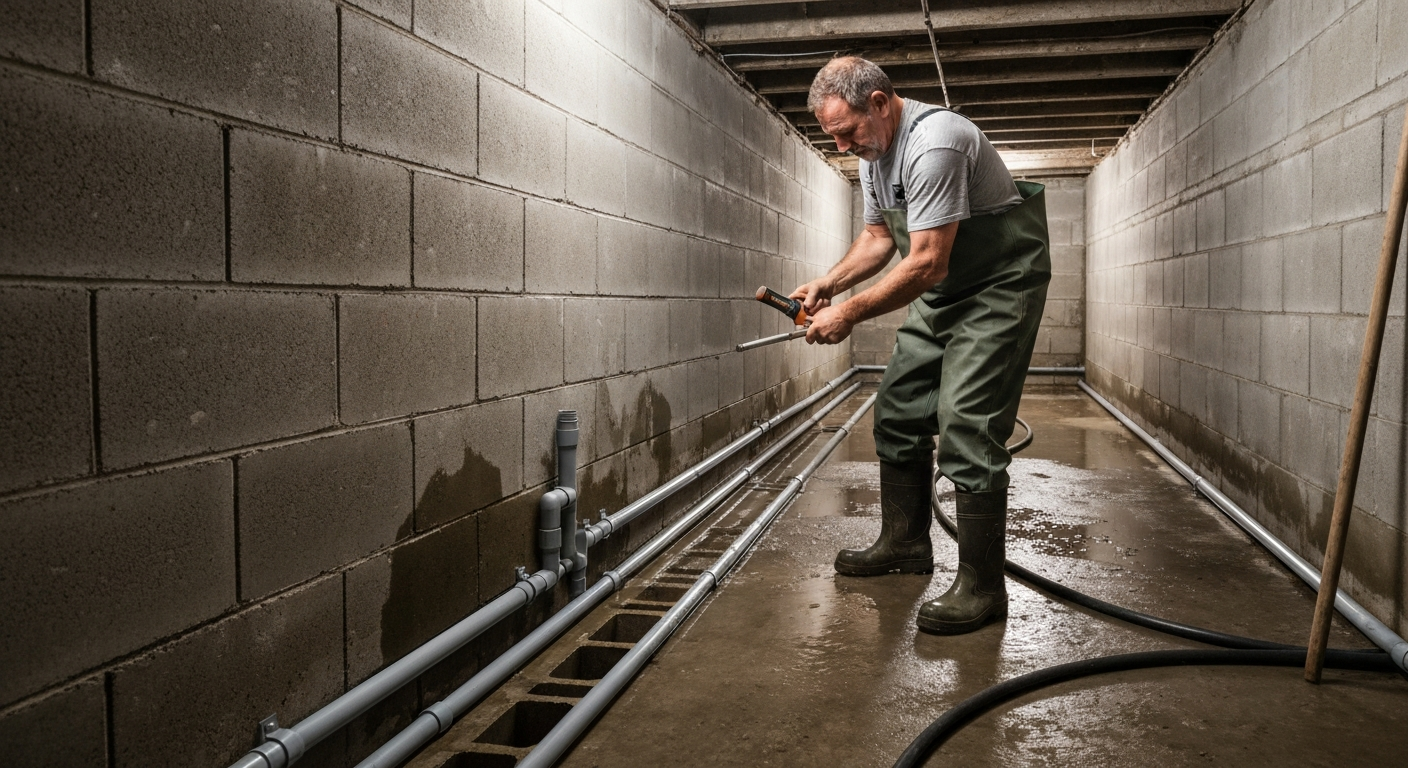
Basement waterproofing options and costs in Clanton Park
Clanton Park, Ontario sits in the Toronto area’s belt of mixed glacial till and clay pockets, which is exactly why basement leaks here are often driven by water pressure rather than just “surface” wetness. With a population of 16,472 (Statistics Canada, 2021 Census), the neighbourhood has a steady mix of homeowners in long-established housing pockets—many of which pre-date modern drainage standards. In these older basements, original tar-and-paper systems and early clay weeping tile (sometimes 60+ years old) can fail quietly, leading to interior dampness, efflorescence, and basement flooding even when exterior walls look “fine.”
Toronto-area freeze–thaw cycles also matter. Small defects at cold joints, tie holes, and cracks can widen over a few winters, turning intermittent seepage into recurring seepage. Access constraints in tight lots around Clanton Park—especially near driveways, additions, and shared paths—can raise excavation labour because contractors may need careful hand-digging and more restoration. That’s why you’ll often see more competitive availability for targeted interior work, while full exterior excavation typically commands higher rates and longer scheduling.
Trade demand is especially noticeable around the more mature streets closer to established commercial corridors in Clanton Park, where older foundations and older drainage lines show up during renovations and pre-listing inspections. The right solution usually comes down to whether you’re treating the source (water at the foundation line) or managing water after it enters (drainage and pumping). Use the comparison below to align your symptoms with a realistic budget before you request itemised quotes.
| Method |
What It Addresses |
Disruption Level |
Durability |
Price Range |
| Exterior excavation + new membrane + drainage tile |
Lateral water pressure, failed weeping tile, and water entry at the foundation exterior |
High (excavation, landscape/driveway restoration) |
Long-term when soil and drainage are designed correctly |
$7,000–$25,000 |
| Interior perimeter drain channel + sump pit |
Active seepage and dampness after water enters; improves control during high water events |
Medium (interior floor work; minimal yard disruption) |
Very good with proper sump sizing and back-up plan |
$3,500–$15,000 |
| Foundation crack injection (epoxy or polyurethane) |
Isolated cracks, tie-hole leaks, and stabilized seepage paths |
Low to Medium |
Good for isolated leaks; best used with drainage strategy |
$600–$3,000 |
| Sump pump installation (primary + battery backup) |
Flood risk reduction during spring melt, outages, and prolonged high groundwater |
Low to Medium |
High with correct discharge routing and backup |
$800–$3,500 |
| Window well drain installation |
Water pooling at egress windows and water entry where grading slopes incorrectly |
Low to Medium |
Moderate to High (depends on grading and downspout control) |
$1,200–$4,500 |
| Lot re-grading / downspout extension |
Surface water management that reduces the load on foundation drainage |
Low (yard work only) |
Moderate (best paired with drainage for persistent pressure) |
$1,000–$6,000 |
Prices are estimates only and vary by project scope, site access and material selection.
What affects the price of waterproofing in Clanton Park
In Clanton Park and across the Toronto region, two contractors can quote the “same” basement issue—say, a damp wall and a musty smell—and the numbers can still differ by 30–50%. The reason is that waterproofing scope isn’t just about sealing one spot; it’s about how water moves through clay-heavy soil, where the water pressure is coming from, how old the drainage system is, and how much demolition and restoration is required to access the foundation.
The biggest local cost drivers that separate Toronto-area pricing from the national average are soil type, water table behaviour, and freeze–thaw cycling. Clay-heavy pockets in southern Ontario expand when saturated and exert lateral pressure on foundation walls, worsening cracks over time. When the water table is high, sump pumps may need longer run times and bigger discharge planning—especially if old drainage is partially clogged. Freeze–thaw then turns a small issue into an active one by widening defects at cold joints and tie holes, which increases the amount of repair work required before any membrane or injection system performs as intended.
Here are concrete examples that commonly move costs in Clanton Park: (1) If you have a 1970s-era block foundation with failing weeping tile, interior drainage alone may stop the mess but an exterior membrane and new drainage tile often becomes the “final” fix, shifting budgets closer to $7,000–$25,000 for excavation and full perimeter work. (2) If the problem is a few active vertical cracks with localized seepage, injection might be $600–$3,000, but only after confirming that downspouts and grading aren’t feeding the foundation. (3) If an addition or deck blocks access along one side, the job can move from straightforward excavation to hand-digging around footings, raising labour and restoration.
| Price Factor |
Why It Matters |
Cost Impact |
| Interior vs. exterior approach — interior is less disruptive but addresses symptoms |
Exterior targets source water; interior manages water after entry |
Interior typically costs less up-front, exterior costs more but can reduce recurrence |
| Foundation type — poured concrete vs. block vs. stone vs. ICF |
Different wall materials crack differently and respond differently to membranes/injection |
Poured concrete often pairs well with targeted crack injection; block may require more drainage strategy |
| Soil type — clay expands more than sand, adding pressure |
Expanded clay increases hydrostatic and lateral load on the wall |
Higher risk of re-leaks if drainage is undersized; more scope and labour |
| Crack type and length — hairline vs. structural horizontal cracks |
Structural defects need evaluation before sealing |
Structural/horizontal cracks can add engineering, patching, or additional repair work |
| Sump pump backup system — battery or water-powered backup needed |
Backup prevents basement flooding during outages or equipment failure |
Usually adds cost, but it’s a sensible safeguard in spring high-water periods |
| Access — landscaping, decks, or driveways must be removed for exterior |
More removal and restoration increases labour and materials |
Can add thousands, especially where excavation is tight |
| Weeping tile age — original tile (60+ years) may be completely failed |
Old drains clog or collapse and stop relieving water pressure |
Often pushes scope toward replacement and exterior work |
| Mould or efflorescence remediation required before sealing |
Salt and moisture need treatment so coatings and sealers bond properly |
Adds time for cleaning, removal, and drying before waterproofing proceeds |
Permits & regulations in Ontario
In Ontario, basement waterproofing can range from “maintenance-style” repairs to work that affects drainage and structural performance—so permits matter. Typically, foundation excavation, changes to lot drainage, and structural crack repair (especially where cracks indicate possible movement or where the wall needs engineered repair) often require a building permit. If you’re installing a sump pump and discharging it to the storm or sanitary system, municipal approval is typically required before any connection is made. Always confirm discharge routing with the municipality and your contractor’s process; in practice, the “how” of discharge can be as important as the sump itself.
For structural cracks—commonly horizontal cracks in block walls, significant step cracks, or cracks that suggest movement—a structural engineer’s assessment is often needed to determine whether underpinning, wall stabilization, or other structural work is required rather than simple sealing. Choose contractors who can provide engineering support for structural repairs when it’s warranted, and who carry liability insurance and WSIB/WCB coverage for their crews.
To verify coverage as a homeowner in Clanton Park, follow this step-by-step approach: (1) Ask for the contractor’s Ontario licence details (and any trade registration they carry) and confirm it through the official online registry used for their trade category. (2) Request a certificate of insurance (COI) showing liability coverage and ensure the policy is active for your job dates. (3) Ask for WSIB/WCB clearance or account details and verify that it covers the workers who will be on-site. (4) For engineering-dependent scope, request the engineer’s letter/report format before work starts. (5) Confirm whether the permit pull is included, who is responsible for it, and which drawings or plans are submitted.
Interior vs exterior waterproofing — what does Clanton Park need?
Think of exterior waterproofing as preventing water from reaching your foundation in the first place. It involves full excavation to the foundation wall, cleaning and priming, applying a durable membrane system, installing or replacing drainage tile, adding appropriate drainage layers, and then backfilling and restoring the yard. Interior waterproofing, by contrast, manages water after it enters: a perimeter drain channel around the basement edge, a sump pit, and a sump pump (often with battery backup). This approach is typically less invasive and faster for many homeowners, but it doesn’t eliminate hydrostatic pressure against the wall.
In Clanton Park’s Toronto climate and soil conditions—mixed glacial till with clay pockets—persistent lateral pressure is common, especially where original weeping tile is clogged or collapsed. That’s why the “best” method depends on how water is getting into the basement and how long it’s been happening. Poured concrete walls often respond well to targeted crack injection (after you confirm the source), while block foundations frequently need interior drainage as a practical complement, and sometimes a full exterior solution when water pressure is high around the perimeter. Freeze–thaw can keep reopening hairline defects over successive winters, so you want a strategy that remains reliable through Ontario’s cycles.
A clear budget example: if you have chronic dampness plus intermittent seepage at a perimeter crack, an interior perimeter drain and sump approach may land in the $3,500–$15,000 range. If you confirm failed exterior drainage and high lateral pressure along multiple sides, the exterior excavation + membrane + drainage tile can be more like $7,000–$25,000, but that’s the range where you’re most likely to reduce recurrence because you’re addressing the source, not just the symptom.
Finally, consider sump pump backup systems. Spring melt periods in Ontario can coincide with power interruptions, and a battery backup (or other approved backup) protects your basement during run-time surges—especially where the discharge path is elevated or where municipal drainage capacity is stressed.
| Method |
Best For |
Addresses Source? |
Disruption |
Lifespan |
Price Band |
| Full exterior excavation + membrane |
Persistent seepage, failed exterior drainage, and high lateral water pressure on foundation walls |
Yes (when paired with new drainage tile and correct backfill) |
High |
Long-term with proper installation and drainage design |
$7,000–$25,000 |
| Interior French drain + sump system |
Chronic seepage or dampness where exterior access is difficult, or interim/permanent control is needed |
No (it collects and controls water after it enters) |
Medium |
Very good with quality sump sizing and discharge routing |
$3,500–$15,000 |
| Crack injection — epoxy (structural) |
Non-moving, primarily water-blocking cracks where the wall is stable |
No (it seals a path, but doesn’t fix exterior water load) |
Low |
Good when the crack is stable and drainage supports it |
$600–$3,000 |
| Crack injection — polyurethane (active leak) |
Active leaks and cracks with movement or ongoing seepage |
No (it controls the leak pathway; source water management still matters) |
Low |
Good for active leaks when combined with drainage strategy |
$600–$3,000 |
| Interior drain channel only (no sump) |
Occasional dampness or minor seepage where gravity drainage is feasible |
No |
Medium |
Moderate (can struggle during high-water periods) |
$2,500–$7,500 |
| Re-grading + downspout extensions |
Surface water management—gutters/roof runoff feeding the foundation |
Indirectly (reduces how much water reaches the foundation line) |
Low |
Moderate (works best with existing drainage) |
$1,000–$6,000 |
How to choose a waterproofing contractor in Clanton Park
Start with verification, not marketing. For Ontario work around foundations, confirm licensing/registration appropriate to the contractor’s scope, plus liability insurance and WSIB/WCB coverage. You can check a contractor’s licence/registration through the relevant online registry for their trade category. Then request a certificate of insurance (COI): it should list active coverage limits and the insured entity name that will perform the work. For worker protection, ask for WSIB/WCB clearance or account details—don’t accept vague statements. If they won’t provide paperwork, that’s a red flag.
Next, get 2–3 itemised written quotes. “Itemised” means you should see labour and materials separated, with clear quantities (linear feet of drain, footage of excavation, number of cracks/ports for injection, sump model, discharge route, and disposal/restoration scope). Make sure the proposal states what’s included in permits, if applicable, and whether excavation spoil disposal and concrete/asphalt/landscape restoration are included or treated as extra. Pay attention to exclusions such as: pre-existing mould, damaged basement finishes, engineer requirements, and utility locating.
Warranty should be specific: a workmanship warranty (often 1–5 years depending on the system and product), plus any manufacturer product warranty, and whether it’s transferable to future owners. For payment, never let the schedule exceed about 10–15% upfront—hold back a portion until the job is complete and you’ve inspected the work. Finally, request a written timeline: expected start date, sequencing (inspection, excavation, membrane/drain installation, curing/backfill, restoration), and completion estimate.
- Ask for an on-site water test plan or moisture assessment, not just a “standard” fix.
- Request an itemised quote with quantities, not a single lump sum.
- Confirm whether permit pull is included and who applies for it.
- Verify the discharge routing plan for sump pumps and whether it needs approvals.
- Ensure utility locating is included before excavation.
- Get the exact membrane system and drainage components named (not just “waterproofing” materials).
- Check how they handle failed or clogged weeping tile and whether they replace or tie into it.
- Confirm crack injection method (epoxy vs polyurethane) is matched to crack behaviour.
- Ask for warranty terms in writing: workmanship and product, including coverage length.
- Require proof of WSIB/WCB coverage and liability insurance (COI) before work starts.
- Use a payment schedule that keeps 10–15% held back until completion and inspection.
- Confirm restoration scope: how deck/steps/driveway edges and landscaping are put back.
Concrete red flags we see with waterfront-adjacent and older-clay basements around Clanton Park: (1) proposals that seal cracks without checking drainage/weepers, (2) no plan for discharge routing or no mention of sump pump backup, (3) unclear warranty language (or only a vague “we stand behind it”), (4) inability to provide a COI and WSIB/WCB documentation, and (5) quoting exterior excavation without listing excavation limits, disposal, and restoration details.
Frequently asked questions — waterproofing in Clanton Park
How does Clanton Park's soil affect my foundation?
Clanton Park’s Toronto-area soils often include glacial till mixed with clay pockets, and that matters because saturated clay expands and can push laterally against foundation walls. Over time, that pressure can worsen cracks—especially at cold joints, tie holes, and areas where earlier repairs weren’t matched to the water movement. If your original weeping tile is old (commonly 60+ years in older homes), it can clog or partially collapse, meaning the soil stays wetter and the wall sees higher pressure. That’s why we often recommend pairing sealing (like crack injection) with a drainage plan, rather than “just waterproofing” one spot. (Statistics Canada, 2021 Census)
Do I need a permit for foundation work in Ontario?
In Ontario, many foundation-related activities can require a permit, especially when you excavate near the foundation, change lot drainage, or perform structural crack repairs that may affect stability. For sump pump installations, connecting discharge to storm or sanitary systems typically requires municipal approval before any connection is made. In Clanton Park, the permit question often comes down to whether your work alters drainage patterns or structural conditions. Generally, straightforward interior cleanout and minor sealing may not trigger a permit, but anything involving excavation, drainage changes, or engineered structural repair usually does. Always ask your contractor to state clearly whether the permit is included in the scope and who is responsible for pulling it.
How long does waterproofing last?
“Lasts” depends on what you’re actually solving: stopping water entry versus managing water after it enters. Exterior excavation with membrane and new drainage tile is designed for long-term source control, but its performance depends heavily on backfill quality, drainage design, and proper downspout/grade management. Interior systems (perimeter drains and sump pumps) can work very well for many years, but they rely on equipment performance—especially during spring high-water and freeze–thaw. In Clanton Park basements, recurring issues typically come from undersized drainage, failed older weeping tile, or untreated discharge problems, not from the concept of waterproofing itself. If your quote is in the $7,000–$25,000 range, it’s usually a more comprehensive, longer-term approach. If it’s closer to $3,500–$15,000, it may still last a long time, but it’s more sensitive to ongoing conditions and sump performance.
Can I waterproof my basement from the inside only?
Yes, you often can waterproof from the inside only—especially when exterior access is difficult or when the goal is to stop chronic seepage and flooding. Typical interior approaches include a perimeter drain channel, sump pit, and sump pump (ideally with backup), plus targeted crack injection where leakage is localized. However, interior-only work doesn’t remove hydrostatic pressure against the wall; it collects water after it enters. In clay-heavy Toronto-area conditions, that can still be an effective long-term plan if drainage and discharge are designed correctly and the seepage pattern is understood. If your problem is widespread perimeter water entry from high lateral pressure, an exterior excavation and membrane system is usually the more complete solution.
What causes foundation cracks in Clanton Park?
Foundation cracks in Clanton Park commonly come from a combination of freeze–thaw cycles, soil moisture changes, and foundation age. The Toronto-area climate repeatedly freezes and thaws, which can widen small defects and turn hairline cracks into active seepage points over a few winters. In clay pockets, saturated soil expands and can push laterally, increasing wall stress. If older drainage systems (like early weeping tile) have clogged, the soil stays wetter around the foundation, amplifying the problem. In some homes, settlement or construction joints also contribute—especially near additions or areas with different soil compaction. The key is identifying crack behaviour: stable vertical cracks can often be treated differently than structural horizontal or step cracks, which may require engineering assessment before sealing.
How do I compare waterproofing quotes?
To compare waterproofing quotes in Clanton Park, focus on scope and details, not just total price. First, insist on itemised quotes that separate labour and materials and specify quantities (linear feet of drain, number of cracks for injection, sump model, membrane type, and disposal/restoration). Second, verify what’s included: permit pull (if needed), excavation and backfill materials, disposal, and discharge routing for a sump pump. Third, check whether the plan matches symptoms—interior drainage for active seepage versus exterior membrane and drainage tile for source control. Fourth, confirm warranty terms for both workmanship and materials, and whether coverage is transferable. Finally, check the contractor’s insurance and WSIB/WCB paperwork. A quote that looks cheaper may be less complete—especially if it avoids addressing failing weeping tile or doesn’t include backup pumping for high-water seasons.