Basement waterproofing options and costs in Casselman
Casselman homeowners often start waterproofing projects after noticing damp corners, musty odours, or spring seepage. With 28.8% of local homes built before 1981 (Statistics Canada, 2021 Census), many basements were originally protected with older tar-and-paper systems and weeping-tile layouts that have since silted, collapsed, or partially failed—especially once clay soils hold more water and swell during Ottawa’s repeated freeze-thaw cycles. Those seasonal movements can widen existing cracks and turn minor seepage into persistent leaks, which is why timing and scope matter as much as waterproofing materials.
In the Ottawa economic region, contractor pricing is shaped by the same three cost drivers we see across communities like Cornwall and Clarence-Rockland: clay-rich soil that increases lateral pressure, higher groundwater periods that raise drainage demands, and excavation complexity due to landscaping, lot grading, and disposal of heavy backfill. In older Casselman neighbourhoods where original drainage is often missing or buried deep, demand is especially strong around areas with long-established lots and mature landscaping—where access can be limited and backfill removal becomes more expensive.
Below are the most common waterproofing approaches contractors propose in Casselman, with typical 2026 Ontario pricing bands for a typical detached home. Use this table to compare methods before you request itemised quotes for your site conditions.
| Method |
What It Addresses |
Disruption Level |
Durability |
Price Range |
| Exterior excavation + new membrane + drainage tile |
Stops water at the source by rebuilding the waterproofing and drainage layer along the foundation perimeter |
High (full excavation, landscaping removal/restore) |
Long-term (typically 20+ years when installed to proper specs) |
$9,000–$45,000 |
| Interior perimeter drain channel + sump pit |
Collects and redirects water once it enters, reducing hydrostatic pressure at the interior slab/wall line |
Medium (interior work; limited exterior disruption) |
Good (often 15+ years depending on sump capacity and maintenance) |
$6,000–$20,000 |
| Foundation crack injection (epoxy or polyurethane) |
Seals cracks; epoxy suits stable, non-moving cracks, polyurethane targets active leaks |
Low to medium (access to crack line required) |
Variable (best results when paired with correct drainage) |
$600–$3,000 |
| Sump pump installation (primary + battery backup) |
Controls groundwater and spring melt infiltration; backup protects during outages and power interruptions |
Low to medium (breakout around sump location, minor interior disruption) |
High when paired with proper discharge and discharge route |
$2,200–$3,500 |
| Window well drain installation |
Prevents water pooling around below-grade windows; helps reduce seepage and mould risk |
Low to medium (excavation and drain grading around window wells) |
Good (often 10–20 years with correct stone wrap and flow path) |
$1,800–$6,500 |
| Lot re-grading / downspout extension |
Redirects roof runoff and improves surface drainage to reduce water load near foundation |
Low (site work; may require some soil movement) |
Moderate (depends on ongoing grading/drainage performance) |
$1,200–$5,500 |
Prices are estimates only and vary by project scope, site access and material selection.
What affects the price of waterproofing in Casselman
In Casselman and the wider Ottawa area, two quotes that look similar on paper can differ by 30–50% because contractors are pricing different levels of risk and site complexity—not just “waterproofing.” The same job category (for example, interior drainage with a sump) may require additional demo, extra disposal, or upgraded discharge routing when the original conditions are worse than what’s visible during an initial walkthrough. Material choice also affects cost: premium membranes and specific drainage assemblies cost more but perform better against clay swelling, freeze-thaw stresses, and long-term clogging.
The biggest separators between regional and national averages are soil type, water table, and freeze-thaw. In clay-heavy ground, water expands and contracts with temperature swings, increasing lateral pressure on foundation walls and worsening cracks over time. Where groundwater is higher, sump pumps run longer, and installers may recommend a larger sump, more reliable backup, and better-grade drainage stone and filter fabric. Freeze-thaw then compounds movement—widening existing cracks and turning small seepage paths into active leaks.
Local examples that commonly raise or lower cost in Casselman include: (1) homes with blocked or missing weeping tile where more excavation and replacement is required, pushing exterior budgets toward the higher end of $9,000–$45,000; (2) basement leaks that are truly “interior-only” from a damp slab edge, which can often be addressed with interior perimeter drainage and a sump in the $6,000–$20,000 band; and (3) older lots where mature shrubs, retaining walls, or decks limit equipment access—adding labour and restoration costs.
Because 72.5% of households in the area own homes (Statistics Canada, 2021 Census), many projects are “planned repairs” rather than quick fixes, so homeowners typically choose scopes that reduce recurrence, not just short-term dampness. That purchasing pattern affects what contractors are willing to include (like backup pumps and proper disposal).
| Price Factor |
Why It Matters |
Cost Impact |
| Interior vs. exterior approach — interior is less disruptive but addresses symptoms |
Exterior targets the water entry point; interior manages water after it enters |
Interior often costs 30–70% less than full exterior excavation, depending on access |
| Foundation type — poured concrete vs. block vs. stone vs. ICF |
Crack behaviour and sealing strategy differ; some wall systems need different preparation |
Crack prep and compatible systems can raise material/labour by 10–25% |
| Soil type — clay expands more than sand, adding pressure |
Clay swelling increases hydrostatic and lateral forces on the wall and joints |
Excavation and reinforcement/discharge requirements may add 25–50% |
| Crack type and length — hairline vs. structural horizontal cracks |
Structural or horizontal cracks may require engineering input and deeper remedial work |
Epoxy vs. polyurethane and engineering steps can widen budgets by 2–5x |
| Sump pump backup system — battery or water-powered backup needed |
Freeze-thaw and spring melt can coincide with localized power interruptions; backup prevents rebound |
Backup typically adds a few hundred to over $1,000 depending on system and install complexity |
| Access — landscaping, decks, or driveways must be removed for exterior |
Equipment access and regrading/restoration add time and material |
Exterior access issues commonly move projects toward the high end of the range |
| Weeping tile age — original tile (60+ years) may be completely failed |
Old systems are often silted or missing, leaving no effective drainage path |
Replacement scope increases excavation and backfill/disposal costs substantially |
| Mould or efflorescence remediation required before sealing |
Sealing over active biological growth or mineral salts reduces adhesion and performance |
Often adds 10–30% for remediation, drying time, and proper cleaning |
Permits & regulations in Ontario
In Ontario, waterproofing work can range from straightforward drainage corrections to projects that touch structural elements and lot drainage—those higher-risk categories typically require permits. In general, foundation excavation that changes the footprint or exposes foundation elements, structural crack repairs that address potentially structural conditions, and changes to how water is managed on the lot often require municipal review and a permit. If your sump pump discharge is being connected into municipal sewer systems (storm or sanitary), municipal approval is typically required.
For structural crack repair—especially horizontal cracks in block walls, large step cracking, or signs the wall has shifted—contractors commonly involve a structural engineer. The engineer assesses whether underpinning or related structural remedial work is required, and that assessment can guide both permit needs and the waterproofing scope. Before work begins, confirm the contractor can support structural repairs with engineering sign-off where needed, and that they carry liability insurance and WSIB/WCB coverage.
Step-by-step for Casselman homeowners:
- Ask for the proposed permit scope in writing (what is being permitted and by whom).
- Request the contractor’s proof of WSIB/WCB coverage and liability insurance (certificate of insurance).
- Confirm whether the contractor’s Ontario licence/registration is required for the scope (and provide the reference number if applicable).
- If structural work is anticipated, require an engineer’s assessment report before injection or membranes are specified.
- Verify permit pull responsibility: who applies, what inspections are scheduled, and what documentation you receive at close-out.
- Ask for a clearance letter or close-out documentation once inspections are complete (if the municipality requires it for your project type).
Interior vs exterior waterproofing — what does Casselman need?
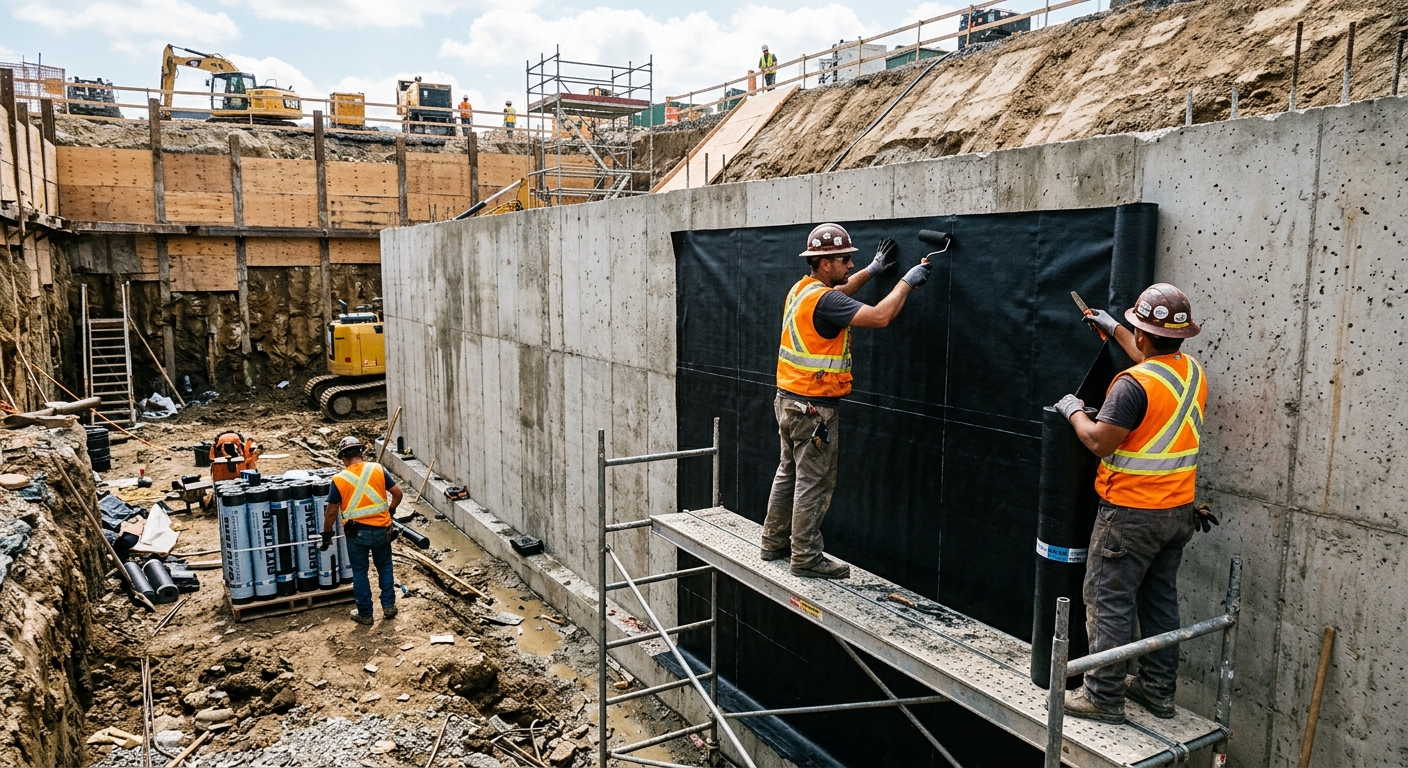
The fundamental difference is that exterior waterproofing addresses the water entry point, while interior waterproofing manages water after it gets past the wall. Exterior solutions involve full excavation, new exterior membranes, proper drainage tile installation, and then careful backfill and re-grading. Done correctly, this permanently reduces hydrostatic pressure against the foundation by rebuilding the drainage pathway along the perimeter, but it is significantly more disruptive because landscaping, walkways, and sometimes driveways must be removed and later restored.
Interior waterproofing typically uses a perimeter drain channel, a sump pit, and a sump pump to collect infiltrating water and discharge it away. In Casselman’s Ottawa-region freeze-thaw climate, the cycle can widen existing cracks and create more seepage paths over time—so interior systems are most effective when they’re paired with crack sealing (where appropriate) and when the sump is sized with a reliable discharge route. For many homes with poured concrete walls, crack injection can help seal stable cracks, while interior drainage reduces the amount of water that reaches the interior finishes. For block foundations, interior drainage often acts as a practical complement because joints and block seams may weep under pressure even when exterior waterproofing has degraded.
Regarding power reliability: spring melt and heavy rain events can strain household power and lead to outages. That’s why many Casselman homeowners choose a battery backup sump system to prevent water accumulation when the grid goes down.
Price-wise, the justification is site-specific. For example, exterior excavation may be the better long-term choice when original drainage is failed and water load is heavy; it can fit the $9,000–$45,000 range. But if the leak is limited to localized seepage and you can’t excavate due to landscaping constraints, interior drainage and sump systems often sit in the $6,000–$20,000 band—and can be the most economical way to stabilize conditions.
| Method |
Best For |
Addresses Source? |
Disruption |
Lifespan |
Price Band |
| Full exterior excavation + membrane |
Widespread seepage, failed weeping tile, persistent hydrostatic pressure, or when you want a long-term source-based fix |
Yes |
High |
20+ years (typical) |
$9,000–$45,000 |
| Interior French drain + sump system |
Homes where exterior access is limited, basements damp or flooding due to groundwater, and retrofits are needed quickly |
No (manages entry) |
Medium |
15+ years with correct pump/discharge |
$6,000–$20,000 |
| Crack injection — epoxy (structural) |
Stable, non-moving cracks (often vertical/hairline where there’s no active water flow) |
Partly (seals pathways) |
Low to medium |
Good when cracks are stable and drainage is adequate |
$600–$2,200 |
| Crack injection — polyurethane (active leak) |
Active leaks where water is moving through the crack during rain or melt |
Partly (seals active pathway) |
Low to medium |
Good to long-lasting with proper preparation and drainage balance |
$900–$3,000 |
| Interior drain channel only (no sump) |
Light seepage where water can be managed without continuous pump operation |
No |
Medium to low |
Moderate (depends on seasonal water load) |
$4,000–$10,500 |
| Re-grading + downspout extensions |
Surface-water issues like roof runoff discharge near the foundation or minor dampness that worsens after rain |
No (reduces load) |
Low |
Moderate (only as good as ongoing maintenance) |
$1,200–$5,500 |
How to choose a waterproofing contractor in Casselman
Choosing the right waterproofing contractor in Casselman comes down to proof and precision. First, verify Ontario licensing/registration requirements for the scope (the contractor should be able to tell you exactly what licence class applies, if applicable). Next, confirm liability insurance and WSIB/WCB coverage. How to check: request certificate of insurance (showing liability limits and the work location), and ask for WSIB/WCB clearance or coverage documentation; avoid contractors who only provide insurance “upon request” or after you sign.
Then get 2–3 itemised written quotes. Not lump sums—look for a breakdown that separates labour and materials (membrane/drain tile/geotextile, sump pump and backup, discharge piping, concrete saw cutting/demo, disposal, and restoration). Make sure the quote clearly lists what is included and what is excluded: permit pull responsibilities, engineering requirements (if crack conditions are potentially structural), and whether disposal and backfill are included. If your project involves excavation, confirm topsoil/landscape restoration scope—partial restore costs can rise quickly.
Warranty should be specific. Ask for the workmanship warranty length, product/manufacturer warranty details, and whether coverage is transferable to a future owner. For payment schedule, never pay more than 10–15% upfront; use a holdback until the waterproofing and final clean-up are complete. Finally, require a timeline in writing with the start date, inspection points, and completion estimate—especially important in Ottawa’s freeze-thaw season when scheduling delays can affect curing and sealing.
- Ask for an itemised scope (labour + materials) and a diagram of the drainage path.
- Confirm exterior discharge route and whether it stays clear of ice-prone areas in winter.
- Ensure the quote states whether disposal of clay backfill is included.
- Verify permit pull responsibility in writing (what the contractor applies for, if needed).
- Request proof of liability insurance and WSIB/WCB coverage before signing.
- Check warranty: workmanship length, product warranty terms, and transferability.
- Look for details on surface grading and downspout extensions—not just membranes.
- Ask whether crack injection type is chosen based on whether the crack is active.
- Confirm sump pump discharge piping diameter and where it terminates.
- Ask whether the sump includes primary + backup and what happens during outages.
- Require a start date and completion schedule that accounts for curing time.
- Pay via milestone payments with a holdback until final inspection/finish.
Red flags to watch for in Casselman include: (1) quotes that promise “guaranteed waterproofing” without addressing drainage and crack stability; (2) unclear disposal/restoration scope when excavation is included; (3) refusal to provide WSIB/WCB proof or certificate of insurance; (4) “one-size-fits-all” crack injection methods (epoxy for active leaks, for example); and (5) requesting large upfront payments (more than 10–15%) or offering no written warranty details.
Frequently asked questions — waterproofing in Casselman
What is a battery backup sump pump and do I need one in Casselman?
A battery backup sump pump is an added power system that keeps your sump operating when the electricity goes out. In Casselman, spring melt and heavy rain can raise groundwater levels quickly; if power is interrupted while water is entering, the basement can rebound even if the waterproofing is otherwise correct. Battery backups are especially valuable where you’ve had outages during storms or where the basement has a history of flooding—not just dampness. Many homeowners also choose backup because freeze-thaw can stress drainage paths, causing intermittent surges. In pricing terms, sump work often lands in the $2,200–$3,500 band, and backup selection can affect the final number.
How much does basement waterproofing cost in Casselman?
Basement waterproofing costs in Casselman vary based on whether you’re solving the water entry point (exterior) or managing water after it gets in (interior). Exterior excavation projects—when full membrane and drainage tile are installed—commonly fall into the $9,000–$45,000 range, particularly when clay-rich soils require deeper excavation and more careful restoration. Interior waterproofing with perimeter drainage and a sump typically sits around $6,000–$20,000, depending on how much concrete needs to be opened and whether the weeping tile system is failed or abandoned. Targeted crack repair is usually less expensive, often within $600–$3,000, but it works best when paired with proper drainage—especially in Ottawa-region freeze-thaw conditions.
Interior vs exterior waterproofing — which is better?
Neither approach is “better” for every Casselman home; the best choice depends on where the water is coming from and how accessible your foundation is. Exterior waterproofing is best when you can excavate and you need a source-based fix: new membrane plus perimeter drainage tile reduces the hydrostatic pressure driving seepage through cracks and joints. Interior systems (perimeter drain channel, sump pit, sump pump) are often better when access is limited due to landscaping, driveways, or retaining walls, or when you’re addressing symptoms of groundwater intrusion. For poured concrete walls, crack injection can seal pathways effectively when cracks are stable, while block foundations frequently benefit from interior drainage as a practical complement. If your quote only offers interior solutions without checking the exterior drainage condition, ask why exterior excavation isn’t required.
Why is my basement leaking in Casselman?
In Casselman, the most common causes are seasonal groundwater changes, failing drainage around the foundation, and movement of foundation cracks due to freeze-thaw. Clay-rich soils can hold water and exert lateral pressure, which increases seepage risk through weak points. Many older homes (Statistics Canada, 2021 Census shows 28.8% built before 1981) have original weeping tile that may be silted, collapsed, or missing, so water has no reliable path to drain away. You might also see efflorescence and dampness along slab edges when interior drainage is inadequate. If downspouts discharge too close to the foundation or grading is flat, roof runoff can increase localized water load. A proper site assessment should identify whether the leak is active through a crack, coming from window wells, or related to surface water management.
How do I know if a foundation crack is serious?
A foundation crack can range from cosmetic to structurally significant, and the details matter. In Ontario homes in Casselman, pay attention to cracks that are wider than expected for shrinkage, show horizontal displacement, or grow between inspections after freeze-thaw seasons. Step cracks in block walls, horizontal cracks, or cracks that are accompanied by ongoing seepage are more concerning than tight hairline cracks that remain unchanged. Also note signs around the crack: water staining, wetness, mould, or active seepage during heavy rain or spring melt suggests you should prioritize sealing and drainage. For structural indicators, you should involve a structural engineer for assessment before major repairs. Many contractors will also choose injection type based on whether the crack is active.
How much does foundation crack repair cost in Casselman?
Foundation crack repair in Casselman usually depends on crack type (active versus stable), length, and accessibility. For typical crack injection work, pricing often falls in the $600–$3,000 range for many basements where the scope is limited to sealing a manageable number of cracks. Epoxy injection is commonly used for stable, non-moving cracks, while polyurethane injection is often selected when there’s active water movement through the crack. If a crack is potentially structural (for example, horizontal displacement in block walls), the cost can rise due to engineering assessment and any additional structural remedial work beyond injection. In Ottawa-region conditions, contractors may recommend pairing crack repair with interior drainage or sump upgrades so the crack isn’t stressed by ongoing hydrostatic pressure.