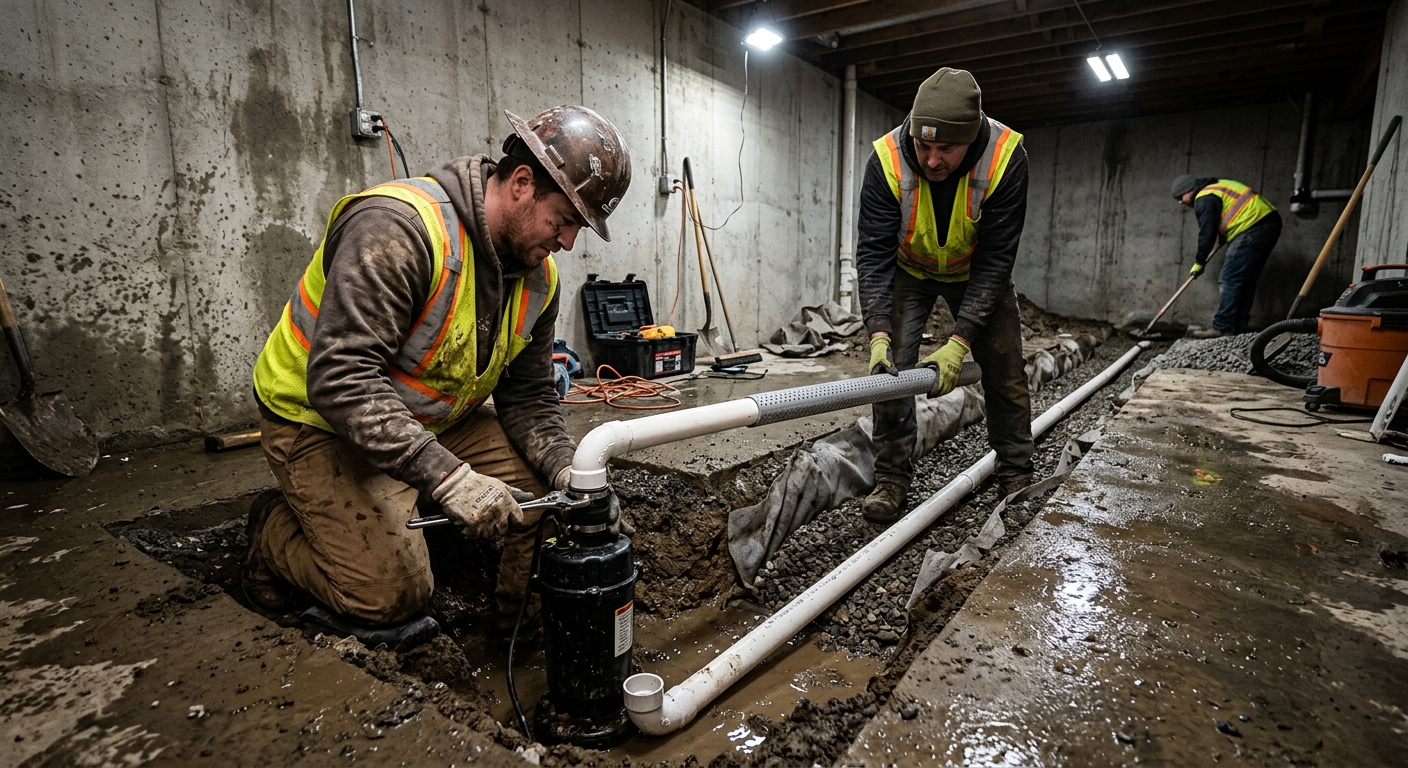
Basement waterproofing options and costs in Moose Factory
Basement waterproofing in Moose Factory is usually about managing two problems at once: water getting in at weak points and water pushing laterally through saturated clay soils. Moose Factory’s smaller local housing base—population 1,807 (Statistics Canada, 2021 Census)—means trades sometimes travel from the broader Toronto area, so access planning and job sequencing strongly affect final pricing. In the Toronto economic region, many homes were built in the post-war and 1960–1980s era; that matters because older drainage systems (including weeping tile) often fail quietly. Instead of obvious exterior wall failure, homeowners see damp concrete, efflorescence, and basement seepage where cold joints, tie holes, and cracks have widened after freeze–thaw cycles.
On top of that, Toronto-area conditions typically include mixed glacial till and clay pockets that hold water against foundations. When saturated, clay can expand during freeze–thaw and increase pressure on the foundation wall, making minor defects active leaks over a few winters. Labour availability is also a factor: excavation jobs require more staging, protective access, and careful backfill, while interior work can be scheduled around occupied space and utilities.
In practice, most Moose Factory basements end up needing either a source-control exterior solution (when water pressure is the main driver) or a drainage/control interior system (when exterior access is limited or the leak path is localized). For isolated leaks, crack injection may be the most cost-effective option. Use the table below to compare common methods by disruption, durability, and budget range.
| Method |
What It Addresses |
Disruption Level |
Durability |
Price Range |
| Exterior excavation + new membrane + drainage tile |
Primary source control: hydrostatic pressure management; replaces failing weeping tile |
High (full excavation, landscape impacts) |
High (often 20–30+ years when installed to spec) |
$9,500 – $24,000 |
| Interior perimeter drain channel + sump pit |
Collects seepage after it enters; reduces hydrostatic pressure at floor/wall joint |
Medium (floor work inside; less yard disruption) |
High (typically 15–25 years with proper pump maintenance) |
$5,500 – $14,500 |
| Foundation crack injection (epoxy or polyurethane) |
Stops localized leakage paths; bridges/anchors cracks based on crack type |
Low (minimal demolition) |
Medium to high (varies by crack movement and crack type) |
$700 – $2,800 |
| Sump pump installation (primary + battery backup) |
Reduces risk of interior flooding during high water events and outages |
Medium (cutting/drilling to route discharge) |
High (more reliable with backup) |
$1,200 – $4,200 |
| Window well drain installation |
Stops water infiltration at egress points; improves drainage around window wells |
Low to medium (excavation at window area only) |
Medium to high (depends on tie-in to drainage/sump) |
$1,300 – $5,200 |
| Lot re-grading / downspout extension |
Redirects roof and surface water away from foundation |
Low (yard grading and minor restoration) |
Medium (needs upkeep; complements other measures) |
$1,100 – $4,500 |
Prices are estimates only and vary by project scope, site access and material selection.
What affects the price of waterproofing in Moose Factory
In Moose Factory, you can see quotes swing by 30–50% for what looks like “the same job,” especially when comparing exterior versus interior solutions. The biggest reason isn’t the pump or membrane—it’s what the contractor must do to actually control water: excavation depth, backfill type, drainage tie-ins, and whether your foundation is fighting active hydrostatic pressure. In the Toronto economic region, installers also price in travel time and scheduling because job sites are frequently tight, with landscaping, deck footings, or additions limiting access.
The three drivers that separate regional costs from the national average are soil type, water table, and freeze–thaw. Clay-heavy soils common across Ontario can expand when saturated, which increases lateral pressure on foundation walls and turns minor cracks into persistent leaks. High local water table conditions mean sump systems run longer and discharge infrastructure may need upgrades. Freeze–thaw then widens small defects in concrete and block foundations—so a crack injection scope in year one may need a broader repair plan if movement continues. In older housing stock, failing original weepers (sometimes 60+ years old) also push cost up because excavation and debris removal are more involved than a “clean replacement.”
Concrete examples from Moose Factory-area basements: (1) A homeowner with exterior seepage along a low side yard often pays closer to $9,500 – $24,000 when weeping tile is completely failed and excavation is unavoidable. (2) If the leak is mainly from a floor-wall joint during heavy melt seasons, an interior drain channel plus sump may land in the $5,500 – $14,500 range because access is internal and we can target the entry points. (3) Where tie holes or cold joints are involved, contractors may add targeted crack injection work to stop water pathways before sealing or finishing.
| Price Factor |
Why It Matters |
Cost Impact |
| Interior vs. exterior approach — interior is less disruptive but addresses symptoms |
Exterior manages the source; interior collects water after entry |
Interior often $3,500–$15,000 range; exterior frequently higher when excavation is required |
| Foundation type — poured concrete vs. block vs. stone vs. ICF |
Crack behaviour and leak points differ by wall construction |
Block and stone often require interior drainage complements; ICF can be faster if seams are intact |
| Soil type — clay expands more than sand, adding pressure |
Saturated clay increases lateral pressure and worsens joint seepage |
More robust drainage and membrane detailing increases scope; costs trend upward |
| Crack type and length — hairline vs. structural horizontal cracks |
Movement cracks need different treatment than stable hairline cracking |
Stable cracks may fall near $600–$3,000; horizontal/structural issues can trigger additional engineering work |
| Sump pump backup system — battery or water-powered backup needed |
Power interruptions can turn minor seepage into a full overflow |
Backup adds cost but can be essential in spring melt conditions; commonly increases the project by roughly $400–$1,000 |
| Access — landscaping, decks, or driveways must be removed for exterior |
Exterior work depends on whether we can excavate safely to the footing line |
Extra teardown and reinstatement can push exterior projects toward the upper end of $7,000–$25,000 |
| Weeping tile age — original tile (60+ years) may be completely failed |
Old drainage is often clogged, collapsed, or disconnected |
Replacement increases labour and disposal; interior-only solutions may avoid this but won’t reduce wall pressure |
| Mould or efflorescence remediation required before sealing |
Moisture must be addressed before coatings; contaminants can reappear |
Additional remediation time can add several hundred to over $1,000 depending on severity |
Permits & regulations in Ontario
In Ontario, many waterproofing-related tasks fall under the “typical homeowner improvement” category, but several items commonly require a building permit because they change drainage, affect foundation elements, or involve plumbing connections. As a general rule, foundation excavation, structural crack repair (especially where cracks indicate movement), and modifications to lot grading or lot drainage that alter how water is directed away from the foundation typically require a permit. If your sump pump discharge ties into a municipal storm or sanitary service (or you’re altering connections), municipal approval is often required before work begins.
For structural crack repair—think major horizontal cracks in block walls, step cracking that suggests differential movement, or any scenario where the wall’s integrity is in question—a structural engineer’s assessment is often recommended to determine whether underpinning or other structural work is needed. Before you sign, confirm the contractor has engineering support for structural repairs (or can coordinate it), carries liability insurance, and has WSIB/WCB coverage for their workers. In Ontario, that protection matters because waterproofing touches both demolition and drainage plumbing.
To verify a contractor in Moose Factory, start by: (1) checking whether they’re properly licensed for the scope of work they’re claiming to do; (2) requesting their certificate of insurance and confirming the coverage is active for your project; (3) asking for a WSIB/WCB clearance letter or account proof and matching the name on the paperwork to the company on the quote; and (4) confirming they will pull any permits required by the City/municipality and list that clearly in the written scope.
Interior vs exterior waterproofing — what does Moose Factory need?
The fundamental difference is simple: exterior waterproofing stops water before it reaches the foundation, while interior waterproofing manages water after it enters. Exterior work usually involves full excavation, installing a membrane, placing or renewing drainage tile, and then carefully backfilling. That approach permanently addresses the source of water pressure, but it’s disruptive because it means removing landscaping and working near deck footings or along tight sides of lots. Interior waterproofing typically adds a perimeter drain channel and sump pit/pump. It’s less invasive and often chosen when the exterior isn’t practical, but it doesn’t stop hydrostatic pressure on the wall itself—it controls the water level inside.
Moose Factory’s soil and Toronto-region climate patterns push many homeowners toward source control when seepage is persistent. Mixed glacial till with clay pockets retains water and expands during freeze–thaw, which increases lateral pressure through tie holes and cracks. Poured concrete walls sometimes respond well to crack injection combined with interior drainage because the concrete can be more stable; epoxy injection is often used for stable, non-moving cracks. Block foundations, however, can leak through mortar joints and micro-gaps where water finds pathways; many homeowners need an interior drain/sump as a practical complement even if exterior measures are limited.
Sump pump backup is another key difference. Ontario spring flooding seasons can coincide with outages, so homeowners often upgrade to battery backup (or a water-powered option depending on the system design) to reduce the chance of overflow during power loss. If you’re comparing budgets, the difference can be justified: a full exterior project commonly sits in the $9,500 – $24,000 band, while interior perimeter drainage plus sump is often $5,500 – $14,500. If your leak is driven by consistently high lateral pressure and failed drainage outside, exterior tends to be the better long-term value; if the issue is chronic seepage at the floor perimeter with limited access, interior can solve the problem without tearing up the yard.
| Method |
Best For |
Addresses Source? |
Disruption |
Lifespan |
Price Band |
| Full exterior excavation + membrane |
Active seepage from hydrostatic pressure; failing exterior drainage; long-standing dampness |
Yes |
High |
20–30+ years |
$9,500 – $24,000 |
| Interior French drain + sump system |
Chronic seepage through the perimeter; limited exterior access; clogged original weepers |
No (water management after entry) |
Medium |
15–25 years |
$5,500 – $14,500 |
| Crack injection — epoxy (structural) |
Stable cracks where water passage is the main issue and the wall isn’t actively moving |
Partial (targets pathways) |
Low |
10–20+ years (depends on movement) |
$600 – $2,200 |
| Crack injection — polyurethane (active leak) |
Cracks with active seepage and slight movement at freeze–thaw joints |
Partial (targets active pathway) |
Low |
8–18 years |
$800 – $3,000 |
| Interior drain channel only (no sump) |
Light dampness or localized seepage where water can be safely managed without sump lift |
No |
Medium-low |
8–15 years |
$3,500 – $8,500 |
| Re-grading + downspout extensions |
Surface water problems; roof runoff management; seasonal wetting at corners |
Partial (reduces external water load) |
Low |
5–10 years (needs maintenance) |
$1,100 – $4,500 |
How to choose a waterproofing contractor in Moose Factory
Choosing a waterproofing contractor in Moose Factory comes down to proof, not promises. First verify Ontario licensing for the specific work they’re proposing, then confirm liability insurance and WSIB/WCB coverage. How to check: (1) ask for their licence number and confirm it matches the business name (and the exact scope); (2) request a current certificate of insurance and ensure it lists you as an interested party if possible; (3) ask for a WSIB/WCB clearance letter or account proof; and (4) confirm the paperwork is from the same company that’s signing the contract.
Next, get 2–3 itemised written quotes with a labour + materials breakdown (not lump sum). A reputable contractor will list what’s included and what’s not—permit pull, excavation limits, disposal fees, pump type, discharge route, and restoration. If they say “we’ll fix everything,” ask for the specific diagnostics: where the water enters, whether the leak is from weeping tile failure, joint seepage, or crack pathways.
Warranty matters for waterproofing. Look for a workmanship warranty length (often multi-year) and separately understand the product/manufacturer warranty. Ask whether warranties are transferable if you sell the home. Payment schedules should be conservative: never more than 10–15% upfront, and use a holdback until key milestones are completed. Finally, require a written start date and completion estimate so you can budget around winter conditions and basement use.
- Itemised scope: excavation depth, membrane system details, and drainage tile specs
- Permit responsibility stated in writing (who pulls it and what’s included)
- Disposal and debris hauling included or priced separately
- Clear discharge plan for sump (route, elevation, and termination)
- Pump model included (primary) and backup type if specified (battery or alternative)
- Foundation crack plan: epoxy for stable cracks vs polyurethane for active leaks
- Moisture mitigation steps before sealing (mould/efflorescence remediation if needed)
- Backfill material type and compaction method listed
- Site protection plan for landscaping/decks/driveways during exterior work
- Warranty: separate workmanship and product warranty terms; transferability confirmed
- Payment schedule: 10–15% max upfront; holdback tied to milestones
- Schedule: written start and completion target, plus weather contingency language
Red flags we see in Moose Factory-area projects include: vague scopes with no permit/disposal details; quotes that ignore soil and water conditions and only talk about “membrane thickness”; inconsistent paperwork (insurance/WSIB unclear or expired); and contractors who won’t discuss whether interior work is just managing symptoms because exterior source control isn’t feasible.
Frequently asked questions — waterproofing in Moose Factory
How do I choose a waterproofing contractor in Moose Factory?
Start by treating waterproofing like a regulated construction scope: confirm Ontario licensing for the work they’re proposing, and ask for liability insurance and WSIB/WCB documentation before any contract is signed. In Moose Factory, many contractors travel from the broader Toronto area, so make sure the company on the quote matches the insurance and clearance paperwork. Then request 2–3 itemised quotes that break out labour, materials, excavation/disposal, and whether permit pulls are included. Pay attention to waterproofing method fit: if your leak is tied to failed exterior drainage and clay-heavy soils holding water, you may need excavation and membrane in the $9,500 – $24,000 band; if access is limited, interior perimeter drainage and a sump often fits the $5,500 – $14,500 band. Finally, get warranty details in writing (workmanship vs product) and a realistic schedule.
What is a battery backup sump pump and do I need one in Moose Factory?
A battery backup sump pump system keeps the pump running during power outages, which matters during spring melt and heavy rain events common across Ontario. In Moose Factory, even if outages are not constant, a few hours of no power can turn seepage into overflow when water tables are high and clay soils are saturated. A backup adds reliability for both day-to-day dampness and the “high-water” days when your sump can’t keep up if it loses power. Many homeowners add backup when they’re already in the sump solution stage rather than relying on interior drain channels alone. Pricing depends on the model and battery size, but it typically increases the project within the sump-related budget band (commonly around the $1,200–$4,200 range). Ask your contractor to explain the backup type, run-time expectation, and maintenance schedule.
How much does basement waterproofing cost in Moose Factory?
Cost depends on whether you need source control (exterior) or water management (interior). For exterior excavation with membrane and new drainage tile, many Moose Factory basements fall around $9,500 – $24,000, especially when we have to excavate near footings and replace failed weeping tile. For interior perimeter drain channels and a sump pit/pump, you’ll often see budgets around $5,500 – $14,500. Isolated work like crack injection can be lower, commonly in the $600–$3,000 range depending on length and crack type. If your main issue is surface runoff from roof water, re-grading and downspout extensions can be far less, often around $1,100–$4,500. To get accurate pricing, ask for an itemised quote and make sure the contractor addresses clay pressure, water entry points, and freeze–thaw risk rather than using a one-size estimate.
Interior vs exterior waterproofing — which is better?
Neither is “always better”—the best option depends on where the water pressure is coming from and how accessible the exterior is. Exterior waterproofing is usually best when failed exterior drainage and hydrostatic pressure are the source, because excavation and new membrane/drainage tile stop water before it reaches the foundation. That’s why excavation-based projects commonly land in the $9,500 – $24,000 range in Moose Factory. Interior waterproofing is often the better choice when you have limited exterior access, need less disruption, or the leak is mostly showing up as seepage along the floor perimeter; interior perimeter drainage and sump systems typically fit the $5,500 – $14,500 band. For poured concrete walls, crack injection (epoxy for stable cracks, polyurethane for active leaks) can complement either approach. In clay-heavy conditions with freeze–thaw, interior solutions still work—but for best long-term results, they’re most effective when paired with measures that reduce water load outside.
Why is my basement leaking in Moose Factory?
Most basement leaks in Moose Factory and the wider Ontario context come from a combination of water entry points and seasonal pressure changes. In Toronto-area soils, clay pockets can hold water against foundations; when they saturate, freeze–thaw cycles expand materials and widen tiny defects in concrete and block walls. That turns hairline cracks, cold joints, and tie holes into active leak pathways. Another common cause is aging drainage: original clay weeping tile or early plastic drains can clog or partially collapse, so water no longer gets routed away and instead finds its way into the basement. You may also see dampness and efflorescence even when the exterior wall looks fine, because the drainage system has failed quietly. If your leak increases during melt or heavy rains, that’s a sign the water table and lateral pressure are driving seepage, and a contractor should assess whether exterior excavation and membrane work is needed versus interior perimeter drains and sump control.
How do I know if a foundation crack is serious?
Not all cracks mean structural failure, but some crack patterns should be treated seriously—especially in freeze–thaw conditions where movement can progress quickly. In Ontario, major horizontal cracks in block walls, widening step cracks, or cracks that show seasonal movement (bigger in spring and tighter in winter) can indicate structural or ongoing movement rather than a stable pathway leak. If the crack is active and water is tracking through it, injection may be needed, but the type matters: epoxy is typically used for stable cracks, while polyurethane is used for active leaks that can flex with moisture and temperature changes. Ask a contractor to document crack length, width, and whether you see evidence of water entry (damp concrete, efflorescence, or water tracks). If there’s any sign of structural concern, get an engineer assessment before sealing. As a baseline, isolated crack repairs can be relatively modest—often within the $600–$3,000 range—but serious movement can require additional structural planning beyond simple waterproofing.